
How to Invest in US Stocks from India: The 2026 Guide
How to invest in US stocks from India in 2026: compare overseas brokers, GIFT City receipts, mutual funds and tokenized stocks, plus LRS, TCS and tax.

Key takeaways
- Resident Indians can reach US stocks through an overseas brokerage account funded under LRS, NSE IFSC Receipts in GIFT City where currently offered, Indian mutual funds, or tokenized US stocks.
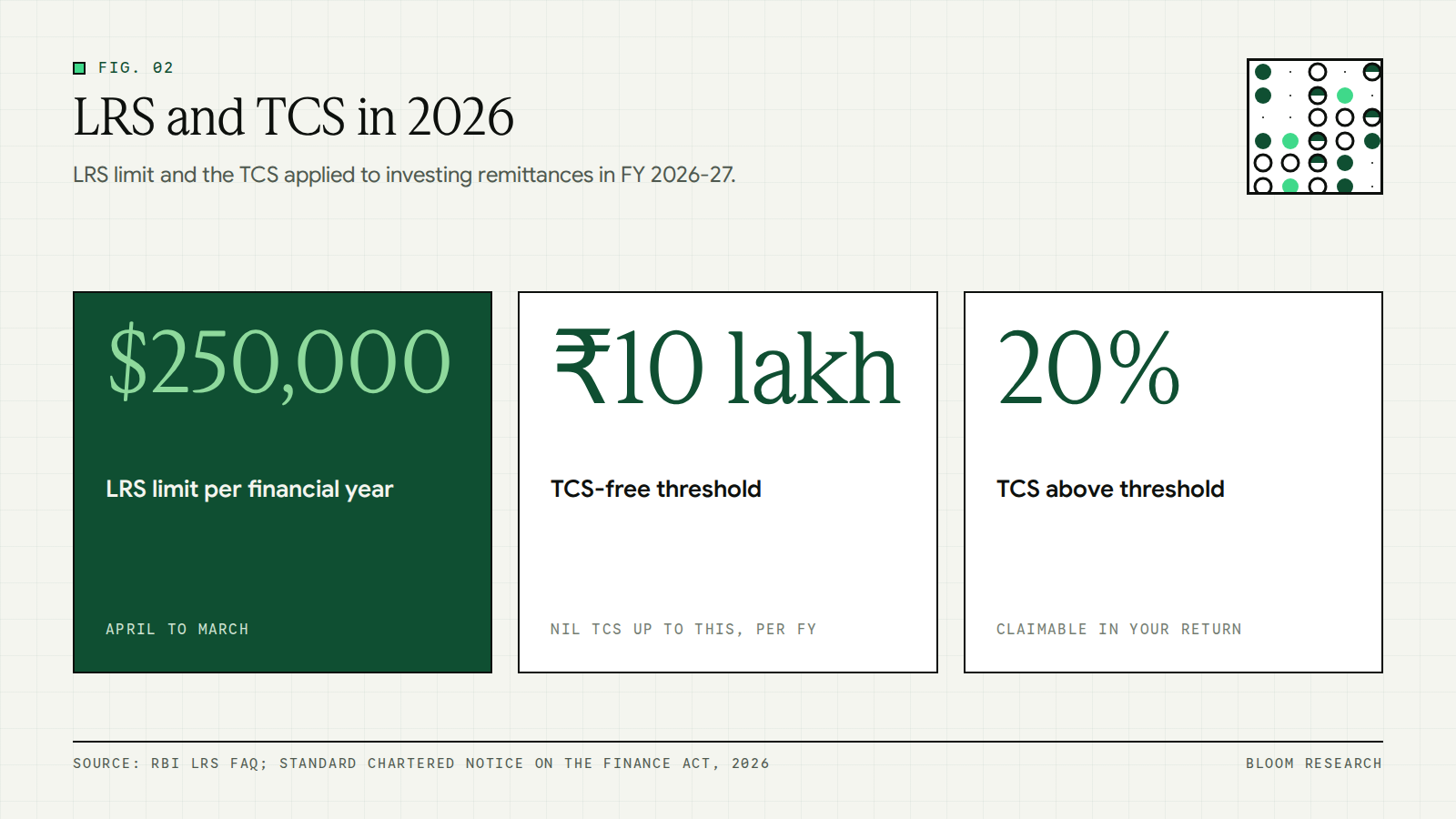
- The RBI's Liberalised Remittance Scheme allows resident individuals to remit up to USD 250,000 per financial year, from April to March.
- From April 1, 2026, under the Finance Act, 2026, banks apply TCS on LRS remittances for purposes such as investing at nil up to ₹10 lakh in a financial year and 20% on the amount above it.
- The NYSE core session of 9:30 a.m. to 4:00 p.m. ET runs from 7:00 p.m. to 1:30 a.m. IST until US daylight saving time ends on November 1, 2026.
- On Bloom, every tokenized stock is backed 1:1 by a real share at a regulated US broker-dealer, trades start at $1, and the trading fee is 0.10% to 0.20%.
There are four practical ways to invest in US stocks from India in 2026. You can open an overseas brokerage account funded under the Liberalised Remittance Scheme (LRS), buy NSE IFSC Receipts in GIFT City, invest through an Indian mutual fund that holds US shares, or buy tokenized US stocks. This guide compares each route, then explains the 2026 LRS and tax collected at source (TCS) rules, US market hours in Indian Standard Time (IST), tax reporting and costs. Our country guide for investors in India shows popular US stocks and ETFs you can buy on Bloom.
We build Bloom, so we describe the tokenized route as the team that operates it: what you hold, where the underlying share sits, how a trade is quoted and settled, and how you verify the backing yourself. For the other routes we state what regulators and exchanges publish and link to them.
#How to invest in US stocks from India: four routes compared
Each route gives you exposure to US companies, but they differ in what you hold and how you fund the purchase.
| Route | What you hold | How you pay |
|---|---|---|
| Overseas brokerage account | US shares at a foreign broker | Rupees converted to US dollars and remitted by your bank |
| NSE IFSC Receipts | Receipts issued against US shares | Rupees converted to US dollars, within LRS limits |
| Indian mutual funds and ETFs | Units of an Indian scheme with an overseas mandate | Rupees |
| Tokenized US stocks on Bloom | A token backed 1:1 by a real share, in your own wallet | Rupees converted to USDC on an exchange |
Whichever route you use, including tokenized stocks on Bloom, your own LRS, TCS, tax, reporting and KYC obligations apply, and your bank and a qualified adviser can confirm how.
Overseas brokerage accounts funded under LRS
An overseas brokerage account holds US shares at a foreign broker. You fund it with an outward remittance from your Indian bank account, which is a capital account transaction under the RBI's Liberalised Remittance Scheme FAQ, updated April 6, 2023. The LRS limit and the documentation described in the next section apply to that remittance.
NSE IFSC Receipts in GIFT City
NSE IFSC Receipts are receipts that market makers issue against US shares they buy, and they trade on NSE IFSC in GIFT City. Coverage of the 2022 launch republished on NSE's website said that Indian retail investors would be able to transact in these receipts within LRS limits. You hold a receipt that references the underlying US share rather than the share itself, so check the current list of receipts and eligibility with the exchange before you invest.
Indian mutual funds and ETFs with US exposure
Some Indian mutual fund schemes have an overseas mandate. As Bajaj Asset Management explains, an investor purchases units of an Indian scheme in rupees, and the asset management company invests the money according to the scheme's overseas mandate, directly in foreign shares, by tracking an international index or through overseas funds and ETFs. SEBI sets overseas investment limits for mutual funds, as in its November 2020 circular on overseas investment limits.
Tokenized US stocks on Bloom
A tokenized stock is an on-chain token that represents a real share. On Bloom, each asset is an on-chain token backed 1:1 by a real share held in custody at a regulated US broker-dealer such as Alpaca Markets or Interactive Brokers. The token is held in your own wallet and the minimum trade is $1. You can browse the US stocks you can buy on Bloom and the US ETFs on Bloom, or read our guide to buying NVIDIA (NVDA) from India.
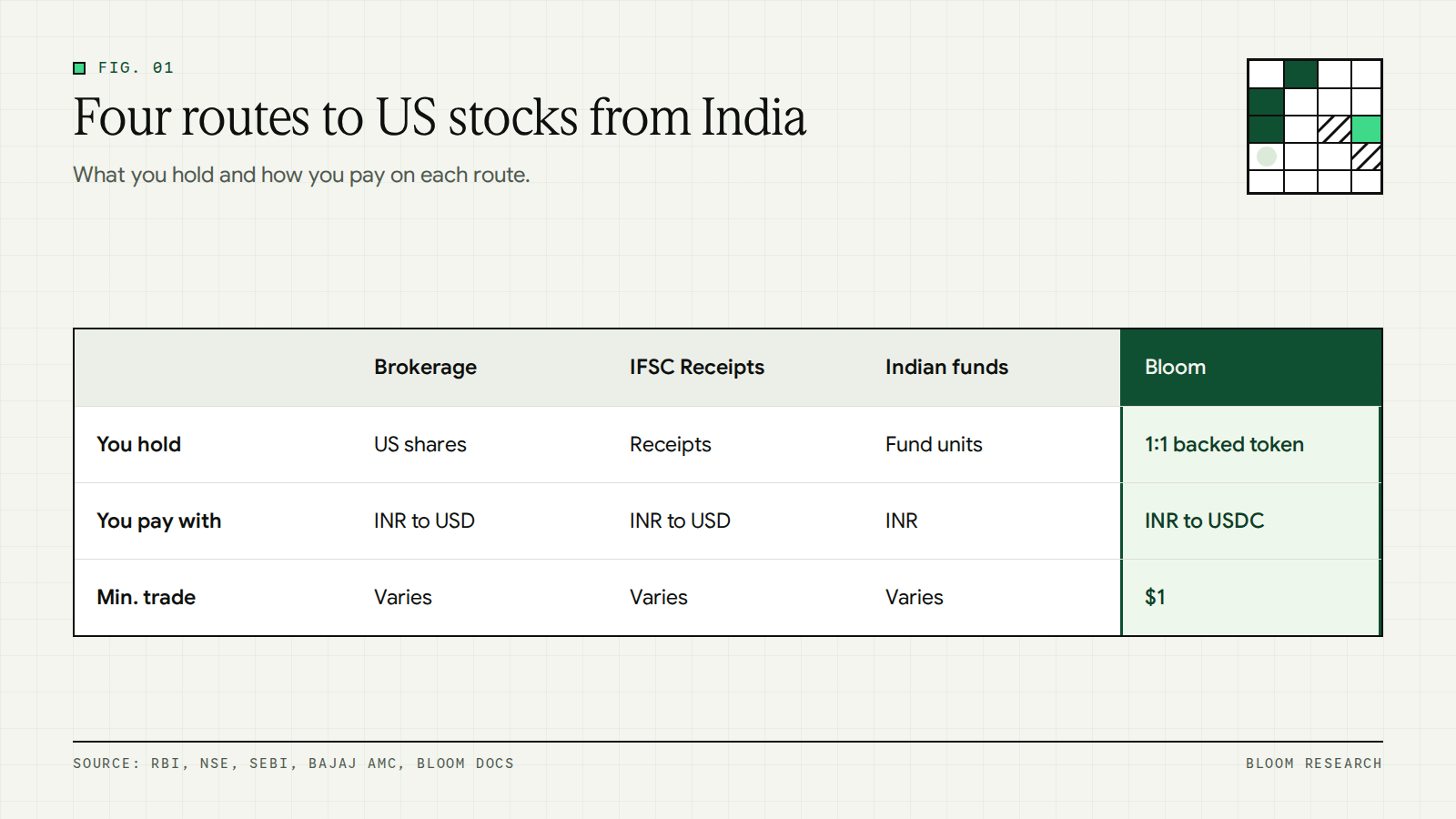
Key point: The routes differ in what you own. A brokerage account holds the share, a receipt references it, a fund unit is a share of a scheme that holds it, and a Bloom token is backed 1:1 by it and sits in your own wallet.
For readers comparing apps rather than routes, our guide to Robinhood alternatives for international investors sets out which Robinhood accounts accept non-US residents and the other route types. Our guide on how to buy SpaceX stock (SPCX) before and after its IPO applies these routes to one recent US listing.
For a side-by-side view of two LRS-based apps and our tokens, see our comparison of Vested vs INDmoney vs Bloom.
#The LRS limit and TCS on foreign remittance in 2026
The Liberalised Remittance Scheme is the RBI framework for money that resident individuals send abroad for current and capital account transactions, including investments. Whether and how it applies to a particular route, including tokenized stocks bought with stablecoins, depends on your facts, so confirm it with your bank and a qualified adviser before you invest.
The USD 250,000 annual limit
Under LRS, resident individuals can remit up to USD 250,000 per financial year, which runs from April to March. The limit covers permissible current and capital account transactions, or a combination of both. Our guide to the Liberalised Remittance Scheme for US stocks covers the LRS limit, PAN and Form A2, and TCS on foreign remittance in more detail.
The RBI also sets conditions on the remitter. You designate one branch of an authorized dealer bank for your capital account remittances under the scheme, and the RBI states that applicants should have maintained the bank account for at least one year before the remittance. If you are a new customer of the bank, the RBI states that the bank should carry out due diligence on your account and obtain your previous year's bank statement. You also furnish Form A-2, which states the purpose of the remittance and declares that the funds are your own.
TCS rates from April 1, 2026
Where tax collected at source (TCS) applies to an LRS remittance, your bank recovers it from your account, and you can claim credit for it when you file your income tax return.
The Union Budget 2026-27 summary lists a TCS cut to 2% for LRS remittances for education and medical treatment, a separate cut to 2% on the sale of overseas tour packages, and does not list a change for other LRS purposes.
Standard Chartered's notice on the Finance Act, 2026 applies the 2% education and medical rate to amounts above ₹10 lakh. Its table has no separate category for investing, so remittances for investing fall under other LRS purposes, which carry these rates from April 1, 2026 across all your LRS remittances in a financial year:
- Nil TCS up to ₹10 lakh
- 20% TCS on the amount above ₹10 lakh
The notice also states that TCS, once collected, cannot be refunded by the bank if the remittance is returned.
Reinvesting and repatriating proceeds
The RBI allows an investor who remitted funds under LRS to retain and reinvest the income earned on those investments. Foreign exchange that is received or realized and not reinvested must be repatriated and surrendered to an authorized person within 180 days. Ask your bank and adviser how this rule applies to sale proceeds and income from your overseas investments on the route you use.
Important: LRS, TCS, KYC, income tax and foreign asset reporting are your obligations as a resident of India, and they depend on your own facts. Nothing on Bloom changes them. Speak to your bank and a qualified adviser before you move money abroad.
#What you own when you buy a tokenized US stock
In a statement published on January 28, 2026, staff of the US Securities and Exchange Commission (SEC) wrote that the format of a security, on-chain or off-chain, does not affect how the federal securities laws apply. The same statement notes that holders of tokens issued by a third party can be exposed to risks of that third party, such as bankruptcy. The sections below set out the custody, backing and continuity arrangements behind every token on Bloom.
Definition: A tokenized stock on Bloom is an on-chain token backed 1:1 by a real share held in segregated custody. Its net asset value (NAV), the on-chain value of the token, reflects the share price, dividends and corporate actions.
Our complete guide to tokenized stocks covers the main token structures, regulation in 2026 and the risks in more detail.
Custody at regulated US broker-dealers
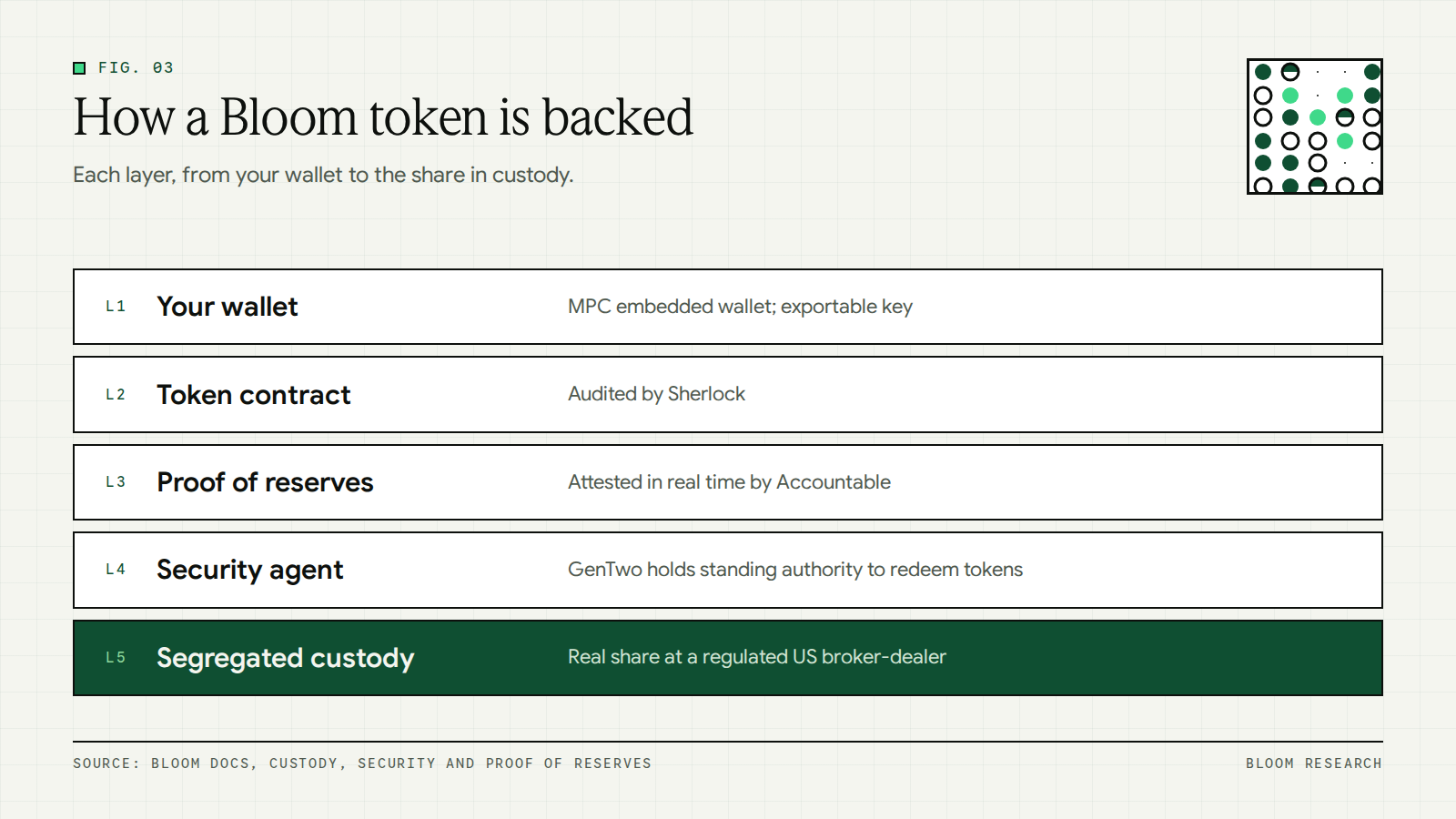
Every token on Bloom is backed 1:1 by a share held in a segregated customer account at a regulated US broker-dealer such as Alpaca Markets or Interactive Brokers. Segregated custody means customer assets are held separately from the broker's own funds. Our custody and backing documentation explains where the shares live.
If we discontinue operations, a designated security agent, GenTwo, works directly with the custodian to redeem outstanding tokens against the underlying shares for token holders. As our risk disclosure notes, that redemption depends on the continued operation of the broker partner. Sherlock audits the token contracts, the mint and redeem partner contracts and the proof-of-reserves attestation contract, as listed in our smart contract audit documentation, and our security overview covers custody, wallet keys, smart contracts and continuity protection.
Dividends and corporate actions
When a company pays a dividend, the cash is used to buy more of the underlying shares, and the token's NAV increases to reflect the added shares per token. Stock splits, spin-offs, mergers and name changes are reflected in the NAV as well. You see the dividend in the token's value rather than as a separate cash payment, as our page on dividends and corporate actions describes.
How to check the backing yourself
Reserves are attested in real time by Accountable, a third-party proof-of-reserves provider that reads broker balances directly and publishes them on-chain. The Transparency page shows the live token supply, attested broker balance, backing ratio and on-chain attestation contract for every asset. Our research note on how a tokenized share settles describes each system involved in a buy, from the quote to your wallet.
#How to buy US stocks from India on Bloom, step by step
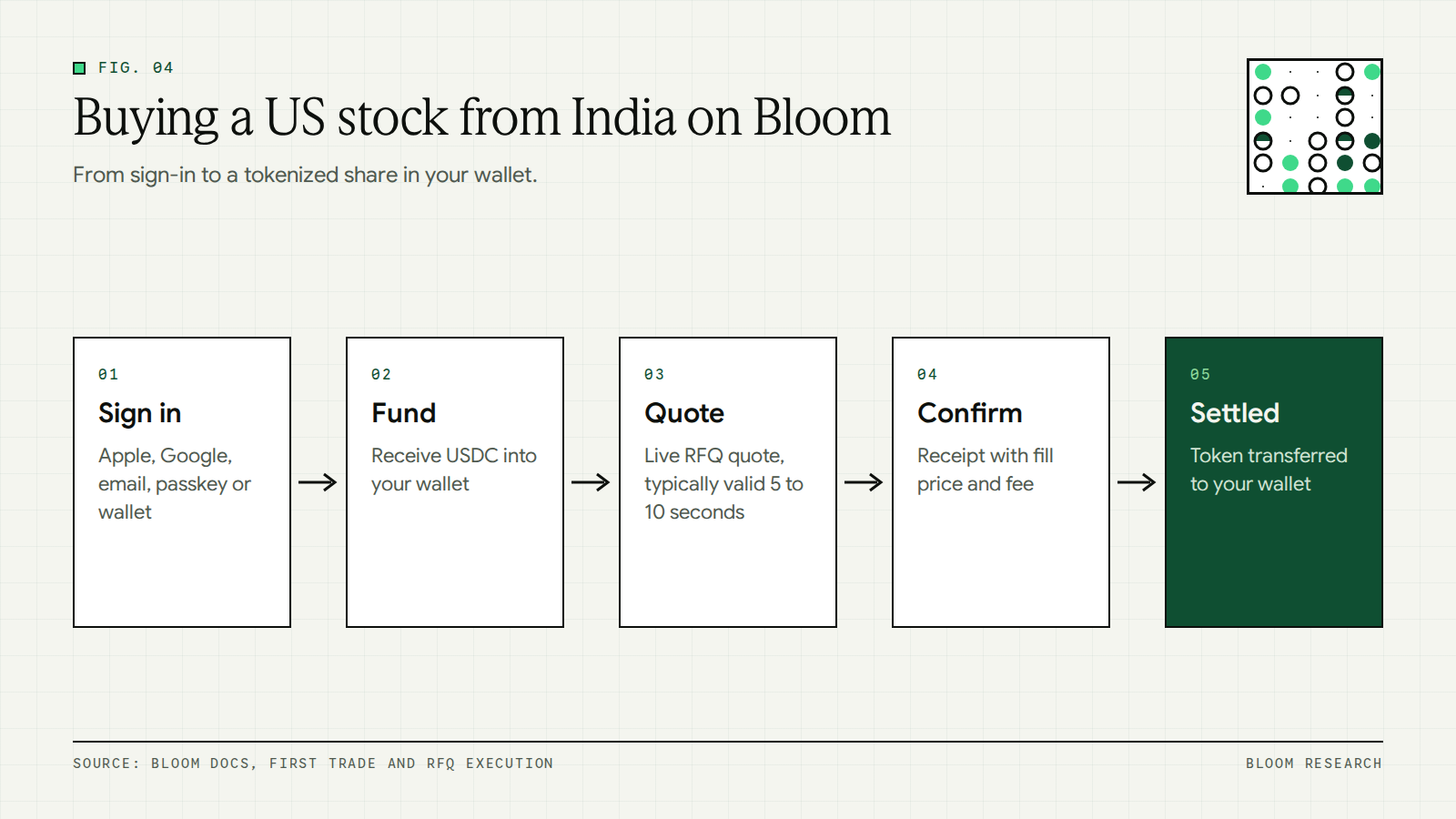
The steps below take you from sign-in to a settled position on Bloom. Quick Trade is the single trade sheet for every asset, so the flow is the same for a stock such as NVDA and an ETF such as VOO.
- Sign in with Apple, Google, an email link or a passkey, and Privy provisions an embedded wallet using multi-party computation (MPC), which splits the key so that no single party, including us, holds your complete private key. You can also connect an external wallet you already use.
- Add funds by receiving USDC into your wallet. Your deposit is credited to your trading balance, a unified USD balance backed 1:1 by USDC and USDT.
- Open an asset, for example NVDA on Bloom, and tap Buy.
- Enter the dollar amount. The trade sheet shows a live quote, your slippage tolerance and the fee.
- Confirm. The order goes to a regulated tokenized security issuer through request for quote (RFQ), and the token is transferred to your wallet.
To practice these steps with virtual funds before trading live, our guide to paper trading and how to practice trading without risking money covers order types, a trading journal and our Paper Trading Challenge.
Funding from India with USDC
For investors in India, funding on Bloom generally starts with a stablecoin. USDC is a US-dollar stablecoin, so its value tracks the dollar. Our guide to what a stablecoin is explains how fiat-backed stablecoins such as USDC and USDT hold a $1 peg. As our India country guide notes, investors in India generally convert rupees into USDC through a locally operating exchange that supports on-chain withdrawals, then move it to a wallet under their own keys. Our page on buying US stocks with USDC lists what you can buy with it, and our overview of the crypto assets you can fund with lists the others. Our comparison of USDC and USDT sets out the issuer, reserves, attestations, redemption terms and depeg history of each token.
When you receive USDC, you pick the network in the deposit flow, and each supported network shows its address and QR code. Per-chain crypto deposits have a minimum of $10 to $50 depending on the chain and asset. The funding sheet only shows methods that work on your current device, and our guide to adding funds lists each one.
The conversion from rupees to USDC happens outside Bloom, on the exchange you choose, and that exchange's fees, exchange rate, tax and reporting rules apply to that step. Your own LRS, TCS, tax and reporting obligations also apply to how you fund, as set out earlier in this guide. Holding and transferring a stablecoin may carry its own tax treatment in India, which we cover in the tax section below.
Placing the order
When you open the trade sheet, a quote request goes out for your size and side. A regulated tokenized security issuer returns a live quote that is typically valid for 5 to 10 seconds. If you confirm within that window, the trade settles back-to-back against the underlying primary market, and the on-chain token transfers to your wallet.
Slippage tolerance is the maximum price movement you accept between quote and execution. The default is 0.5%, and you can set it to 0.1%, 1% or a custom value. Within about one second of confirming, you see a receipt with the fill price, fee, total and the on-chain transaction hash. Our page on RFQ execution covers the full lifecycle of a trade.
Selling and withdrawing
Selling and withdrawing are two separate actions on Bloom. Selling converts a holding back into your USD trading balance through the same RFQ flow as a buy, and sells outside market hours are queued for the next open. Withdrawing moves your trading balance to an external wallet, which completes in seconds once the network confirms the transfer. Our page on selling and withdrawing covers both.
Buying S&P 500 ETFs from India
To invest in the S&P 500 from India on Bloom, you can buy S&P 500 ETFs such as SPY and VOO with the same trade sheet and the same $1 minimum as any other asset. Our S&P 500 index page lists the individual constituents available on Bloom, and our SPY versus VOO comparison sets the two ETFs side by side on name, exchange, fee and minimum trade.
On Bloom: You can set the app to display values in INR under Account and Security, and the Portfolio chart can overlay the NIFTY as a benchmark next to your US holdings.
#Fees, FX and minimums on Bloom
We charge one trading fee, set by your trailing 14-day trading volume, plus network gas on each trade. The fee is included in the quoted price, and the "You will receive" line in the trade sheet is the final amount that reaches your wallet.
VIP fee tiers
| VIP tier | 14-day trading volume | Trading fee |
|---|---|---|
| Tier 1 | Under $1,000 | 0.20% |
| Tier 2 | $1k to $10k | 0.175% |
| Tier 3 | $10k to $100k | 0.15% |
| Tier 4 | $100k to $1M | 0.125% |
| Tier 5 | $1M and above, with invite-only events | 0.10% |
On a $1,000 trade, the fee is $2.00 at Tier 1 and $1.00 at Tier 5. There is no account minimum, the minimum trade is $1, and fractional shares are supported down to six decimal places, so you can buy a part of a high-priced share. The full fee schedule on our pricing page includes worked examples.
What we do not charge
We do not charge deposit fees, withdrawal fees, custody fees, inactivity fees or FX markups. Converting rupees into USDC happens on a third-party exchange, so that exchange's charges and the INR to USD rate you receive apply to that step. Our pricing and fees documentation explains what appears on each receipt.
#US stock market timing in India
US stock exchanges run on Eastern Time (ET), so the hours shift for investors in India when US clocks change. The NYSE core trading session runs from 9:30 a.m. to 4:00 p.m. ET.
- While US daylight saving time is in effect, IST is nine and a half hours ahead of ET, so the core session runs from 7:00 p.m. to 1:30 a.m. IST.
- New York City's official notice confirms that daylight saving time ends on Sunday, November 1, 2026.
- From Monday, November 2, 2026, IST is ten and a half hours ahead of ET, so the core session runs from 8:00 p.m. to 2:30 a.m. IST.
How orders behave outside US hours on Bloom
Each asset on Bloom follows the trading session of its underlying market, and the asset page shows a trading-hours pill before you tap Buy. If the market is closed when you confirm, the order is queued and executes automatically at the next market open, and you receive a push notification when it fills. Orders placed in the pre-market or after-hours session route to that extended session and may fill in part, with the remainder queued for the next open.
For assets with continuous markets, orders fill immediately at the prevailing RFQ price at any time of day. Our trading hours documentation lists every order state and what the receipt shows.
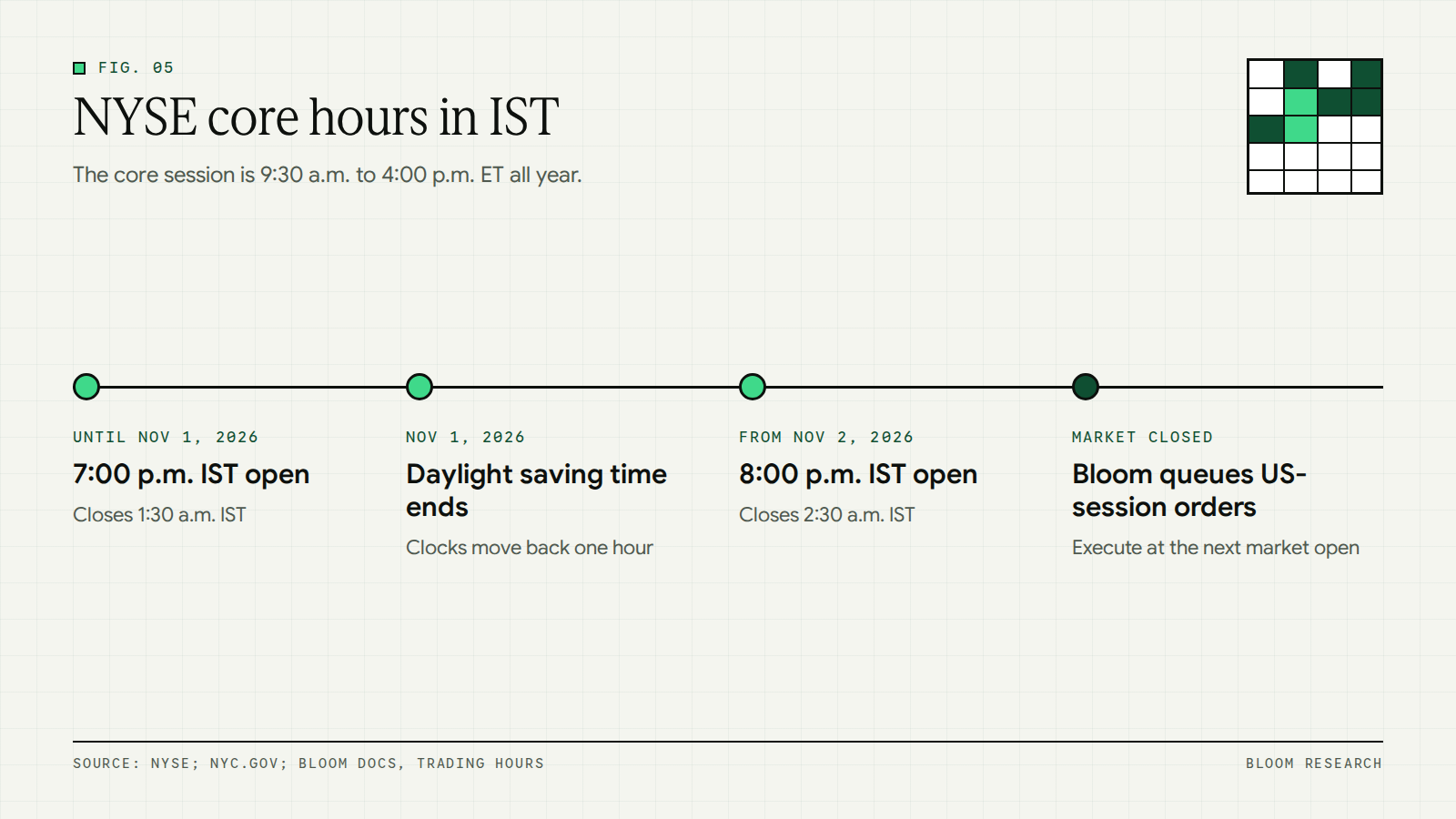
In practice: Until November 1, 2026, the NYSE core session opens at 7:00 p.m. IST. An order for a US-listed stock that you confirm on Bloom while its market is closed is queued and executes automatically at the next market open.
Our guide to pre-market trading hours, risks and how it works converts each US extended session to IST.
Our guide to US stock market hours in every time zone lists the full 2026 holiday calendar and the session times in IST.
#Tax on US stocks in India and what to report
This section states what the Income Tax Department publishes and leaves the application to your adviser.
Capital gains
The Income Tax Department's guidance on tax on long-term capital gains sets a 12.5% rate for long-term capital gains on transfers on or after July 23, 2024. The same page sets the holding period above which gains are long-term at 12 months for shares listed on a recognized stock exchange in India and 24 months for unlisted shares. That page describes the Income-tax Act, 1961, and the Union Budget 2026-27 summary notes that the new Income-tax Act, 2025 comes into effect from April 2026. Ask a qualified Indian tax adviser how the current rules apply to shares listed on a US exchange, to fund units and to tokenized securities.
Virtual digital assets
India taxes income from the transfer of virtual digital assets (VDAs) at a flat 30% plus surcharge and cess, with no deduction except the cost of acquisition, according to the Income Tax Department's page on taxation of virtual digital assets. If you fund with a stablecoin, ask your adviser whether and how these rules apply to each step you take.
Foreign assets reporting
Resident taxpayers report foreign assets in Schedule FA and foreign-source income in Schedule FSI of their return. The Central Board of Direct Taxes has stated that this reporting is mandatory under the Black Money Act, 2015. Ask your adviser whether your holdings on any route, including tokenized stocks, fall within Schedule FA.
We do not file taxes on your behalf and do not provide tax advice. From Portfolio, you can export a complete CSV of every trade and transaction to share with your tax adviser.
Note: This section is general information drawn from published government sources, not tax advice. Rules change with each Finance Act, so confirm the current position with a qualified Indian tax adviser before you file.
US brokers generally ask non-US investors for Form W-8BEN; our W-8BEN form guide explains each part of the form as the IRS instructions describe it.
#Risks to weigh before you invest from India
The risks below apply to tokenized stocks on Bloom.
Market and currency risk
- Market risk: prices can move against you, including gaps between sessions that may exceed your slippage tolerance.
- Currency risk: we settle in USD stablecoins, so you hold INR to USD exchange-rate exposure in addition to the price movement of the stock.
Platform, custody and liquidity risk
- Smart contract risk: every contract is audited, and no audit eliminates risk entirely.
- Custody risk: investor-protection arrangements apply within the jurisdictional limits of each broker and are not unlimited.
- Liquidity risk: the issuers that quote prices may withdraw liquidity in extreme conditions, and you cannot trade until it returns.
- Bridging and chain risk: blockchains and cross-chain bridges can be congested, halted or compromised, so confirm the network before you send USDC.
All investing carries risk, including the loss of principal. Read our full risk disclosure before you trade. We are in public beta.
Our service is not available in the United States or in other restricted jurisdictions, and you must be 18 or older to use Bloom. The service availability page explains how regional gating works, and our legal page sets out the full terms.
Our article Is Robinhood safe? What international users should know explains how investor protection depends on the legal entity that holds an account.
#Choosing how to invest in US stocks from India
The four routes differ in the asset you end up holding and where it is kept.
- An overseas brokerage account holds US shares at a foreign broker, funded by bank remittance.
- NSE IFSC Receipts are receipts on US shares that trade on an exchange in GIFT City.
- Indian mutual funds and ETFs are schemes you buy in rupees that hold the overseas investments.
- Tokenized US stocks on Bloom are tokens backed 1:1 by real shares, held in your own wallet, with trades from $1, fractional shares and a trading fee of 0.10% to 0.20%.
To see every market we serve, visit our country guides or the overview of investing in US stocks on Bloom. For India, the trending page, ranked by global popularity on Bloom, shows the most popular names, and our documentation on tokenized stocks explains how the instrument works.
Frequently asked questions
Can I invest in US stocks from India?
Yes. Resident individuals in India can invest in US stocks through an overseas brokerage account funded under the Liberalised Remittance Scheme, through NSE IFSC Receipts in GIFT City where the exchange currently offers them, through Indian mutual funds that invest overseas, or through tokenized US stocks. On Bloom, each tokenized stock is backed 1:1 by a real share held at a regulated US broker-dealer. Your own remittance, tax and reporting obligations apply whichever route you choose.
Is it legal to invest in US stocks from India?
The RBI's Liberalised Remittance Scheme lets resident individuals remit up to USD 250,000 per financial year for permissible current and capital account transactions, which include investments abroad. How the rules apply depends on the route you use and your own facts, and they change over time, so confirm your position with your bank and a qualified adviser. This is general information, not legal advice.
How much can I invest in US stocks from India under LRS?
Under the RBI's Liberalised Remittance Scheme, a resident individual can remit up to USD 250,000 per financial year, which runs from April to March. The limit covers all permissible current and capital account remittances combined. From April 1, 2026, under the Finance Act, 2026, banks apply TCS on remittances for purposes such as investing at nil up to ₹10 lakh in a financial year and 20% on the amount above it, and you can claim the TCS as a credit in your income tax return.
Do I have to pay tax on US stocks in India?
Resident taxpayers in India report income and gains from foreign investments in their income tax return, and the Income Tax Department treats accurate reporting of foreign assets in Schedule FA as mandatory. Its long-term capital gains guidance, written for the Income-tax Act, 1961, sets a 12.5% rate for transfers on or after July 23, 2024, and the Income-tax Act, 2025 takes effect from April 2026. How these rules apply to your holdings, including tokenized securities, depends on your facts, so consult a qualified Indian tax adviser.
What time does the US stock market open in India?
The NYSE core session runs from 9:30 a.m. to 4:00 p.m. Eastern Time. While US daylight saving time is in effect, that is 7:00 p.m. to 1:30 a.m. IST. Daylight saving time ends on November 1, 2026, and from the next trading day the core session runs from 8:00 p.m. to 2:30 a.m. IST.
What is the minimum amount to invest in US stocks from India?
The minimum depends on the route. On Bloom, the minimum trade is $1, there is no account minimum, and fractional shares are supported down to six decimal places. Crypto deposits on Bloom have a per-chain minimum of $10 to $50 depending on the chain and asset, shown in the deposit sheet before you send. Other routes set their own minimums and remittance charges.
Can I buy fractional US shares from India?
Yes, on Bloom you can buy fractional shares of US stocks and ETFs down to six decimal places, with a minimum trade of $1. You enter the dollar amount you want to invest, the trade sheet shows the live quote and fee, and the tokenized fraction settles into your own wallet. Each token is backed 1:1 by a real share held in segregated custody at a regulated US broker-dealer.