
How to Buy SpaceX Stock (SPCX) Before and After Its IPO
How to buy SpaceX stock (SPCX): how investors got exposure before the June 2026 IPO, how to buy shares through a broker now, the India LRS route and key risks.
Key takeaways
- SpaceX priced its IPO at $135.00 per share on June 11, 2026, and its Class A shares have traded on Nasdaq under the ticker SPCX since June 12, 2026.
- Before the IPO, exposure came through private share purchases largely limited to accredited investors, SPVs and listed funds such as DXYZ and XOVR, each with limits such as NAV gaps and fees.
- After the IPO, you can buy SPCX through a broker that offers US-listed stocks by placing a market order or a limit order.
- From India, overseas investing runs under LRS, which allows up to USD 250,000 per financial year, and from April 1, 2026 banks collect TCS at 20% above ₹10 lakh on investment remittances.
- SPCX has had large price moves: it closed at $160.95 on its first trading day, June 12, 2026, and at $108.27 on August 5, 2026, below its $135 IPO price.
- On Bloom, tokenized SPCX is backed 1:1 by an actual share held in custody at a regulated broker-dealer, starts from $1 and is not offered in the United States.
Learning how to buy SpaceX stock starts with one date: SpaceX has been a public company since June 12, 2026, when its Class A shares began trading on Nasdaq under the ticker SPCX. You can buy SPCX through a broker that offers US-listed stocks, and outside the US you can also buy tokenized SPCX on Bloom, where each token is backed 1:1 by an actual share held in custody at a regulated broker-dealer, as set out in our SpaceX (SPCX) stock guide.
This guide on how to buy SpaceX stock covers how investors got exposure to SpaceX while it was private, the IPO timeline and price, how to buy SPCX now, including from India, and the risks on each route. It reports sourced facts only and makes no price predictions.
#How to buy SpaceX stock: the short answer
There are three current routes to SPCX shares or share-backed tokens:
- A broker that offers US-listed stocks, where you place a market order or a limit order for SPCX.
- From India, an overseas brokerage account funded under the Reserve Bank of India's Liberalised Remittance Scheme, which the India section below explains.
- Tokenized SPCX on Bloom, where the minimum trade is $1 and fractional shares are supported down to six decimal places.
The pre-IPO routes described below are mostly history now that SPCX trades on an exchange. We still cover them because some funds that held SpaceX while it was private continue to hold it after the listing.
Key point: SpaceX priced 555,555,555 Class A shares at $135.00 on June 11, 2026, and trading began on June 12, 2026 on the Nasdaq Global Select Market and Nasdaq Texas under the ticker SPCX.
#Before the IPO: how investors got SpaceX exposure while it was private
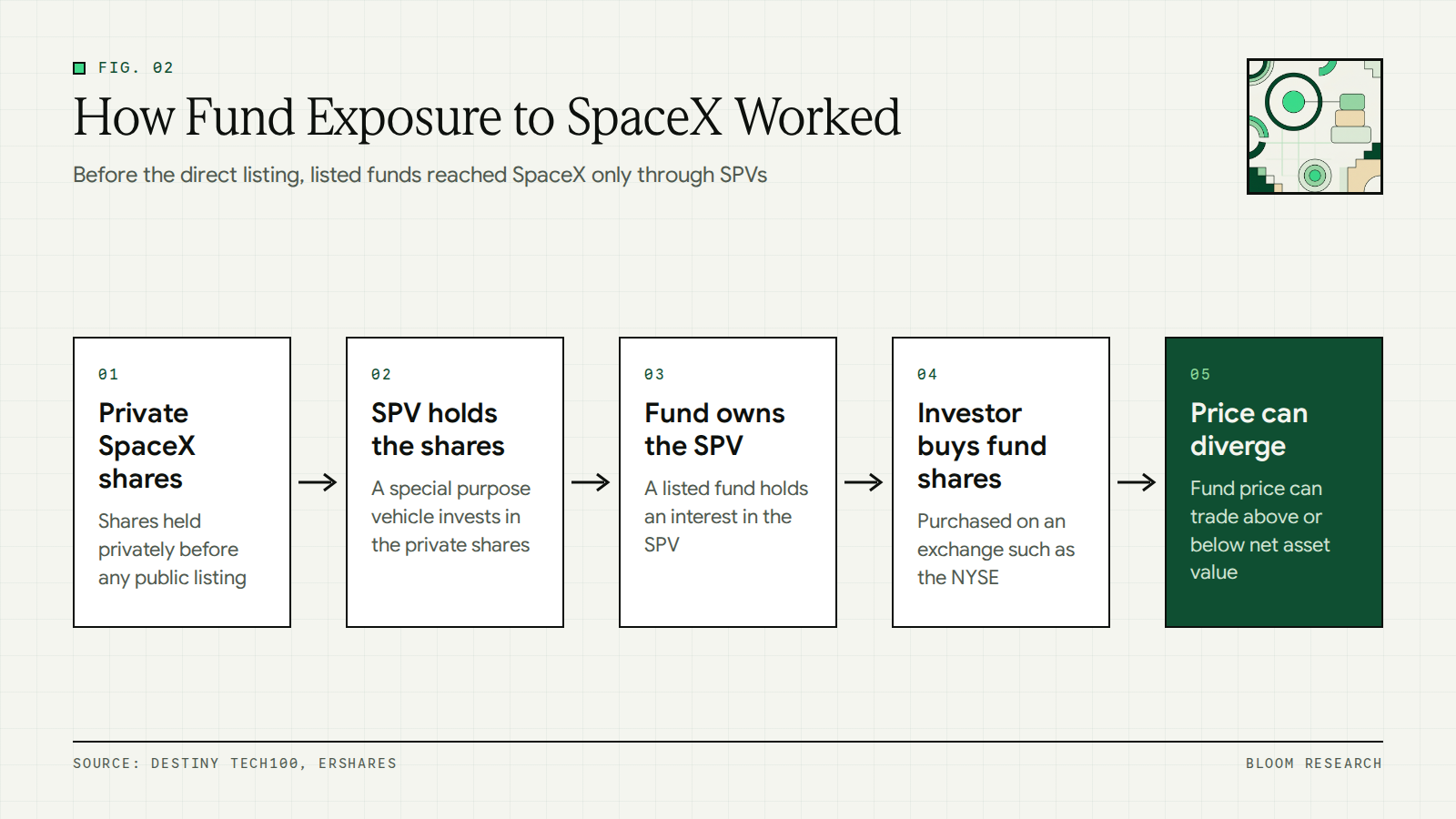
Musk founded SpaceX in 2002. Until June 2026 its shares did not trade on a stock exchange, so outside investors reached the company through restricted or indirect routes. The main routes were private share purchases, funds that held SpaceX through separate legal entities, and stakes held by public companies.
Employee shares and secondary sales for accredited investors
The SEC describes pre-IPO investing as buying a stake in a company before the company makes its initial public offering. Many offering exemptions under US federal securities laws limit participation to accredited investors or restrict participation by non-accredited investors. As a result, private purchases of SpaceX shares were generally open only to investors who met those tests.
An accredited investor is a person who meets SEC thresholds, such as income over $200,000, or $300,000 with a spouse or partner, in each of the prior two years. Net worth over $1 million, excluding a primary residence, also qualifies, as does holding a Series 7, Series 65 or Series 82 license in good standing. The SEC's page on accredited investors lists the full criteria.
Pre-IPO offerings are not registered with the SEC. The SEC also warns that a market for a private company's shares may never develop and that investors may be unable to resell their shares.
Special purpose vehicles and funds that held SpaceX
A special purpose vehicle (SPV) is an entity whose primary objective is investing in privately offered securities. A closed-end fund is a type of investment company that generally is not required to buy its shares back from investors on request. Some closed-end funds are publicly traded, with shares bought and sold on national securities exchanges at market prices.
Net asset value (NAV) is an investment company's total assets minus its total liabilities. NAV per share is that figure divided by the number of shares outstanding. When a closed-end fund's market price is above its reported NAV it trades at a premium, and when the price is below NAV it trades at a discount.
Three funds disclosed large SpaceX positions before the listing:
- Destiny Tech100 (DXYZ): a non-diversified closed-end fund listed on the New York Stock Exchange. It holds SpaceX through SPVs such as DXYZ SpaceX I LLC, which gives economic exposure to SpaceX Class A common stock. As of June 30, 2026, SpaceX was 10.6% of its economic exposure across 37 companies. The fund charges a 2.5% annual management fee, and its shares may trade above or below NAV.
- ERShares Private-Public Crossover ETF (XOVR): ERShares announced on December 3, 2024 that SpaceX had become the top holding in XOVR. The fund does not directly hold SpaceX shares and seeks exposure through SPV Exposure to SpaceX LLC or other special purpose vehicles. ERShares states that XOVR held SpaceX while it was private and continues to hold it after the 2026 public listing.
- Baron Partners Fund: its letter for the first quarter of 2026, which ended March 31, 2026, named SpaceX the fund's largest holding and said it appreciated 24.5% in the quarter. Baron stated that it valued SpaceX using prices of recent financing transactions.
Public companies with a SpaceX stake
Alphabet reports a SpaceX stake in its quarterly filings. Its Form 10-Q for the second quarter of 2026 reports $80.0 billion of SpaceX shares subject to short-term restrictions on the ability to sell. It reports a further $14.1 billion of SpaceX shares subject to long-term restrictions on the ability to sell through the third quarter of 2027.
The same filing reports net gains on equity securities of $99.0 billion for the quarter. Alphabet said these were primarily unrealized gains in its equity securities portfolio from SpaceX and a private company.
#Limits and risks of pre-IPO SpaceX exposure
Each pre-IPO route carried its own limits on price, cost, structure and resale:
- Pricing: while SpaceX was private, there was no exchange price, and Baron valued its SpaceX holding from the prices of recent financing transactions rather than a market quote.
- Fund prices and fees: DXYZ shares may trade above or below NAV, and the fund charges a 2.5% annual management fee.
- Indirect structure: XOVR states that it does not directly hold shares of SpaceX and that exposure is sought indirectly through special purpose vehicles.
- Registration and resale: pre-IPO offerings are not registered with the SEC, and investors may be unable to resell their shares.
Important: The SEC's investor alert on pre-IPO investment scams, dated June 7, 2024, warns that pre-IPO offerings are not registered with the SEC. It says to check whether a seller is currently registered or licensed before purchasing pre-IPO shares.
Since June 12, 2026, SPCX shares have traded on Nasdaq under the ticker SPCX. Investors who want diversified exposure through listed funds can review the ETFs available on Bloom.
#The SpaceX IPO: timeline, price and ticker
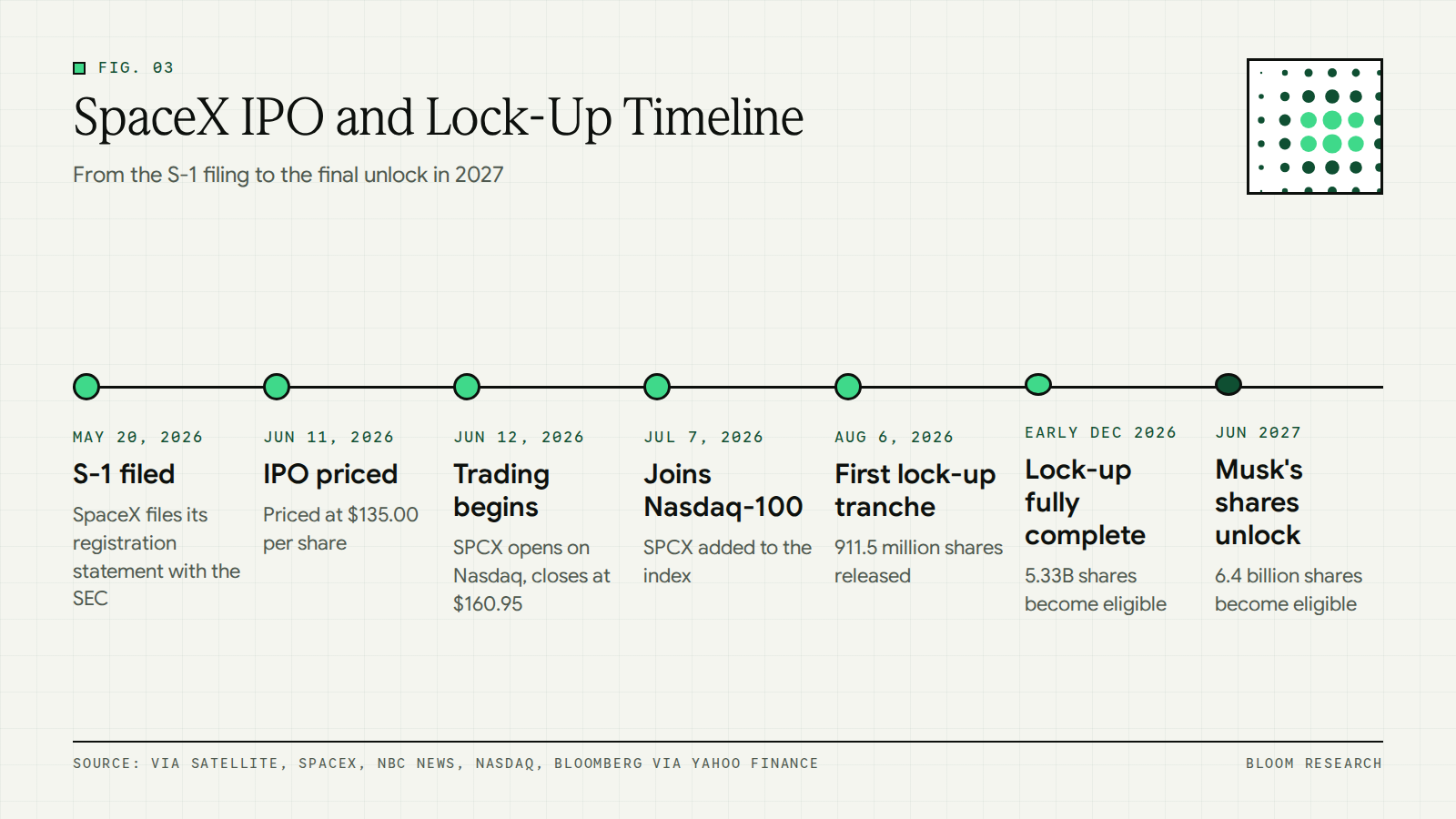
An initial public offering (IPO) is the first time a company offers its shares of capital stock to the general public. To register an IPO, a company files a registration statement with the SEC, typically using Form S-1, and these filings are publicly available through the SEC's EDGAR database. SpaceX's S-1 was filed with the SEC on May 20, 2026, and that version did not state a price per share.
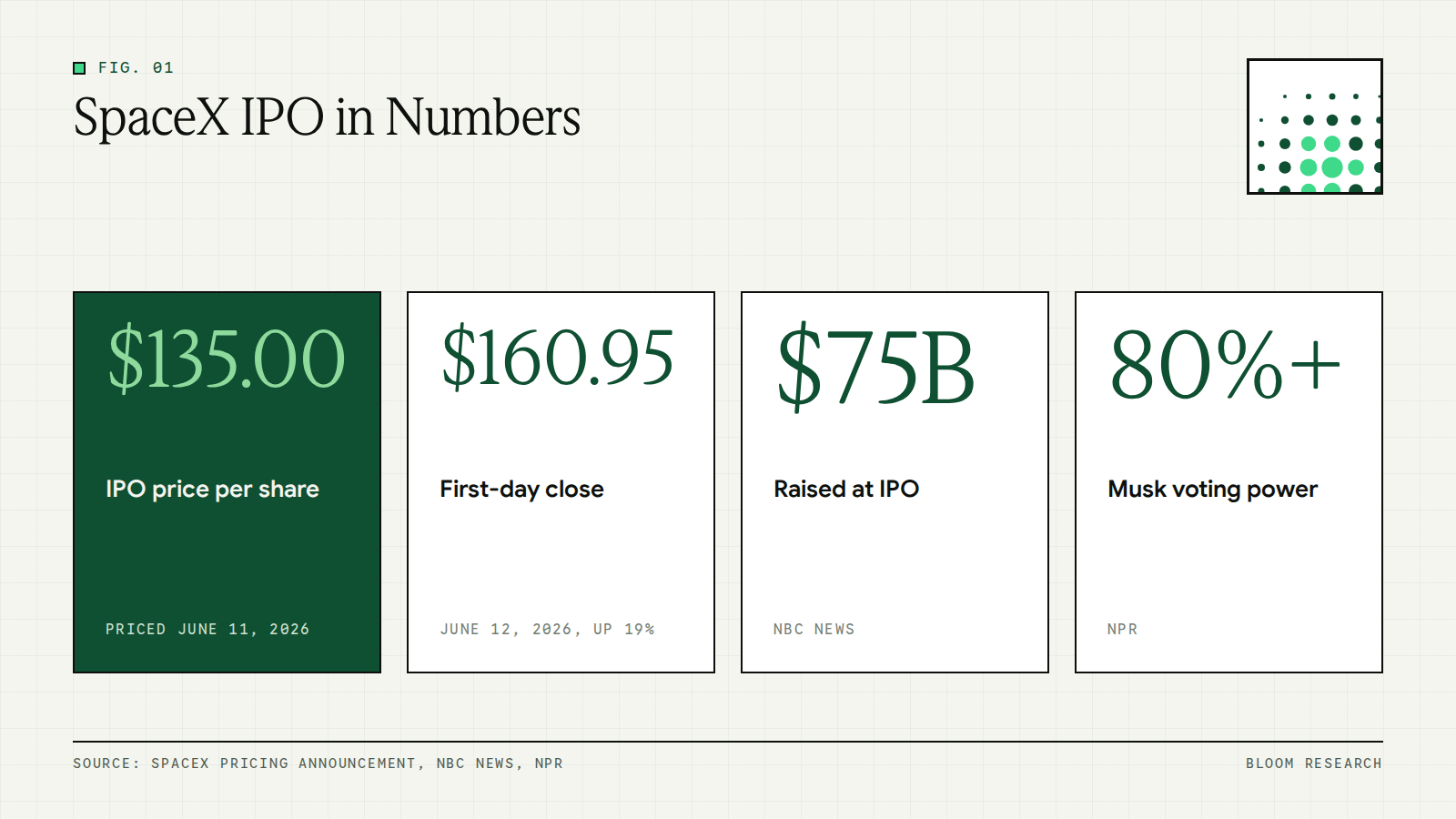
On June 11, 2026, SpaceX priced its IPO of 555,555,555 shares of Class A common stock at $135.00 per share. The shares were expected to begin trading on June 12, 2026 on the Nasdaq Global Select Market and Nasdaq Texas under the ticker SPCX, and the offering was expected to close on June 15, 2026. These terms appear in the SpaceX IPO pricing announcement published the same day.
An over-allotment option lets the underwriters of an IPO buy additional shares from the company after pricing. SpaceX granted its underwriters a 30-day option to buy up to 83,333,333 additional shares. Goldman Sachs, Morgan Stanley, BofA Securities, Citigroup and J.P. Morgan were among the book-running managers.
NBC News called the SpaceX offering the largest IPO ever, raising $75 billion. Nasdaq reported that the capital raised reached $85.7 billion after the underwriters' over-allotment option was exercised. NPR reported that the $135 price put SpaceX's valuation at around $1.75 trillion and that the IPO raised more than Saudi Aramco's 2019 listing, which raised $29.4 billion.
SpaceX shares opened at $150 on June 12, 2026, their first trading day, and closed at $160.95, a gain of 19%, according to NBC News coverage of the first trading day. Nasdaq reported that the first day's trading put SpaceX's market capitalization at $2.1 trillion.
| Item | Detail | Source |
|---|---|---|
| S-1 filed | May 20, 2026 | Via Satellite |
| Priced | June 11, 2026 at $135.00 per share | SpaceX |
| Shares offered | 555,555,555 Class A (plus option on 83,333,333) | SpaceX |
| Exchanges | Nasdaq Global Select Market and Nasdaq Texas | SpaceX |
| Ticker | SPCX | SpaceX |
| First trade | June 12, 2026 | SpaceX, NBC News |
| First-day open and close | $150 and $160.95 | NBC News |
| Offering close | June 15, 2026 (expected) | SpaceX |
| Raised | $75 billion (NBC News), $85.7 billion after over-allotment (Nasdaq) | NBC News, Nasdaq |
| Nasdaq-100 entry | July 7, 2026 | Nasdaq |
Note: The SEC investor bulletin on investing in an IPO says underwriters often distribute most IPO shares to their institutional and high net-worth clients. The same bulletin says the closing price shortly after an IPO can be well above or below the offering price.
SPCX stock symbol and share classes
SPCX is the ticker symbol for SpaceX Class A common stock, the class sold in the IPO. Dual-class shares are separate classes of common stock where one class has greater voting power than the class sold in the IPO. Elon Musk is SpaceX's chairman, CEO and controlling shareholder.
NPR reported that Musk would control the board and hold more than 80% of stock voting power. The S-1 notes that SpaceX would be a controlled company after going public, meaning a single shareholder, family or group holds more than 50% of the voting power. SpaceX does not expect to pay dividends to its stockholders in the foreseeable future.
A lock-up agreement stops company insiders, including employees and large shareholders, from selling their shares for a set period after an IPO. The Investor.gov glossary entry on IPO lockup agreements says most lockups prevent insiders from selling for 180 days. The timeline below shows the SpaceX lock-up dates reported by Bloomberg alongside the IPO milestones.
#How to buy SPCX stock after the IPO through a broker
SpaceX shares trade on Nasdaq under the ticker symbol SPCX, and brokers that offer US-listed stocks give access to the listed share. The steps below describe the general process without reference to any specific broker.
- Choose a broker registered in your country that offers US-listed stocks, and check its registration with your securities regulator. In a June 7, 2024 investor alert, the SEC advised investors to verify that sellers of investments are registered.
- Open the account and complete the broker's identity verification checks.
- Fund the account in US dollars. Readers in India can find the remittance rules in the India section of this guide.
- Search for the ticker SPCX to open the SpaceX Class A share page.
- Choose an order type. A market order is an order to buy or sell a security immediately, and a limit order is an order to buy or sell at a specific price or better.
- Review the fill price and the trade confirmation after the order executes.
The SEC's guide to order types notes that the last-traded price is not necessarily the price at which a market order executes.
On Bloom, each asset follows the primary-market trading session inherited from its underlying instrument. Orders placed overnight, on weekends or on holidays are queued until the next open, as described in our trading hours on Bloom guide. Our compare pages let you compare two listed tickers side by side, and our sector hub shows stocks and ETFs on Bloom grouped by sector.
Our guide to US stock market hours in every time zone lists when the Nasdaq session opens and closes in local time.
#SpaceX in the Nasdaq-100 and index funds
Fast Entry is a Nasdaq-100 methodology rule that went live on May 1, 2026. It evaluates newly listed companies that rank within the top 40 of current Nasdaq-100 constituents by full market capitalization on their seventh trading day.
How it works: Under Fast Entry, Nasdaq evaluates a newly listed company on its seventh trading day. If the company ranks within the top 40 of current Nasdaq-100 constituents by full market capitalization, it is eligible. Eligible companies are added to the index shortly after that evaluation.
On June 26, 2026, Nasdaq announced that SpaceX would become a component of the Nasdaq-100 Index before the market open on Tuesday, July 7, 2026. The announcement, carried in the Nasdaq release on SpaceX joining the Nasdaq-100, says the index measures the performance of 100 of the largest Nasdaq-listed non-financial companies. The same release says more than 200 investment products with over $800 billion in assets under management track the index.
Investment products that track the Nasdaq-100 follow its components, which have included SpaceX since July 7, 2026. The pre-IPO funds covered earlier in this guide held SpaceX through different structures. We list the Nasdaq-100 constituents available on Bloom and the S&P 500 constituents available on Bloom on our index pages.
#How to buy SpaceX stock in India
SpaceX shares trade on the Nasdaq Global Select Market and Nasdaq Texas under the ticker SPCX, with trading that began on June 12, 2026. There is no Indian listing, so an investor in India reaches SPCX through a US market. This section covers how to buy SpaceX stock from India by two routes: an overseas broker funded under the Liberalised Remittance Scheme, and tokenized SPCX on Bloom. For the wider picture, read our guide to investing in US stocks from India.
The LRS route through an overseas broker
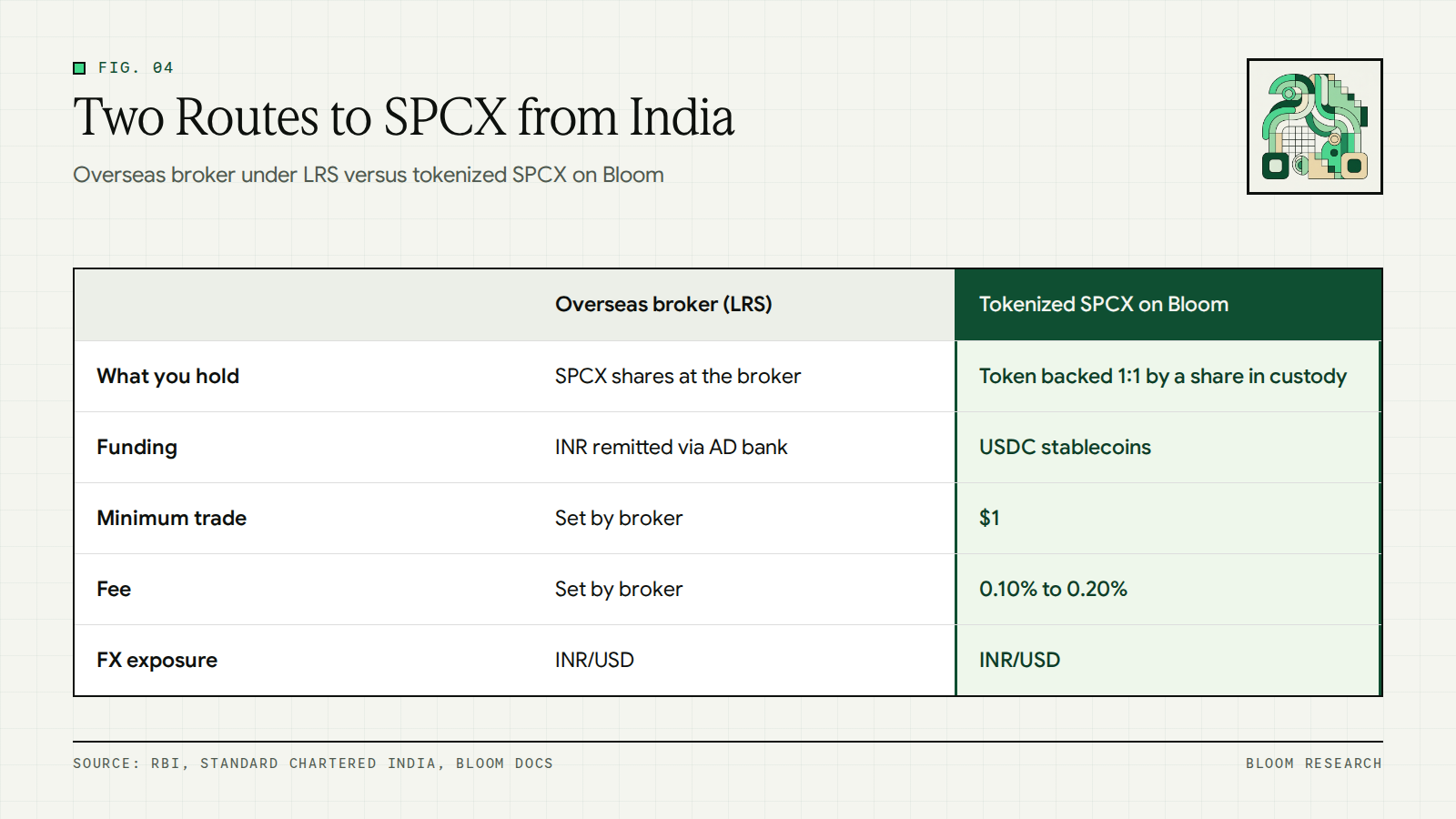
The Liberalised Remittance Scheme (LRS) is the Reserve Bank of India framework for sending money abroad. Under LRS, resident individuals can remit up to USD 250,000 per financial year (April to March) for permitted current or capital account transactions. Investment counts as a capital account transaction, as RBI's FAQs on the Liberalised Remittance Scheme explain.
The remitter designates a branch of an authorized dealer (AD) bank, and all capital account remittances under the scheme go through that branch. The applicant should have held the bank account for at least one year before the remittance. For a new customer, the AD bank carries out due diligence on the account and obtains the previous year's bank statement.
Each remittance needs Form A-2, which states the purpose of the remittance and declares that the funds belong to the remitter. An investor can retain and reinvest income earned on investments made under LRS. Unspent foreign exchange that is not reinvested must be repatriated within 180 days.
Tax collected at source (TCS) is an amount the bank collects at the time of the remittance. From April 1, 2026, under the Finance Act, 2026 read with the Income Tax Act, 2025, TCS on other LRS purposes such as investing is nil up to ₹10 lakh and 20% above ₹10 lakh. The threshold counts all LRS remittances in the financial year, and the TCS credit can be claimed in the income tax return, per Standard Chartered India's notice on TCS for LRS remittances.
Shares bought abroad also carry a reporting duty. The Central Board of Direct Taxes states that accurate reporting of foreign assets in Schedule FA is mandatory under the Black Money Act, 2015.
Important: LRS limits, TCS and foreign-asset reporting apply to Indian residents who invest abroad, whichever route they use. Confirm the details with your bank and a qualified tax adviser. We do not file taxes on your behalf and do not give tax advice.
Tokenized SPCX on Bloom
A tokenized stock is an on-chain token that represents one share, backed 1:1 by an actual share held in custody at a regulated broker-dealer (how tokenized stocks work). On Bloom, the underlying share is held in a segregated customer account at a regulated US broker-dealer such as Alpaca Markets or Interactive Brokers, separate from the broker's own funds (custody and backing). Reserves are attested in real time by Accountable, a third-party proof-of-reserves provider. The transparency page shows the token supply, attested broker balance and backing ratio for every asset.
A new asset appears on our markets page only when three things are in place: a custody arrangement at a regulated broker partner, a live attestation feed into proof of reserves and liquidity coverage from a tokenized security issuer (how assets are added). Every asset uses its underlying ticker only, so SpaceX appears as SPCX. We do not claim ownership of, affiliation with, or endorsement by SpaceX or any other listed company.
The minimum trade is $1, and fractional amounts are supported down to six decimal places. Trades run on request for quote (RFQ), an execution model in which a tokenized security issuer returns a live quote that you accept within a short window. That quote is typically valid for 5 to 10 seconds. The trading fee is 0.10% to 0.20%, with 0.20% as the default and lower rates as your 14-day trading volume grows. The fee is included in the quoted price (our pricing and fees).
Trades on Bloom settle in USD stablecoins. From India, rupees are generally converted into USDC through a locally operating exchange that supports on-chain withdrawals, then moved to a self-custody wallet. Because settlement is in USD stablecoins, an India investor holds INR/USD exchange-rate exposure in addition to the price movement of the stock. The treatment of tokenized securities can differ from that of directly held shares, as our India country page notes.
On Bloom: Each SPCX token represents one share and is backed 1:1 by a real share held in custody at a regulated US broker-dealer such as Alpaca Markets or Interactive Brokers.
#Risks to understand before buying SPCX
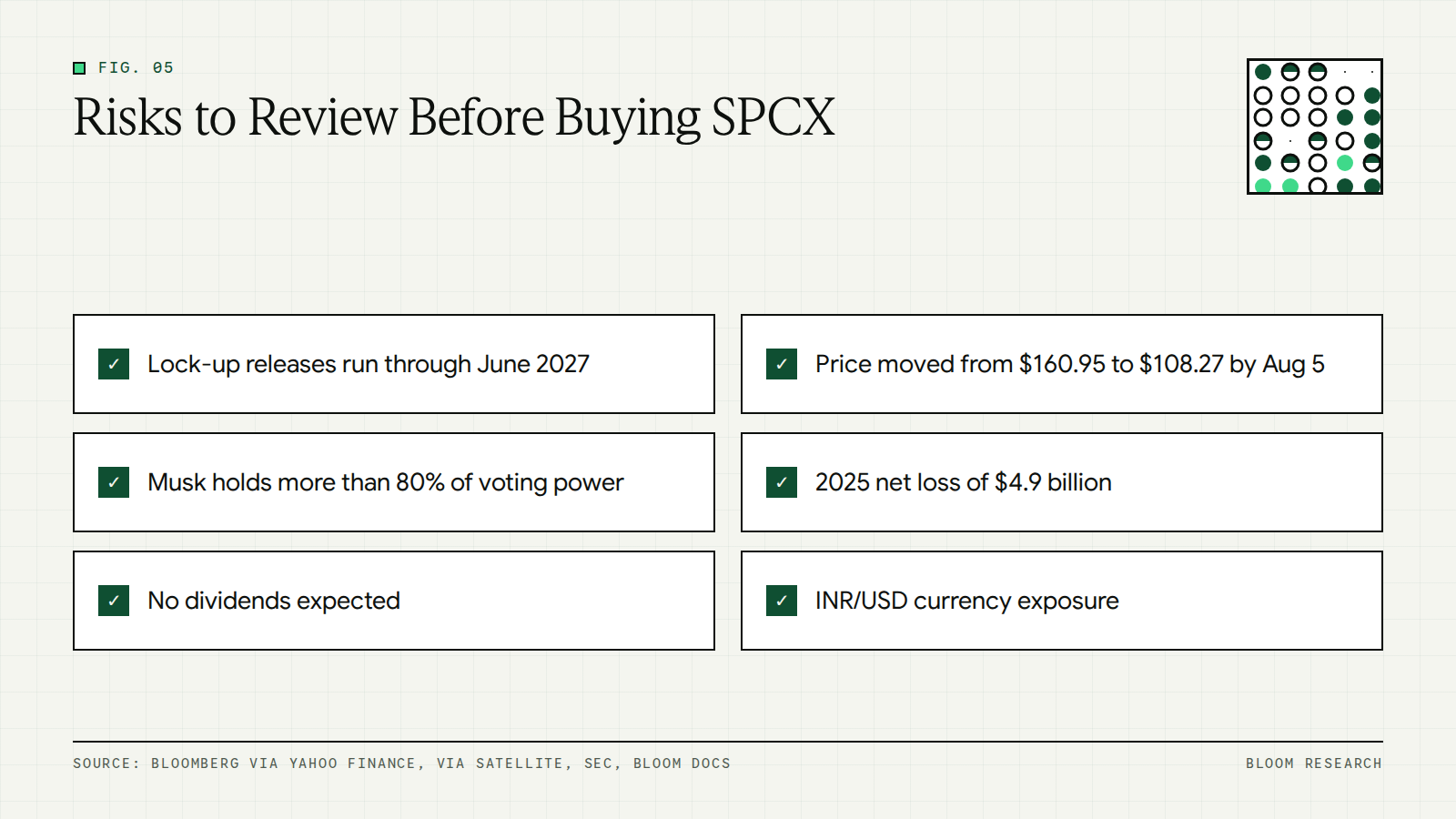
SPCX has moved sharply since its listing, and several scheduled events can affect its supply of tradable shares. The list below sets out the main sourced risks.
- Price volatility: SpaceX priced its IPO at $135 and closed at $160.95 on its first trading day, June 12, 2026. The stock closed at $108.27 on Aug 5, 2026, below the IPO price. Bloomberg reported that shares moved back above $135 within five sessions after the first lock-up expiry.
- Lock-up releases: SpaceX staggered its lock-up across nine stages rather than a single 180-day expiry. On Aug 6, 2026, 911.5 million shares became eligible to trade, which lifted the freely tradable portion of stock to 11.8% of shares outstanding from 4.9%. Per Bloomberg, the full 180-day lock-up runs through early December 2026, when up to 5.33 billion shares would be eligible, and a separate lock-up covering Musk's 6.4 billion shares runs until June 2027. The SEC notes that the share price may decline significantly when many locked shares become available for sale at once.
- Company finances and concentration: SpaceX reported $18.7 billion in revenue and a $4.9 billion net loss in 2025. A single stock carries company-specific risk.
- Voting control: the SEC notes that a dual-class structure may make it difficult, if not impossible, for public shareholders to influence corporate matters. The share-class section above covers how voting power at SpaceX is split.
- Tokenized-asset risks: tokenized assets carry market, smart contract, custody, bridging and liquidity risk. Redemption depends on the continued operation of the broker partner. SEC staff note that holders of third-party tokenized securities may be exposed to risks of that third party, such as bankruptcy.
- Currency: an India investor holds INR/USD exchange-rate exposure in addition to the stock's price movement.
Trading carries risk, including the loss of principal. For the full list of risk categories, read our risk disclosure.
#Where to follow SPCX on Bloom
You can find SPCX on our markets page, which lists every asset available to trade. For funding steps and currency notes written for India investors, read our SPCX guide for India.
We do not offer our product or services to users in the United States or in other restricted jurisdictions. Our service availability page explains how jurisdictional gating works.
Frequently asked questions
Can I buy shares of SpaceX now?
Yes. SpaceX Class A shares have traded on the Nasdaq Global Select Market and Nasdaq Texas under the ticker SPCX since June 12, 2026, so you can buy them through a broker that offers US-listed stocks. Outside the United States, you can also buy tokenized SPCX on Bloom. Each token represents one share and is backed 1:1 by an actual share held in custody at a regulated broker-dealer. We do not offer our product or services in the United States or other restricted jurisdictions.
Can the public purchase SpaceX stock?
Yes. Since June 12, 2026, SpaceX Class A shares have traded on Nasdaq under the ticker SPCX, and they can be bought through a broker that offers US-listed stocks. Before the IPO, private purchases were largely limited to accredited investors, because many offering exemptions under US securities laws restrict participation by non-accredited investors. Even in an IPO, the SEC notes that underwriters often distribute most of the shares to their institutional and high net-worth clients.
Which ETF holds SpaceX?
ERShares states that its Private-Public Crossover ETF (XOVR) held SpaceX while it was private and continues to hold it after the 2026 public listing. SpaceX also became a component of the Nasdaq-100 Index before the market open on July 7, 2026. Nasdaq says the Nasdaq-100 is tracked by more than 200 investment products. Each fund publishes its own holdings, so check a fund’s holdings list for SPCX.
What is the SpaceX stock symbol?
The SpaceX stock symbol is SPCX. The listed security is SpaceX Class A common stock, which trades on the Nasdaq Global Select Market and Nasdaq Texas. Trading under SPCX began on June 12, 2026, one day after SpaceX priced its initial public offering of 555,555,555 Class A shares.
What was the SpaceX IPO price and date?
SpaceX priced its initial public offering at $135.00 per share on June 11, 2026. The shares began trading on Nasdaq on June 12, 2026. According to NBC News, the stock opened at $150 on its first day and closed at $160.95, a gain of 19%, and the offering raised $75 billion.
How can I buy SpaceX stock in India?
SPCX is listed in the US, not in India. One route is an overseas brokerage account funded under the Liberalised Remittance Scheme, which allows resident individuals to remit up to USD 250,000 per financial year. From April 1, 2026, banks collect TCS at 20% on investment remittances above ₹10 lakh. Another route is tokenized SPCX on Bloom, where funding options include receiving USDC from an external wallet. In India, rupees are generally converted into USDC through a locally operating exchange that supports on-chain withdrawals.
How could investors buy SpaceX stock before the IPO?
Before June 12, 2026, SpaceX shares did not trade on an exchange. Many offering exemptions under US securities laws limit participation to accredited investors, so private share sales were largely open only to them. Pre-IPO offerings are not registered with the SEC, and investors may be unable to resell their shares. Others used listed funds such as Destiny Tech100 (DXYZ), which holds SpaceX through SPVs such as DXYZ SpaceX I LLC, and XOVR, which seeks SpaceX exposure indirectly through SPV Exposure to SpaceX LLC.
How do I invest $1000 in SpaceX?
We do not advise on how much to invest. A fixed dollar amount can go toward SPCX through a broker that offers US-listed stocks, or through tokenized SPCX on Bloom, where the minimum trade is $1 and fractional amounts are supported down to six decimal places. On Bloom, the amount buys a fractional position at the quoted price. From India, the money is first remitted under LRS or converted to USDC, as the India section of this guide explains.