

US Stock Market Hours: The Full Schedule in Every Time Zone
US market hours in 2026: the NYSE and Nasdaq regular session, extended and overnight sessions, holidays, DST dates and times in IST, GMT, CET and more.
Key takeaways
- US market hours for the NYSE and Nasdaq regular session are 9:30 a.m. to 4:00 p.m. ET, Monday through Friday, except exchange holidays.
- Extended sessions run from 4:00 a.m. to 8:00 p.m. ET on Nasdaq and NYSE Arca, and both plan 9:00 p.m. to 4:00 a.m. ET overnight sessions from December 6, 2026.
- In India the regular session is 7:00 p.m. to 1:30 a.m. IST until November 1, 2026 and 8:00 p.m. to 2:30 a.m. IST after it.
- UK and EU clocks change on different dates from US clocks, so from October 26 to 30, 2026 the session starts one hour earlier in London and Central Europe.
- The remaining 2026 closures are November 26 and December 25, with 1:00 p.m. ET early closes on November 27 and December 24.
US market hours for the NYSE and Nasdaq regular session run from 9:30 a.m. to 4:00 p.m. Eastern Time (ET), Monday through Friday, except exchange holidays. Extended sessions on some venues run from 4:00 a.m. to 8:00 p.m. ET, and the local clock time of the session changes when US daylight saving time starts or ends.
This guide gives US market operating hours in 13 time zones, the holiday calendar for 2026 and 2027, and what happens to an order on Bloom outside the session. On Bloom, an order submitted overnight, on a weekend or on a holiday is queued server-side until the next open. Our trading hours documentation explains how our trading hours and queued orders work.
#US market hours for the NYSE and Nasdaq
Eastern Time (ET) is the New York clock. It is Eastern daylight time (EDT), or UTC minus 4 hours, while US daylight saving time applies, and Eastern standard time (EST), or UTC minus 5 hours, the rest of the year. Regular trading hours, also called the core session, are the hours from 9:30 a.m. to 4:00 p.m. ET that the SEC defines for listed stocks, according to FINRA, and they apply Monday through Friday.
The opening auction is the NYSE Core Open Auction at 9:30 a.m. ET, which starts the core session; orders entered from 6:30 a.m. ET are queued until it. The closing auction is the NYSE Closing Auction at 4:00 p.m. ET, which ends the core session after a Closing Imbalance Period from 3:50 p.m. ET. FINRA states that share prices recorded at 4 p.m. on the exchanges are the official closing prices for that day, regardless of extended-hours trading. The NYSE holidays and trading hours page lists the sessions and closures for each NYSE market.
Nasdaq runs Regular Market Hours until 4:00 p.m. ET, after a Pre-Market Hours session from 4:00 a.m. to 9:30 a.m. ET. SpaceX shares began trading on Nasdaq on June 12, 2026 under the ticker SPCX, and follow the same session, as our guide on how to buy SpaceX stock (SPCX) covers.
On Bloom, each asset has a primary-market trading session inherited from its underlying instrument. The tokenized constituents on our S&P 500 stocks on Bloom page and our Nasdaq-100 stocks on Bloom page therefore follow the US market hours of their underlying stocks.
Key point: The NYSE lists its session times in Eastern Time, so the regular session is 9:30 a.m. to 4:00 p.m. ET in both EDT and EST. What changes is the local time in other countries when US clocks move, as on March 8 and November 1, 2026.
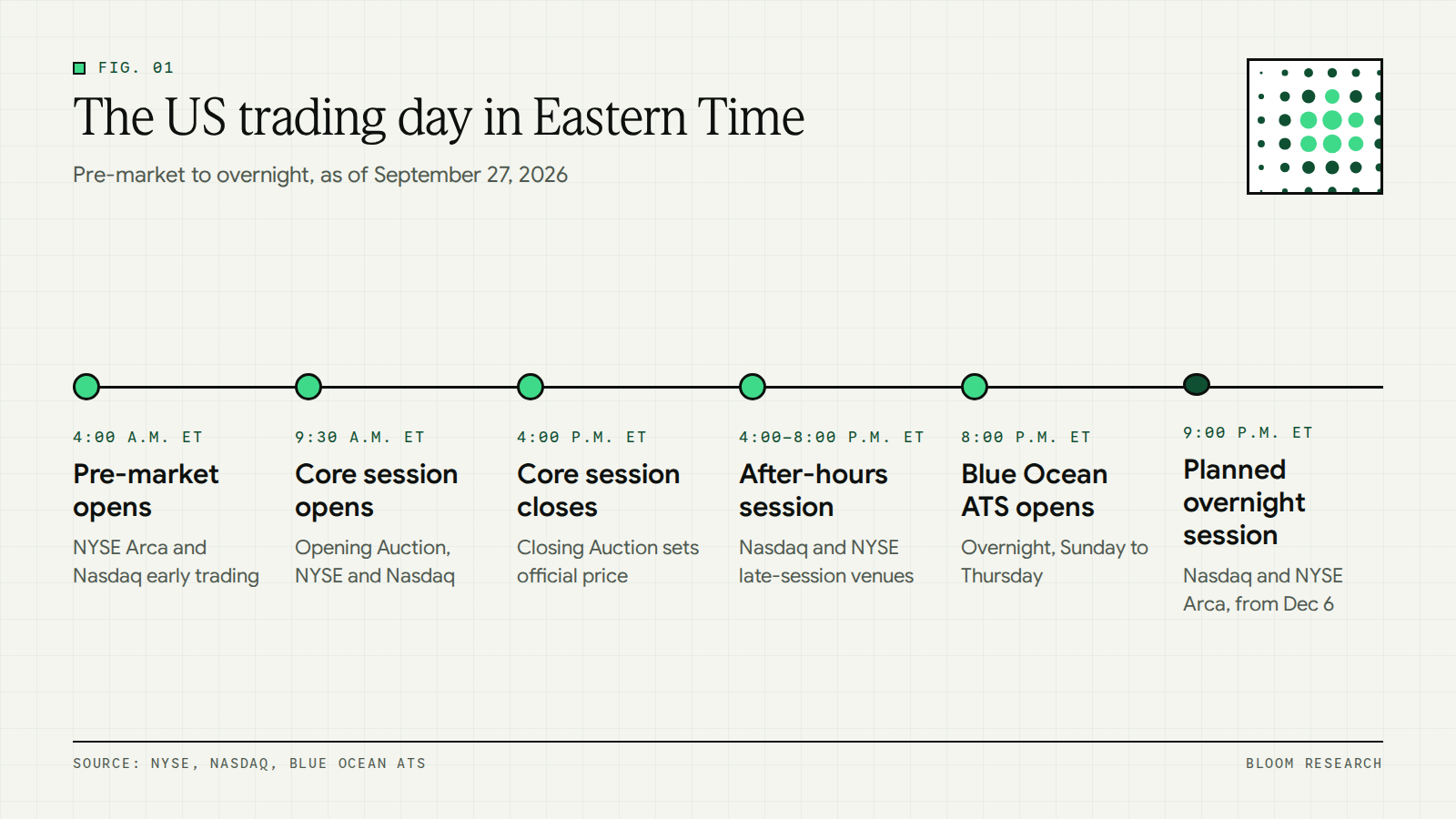
The table lists US market trading hours by session (ET) for each venue, as of September 27, 2026.
| Session | Venue | Hours (ET) | Source |
|---|---|---|---|
| Pre-opening order entry | NYSE (Tape A) | From 6:30 a.m., queued until the 9:30 a.m. opening auction | NYSE |
| Early session | NYSE Arca | 4:00 a.m. to 9:30 a.m. | NYSE |
| Pre-market | Nasdaq | 4:00 a.m. to 9:30 a.m. | SEC |
| Early session | NYSE American, NYSE National, NYSE Texas | 7:00 a.m. to 9:30 a.m. | NYSE |
| Core or regular session | NYSE and Nasdaq | 9:30 a.m. to 4:00 p.m. | NYSE, SEC |
| Late or post-market session | NYSE American, NYSE Arca, NYSE National, NYSE Texas; Nasdaq | 4:00 p.m. to 8:00 p.m. | NYSE, SEC |
| Overnight today | Blue Ocean ATS | 8:00 p.m. to 4:00 a.m., Sunday to Thursday | Blue Ocean |
| Planned from December 6, 2026 | Nasdaq, NYSE Arca | 9:00 p.m. to 4:00 a.m. | Nasdaq, NYSE |
#Pre-market, after-hours and overnight sessions
FINRA calls any activity outside regular trading hours extended-hours trading. FINRA says pre-market trading is typically defined as 7 to 9:30 a.m. ET and after-hours trading as 4 to 8 p.m. ET. Some venues start earlier: the Nasdaq Pre-Market Hours session and the NYSE Arca Early Trading Session both begin at 4:00 a.m. ET.
Pre-market and after-hours by venue
NYSE American, NYSE National and NYSE Texas open their early sessions at 7:00 a.m. ET, three hours after NYSE Arca and Nasdaq. FINRA notes that brokerage firms might only accept limit orders in extended hours, or might not offer extended hours at all. Extended-hours trading is less liquid, so an order may be executed partially or not at all, as FINRA's guide to extended-hours trading explains. Our guide to pre-market trading hours and risks covers pre-market IST conversions and risks in detail. Our guide to after-hours trading covers after-hours session times in ET, IST and UK time and the risks FINRA and the SEC list.
Overnight trading and the December 6, 2026 sessions
An alternative trading system (ATS) is a trading venue operated by a broker-dealer, and the SEC notes that extended-hours trading may take place on ATSs. Today, Blue Ocean ATS matches buy and sell orders in US National Market System (NMS) stocks from 8:00 p.m. to 4:00 a.m. ET, Sunday to Thursday. Retail investors request access through their US brokerage firm. Our guide to what Blue Ocean ATS is explains how an order reaches this venue and gives its overnight hours in IST.
As of September 27, 2026, the exchange overnight sessions are planned and not yet live. Nasdaq will begin a new trading session from 9:00 p.m. to 4:00 a.m. ET on Sunday, December 6, 2026, as part of its 23/5 strategy. 23/5 trading means trading 23 hours a day, five days a week. The SEC approved the Nasdaq rule change on April 10, 2026.
Nasdaq will operate a Night Trading Session from 9:00 p.m. to 4:00 a.m. ET and a Day Trading Session from 4:00 a.m. to 8:00 p.m. ET, and orders still open at 4:00 a.m. ET will be canceled and can be re-entered in the next session. Nasdaq's notice on the 9:00 p.m. to 4:00 a.m. session gives the December 6, 2026 launch date.
NYSE Arca and 24X plan matching 9:00 p.m. to 4:00 a.m. ET overnight sessions with the same December 6, 2026 target, subject to SEC approval and, for NYSE Arca, the availability of the securities information processors described below. Our guide to weekend and overnight trading venues covers the Nasdaq, NYSE Arca, 24X and Blue Ocean ATS mechanics and approval status venue by venue.
A securities information processor (SIP) is an industry utility that consolidates quotation and trade data from different markets and reports last-sale information. Beginning December 6, 2026, the SIPs are expected to operate 23x5, from 9:00 p.m. ET Sunday through 8:00 p.m. ET Friday. The daily one-hour pause from 8:00 p.m. to 9:00 p.m. ET supports trade clearance, system maintenance and the transition to the next trade date.
Only US broker-dealers that are members of Nasdaq and NYSE Arca may trade in the Overnight Session, and retail investors must access it through a member. The regular market will continue to open at 9:30 a.m. ET, and the 4:00 p.m. ET close will continue to set the price mutual funds use to calculate net asset value. Trading will start at 9:00 p.m. ET on Sunday and end at 8:00 p.m. ET on Friday.
#How daylight saving time moves US market hours
Daylight saving time (DST) is the part of the year when clocks are set one hour ahead of standard time. Under NIST's daylight saving time rules, US DST begins at 2:00 a.m. on the second Sunday of March and ends at 2:00 a.m. on the first Sunday of November. During 2026, DST is in effect from March 8 at 2 a.m. to November 1 at 2 a.m. local time, when clocks are set back one hour.
Coordinated Universal Time (UTC) is the base for world time zone offsets. The US Naval Observatory time zone table gives Eastern daylight time (EDT) as UTC minus 4 hours and Eastern standard time (EST) as UTC minus 5 hours. The 9:30 a.m. to 4:00 p.m. ET session is therefore 1:30 p.m. to 8:00 p.m. UTC under EDT and 2:30 p.m. to 9:00 p.m. UTC under EST.
Clock changes in the UK, EU and Australia
Each of the following clock changes moves US market hours in that country's local time.
- United Kingdom: the GOV.UK clock change dates are March 29 and October 25 in 2026, and March 28 and October 31 in 2027. The UK is on Greenwich Mean Time (GMT) in winter, and British Summer Time (BST) is the period when clocks are 1 hour ahead.
- European Union: the European Commission summer-time schedule for 2022 to 2026 sets summer time in 2026 on the Sundays of March 29 and October 25 at 1.00 a.m. UTC. For 2027, a later communication sets March 28 and October 31. Central European Time (CET) is UTC+1, and Central European Summer Time (CEST) is UTC+2.
- Australia: the NSW Government daylight saving dates are Sunday 4 October 2026 at 2am AEST to Sunday 4 April 2027 at 3am AEDT. Australian Eastern Standard Time (AEST) is UTC+10 and Australian Eastern Daylight Time (AEDT) is UTC+11. Queensland, Western Australia and the Northern Territory do not observe daylight saving.
- Brazil: Decree No. 9,772 of April 25, 2019 ended daylight saving time across Brazil's national territory.
The mismatch weeks in March and October
US clocks and UK and EU clocks change on different Sundays. During the weekdays from March 9 to 27, 2026 and from October 26 to 30, 2026, New York is 4 hours behind London instead of 5. In those windows the regular session runs 1:30 p.m. to 8:00 p.m. GMT and 2:30 p.m. to 9:00 p.m. CET, one hour earlier than usual. As of the date of this guide, the October 26 to 30, 2026 window is the next one.
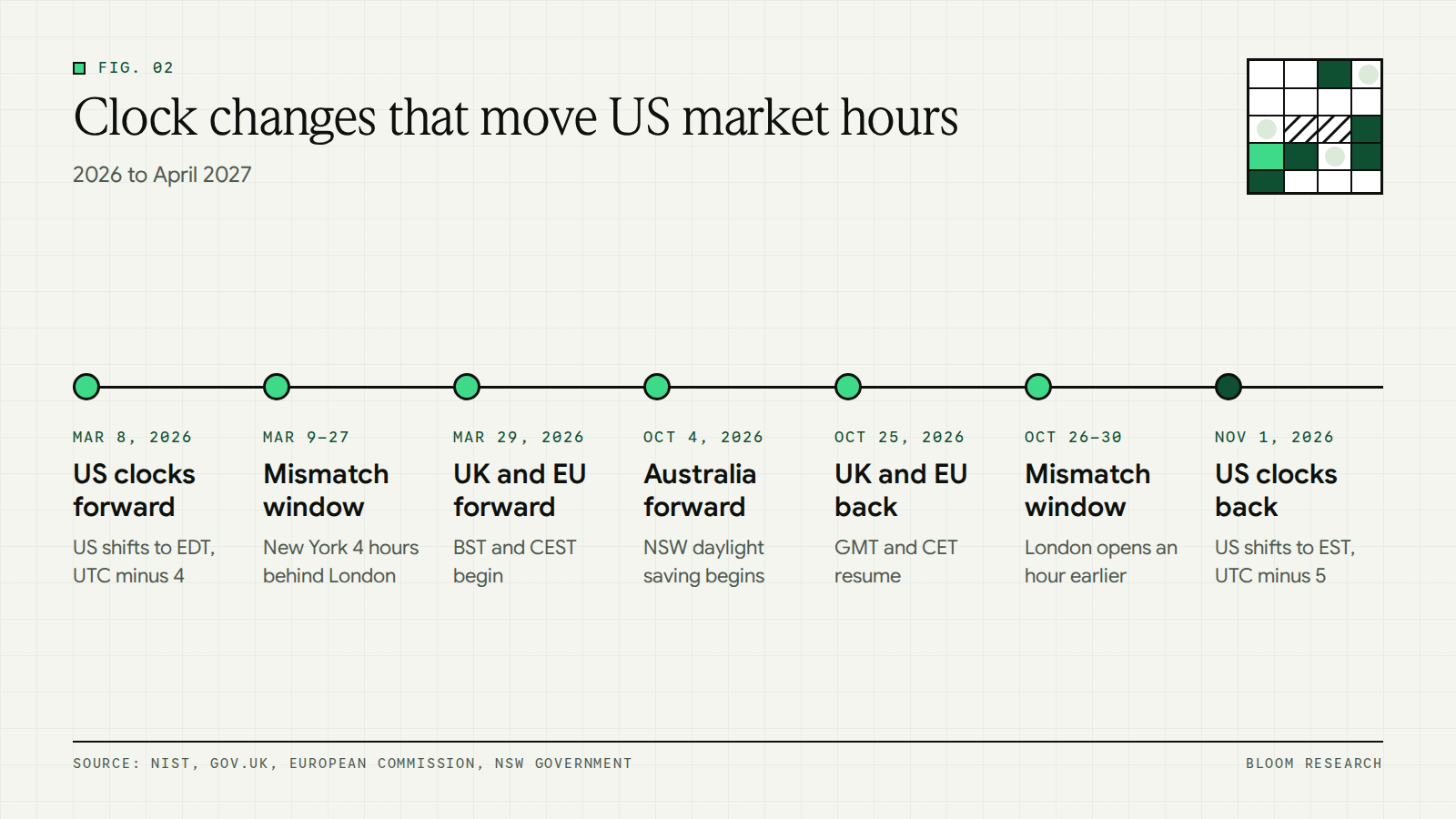
Important: In the mismatch weeks the session starts and ends one hour earlier in London and Central Europe, while the ET times stay 9:30 a.m. to 4:00 p.m.
For 2027, the UK and EU move to summer time on March 28. NIST states the US start as a rule, the second Sunday of March, so we give that rule here and no specific US date.
#US market hours in every time zone
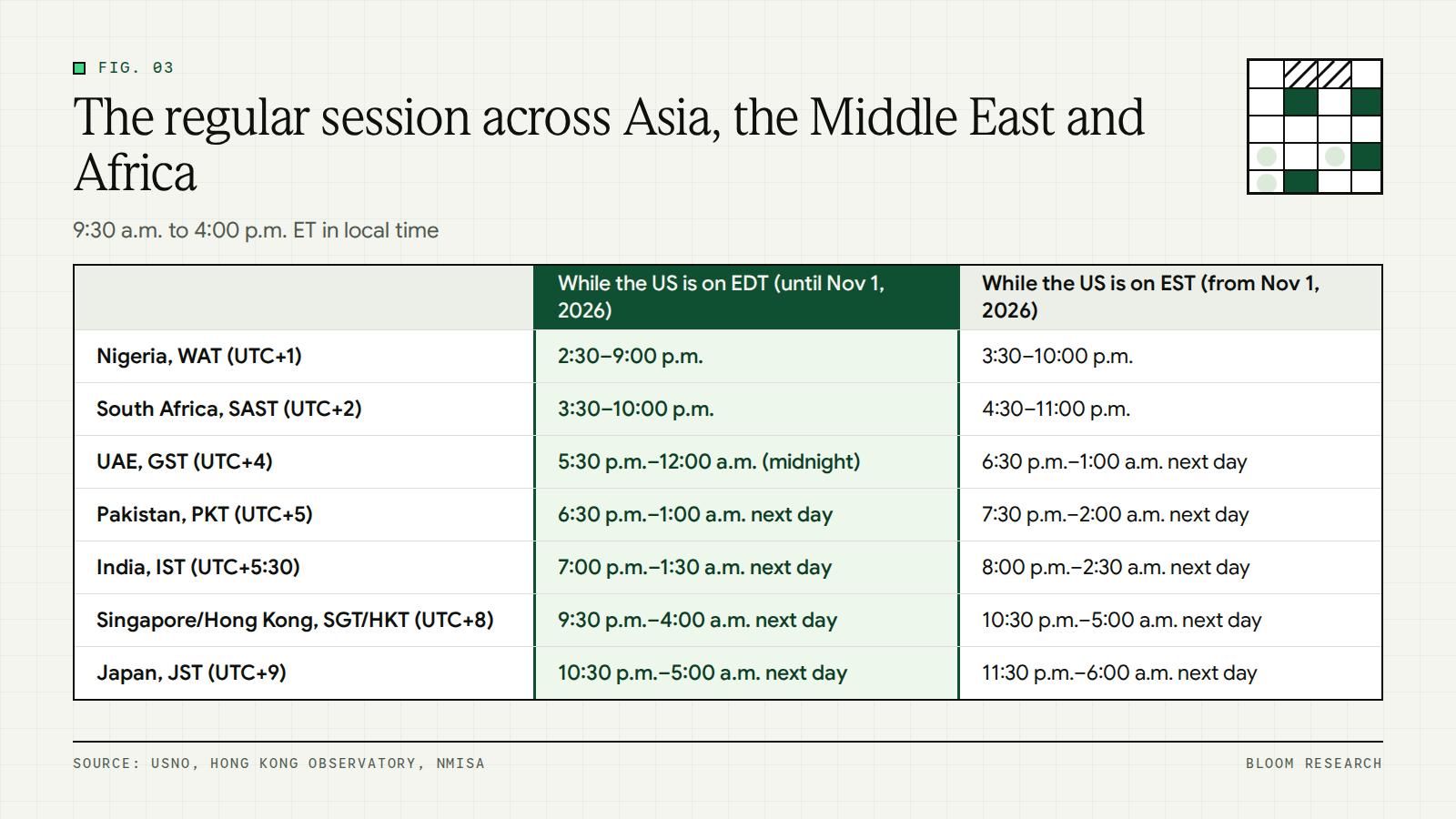
We convert the session in two steps: ET to UTC with the US Naval Observatory offsets, then UTC to local time with the standard offset each source lists. The Hong Kong Observatory world time list gives the offsets for WAT, CET, SAST, GST, PKT, IST, SGT, HKT, JST, AEST, BRT and GMT. NMISA defines SAST as UTC + 2 hours, and Tourism Australia gives AEST and AEDT. Summer time follows the GOV.UK, EU and NSW dates above, and "next day" marks a local date change.
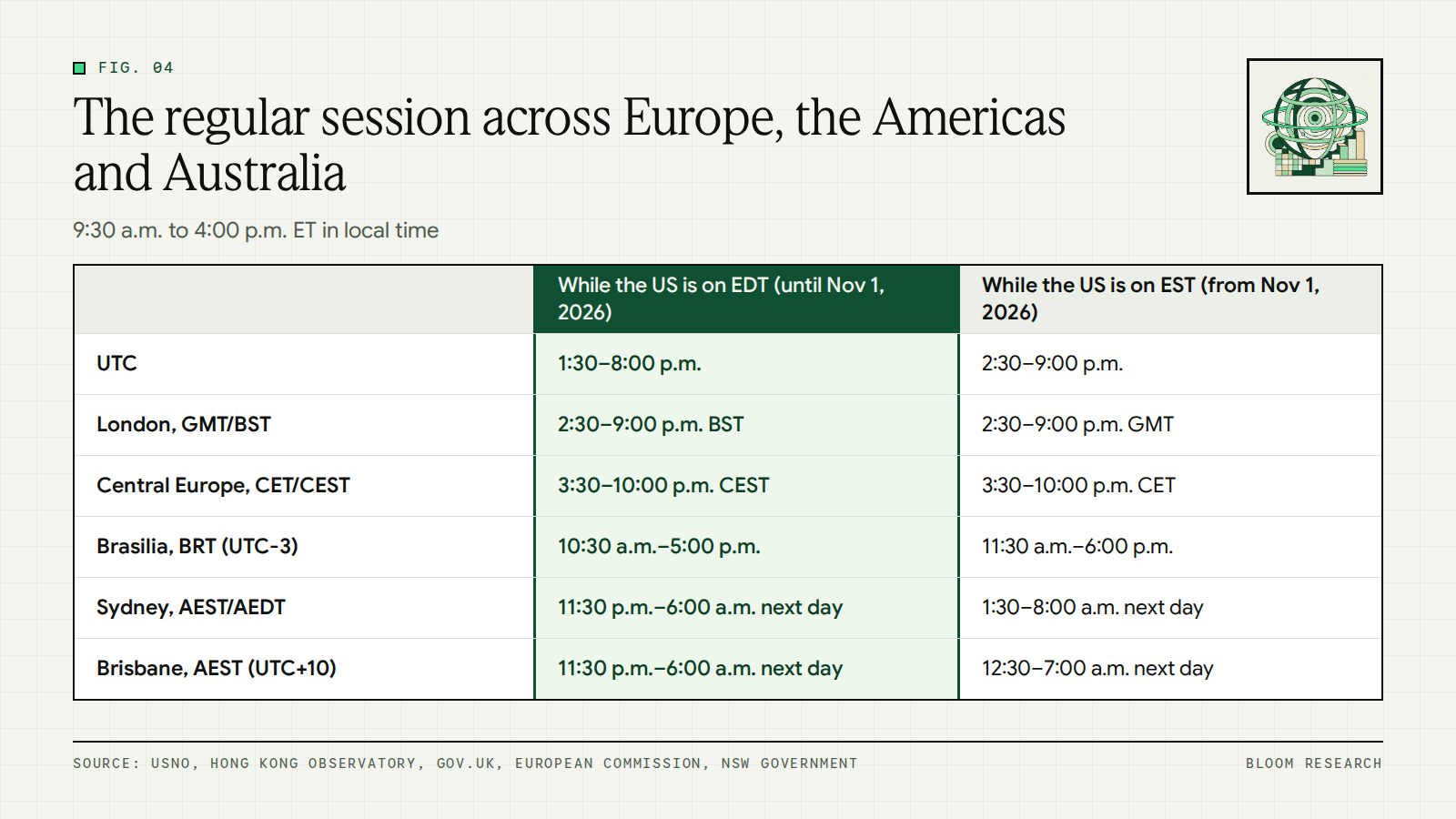
US regular session (9:30 a.m. to 4:00 p.m. ET) in local time
| Zone (UTC offset) | While the US is on EDT (to November 1, 2026) | While the US is on EST (from November 1, 2026) |
|---|---|---|
| UTC | 1:30 p.m. to 8:00 p.m. | 2:30 p.m. to 9:00 p.m. |
| London GMT/BST | 2:30 p.m. to 9:00 p.m. BST (1:30 p.m. to 8:00 p.m. GMT in the mismatch weeks) | 2:30 p.m. to 9:00 p.m. GMT |
| Central Europe CET/CEST | 3:30 p.m. to 10:00 p.m. CEST (2:30 p.m. to 9:00 p.m. CET in the mismatch weeks) | 3:30 p.m. to 10:00 p.m. CET |
| Nigeria WAT (UTC+1) | 2:30 p.m. to 9:00 p.m. | 3:30 p.m. to 10:00 p.m. |
| South Africa SAST (UTC+2) | 3:30 p.m. to 10:00 p.m. | 4:30 p.m. to 11:00 p.m. |
| UAE GST (UTC+4) | 5:30 p.m. to 12:00 a.m. (midnight) | 6:30 p.m. to 1:00 a.m. next day |
| Pakistan PKT (UTC+5) | 6:30 p.m. to 1:00 a.m. next day | 7:30 p.m. to 2:00 a.m. next day |
| India IST (UTC+5:30) | 7:00 p.m. to 1:30 a.m. next day | 8:00 p.m. to 2:30 a.m. next day |
| Singapore SGT and Hong Kong HKT (UTC+8) | 9:30 p.m. to 4:00 a.m. next day | 10:30 p.m. to 5:00 a.m. next day |
| Japan JST (UTC+9) | 10:30 p.m. to 5:00 a.m. next day | 11:30 p.m. to 6:00 a.m. next day |
| Sydney AEST/AEDT | 11:30 p.m. to 6:00 a.m. next day (AEST, to October 3, 2026); 12:30 a.m. to 7:00 a.m. next day (AEDT, October 4 to 31) | 1:30 a.m. to 8:00 a.m. next day (AEDT) |
| Brisbane AEST (UTC+10) | 11:30 p.m. to 6:00 a.m. next day | 12:30 a.m. to 7:00 a.m. next day |
| Brazil BRT (UTC-3) | 10:30 a.m. to 5:00 p.m. | 11:30 a.m. to 6:00 p.m. |
In Asia, the Middle East and Africa, the regular session falls in the local evening or night. Under EDT it runs 5:30 p.m. to 12:00 a.m. (midnight) GST in the UAE and 9:30 p.m. to 4:00 a.m. next day in Singapore and Hong Kong. The India section below covers IST in more detail.
In London and Central Europe, the regular session runs from the afternoon into the evening. From March 29 to October 24, 2026, it is 2:30 p.m. to 9:00 p.m. BST in London and 3:30 p.m. to 10:00 p.m. CEST in Central Europe. From November 1, 2026, with the US on EST and the UK and EU on standard time, it is 2:30 p.m. to 9:00 p.m. GMT and 3:30 p.m. to 10:00 p.m. CET.
Brasilia Time (BRT) is UTC-3 on the HKO list, so the session falls in the Brazilian daytime. It runs 10:30 a.m. to 5:00 p.m. BRT under EDT and 11:30 a.m. to 6:00 p.m. BRT under EST. The table uses the HKO standard offset for Brasilia, so only the US clock change moves these hours.
In Sydney, the session falls in the early morning of the next day, and the local time moves twice in October and November 2026. Until October 3, 2026, with the US on EDT and Sydney on AEST, it runs 11:30 p.m. to 6:00 a.m. next day. From October 4 to October 31, 2026, after New South Wales moves to AEDT, it runs 12:30 a.m. to 7:00 a.m. next day. From November 1, 2026, with the US on EST, it runs 1:30 a.m. to 8:00 a.m. next day.
Brisbane in Queensland stays on AEST all year, so its hours change only with the US clock. The session there is 11:30 p.m. to 6:00 a.m. next day under EDT and 12:30 a.m. to 7:00 a.m. next day under EST.
Our guides to buying US stocks by country cover many of these markets, with funding rails, currency and popular stocks for each.
#US stock market timings in India (IST)
Indian Standard Time (IST) is the official time of India. It is UTC plus 5 hours 30 minutes and is maintained by the CSIR-National Physical Laboratory. US stock market timings in India change with the US clock. From March 8 to November 1, 2026, while the US is on daylight time, the regular session runs from 7:00 p.m. to 1:30 a.m. IST (next day).
From November 1, 2026, when the US returns to standard time, the same session runs from 8:00 p.m. to 2:30 a.m. IST (next day). The US market opening time in IST is 7:00 p.m. until November 1, 2026 and 8:00 p.m. after that date. The time zone table above gives US market hours for the regular session in the other zones.
Trading US stocks after NSE closes at 3:30 p.m.
The National Stock Exchange of India (NSE) runs its normal market from 09:15 to 15:30 IST. NSE equities do not trade on Saturdays, Sundays or holidays declared by the exchange. Nasdaq's pre-market session and the NYSE Arca early trading session both open at 4:00 a.m. ET. That is 1:30 p.m. IST under EDT and 2:30 p.m. IST under EST, before the NSE close.
After-hours trading on Nasdaq ends at 8:00 p.m. ET, which is 5:30 a.m. IST next day under EDT and 6:30 a.m. IST next day under EST. Nasdaq plans a new overnight session from 9:00 p.m. to 4:00 a.m. ET beginning December 6, 2026. In IST, that planned session would run from 7:30 a.m. to 2:30 p.m.
Access to extended sessions depends on the broker. FINRA notes that firms may accept only limit orders during extended hours, may cancel or carry over unexecuted orders, or may not offer extended-hours trading at all.
In practice: For an India-based investor, the NSE close at 3:30 p.m. IST and the US regular open at 7:00 p.m. IST (8:00 p.m. from November 1, 2026) are separate sessions on separate exchanges.
For the platform steps, read our guide to buying tokenized US stocks in India. For the remittance rules, see how Indian residents invest in US stocks, including LRS.
#US stock market holidays 2026 and 2027
All NYSE markets observe the US holidays listed on the NYSE calendar, and all times on that calendar are Eastern Time. Nasdaq lists the same 2026 closures for US equity and options markets in Nasdaq's 2026 holiday and trading calendar. Our guide to stock market holidays in 2026 lists every NYSE and Nasdaq closure and early close.
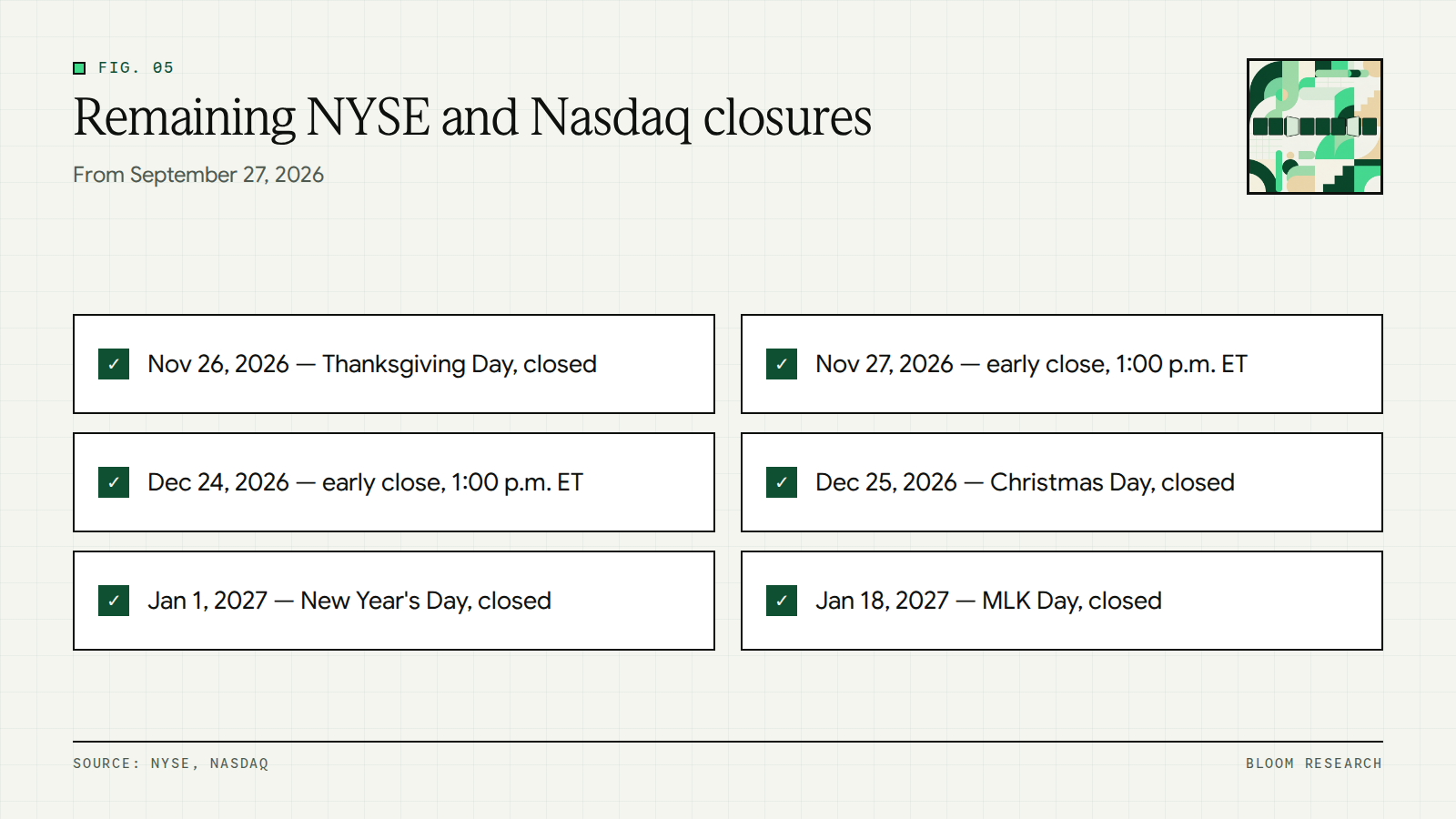
The 2026 closure dates are listed below, marked as passed or upcoming as of September 27, 2026:
- Thursday, January 1, 2026: New Year's Day (passed)
- Monday, January 19, 2026: Martin Luther King, Jr. Day (passed)
- Monday, February 16, 2026: Washington's Birthday (passed)
- Friday, April 3, 2026: Good Friday (passed)
- Monday, May 25, 2026: Memorial Day (passed)
- Friday, June 19, 2026: Juneteenth National Independence Day (passed)
- Friday, July 3, 2026: Independence Day observed (passed)
- Monday, September 7, 2026: Labor Day (passed)
- Thursday, November 26, 2026: Thanksgiving Day (upcoming)
- Friday, December 25, 2026: Christmas Day (upcoming)
The NYSE closures for 2027 are Friday, January 1 (New Year's Day), Monday, January 18 (Martin Luther King, Jr. Day), Monday, February 15 (Washington's Birthday), Friday, March 26 (Good Friday) and Monday, May 31 (Memorial Day). The rest are Friday, June 18 (Juneteenth observed), Monday, July 5 (Independence Day observed), Monday, September 6 (Labor Day), Thursday, November 25 (Thanksgiving Day) and Friday, December 24 (Christmas Day observed).
Early closes in 2026 and 2027
An early close is a trading day on which the exchange ends its regular session before the usual 4:00 p.m. ET. NYSE markets close early at 1:00 p.m. ET, or 1:15 p.m. for eligible options, on Friday, November 27, 2026, Thursday, December 24, 2026 and Friday, November 26, 2027. On the Fridays after Thanksgiving, the late trading sessions on NYSE American, NYSE Arca, NYSE National and NYSE Texas close at 5:00 p.m. ET.
Nasdaq lists the same two 2026 early closes at 1:00 p.m. and sends alerts to notify customers of days when the market will close early. The 1:00 p.m. ET close on November 27 and December 24, 2026 is 11:30 p.m. IST, 6:00 p.m. GMT and 7:00 p.m. CET.
#How US market hours apply to orders on Bloom
A trading-hours pill is the status label in the Asset detail header that shows this session, and we always display it so you know what to expect before tapping Buy. The Quick Trade sheet and its market-hours pill show one of three states: LIVE, Queued or Extended hours.
A queued order is an order we accept outside its session and hold server-side until the next open. Our trading hours documentation lists four states, and the receipts below are examples:
- Regular market hours: the order routes to market, executes and fills, with a receipt such as "Filled @ $X".
- Pre-market or after-hours extended session: the order routes to the extended session, may partial-fill, and the remainder is queued, with a receipt such as "Extended-hours · Filled 2 of 5 · 3 queued for next open".
- Overnight, weekends and holidays: the order is queued server-side until the next open, with a receipt such as "Queued · Executes at market open in 6h 23m".
- During hours with insufficient liquidity: the order partially fills at the available price, and the remainder is queued for the next session.
Queued orders appear in Portfolio → Orders with a badge such as "Queued · executes ≈ Mar 6, 09:30 local". The badge stays until the order becomes Filled, Partially filled or Cancelled. The Buy or Sell button text never changes off-hours, and a push notification arrives when the order fills.
Only assets with continuous markets fill immediately at the prevailing RFQ (request for quote) price regardless of time of day. The pill on those assets reads "LIVE 24/7". Our US stocks are single-listed equities on NYSE, NASDAQ and AMEX, and our US ETFs include SPY, QQQ and VOO.
On Bloom: We show the trading session on every asset before you tap Buy. An order placed outside that session is queued for the next open, and the receipt gives an estimated execution time.
Asset prices can move against you, including overnight gaps that may exceed your slippage tolerance or Stop Loss trigger. Markets can become illiquid outside regular hours, so orders may queue or partial-fill. Trading carries risk, including the loss of principal, as set out in our risk disclosure.
#Where to find US stocks and ETFs on Bloom
You can browse tokenized stocks by sector, where every tokenized US stock and ETF on Bloom is grouped by the sector its underlying company trades in. Our list of tokenized ETFs shows 68 ETFs with price and day change. You can also compare two tokenized stocks or ETFs side by side by sector and exchange.
The Bloom markets page lists price, 24-hour change, market cap and 7-day columns, plus top gainers, top losers and stocks in the news. Each asset on these pages follows the trading session of its underlying share. We do not offer our product or services to users in the United States or in other restricted jurisdictions, as stated on our service availability page.
Frequently asked questions
Is the USA market open today?
On weekdays other than NYSE and Nasdaq holidays, US market hours for the regular session are 9:30 a.m. to 4:00 p.m. ET. The remaining 2026 closures are Thanksgiving Day on Thursday, November 26 and Christmas Day on Friday, December 25. Both markets close early at 1:00 p.m. ET on Friday, November 27 and Thursday, December 24, 2026. The NYSE holidays and trading hours page lists every closure for the year.
Can I trade after 3.30 PM?
The NSE normal market runs from 09:15 to 15:30 IST. US pre-market trading on Nasdaq and NYSE Arca opens at 4:00 a.m. ET, which is 1:30 p.m. IST under EDT and 2:30 p.m. IST under EST. The US regular session runs from 7:00 p.m. to 1:30 a.m. IST until November 1, 2026, and from 8:00 p.m. to 2:30 a.m. IST after that date. Access to extended hours depends on the brokerage firm.
What is the US market opening time in IST?
The US regular session opens at 9:30 a.m. ET. In India that is 7:00 p.m. IST from March 8 to November 1, 2026, while US daylight saving time is in effect. From November 1, 2026, it is 8:00 p.m. IST until US daylight saving time begins again on the second Sunday of March. The session closes at 1:30 a.m. IST or 2:30 a.m. IST the next day.
What are NYSE and Nasdaq trading hours?
Both the NYSE and Nasdaq run the core session from 9:30 a.m. to 4:00 p.m. ET, the regular trading hours the SEC defines for listed stocks. Nasdaq also runs a Pre-Market Hours session from 4:00 a.m. to 9:30 a.m. ET and Post-Market Hours until 8:00 p.m. ET. NYSE Arca runs an Early Trading Session from 4:00 a.m. ET, and NYSE American, NYSE Arca, NYSE National and NYSE Texas run late sessions until 8:00 p.m. ET.
When are the US stock market holidays in 2026?
The NYSE and Nasdaq are closed on ten days in 2026: January 1, January 19, February 16, April 3, May 25, June 19, July 3, September 7, November 26 and December 25. Both close early at 1:00 p.m. ET on Friday, November 27, the day after Thanksgiving, and on Thursday, December 24, 2026. On November 27, the NYSE American, NYSE Arca, NYSE National and NYSE Texas late trading sessions close at 5:00 p.m.
Is the US stock market open 24 hours?
No. The regular session runs from 9:30 a.m. to 4:00 p.m. ET on weekdays. Today, Blue Ocean ATS matches orders overnight from 8:00 p.m. to 4:00 a.m. ET, Sunday to Thursday. Nasdaq and NYSE Arca plan overnight sessions from December 6, 2026 for trading 23 hours a day, five days a week, with a one-hour pause from 8:00 p.m. to 9:00 p.m. ET. Trading will start at 9:00 p.m. ET on Sunday and end at 8:00 p.m. ET on Friday, so there is no Saturday session.
Does daylight saving time change US market hours?
The regular session stays 9:30 a.m. to 4:00 p.m. ET, because the NYSE lists its session times in Eastern Time, but its local time in other countries shifts. In 2026, US daylight saving time runs from March 8 to November 1, while UK and EU summer time runs from March 29 to October 25. From October 26 to 30, 2026, the session runs from 1:30 p.m. to 8:00 p.m. GMT in London, one hour earlier than usual.