
Weekend Nasdaq Trading: How to Trade US Stocks on Weekends
Can you trade stocks on weekends? US exchanges have no Saturday session. See 2026 overnight hours, Sunday night starts, IST times and how weekend orders queue.

Key takeaways
- No US exchange or overnight venue in our sources opens on Saturday. Blue Ocean ATS runs overnight Sunday to Thursday, and Nasdaq plans to start its week at 9 p.m. ET on Sunday.
- An order placed on a weekend waits for the next session, and brokerage firms may cancel it or carry it over to regular trading hours under their own policies.
- Nasdaq, NYSE Arca and 24X plan 23-hour weekday trading from December 6, 2026, each still subject to SEC approvals or a further rule change.
- In IST, the US regular session runs from 7:00 p.m. to 1:30 a.m. until November 1, 2026, and from 8:00 p.m. to 2:30 a.m. after it.
- On Bloom, a weekend stock order is queued with an estimated execution time on the receipt, and tokens you hold stay in your own embedded wallet.
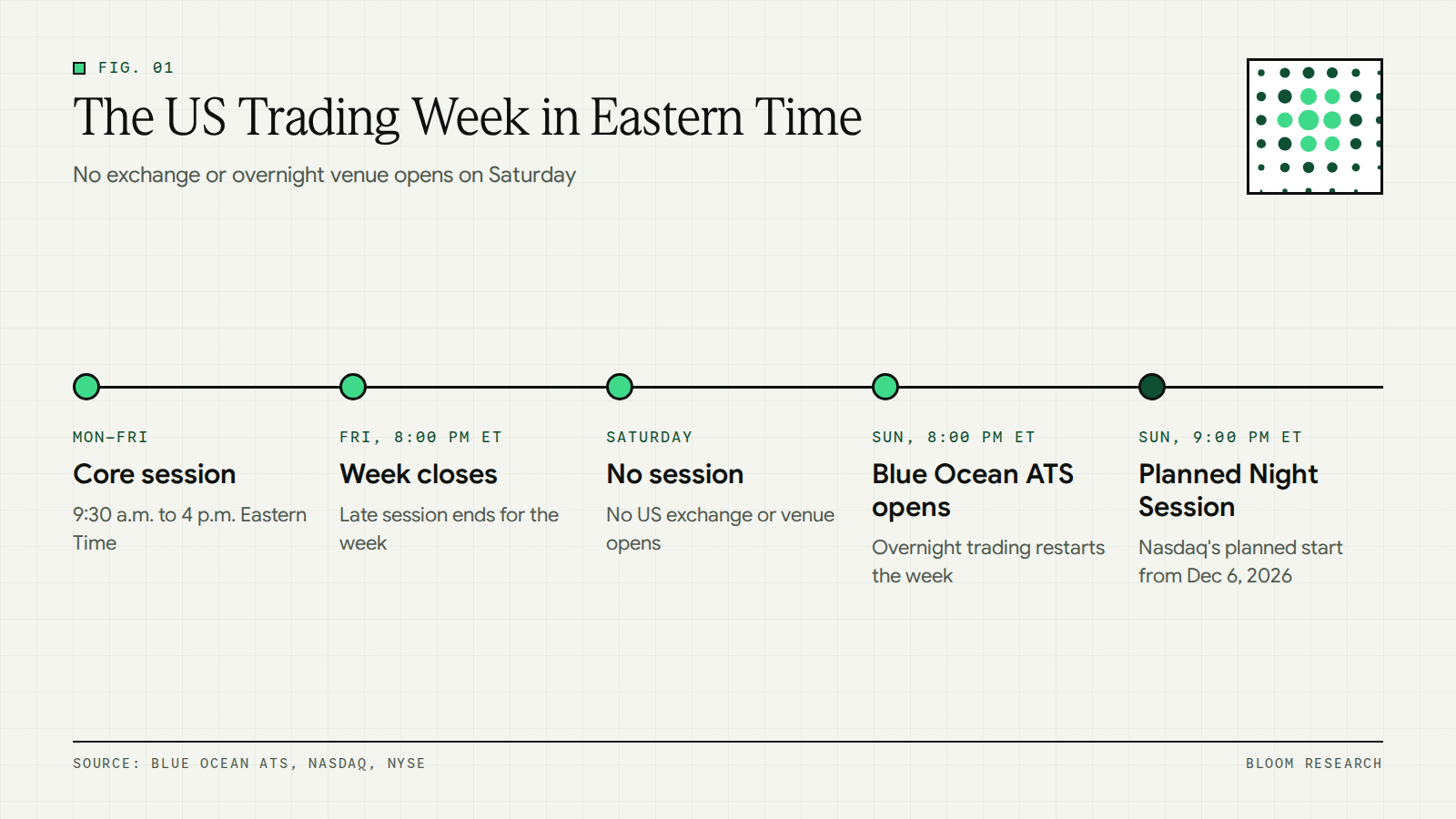
You cannot trade stocks on weekends on a US exchange: no US exchange or overnight venue in our sources opens on Saturday, and the US trading week starts again on Sunday evening Eastern Time (ET). Blue Ocean ATS opens its Sunday overnight session at 8:00 p.m. ET, and Nasdaq plans to start trading at 9 p.m. ET on Sunday evening from December 6, 2026.
You can still place an order on a weekend, and the order waits for the next session under your broker's policy. On Bloom, a stock order submitted on a weekend is queued server-side until the next open, and the receipt gives an estimated execution time. Our documentation on how our trading hours and queued orders work shows what the receipt states. This guide covers the 2026 overnight changes and the same times in Indian Standard Time (IST).
#Can you trade stocks on weekends in 2026?
Regular trading hours are the main weekday session of US stock exchanges. As defined by the Securities and Exchange Commission (SEC), regular trading hours for listed stocks run from 9:30 a.m. to 4 p.m. ET. FINRA defines extended-hours trading as any activity outside regular trading hours, whether in the pre-market, after-hours or overnight periods. The NYSE publishes its session times and 2026 holidays on its NYSE trading hours and holiday calendar.
Today the only overnight US stock venue named in our sources is Blue Ocean ATS. It matches buy and sell orders of US National Market System (NMS) stocks during US overnight hours, from 8:00 p.m. to 4:00 a.m. ET, Sunday to Thursday. The ATS does not open at 8:00 p.m. ET on Friday evening, because the NYSE trade reporting facility (TRF) is not available for the reporting of trades on Saturday. Our guide to what Blue Ocean ATS is explains how an order reaches this venue and gives its overnight hours in IST.
Nasdaq's planned week has no Saturday session either. Its global trading hours FAQ states that trading will start at 9 p.m. ET on Sunday evening and end at 8 p.m. ET on Friday evening, with a one-hour pause from 8 p.m. to 9 p.m. ET daily. The first step is a new trading session from 9 p.m. to 4 a.m. ET on December 6, 2026, announced in the Nasdaq trader alert on the December 6, 2026 session.
Key point: No US exchange or overnight venue in our sources opens on Saturday. The earliest weekend trading is on Sunday evening ET: from 8:00 p.m. on Blue Ocean ATS today, and from 9 p.m. on Nasdaq's planned week.
What happens if you buy stocks on a weekend
Each broker sets its own policy for orders entered while no session is open. FINRA notes that brokerage firms may have different policies on whether unexecuted extended-hours orders are canceled or carried over to the start of regular trading hours. Some firms accept only limit orders during extended hours, and some do not offer extended-hours trading at all. The SEC tells investors to check with their brokerage firm whether orders not executed during extended hours are canceled or automatically entered when regular trading hours begin.
On Bloom, a stock order placed on Saturday or Sunday is queued server-side until the next open. After you confirm, the receipt tells you the order has been queued and gives an estimated execution time, and you receive a push notification when the order fills.
#Weekend stock trading hours: the US week in Eastern Time
The table below lists the US stock sessions in our sources, with their hours in ET and their status on September 26, 2026. Pre-market and early sessions, the late session and the overnight sessions are all forms of extended-hours trading.
| Session | Hours (ET) | Days | Status on September 26, 2026 |
|---|---|---|---|
| NYSE Arca Equities early trading session | 4:00 a.m. to 9:30 a.m. | Monday to Friday | Operating |
| Pre-market, as FINRA typically defines it | 7:00 a.m. to 9:30 a.m. | Monday to Friday | Operating |
| Core trading session (regular trading hours) | 9:30 a.m. to 4:00 p.m. | Monday to Friday | Operating |
| NYSE Arca late session and after-hours trading | 4:00 p.m. to 8:00 p.m. | Monday to Friday | Operating |
| Blue Ocean ATS overnight session | 8:00 p.m. to 4:00 a.m. | Sunday to Thursday nights | Operating |
| Nasdaq Night Session | 9:00 p.m. to 4:00 a.m. | Sunday to Thursday nights | Planned from December 6, 2026 |
| Saturday | No session | Saturday | No US venue opens |
A market holiday also closes the core session on a weekday. The NYSE 2026 calendar lists Thanksgiving Day on Thursday, November 26 and Christmas Day on Friday, December 25 as holidays. Markets close early at 1:00 p.m. ET on Friday, November 27, 2026 and on Thursday, December 24, 2026. Our guide to stock market holidays in 2026 lists every NYSE and Nasdaq closure and early close.
Our Nasdaq-100 stocks tokenized on Bloom page lists 50 constituents available on Bloom, with the constituent list reviewed on June 20, 2026. We offer US stocks listed on NYSE, NASDAQ and AMEX and US ETFs such as SPY, QQQ and VOO, with current prices on our live markets list.
#US trading hours in India time and why NSE is also closed on weekends
Indian stock exchanges also close on weekends. On the National Stock Exchange of India (NSE), trading on the equities segment takes place on all days of the week except Saturdays, Sundays and holidays declared by the exchange in advance. The NSE normal market runs from 09:15 to 15:30 IST, according to the NSE market timings and holidays page. So you cannot trade stocks on weekends in India on the NSE equities segment either.
For US stocks, the US trading week maps onto Indian evenings and nights. Our India page for investing in US stocks shows popular stocks and ETFs to buy from India. Because we settle in USD stablecoins, an investor in India holds INR/USD exchange-rate exposure in addition to the price movement of the stock itself.
Converting ET to IST before and after November 1, 2026
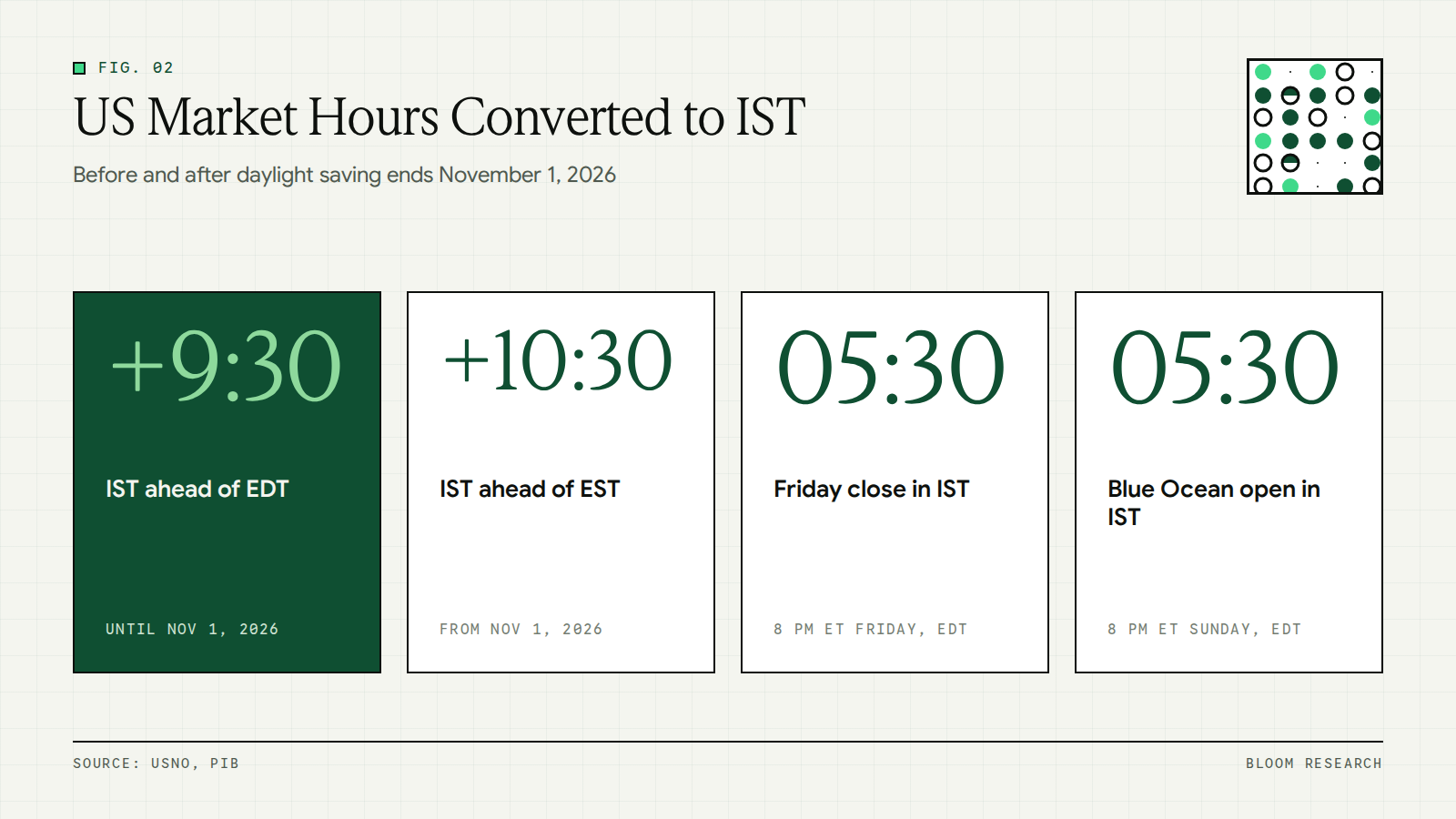
Indian Standard Time (IST) is based on UTC with a +5:30-hour offset and is maintained by the CSIR-National Physical Laboratory. Eastern Time has two forms: for Eastern Daylight Time (EDT) subtract 4 hours from UTC, and for Eastern Standard Time (EST) subtract 5 hours from UTC, according to the US Naval Observatory time zone table. US daylight saving time ends on Sunday, November 1, 2026, and at that time clocks are set back one hour.
IST is therefore 9 hours 30 minutes ahead of EDT and 10 hours 30 minutes ahead of EST. Converted with those offsets, the key US market times in IST are:
- The 9:30 a.m. to 4:00 p.m. ET regular session is 7:00 p.m. to 1:30 a.m. IST while EDT applies, until November 1, 2026.
- After EDT ends, the same regular session is 8:00 p.m. to 2:30 a.m. IST.
- A Friday 8:00 p.m. ET close is 5:30 a.m. IST Saturday under EDT, or 6:30 a.m. IST Saturday under EST.
- The Sunday 8:00 p.m. ET Blue Ocean ATS open is 5:30 a.m. IST Monday under EDT.
- The planned Sunday 9:00 p.m. ET start on December 6, 2026 is 7:30 a.m. IST on Monday, December 7.
In practice: In IST, no US session runs on Saturday after the early morning or at any time on Sunday. The US trading week in India time runs from early Monday morning to early Saturday morning.
#Nasdaq weekend trading and the move to 23-hour weekdays
Nasdaq Equity Trader Alert #2026-46, dated August 17, 2026, says Nasdaq will introduce a new trading session from 9 p.m. to 4 a.m. ET on December 6, 2026. The session is part of Nasdaq's plan to offer nearly continuous trading 23 hours a day, 5 days a week. In this guide we call this schedule 23/5 trading, meaning 23 hours on each of the 5 weekdays; a Sidley summary of the SEC roundtable calls it a 23x5 basis. Nasdaq's FAQ says the planned week starts at 9 p.m. ET on Sunday and ends at 8 p.m. ET on Friday, with a one-hour industry-wide pause from 8 p.m. to 9 p.m. ET daily.
The SEC granted accelerated approval to Nasdaq's rule change on April 10, 2026, in SEC order 34-105199. The order sets a Day Session from 4:00 a.m. to 8:00 p.m. ET and a Night Session from 9:00 p.m. to 4:00 a.m. ET on Sunday through Thursday nights. An overnight session is a trading session that runs through the night before a business day, after the late session ends and before the early trading session starts. The Night Session cannot start until a further rule change confirms that the securities information processors (SIPs) are ready, and SIPs are the industry utilities that consolidate quote and trade data from different markets and report last-sale information.
Nasdaq's alert also sets out how the new session handles orders. Any orders still open at 4 a.m. ET will be canceled and can be re-entered in the next session. Trades executed between 9 p.m. ET and midnight will get the next trading day's trade date, which is the date a trade is recorded as executed. Under an amendment the SEC approved, exchanges reject orders priced outside static bands set 20% above and 20% below reference prices.
The NYSE extended-hours trading FAQ, version 4.0 from August 2026, says NYSE Arca plans nearly continuous trading 23 hours per day, from 9:00 p.m. through 8:00 p.m. the following day. Its Overnight Session would run from 9:00 p.m. to 4:00 a.m. ET, beginning on Sunday through Thursday evenings. NYSE Arca plans to launch this on December 6, 2026, subject to SEC approvals, the availability of the SIPs and DTCC modernization. The FAQ says all other NYSE Group equities exchanges plan to keep their current trading hours.
The 24X National Exchange says that, pending SEC approval, it will add a fourth session, the 24X Market Session, from 9:00 p.m. to 4:00 a.m. ET. According to the 24X overnight trading FAQ, the Overnight Trading Session would run from Sunday at 9:00 p.m. through Friday evening, with a target date of Sunday, December 6, 2026. Only US broker-dealers that are 24X members can trade in that session, and market orders are not eligible for execution in it. On April 29, 2026, 24X said it had filed a response letter with the SEC on its application for a temporary exemption to start overnight trading.
An alternative trading system (ATS) is a trading venue that matches buy and sell orders from its subscribers. Blue Ocean ATS matches orders in US National Market System (NMS) stocks from 8:00 p.m. to 4:00 a.m. ET, Sunday to Thursday, according to the Blue Ocean ATS FAQ. It accepts only limit day orders, which stay in force for one session and do not carry over to the next, and it rejects orders priced more than 20% away from the reference price. Retail investors request access through their US brokerage firm.
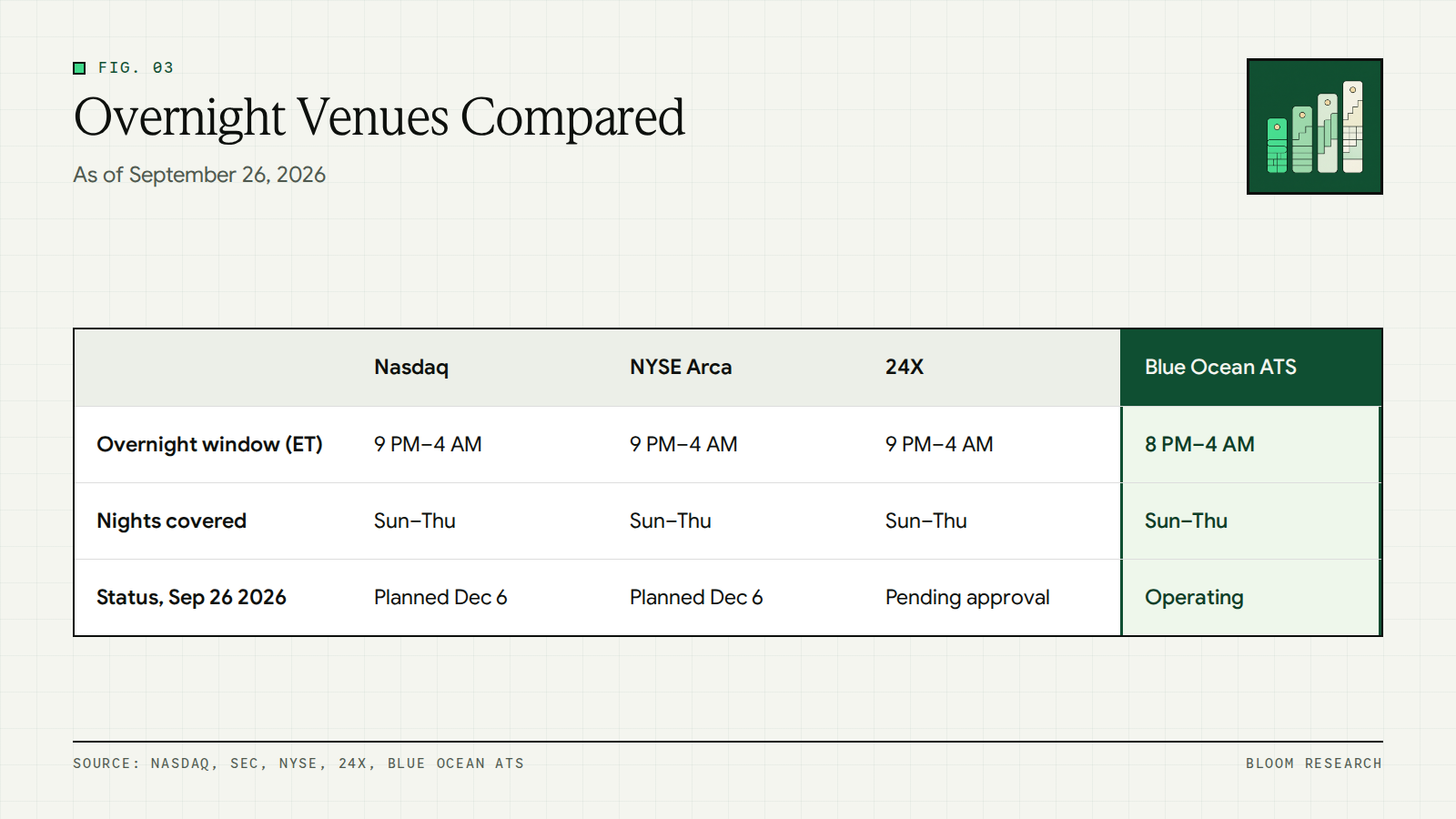
Note: The Nasdaq, NYSE Arca and 24X schedules are planned for December 6, 2026 and depend on regulatory approvals and SIP readiness. None of these 23/5 schedules includes Saturday.
What the 23/5 schedule does and does not change
A Sidley summary of the SEC roundtable on 24-hour trading, held on September 17, 2026, says the SIPs are expected to operate on a 23x5 basis from December 6, 2026. That schedule runs from 9 p.m. ET Sunday through 8 p.m. ET Friday, with a one-hour maintenance pause from 8 p.m. to 9 p.m. ET Monday through Thursday. The regular market will continue to open at 9:30 a.m. ET, and the 4 p.m. ET close will continue to set the price mutual funds use to calculate net asset value.
Speakers at the roundtable said firms will not be required to take part in expanded trading hours because the infrastructure permits it. FINRA said a broker's execution obligations apply regardless of when a customer order is received or executed. SEC staff data showed that in August 2026 the overnight session accounted for 0.9% of total NMS share volume and 0.8% of total NMS dollar volume. The SEC's Division of Trading and Markets noted that further expansion to 24x7 trading remains a possibility, while Saturday and Sunday stay closed under every plan described here.
#Other ways US stock prices are quoted on Saturday and Sunday
A few products show US stock or index prices on weekends, but none of them is a US exchange session. They fall into three groups:
- Weekend index markets quoted by a broker, with prices set separately from weekday prices.
- Tokenized stocks held in an on-chain wallet, which the holder can move at any time.
- Tokenized securities platforms that exchanges are developing, which still need regulatory approval.
Weekend index markets quoted by brokers
IG offers weekend markets on Saturday and Sunday, including Weekend Wall Street and Weekend US Tech 100. IG states that weekend prices for indices are quoted separately from their weekday counterparts. It bases those prices on underlying market conditions such as volatility, as well as client activity and news flow.
Tokenized stocks held in an on-chain wallet
Definition: A tokenized stock is an on-chain token backed 1:1 by a real share held in custody at a regulated US broker-dealer, such as Alpaca Markets or Interactive Brokers.
This is how our tokenized stocks work: the token sits in your own embedded wallet, so you keep custody. You can move, trade, lend, borrow or provide it as liquidity across DeFi at any time. Your tokenized stock holdings are per-chain at the wallet level across the networks we support.
Every token outstanding is backed 1:1 by a share at our broker partner, and you can verify this independently at any time through our proof of reserves. Some tokenized stock issuers state that their tokens trade 24/5 on their own venue and can be traded 24/7 on-chain once withdrawn to a self-hosted wallet.
Exchanges are also building tokenized platforms. On January 19, 2026, NYSE announced a platform for trading and on-chain settlement of tokenized securities, including 24/7 operations, for which it will seek regulatory approvals. On September 23, 2026, Blockchain.com and NYSE Group signed a memorandum of understanding (MOU) to give Blockchain.com users access to tokenized US equities and ETFs on NYSE's digital ATS, subject to regulatory approvals. On September 17, 2026, the SEC issued an Innovation Exemption for trading tokenized NMS stock on Tokenized Securities Venues, and the release does not address trading hours.
#How a weekend stock order works on Bloom
Each asset on Bloom follows the primary-market trading session inherited from its underlying instrument. The Asset detail header always shows a trading-hours pill, so you can see the session status before you tap Buy. In the Quick Trade sheet, the market-hours pill has three states: LIVE, Queued and Extended hours. LIVE means the order executes immediately, Queued means the order will execute at the open, and Extended hours means limited liquidity with a possible partial fill.
Quick Trade offers two order types, Market and Limit, with Market as the default. A market order is an order at the current quoted price, and it executes immediately during market hours. Take Profit and Stop Loss resting orders are optional additions in the same sheet.
When you place a stock order on Saturday or Sunday, the order is queued server-side until the next open. After you confirm during off-hours, the receipt tells you the order has been queued and gives you an estimated execution time. A sample receipt line reads "Queued · Executes at market open in 6h 23m." You receive a push notification when the order fills.
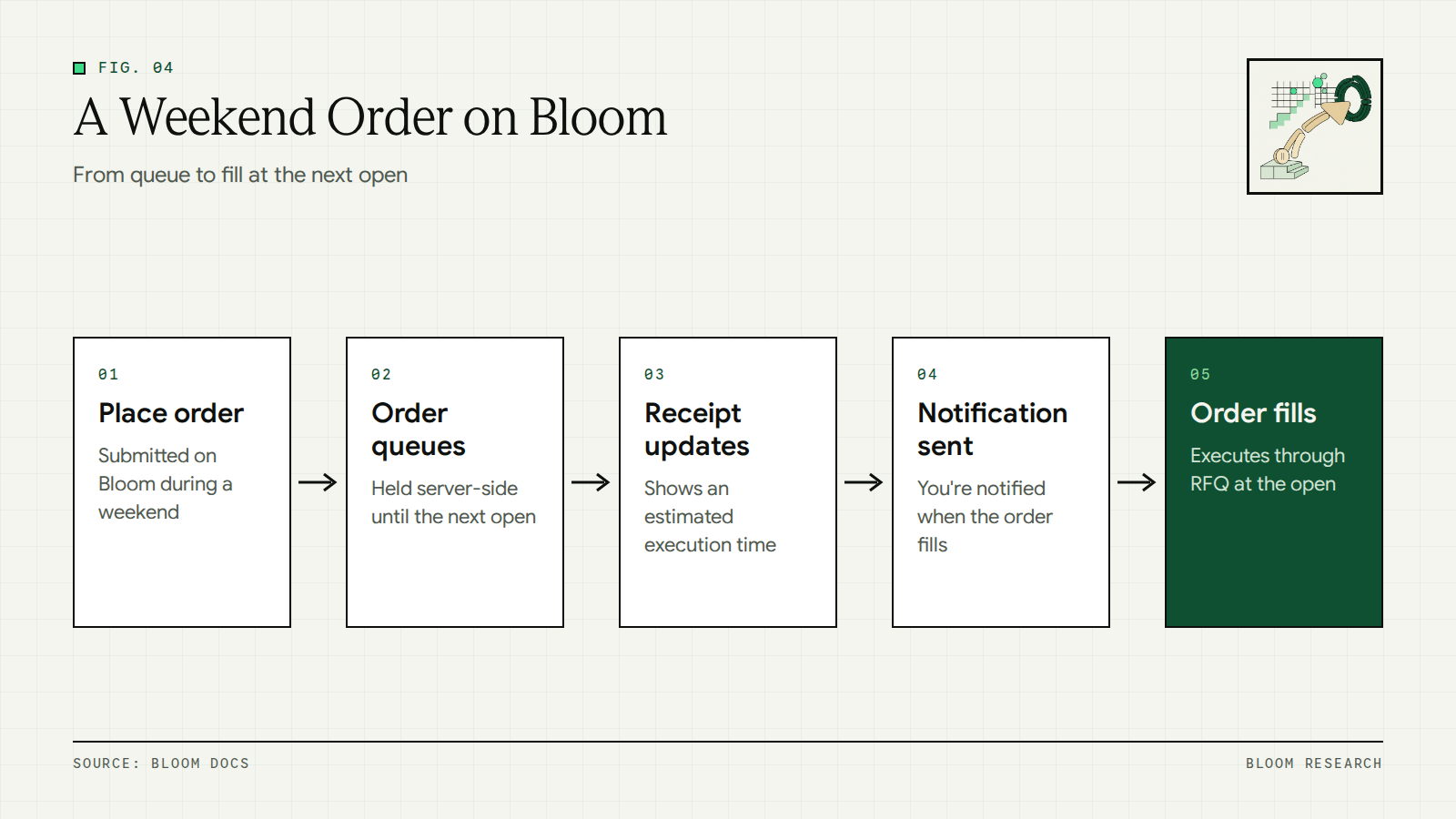
The Buy or Sell button text does not change off-hours, and the queue status appears on the receipt, not on the button. The same rule applies when you are selling a holding: sells during market hours fill immediately, and sells outside market hours are queued for the next open. Only assets with continuous markets fill immediately at any time of day, and their trading-hours pill reads LIVE 24/7.
At the next open, the queued order executes through RFQ. RFQ (request for quote) is the execution model on Bloom: a regulated tokenized security issuer, which holds the underlying shares in custody 1:1 to back the on-chain tokens, returns a live quote that you accept within a short window. That quote is typically valid for 5 to 10 seconds, and our page on how RFQ execution prices each trade covers each step.
The trading fee ranges from 0.10% to 0.20%, with 0.20% as the default rate, and our pricing and fees documentation states that the fee is included in the quoted price you see in the trade sheet. The fee drops toward 0.10% as your 14-day trading volume grows through the VIP fee tiers.
On Bloom: You can place a stock order on a weekend. The order is queued server-side and executes at the next market open, and the receipt shows the estimated execution time.
What the receipt and Portfolio show
A queued order is an order submitted while the market for its underlying instrument is closed, held server-side until the next open. All queued orders appear in Portfolio → Orders with a badge such as "Queued · executes ≈ Mar 6, 09:30 local" until they become Filled, Partially filled or Cancelled. In Portfolio orders, you can filter by Pending, Executed or Cancelled, tap a pending order to modify its quantity, price, Take Profit or Stop Loss, or swipe left to cancel it.
A limit order is an order at a specified price. It is held server-side and routed to RFQ when the live quote reaches your target, and you can cancel it any time before it fills.
Our explainer on RFQ trading and why tokenized stock platforms use it covers the quote step in more detail.
#Weekend gap risk and other risks outside regular hours
A weekend gap is the difference between Friday's official closing price and the price when trading opens again. FINRA's guidance on order types notes that if you place an order before or after normal trading hours, news events or other factors might significantly impact the price when the market opens again. Share prices recorded at 4 p.m. on the exchanges are the official closing prices for that day, regardless of what happens during extended-hours trading.
FINRA also states that the next day's opening prices are generated based on supply and demand at or around the time markets open. Extended-hours trading is less liquid, so an order may be executed partially or not at all, and if it is executed, it might not be at a competitive price compared to regular trading hours. Extended-hours trading is often more volatile because fewer trades occur, and stocks might be vulnerable to wider swings.
During regular trading hours, brokerage firms are generally required by SEC rules to fill customer orders for listed stocks at the NBBO, the top national bid and offer price at the time. FINRA notes that the NBBO is only published during regular trading hours, so this requirement does not apply to extended-hours trading. The SEC's investor bulletin on extended-hours trading states that the reduced level of trading interest generally results in wider spreads between the bid and ask prices. Under FINRA rules, all brokerage firms must advise customers of the risks of trading outside of regular trading hours.
Our risk disclosure states that asset prices can move against you, including overnight gaps that may exceed your slippage tolerance or Stop Loss trigger. Slippage tolerance is the maximum acceptable drift between quote and execution. Markets can become illiquid, especially outside regular hours, and your order may queue or partial-fill.
If the market moves beyond your slippage tolerance during the quote window, the trade stays in a pending state until you cancel it. The tokenized security issuers that quote prices may withdraw liquidity in extreme conditions, and no quote returns until liquidity returns.
Important: The price at the next open can differ from the last price you saw on Friday, because news events or other factors might significantly impact the price when the market opens again.
#A checklist before placing a weekend order
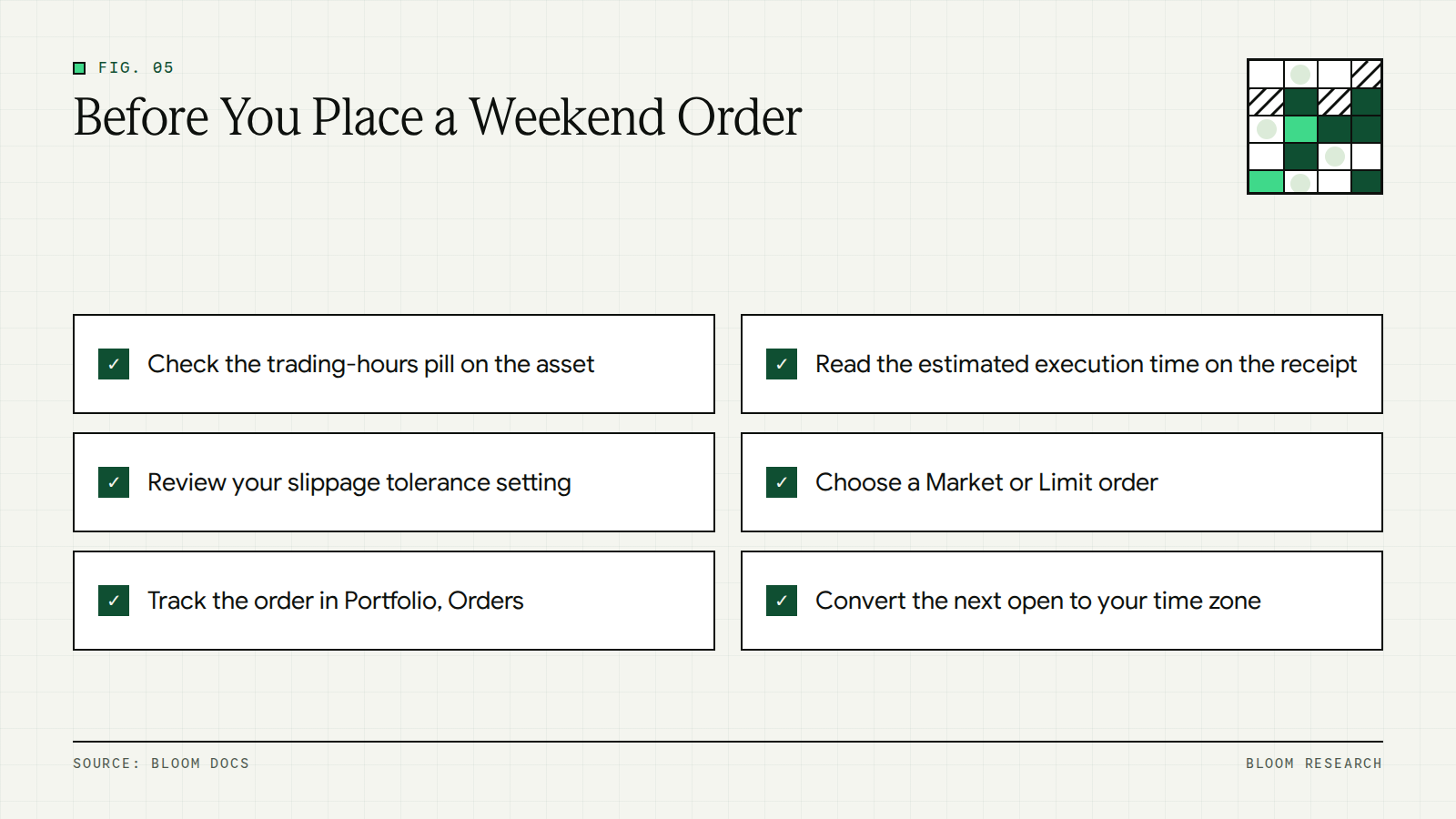
These six items match what the app and our docs show for a weekend stock order.
- The trading-hours pill in the Asset detail header shows the session of the underlying instrument.
- The receipt shows that the order is queued and gives an estimated execution time.
- Slippage tolerance defaults to 0.5% and is editable to 0.1%, 1% or a custom value in the trade sheet.
- The order type is Market or Limit, with Market as the default in Quick Trade.
- Portfolio → Orders lists each queued order with its badge until it is Filled, Partially filled or Cancelled.
- The next open in Eastern Time converts to your local time zone, using the IST conversion in the India time section above.
Our guide to paper trading with virtual funds covers practice trading with virtual funds instead of real money.
#Where to start on Bloom
The trading-hours pill on each asset and the Quick Trade sheet show whether a stock order will execute immediately or queue for the next open. Our trading-hours documentation lists the full off-hours behavior for queued orders.
Trading on Bloom carries risk, including the loss of principal, and past performance does not guarantee future returns. We do not offer our product or services to users in the United States or in other restricted jurisdictions, and our service availability page lists the details. For the wider context, read our guide to investing in US stocks from India.
Frequently asked questions
Can I trade in the stock market on weekends?
Not on a US exchange. No US exchange or overnight venue in our sources opens on Saturday. Blue Ocean ATS matches orders overnight from 8:00 p.m. to 4:00 a.m. ET, Sunday to Thursday, and does not open on Friday evening because trades cannot be reported on Saturday. Nasdaq plans trading from 9 p.m. ET on Sunday to 8 p.m. ET on Friday. In India, NSE equities do not trade on Saturdays or Sundays.
What happens if you buy stocks on a weekend?
The order waits for the next session. FINRA notes that brokerage firms may cancel unexecuted extended-hours orders or carry them over to the start of regular trading hours, and some accept only limit orders. The SEC tells investors to check with their brokerage firm. On Bloom, a weekend stock order is queued server-side until the next open, the receipt gives an estimated execution time, and you receive a push notification when it fills.
Can you trade stocks on weekends in India?
Not on the NSE: trading on the NSE equities segment takes place on all days of the week except Saturdays, Sundays and exchange holidays, and the normal market runs from 09:15 to 15:30 IST. US stocks also have no Saturday session. In IST, the US regular session runs from 7:00 p.m. to 1:30 a.m. until November 1, 2026, and from 8:00 p.m. to 2:30 a.m. after that date.
Is there Nasdaq weekend trading?
Not on Saturday. Nasdaq will introduce a new trading session from 9 p.m. to 4 a.m. ET on December 6, 2026, as part of nearly continuous trading 23 hours a day, 5 days a week. Its planned week starts at 9 p.m. ET on Sunday evening and ends at 8 p.m. ET on Friday evening. The SEC granted approval on April 10, 2026, but the Night Session cannot start until a further rule change confirms SIP readiness.
What is 24 hour stock trading?
In the US it refers to plans for nearly continuous weekday trading, not weekend trading. Beginning December 6, 2026, the securities information processors (SIPs) are expected to operate from 9 p.m. ET Sunday through 8 p.m. ET Friday. NYSE Arca plans trading 23 hours per day, subject to SEC approvals, and 24X plans a 9:00 p.m. to 4:00 a.m. session pending SEC approval. At an SEC roundtable, staff noted that 24x7 trading remains a possibility.
Can I place an order on Bloom on a Sunday?
Yes. A stock order submitted on a weekend is queued server-side until the next open, and the receipt reads like 'Queued · Executes at market open in 6h 23m'. The receipt gives an estimated execution time, and you receive a push notification when the order fills. Queued orders appear in Portfolio → Orders with a Queued badge until they become Filled, Partially filled or Cancelled.
Do stock prices move over the weekend?
US exchanges do not trade on Saturday, and companies may announce important news outside regular trading hours. FINRA notes that if you place an order before or after normal trading hours, news events or other factors might significantly impact the price when the market opens again. Our risk disclosure notes that prices can gap overnight beyond your slippage tolerance or Stop Loss trigger, and that orders may queue or partial-fill.