
Best Stock Market Simulators in 2026: Seven Compared
The best stock market simulators compared: seven options by cost, starting virtual cash, assets, price data and who can use them, from each provider's pages.

Key takeaways
- Four of the seven simulators start users with $100,000 in virtual money: The Stock Market Game, HowTheMarketWorks, Wall Street Survivor and thinkorswim paperMoney.
- Webull lists unlimited virtual funds and Neostox offers ₹5 lakh of virtual money to start, while the default TradingView Paper Trading account currency is USD.
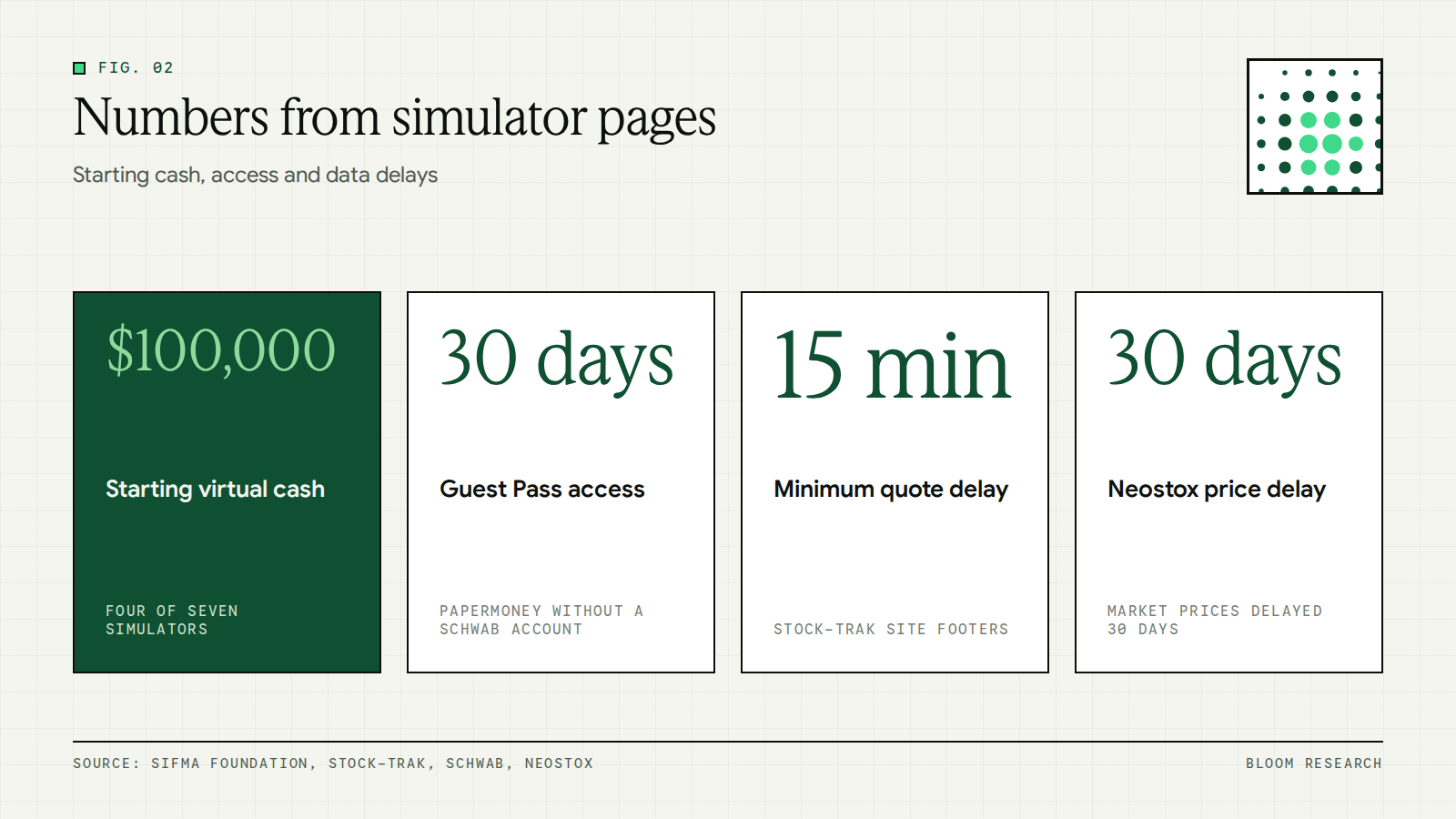
- Schwab states paperMoney uses real-time market data, the two Stock-Trak sites state in their footers that quotes are delayed by at least 15 minutes, and Neostox prices are delayed by 30 days.
- TradingView states Paper Trading is available globally for all users, while Schwab states its site is designed for US residents and offers a 30-day Guest Pass without an account.
- SEBI's circular of May 8, 2026 set a 30-day lag for sharing and usage of price data for educational purposes, applicable from July 1, 2026.
- Our Paper Trading Challenge offers practice with virtual funds, and real trades on Bloom start at $1.
This guide to the best stock market simulators compares seven simulators on the facts their providers publish: cost, starting virtual balance, asset coverage, price data and who can use them. The seven are The Stock Market Game, HowTheMarketWorks, Wall Street Survivor, thinkorswim paperMoney, TradingView Paper Trading, Webull paperTrade and Neostox. We do not rank them; the table and sections below set out what each provider states.
The comparison uses each provider's own pages as of September 2026. For how paper trading works and how to run a practice routine, read our guide to paper trading without risking money. For broker apps such as moomoo, Interactive Brokers, FrontPage and Sensibull, see our comparison of paper trading apps. This post covers classroom games, broker and charting simulators, the rules on price data in India, and the step from practice to a first real trade.
#The best stock market simulators compared at a glance
Every cell in this table of the best stock market simulators comes from the provider's own website or help center. "Not stated" means the pages we reviewed do not give the figure, not that the feature is missing.
| Simulator | Operator | Cost | Starting virtual balance | Assets simulated | Price data | Who can use it |
|---|---|---|---|---|---|---|
| The Stock Market Game | SIFMA Foundation | No cost or low cost | $100,000 portfolio | Stocks, bonds and mutual funds on the NYSE and Nasdaq | Not stated | Grades 4-12, post-secondary learners and adults; available nationwide |
| HowTheMarketWorks | Stock-Trak | Free | $100,000 in virtual cash | Stocks, ETFs, bonds and mutual funds | Homepage cites real-time prices; footer says quotes are delayed at least 15 minutes | Free registration; teachers can set up private class games |
| Wall Street Survivor | Stock-Trak | Free, no subscription fee or credit card | $100,000 in virtual money | Stocks, ETFs, options and crypto | FAQ cites real-time data; footer says quotes are delayed by at least 15 minutes | Not stated |
| thinkorswim paperMoney | Charles Schwab | Free for Schwab clients | $100,000 of virtual buying power | Equities, options, futures and forex | Real-time market data | Schwab account, or a 30-day Guest Pass; site designed for US residents |
| TradingView Paper Trading | TradingView | No fees | Not stated; default account currency is USD | Stocks, forex, crypto, commodity and index futures | Not stated | Available globally for all users |
| Webull paperTrade | Webull | Listed as free | Unlimited virtual funds | US stocks, options, crypto and event contracts | Orders filled against real-time data | Not stated |
| Neostox | Neostox | Free 3-day trial, then a subscription | ₹5 lakh to start | Stocks, futures and options | Delayed by 30 days | Virtual trades during market hours |
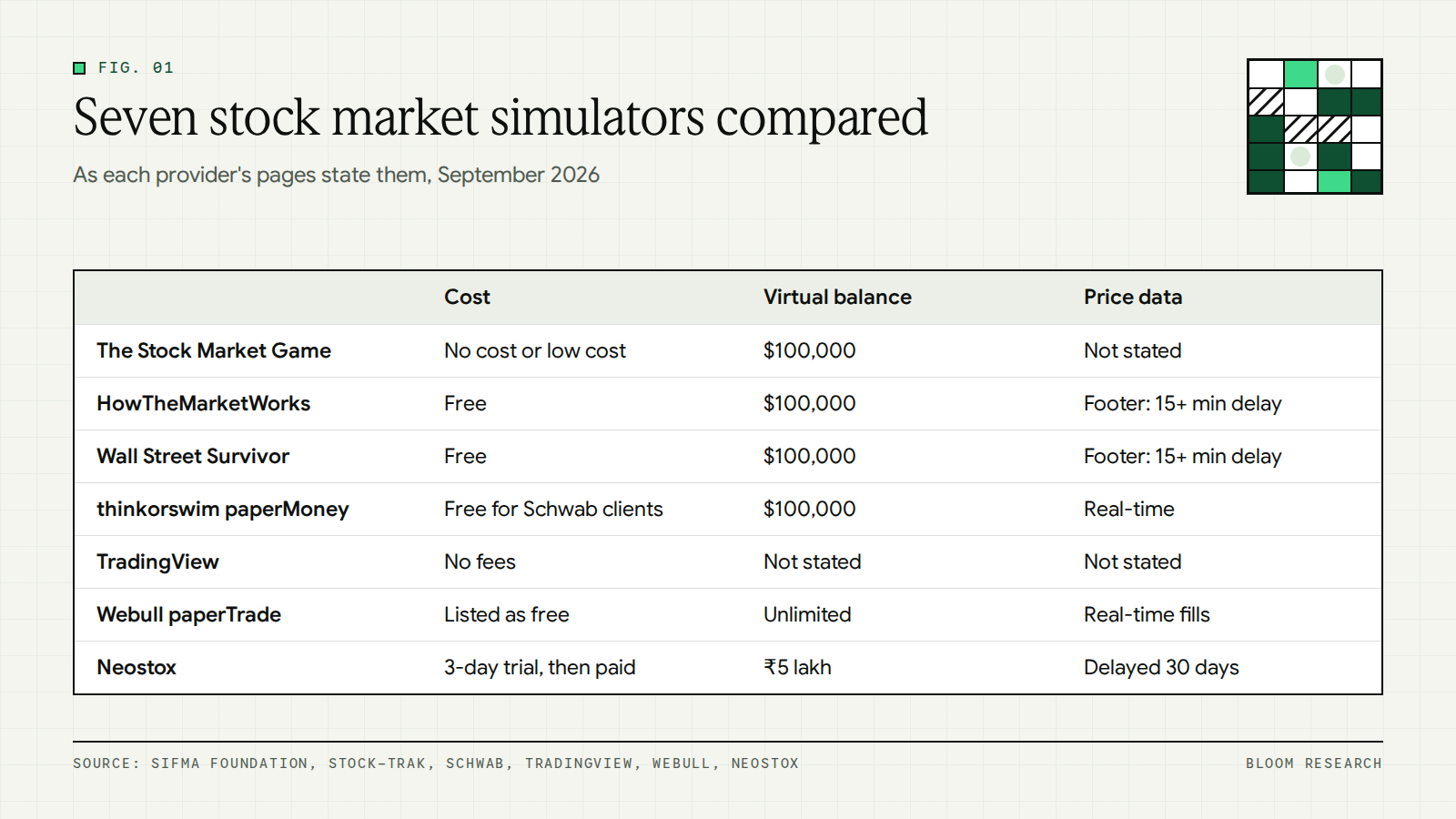
Four of the seven start users with $100,000 in virtual money: The Stock Market Game, HowTheMarketWorks, Wall Street Survivor and thinkorswim paperMoney. Webull lists unlimited virtual funds, and Neostox starts users with ₹5 lakh. The TradingView pages we reviewed give a default account currency of USD but no starting amount.
Key point: Two Stock-Trak sites describe their data in two ways. HowTheMarketWorks mentions real-time stock prices on its homepage, and Wall Street Survivor's FAQ says it uses real-time market data. The footer of each site states that quote data is delayed by at least 15 minutes and is provided by XIGNITE and QuoteMedia.
Asset coverage also differs. The Stock Market Game covers stocks, bonds and mutual funds found on the New York Stock Exchange and Nasdaq. thinkorswim paperMoney adds futures and forex to equities and options. Neostox covers stocks, futures and options, and it shows market prices delayed by 30 days.
Cost terms range from free to a subscription. Wall Street Survivor states that no subscription fee or credit card is needed to open a practice account. thinkorswim paperMoney is free for Schwab clients, and people without a Schwab account can use a Guest Pass for 30 days. Neostox offers a free full 3-day access trial, after which an active subscription is needed for its paid features.
#What a stock market simulator is
A stock market simulator is a program that lets you place buy and sell orders with virtual money instead of real money. It records positions, gains and losses as if the trades had happened, but no order reaches an exchange. The Stock Market Game describes itself as a hands-on investing simulation in which participants make investment decisions and track how market events influence their portfolio over time.
Definition: A stock market game is a simulator run as a contest or class activity, often with rankings and teacher tools. A broker or charting simulator is a practice mode inside a trading platform, built to teach that platform's order tools.
The seven simulators in this post fall into these two groups. The Stock Market Game, HowTheMarketWorks and Wall Street Survivor are education and game sites. thinkorswim paperMoney, TradingView Paper Trading and Webull paperTrade are practice modes inside trading platforms. Neostox describes itself as a paper trading platform for stocks, futures and options.
Virtual balance and simulated fills
A virtual balance is the amount of simulated money a simulator credits to a practice account. Some simulators let users change it. Schwab's paperMoney tutorial shows users adjusting account cash to a different value, and it states that resetting all balances and positions returns the account to $100,000 overnight. HowTheMarketWorks lets teachers choose contest dates, starting cash, commissions and custom trading rules for a private class game.
A simulated fill is the price and quantity a simulator records for a practice order. Each provider sets its own fill rules, and a later section sets out what Webull and Schwab state about theirs.
Games, contests and prizes
Several simulators add rankings or contests on top of practice trading. HowTheMarketWorks describes its free game as featuring real-time stock prices and rankings, and any user can create a custom contest. The SIFMA Foundation also runs InvestWrite, a national essay competition that serves as a culminating activity for Stock Market Game students.
Some contests carry prizes. TradingView runs The Leap, a global virtual trading competition in which participants compete against traders worldwide for real-money prizes. Our own Paper Trading Challenge awards points, and a later section describes it.
Real-time and delayed price data
Real-time price data shows prices as they change in the market. Delayed price data shows prices from an earlier time, such as 15 minutes or 30 days before. The delay matters for any strategy that depends on the current price, such as a limit order placed near the market.
In our table, Schwab states that paperMoney uses real-time market data. The two Stock-Trak sites state in their footers that quote data is delayed by at least 15 minutes. Neostox states that its market prices are delayed by 30 days, and a later section covers the SEBI rule on price data for education in India.
#Classroom and game-style stock market simulators
The three simulators in this section are run as education programs or games, and each pairs practice trading with lessons, courses or teacher resources.
The Stock Market Game
The Stock Market Game is a program of the SIFMA Foundation, which describes itself as an independent 501(c)3 educational organization serving nearly 20 million students since 1977. Its trading platform is powered by Broadridge Financial Solutions. The site shows registration open for the 2026-2027 year.
Participants use a virtual $100,000 portfolio to research real stocks, bonds and mutual funds found on the New York Stock Exchange and Nasdaq. The game is designed for grades 4-12, post-secondary learners and adult participants. The site states that it is available nationwide at no cost or low cost, and that the game provides step-by-step guidance, lessons, and educator and asynchronous resources. The pages we reviewed do not state whether prices are live or delayed.
HowTheMarketWorks
HowTheMarketWorks offers a free stock market game for practicing investing in stocks, ETFs, bonds and mutual funds. New users receive $100,000 in virtual cash when they register, along with access to lessons and videos in its Education Center. Any user can create a custom contest and invite friends, family or co-workers.
Teachers can create a private stock market game for a class. They choose the contest dates, starting cash, commissions and custom trading rules. Teachers can create one or multiple games each semester and reuse the platform across different classes and grade levels. The site is a property of Stock-Trak, which provides educational stock market simulations for K12, university and corporate education markets.
The homepage describes real-time stock prices and rankings. The site footer states that quote data is delayed at least 15 minutes and is provided by XIGNITE and QuoteMedia.
Wall Street Survivor
Wall Street Survivor lists stocks, ETFs, options and crypto with $100,000 in virtual money. Its FAQ states that it is free to use, with no subscription fee or credit card required to open a practice account. Its mini-courses let users study and trade at the same time in a virtual brokerage account.
Wall Street Survivor is also a Stock-Trak property. Its FAQ says the simulator uses real-time market data, while its footer states that quote data is delayed by at least 15 minutes and is provided by XIGNITE and QuoteMedia.
Note: In a class game, the teacher sets the rules. HowTheMarketWorks lets teachers choose contest dates, starting cash, commissions and custom trading rules, so a private class game can start with an amount other than $100,000.
#Broker and charting platform simulators
The three simulators in this section are practice modes inside trading or charting platforms. They teach the platform's own order tools, and the virtual balance and data rules come from the platform.
thinkorswim paperMoney
Schwab's thinkorswim paper trading page describes paperMoney as a virtual trading experience that uses real-time market data with $100,000 of virtual buying power. Schwab states that paperMoney is free, built into every thinkorswim platform and available at no cost to Schwab clients. The page lists equities, options, futures and forex in a live market simulation. It also lists virtual trade data, including profit and loss analysis, for reviewing a strategy.
Schwab's paperMoney tutorial shows two account types, a margin account and an IRA account, and states that both come with $100,000.
A Schwab account is required to log in to thinkorswim and use paperMoney. A Guest Pass is a trial login that gives people without a Schwab brokerage account access to paperMoney for 30 days. According to Schwab's Guest Pass page, a Guest Pass cannot be extended, and the credentials expire at the end of the 30-day period.
Schwab's pages state that its site is designed for US residents, and that non-US residents are subject to country-specific restrictions.
TradingView Paper Trading
TradingView states that Paper Trading is available globally for all users. Its simulator supports almost every asset class available on TradingView, including stocks, forex, crypto, commodity and index futures. TradingView describes it as a simulator with no fees, available to every TradingView user.
The default Paper Trading account currency is USD, and users can choose other available currencies. Users can create several accounts in different currencies and switch between them in the trading panel. To change the currency of an existing account, TradingView says to create a new account or reset the existing one, and the system then prompts for a new currency. The pages we reviewed do not state a starting virtual balance or whether prices are real-time or delayed.
Webull paperTrade
Webull's paperTrade page lists the service as free and offers unlimited virtual funds. Users can reset, reload and retry whenever they want. Webull states that paperTrade orders are processed and filled against real-time data.
For US stocks, the page lists regular hours, pre-market, after-hours and overnight sessions. Weekend paperTrade is available for crypto and event contracts. The page also lists multi-leg options strategies such as butterflies, condors and spreads. Webull states that asset events in paperTrade, from equity dividends to options exercises and expirations, follow real-world logic.
Securities trading at Webull is offered by Webull Financial LLC, a broker dealer registered with the SEC. The paperTrade page we reviewed does not state which countries can open a paperTrade account.
In practice: Session rules differ between a simulator and a live account. On Bloom, if the market is closed, the order is queued and executes automatically at the next market open, as set out in our trading hours and queued orders page. Weekend sessions for US stocks are covered in our guide to trading US stocks on weekends.
Across these six simulators, the virtual balance ranges from $100,000 to unlimited funds, and data ranges from real-time to delayed by at least 15 minutes. The next section covers the one simulator in our table built around Indian markets, and SEBI's rule on price data for educational purposes in India.
#Stock market simulators for Indian markets
In India, price data for education follows a SEBI rule. The SEBI circular of May 8, 2026 on price data for educational purposes prescribes a time lag of 30 days for both sharing and usage of price data for educational purposes. Its provisions apply with effect from July 1, 2026.
SEBI states that it made this change after feedback that the lag of one day for sharing price data was "very short", with a possibility of misuse. The same feedback said a three-month lag for using the data was too long for educational purposes. Under the circular, the National Institute of Securities Markets (NISM), which SEBI describes as its capacity building initiative, may access market price data with a lag of one day for use in its simulation lab.
The circular is addressed to recognized stock exchanges, clearing corporations, depositories and registered intermediaries. It states that market price data may be shared for investor education and awareness activities, without offering any kind of monetary incentive to participants, with a lag of thirty days. The market infrastructure institutions or intermediaries sharing the data must enter into a legal agreement with each recipient, with provisions to prevent misuse, including an audit trail for usage of the data. This May 2026 circular states that it modifies two earlier SEBI circulars: one dated May 24, 2024, which set a one-day lag for sharing price data for educational purposes, and one dated January 29, 2025, which set a three-month lag for using it.
Neostox
Neostox describes itself as a paper trading platform for stocks, futures and options using virtual money, and it lists a New Delhi address. It offers ₹5 lakh in virtual money to start. Users can add virtual capital whenever required, up to the maximum virtual-capital limit Neostox permits.
Neostox states that market prices on its platform are delayed by 30 days, and that virtual trades can be placed during market hours. New users get a free full 3-day access trial. After the trial ends, an active subscription is needed to keep using the paid features. Along with virtual trading, Neostox lists advanced charts, screeners, options tools and performance reports. It also offers a Historical Replay mode, and virtual trades cannot be executed while using it.
For US-listed stocks rather than simulated positions, our platform offers US stocks listed on NYSE, NASDAQ and AMEX, and US ETFs such as SPY, QQQ and VOO. The page on US stocks and ETFs popular with investors in India lists the names available from India.
#How accurate are stock market simulators
A simulator records trades under its own rules, and each provider states those rules in its own way. The statements below come from the providers' pages.
- Fill rules: Webull fills paperTrade orders against real-time data, per its paperTrade page. Schwab's paperMoney tutorial says the simulation will vary in some respects from a live account.
- Price data: This post's price-data range, from real-time to a 30-day delay, is covered above under real-time and delayed price data.
- Results: Neostox states that simulated results do not guarantee similar results when real money is involved. Schwab's Guest Pass page states that successful virtual trading during one time period does not guarantee successful investing of actual funds during a later time period, as market conditions change continuously.
- Sessions: Neostox states that virtual trades can be placed during market hours, while Webull lists regular, pre-market, after-hours and overnight sessions for US stocks in paperTrade.
- Money: Schwab states that you cannot make money from paper trading.
Important: A simulator result reflects one provider's fill rules, price data and balance. It does not predict a live result, and a live account adds fees, quotes and settlement that a simulator may not include.
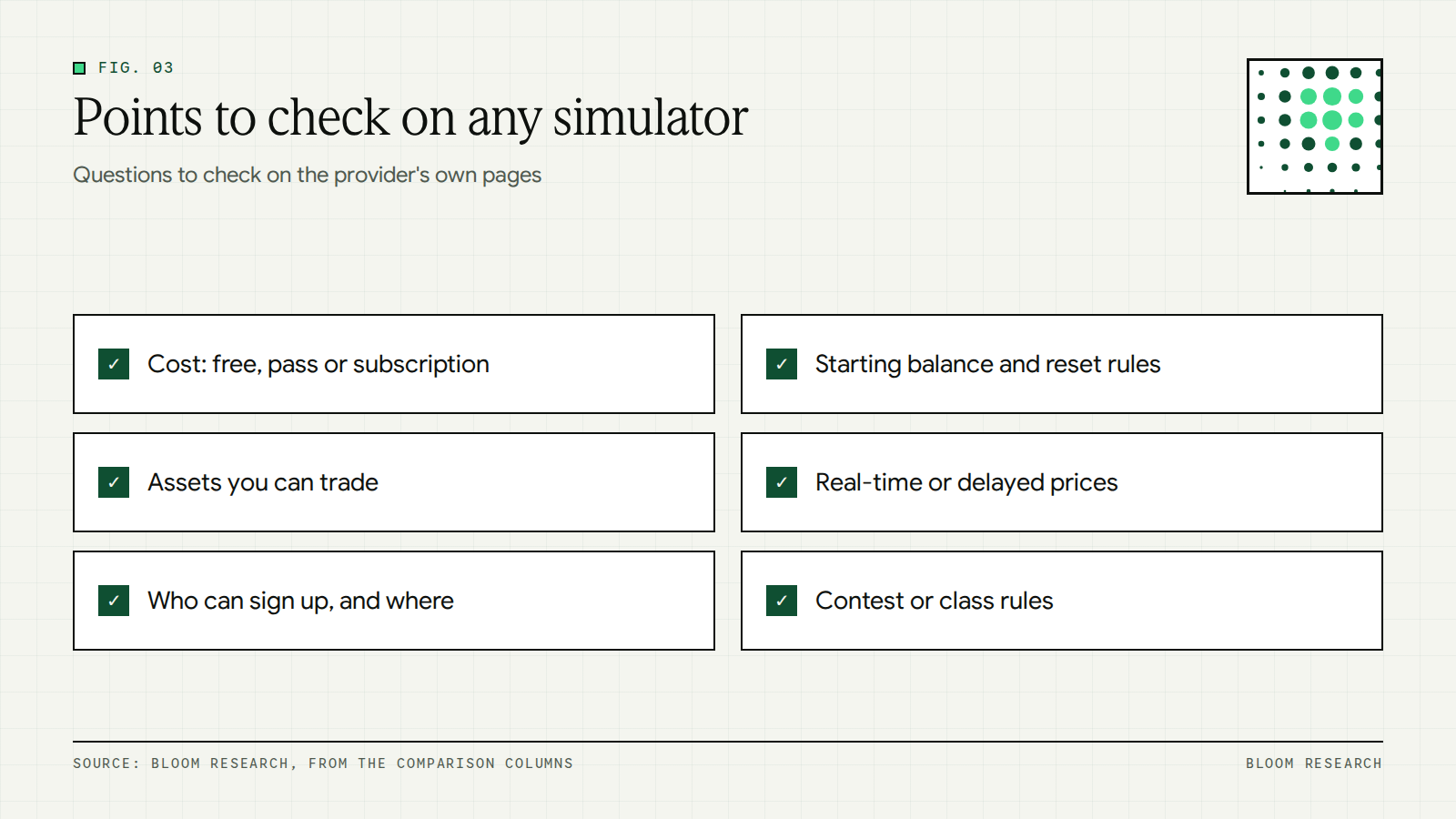
#Points to check before choosing a simulator
The points below follow the columns in our comparison of the best stock market simulators. They are questions to check on each provider's own pages, not recommendations.
- Cost terms: free, free for account holders, a time-limited pass or a trial followed by a subscription.
- Starting balance and resets: a fixed amount, an amount you can adjust, or unlimited virtual funds.
- Assets: stocks only, or also ETFs, bonds, mutual funds, options, futures, forex or crypto.
- Price data: real-time, delayed by minutes, or delayed by days.
- Availability: global access, an account requirement, or a site designed for residents of one country.
- Contest rules: class or contest settings such as start dates, commissions and custom trading rules.
Providers can change these terms at any time. We checked the pages cited in this post on September 28, 2026, and each provider's current page is the reference for its own terms.
#From a simulator to a first trade on Bloom
We run our own practice contest with virtual funds, and our real trades start at $1. We are currently in public beta.
Our Paper Trading Challenge
Our homepage states that the paper trading competition is live. Participants practice with virtual funds, help shape Bloom and earn points along the way. The competition asks participants to trade daily, report bugs and earn points. The rules and standings are on our Paper Trading Challenge and leaderboard page.
A first real trade from $1
On Bloom: The minimum trade is $1, fractional shares are supported down to six decimal places, and the platform imposes no maximum trade size.
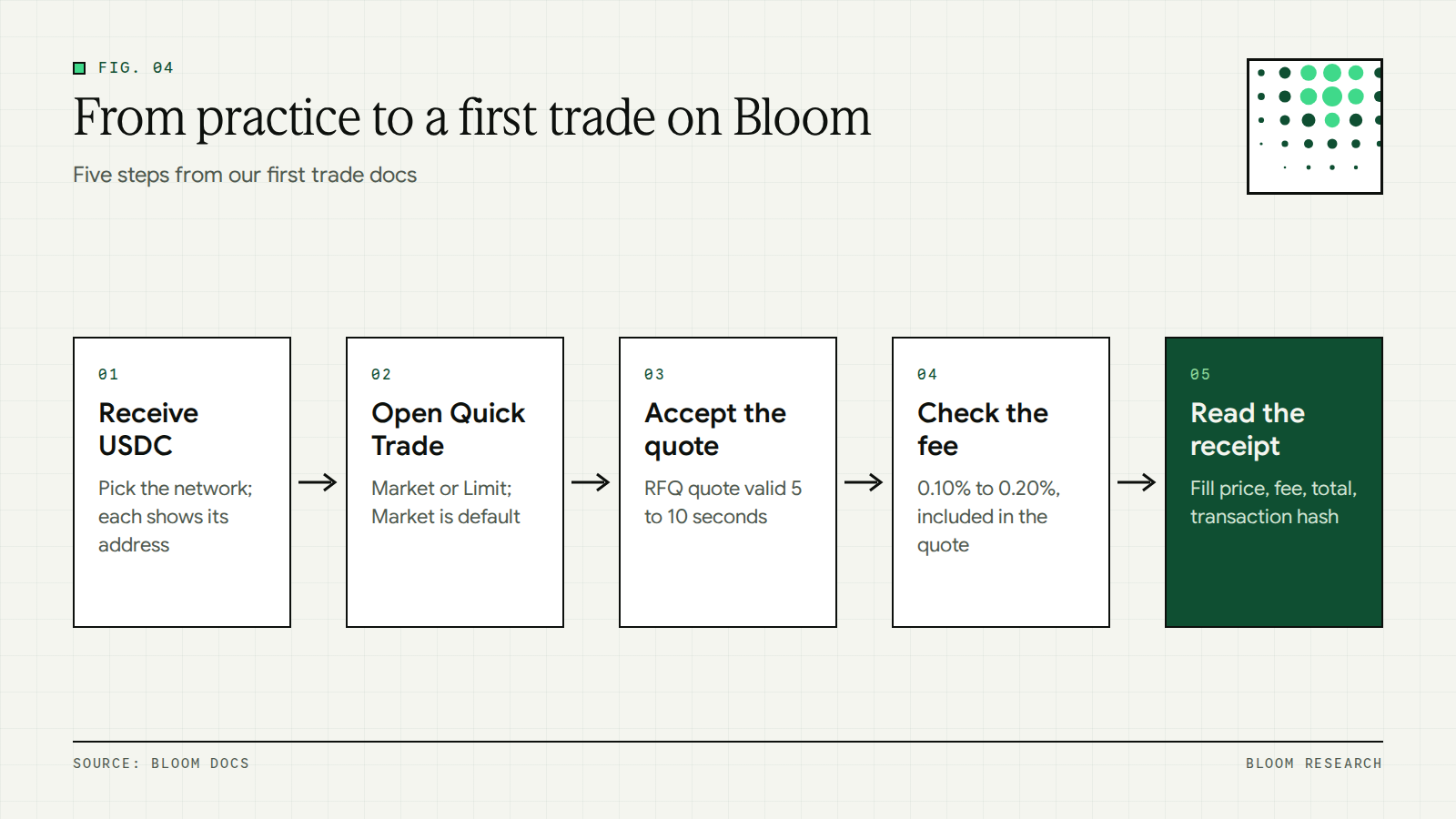
The five steps below follow our docs for a first real trade.
- Fund the account by receiving USDC from an external wallet. When you receive USDC, you pick the network, and each supported network shows its address and QR code, as our page on networks supported for USDC deposits explains.
- Open the Quick Trade sheet with Market and Limit orders, which is the single trade sheet for every asset. Market is the default.
- Accept the quote. RFQ (Request-For-Quote) is our execution model, in which trades execute through regulated tokenized security issuers who hold the underlying shares in custody. The issuer returns a live quote typically valid for 5 to 10 seconds, and the default slippage tolerance is 0.5%, as the page on how RFQ execution works sets out. For how RFQ compares with order books, see our guide to RFQ trading.
- Check the fee. The trading fee ranges from 0.10% to 0.20%, with 0.20% by default, and it drops as your 14-day trading volume grows. The quoted price already includes the trading fee, as our pricing and fees documentation and the VIP fee tiers on our pricing page show.
- Read the receipt. Within about 1 second, a receipt shows the fill price, fee, total and on-chain transaction hash, as our first trade guide describes.
A simulator's fill rule and a live RFQ quote are different mechanisms. On Bloom, the trade sheet shows a live quote, slippage tolerance and a fee breakdown with platform fee and network gas before you confirm.
#Start practicing, then trade small on Bloom
This comparison of the best stock market simulators covers seven options that differ in cost, virtual balance, assets, price data and access, and the table at the top sets these out side by side. Our Paper Trading Challenge offers practice with virtual funds, and our first trade guide covers a real trade from $1.
Trading on Bloom carries risk, including the loss of principal, and market, smart contract, custody, bridging and liquidity risks apply, as our risk disclosure sets out. We do not offer our product or services to users in the United States or in other restricted jurisdictions, as our service availability page states.
Frequently asked questions
What is a stock market simulator?
A stock market simulator lets you place buy and sell orders with virtual money, and it records positions, gains and losses without sending any order to an exchange. Some are classroom games, such as The Stock Market Game, which uses a virtual $100,000 portfolio. Others are practice modes inside trading platforms, such as thinkorswim paperMoney and TradingView Paper Trading.
Is there a free stock market simulator?
Several simulators state they are free. Wall Street Survivor says it is free with no subscription fee or credit card required, HowTheMarketWorks offers a free stock market game, and TradingView describes Paper Trading as having no fees. thinkorswim paperMoney is free for Schwab clients. Neostox offers a free 3-day trial, after which an active subscription is needed for its paid features.
How much virtual money do stock market simulators give?
The Stock Market Game, HowTheMarketWorks, Wall Street Survivor and thinkorswim paperMoney each start users with $100,000 in virtual money or buying power. Webull lists unlimited virtual funds, and Neostox offers ₹5 lakh to start. The TradingView pages we reviewed give a default account currency of USD but no starting amount.
Are stock market simulators accurate?
A simulator shows how orders behave under its own rules, and it does not reproduce a live market exactly. Schwab's tutorial states that paperMoney is a simulation and will vary in some respects from trading in a live account. Neostox states that simulated results do not guarantee similar results when real money is involved. Price data also differs, from real-time data to prices delayed by 30 days.
Can I use a stock market simulator in India?
TradingView states that Paper Trading is available globally for all users. Neostox offers virtual trading in stocks, futures and options with ₹5 lakh to start, and its market prices are delayed by 30 days. SEBI's circular of May 8, 2026 prescribes a 30-day lag for sharing and usage of price data for educational purposes from July 1, 2026. Schwab states its site is designed for US residents.
What is virtual stock trading?
Virtual stock trading means buying and selling stocks with simulated money inside a simulator. The simulator credits a virtual balance, records each order at a price set by its own fill rules, and tracks gains and losses. Webull, for example, states that paperTrade orders are processed and filled against real-time data, and Neostox lets users trade stocks, futures and options using virtual money.
Can you make money on a stock market simulator?
Gains in a simulator are virtual and cannot be withdrawn. Schwab's Guest Pass page states that successful virtual trading during one time period does not guarantee successful investing of actual funds during a later time period. Some contests offer prizes: TradingView runs The Leap, a global virtual trading competition for real-money prizes, and our Paper Trading Challenge awards points.