
Paper Trading Apps Compared: 2026 Guide to Practice Trading
Compare paper trading apps in 2026: TradingView, moomoo, Webull, Interactive Brokers, FrontPage, Neostox and Sensibull by markets, balance, cost and data.
Key takeaways
- TradingView simulates stocks, forex, crypto and futures, and Interactive Brokers covers all instruments available through IBKR TWS. FrontPage, Neostox and Sensibull simulate Indian stocks, futures and options.
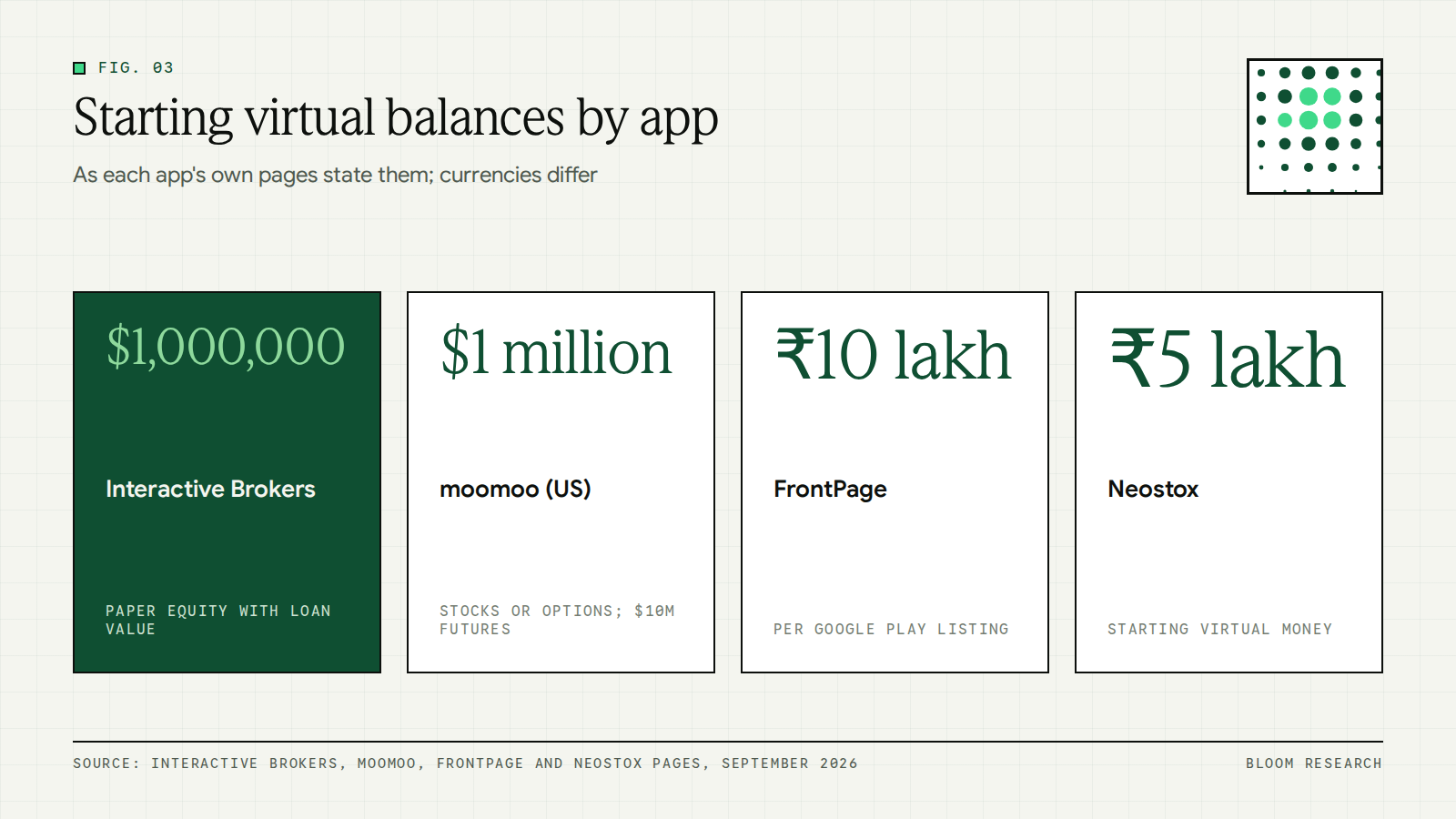
- Virtual balances differ: Interactive Brokers starts at USD 1,000,000 and moomoo at $1 million for stocks or options. FrontPage gives ₹10 lakh, Neostox gives ₹5 lakh and Webull lists unlimited virtual funds.
- Price data ranges from live to delayed by 30 days, and SEBI's 30-day lag for sharing and usage of educational price data applies from July 1, 2026.
- Zerodha's support portal states that Zerodha does not offer demo accounts for paper trading, and its Kite demo uses dummy data.
- Webull and Interactive Brokers state their own rules for simulated fills, and on Bloom real trades start at $1 with fractional shares to six decimal places.
A paper trading app lets you place simulated trades with virtual money, and the apps compared here are TradingView, moomoo, Webull and Interactive Brokers for global and US markets, and FrontPage, Neostox and Sensibull for Indian stocks and F&O (futures and options). Zerodha's support portal states that Zerodha does not offer demo accounts for paper trading.
This post compares apps. For what paper trading is and how to run a practice routine, read our guide to paper trading and how to practice without risking money. Here we set out the markets, virtual balance, cost and price data for each app, the SEBI rules on price data, the limits of simulated fills, and the step from practice to small real positions on Bloom.
#Paper trading apps compared at a glance
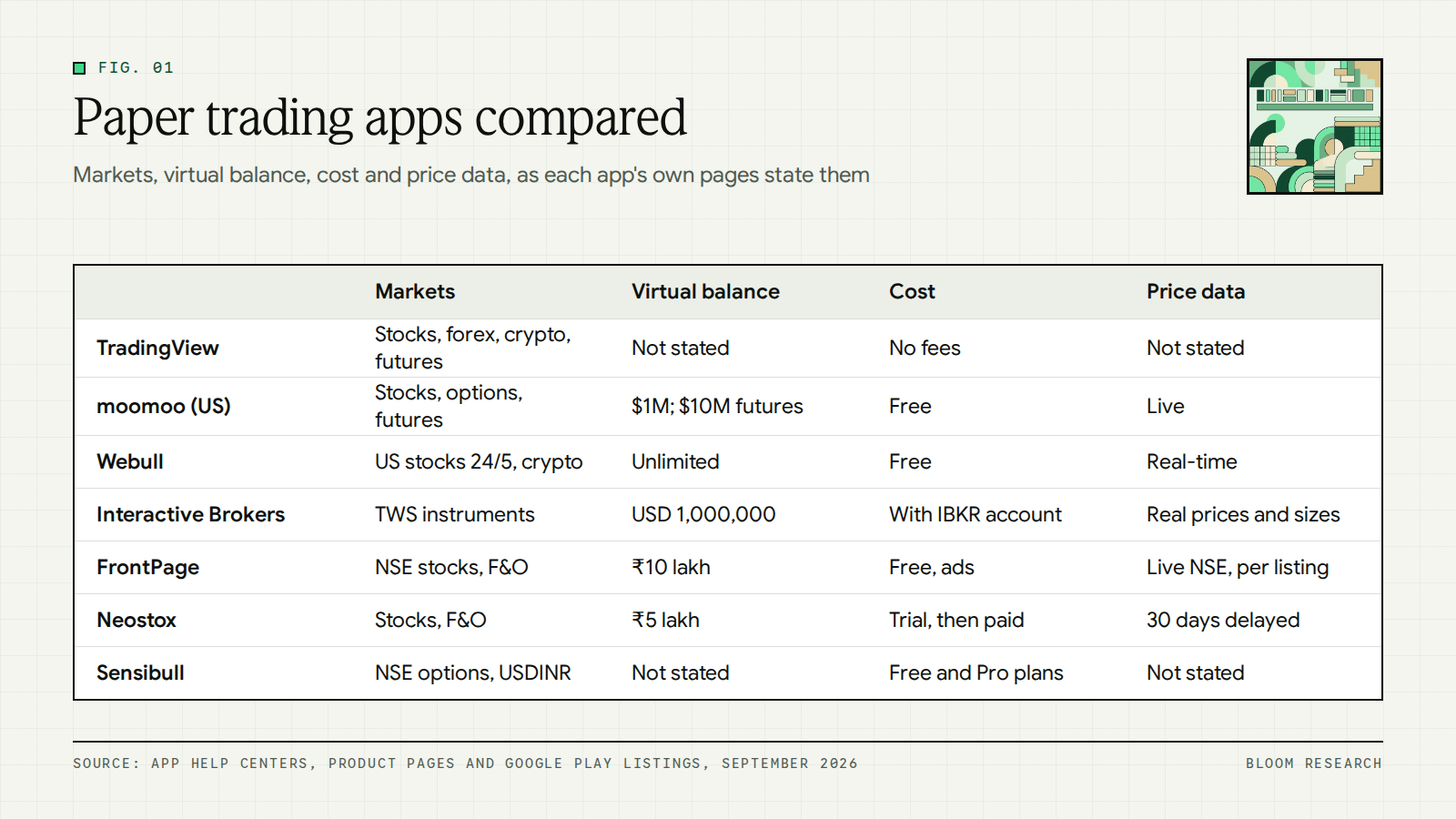
Every cell in this table comes from the app's own help center, product page or app store listing as of September 2026, and "not stated" means the sources we reviewed do not give the figure.
| App | Markets simulated | Virtual balance | Cost | Price data | Access notes |
|---|---|---|---|---|---|
| TradingView | Stocks, forex, crypto, commodity and index futures | Not stated; default account currency is USD | No fees | Not stated; orders and positions tracked in real time | Available globally for all users |
| moomoo (US) | Stocks, options and futures | $1 million for stocks or options, $10 million for futures | Free to use | Live market data | No brokerage account needed; desktop, mobile and web |
| Webull | US stocks 24/5; crypto and event contracts on weekends | Unlimited virtual funds | Free | Orders filled against real-time data | Funds cannot be moved into or out of paper trading |
| Interactive Brokers | All instruments available through IBKR TWS | USD 1,000,000 of Equity with Loan Value | Not stated | Real market prices and sizes; same market data subscriptions as the regular account | New individual account holders receive one automatically; residents of India log in with separate paper trading credentials |
| FrontPage | NSE stocks, futures and options, intraday and delivery | ₹10 lakh | Free; contains ads | Live NSE market prices, per its listing | Android app on Google Play |
| Neostox | Stocks, futures and options | ₹5 lakh to start | Free trial, then subscription | Delayed by 30 days | Virtual trades during market hours; Android app on Google Play |
| Sensibull | NIFTY, BANKNIFTY and NSE stock options; USDINR options | Virtual funds, amount not stated | Free plans and Pro paid plans | Not stated | Log in with Zerodha, Angel One, Upstox or ICICI Direct, or sign in with Google |
| Zerodha | No paper trading demo account | None | None | Kite demo uses dummy data | Not applicable |
Key point: Virtual balances differ in size and currency. Interactive Brokers starts paper accounts at USD 1,000,000, moomoo gives $1 million for stocks or options, and Webull lists unlimited virtual funds. FrontPage gives ₹10 lakh and Neostox gives ₹5 lakh to start. Price data ranges from live market data at moomoo to prices delayed by 30 days at Neostox.
#What each column in the comparison means
- Markets simulated: the asset classes and exchanges an app lets you place paper orders on.
- Virtual balance: the amount of simulated money an app credits to a practice account.
- Cost: whether the app states a fee, a free plan, a free trial or a paid subscription for paper trading.
- Price data: real-time data shows prices as they change in the market, while delayed data shows prices from an earlier time, such as 30 days before.
- Access notes: the account, login or platform an app states you need to start paper trading.
A simulated fill is the price and quantity a simulator records for a paper order, even though no order reaches an exchange. Each app sets its own rules for these fills, and a later section of this post compares them. Timing rules also differ: Neostox states that virtual trades can be placed during market hours. Outside market hours, we queue stock orders and execute them automatically at the next market open, as set out in our trading hours and queued orders page.
#Why some Indian simulators show delayed prices
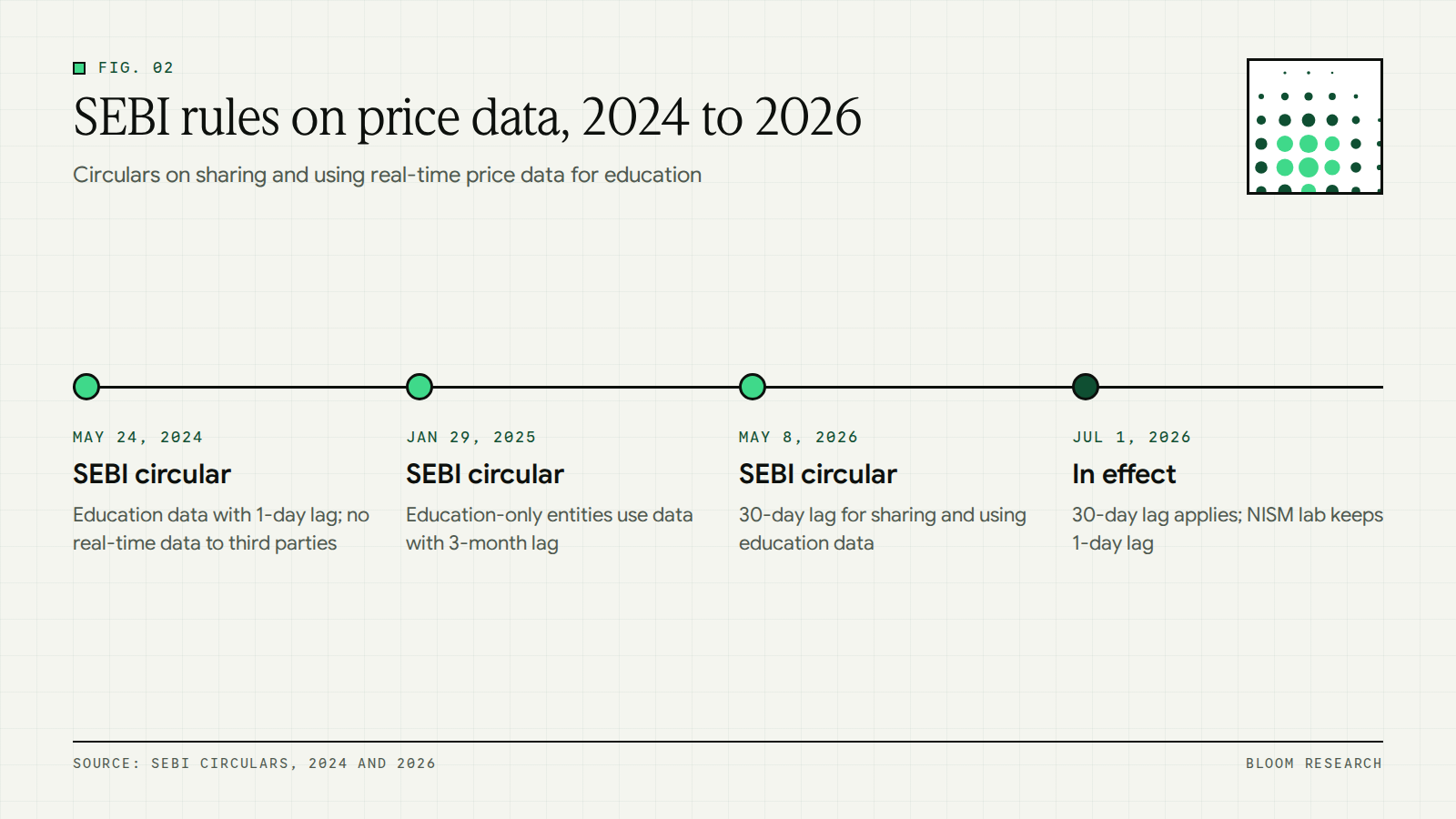
The SEBI circular of May 24, 2024 on sharing real time price data observed that certain online platforms, apps and websites provide virtual trading services or fantasy games based on movement of real time share prices. It also observed that some platforms offer monetary incentives based on the performance of the virtual stock portfolio. The circular says its conditions follow the recommendations of SEBI's Secondary Market Advisory Committee (SMAC) and aim to curb misuse or unauthorized use of such data.
The circular groups stock exchanges, clearing corporations and depositories as Market Infrastructure Institutions (MIIs). It requires MIIs and registered market intermediaries to ensure that no real time price data is shared with any third party, including platforms. The exception is sharing required for orderly functioning of the securities market or for fulfilling regulatory requirements. Market price data could be shared for investor education and awareness, without monetary incentives, with a lag of 1 day. MIIs and intermediaries must also enter into an agreement with each entity they intend to share real time price data with, and that agreement must state the activities the data will be used for.
SEBI's circular of January 29, 2025 tightened these norms. It stipulated that entities solely engaged in education may use price data only with a lag of three months. The May 2026 circular notes that the two earlier circulars had different purposes: the 2024 circular allowed exchanges to share data for education with a one-day lag, and the 2025 circular set how old the data used solely for education must be.
The SEBI circular of May 8, 2026 on price data for educational purposes prescribes a time lag of 30 days for both sharing and usage of price data for educational purposes. SEBI states it made this change after stakeholders said the one-day lag for sharing carried a possibility of misuse, and the three-month lag for usage was too long for education. Its provisions apply with effect from July 1, 2026. Under the same circular, the National Institute of Securities Markets (NISM), which SEBI describes as its capacity building initiative, may access market price data with a lag of one day for use in its simulation lab.
Among the Indian apps compared here, Neostox shows market prices delayed by 30 days, while FrontPage's Google Play listing says its simulator uses live NSE market prices.
Important: These circulars set rules for how stock exchanges, clearing corporations, depositories and registered intermediaries share and use price data. Check each app's own data disclosure before relying on the prices it shows.
#Global paper trading apps for US and multi-asset markets
The four apps in this section cover US stocks and other asset classes, and each description below uses the app's own help center or product pages.
TradingView paper trading
TradingView's help center describes paper trading as demo trading with no deposits and no real money involved, tested in close-to-real market conditions. TradingView states that Paper Trading is available globally for all users. To activate it, a user opens Supercharts, clicks Trade, selects Paper Trading and then clicks Connect.
The simulator supports almost every asset class available on TradingView, including stocks, forex, crypto, commodity and index futures. TradingView describes the simulator as having no fees and being available to every TradingView user. Its system tracks paper orders and positions in real time.
Orders can be placed in three places. The order ticket accepts side, quantity, order type (market, limit or stop), stop loss and take profit. Users can also trade from a depth of market window, which lists the buy and sell orders waiting at each price level, or directly on the chart.
The default TradingView paper account currency is USD, and users can choose any of the other available currencies. Users can create several paper accounts in different currencies and switch between them in the trading panel. Resetting a paper account deletes the transaction history, active orders and open positions.
TradingView also runs The Leap, a global virtual trading competition in which participants compete against traders worldwide for real-money prizes.
moomoo paper trading
moomoo's US paper trading page states that paper trading starts with $1 million in virtual funds for stocks or options and $10 million in virtual funds for futures. The same page says moomoo paper trading is free to use and runs on live market data. It also states that paper trading does not require a brokerage account. Users can start on the moomoo desktop app, the mobile app or the web. Because the page gives one amount for stocks or options and another for futures, the starting virtual balance depends on the asset class traded.
Webull paper trading
Webull's paperTrade page lists the service as free and offers unlimited virtual funds. The page says users can reset the paper account at any time, and can reload and retry the trial whenever they want. Webull states that paper orders are processed and filled against real-time data.
For US stocks, the paperTrade page lists regular hours, pre-market, after-hours and overnight sessions, which Webull labels 24/5. Weekend paper trading is available for crypto and event contracts. A Webull help lesson states that paper trading is simulated and that funds cannot be moved into or out of paper trading.
Interactive Brokers paper trading account
Interactive Brokers states that new individual account holders automatically receive a paper trading account. All paper trading accounts start with USD 1,000,000 of paper trading Equity with Loan Value. IBKR's glossary says Equity with Loan Value forms the basis for determining whether a client has the necessary assets to initiate or maintain security positions. Interactive Brokers states this paper equity fluctuates as if the trades had executed in the real market.
According to Interactive Brokers, paper trading accounts work like production accounts. Users can place most order types, trade all instruments available through the IBKR TWS trading platform, and experiment with almost every aspect of TWS. Paper cash equity can be reset at any time in Client Portal to up to five times the production account's value.
Paper trades do not execute on any exchange or settle at a clearing house. Interactive Brokers states that the simulated execution prices are determined by real market prices and sizes. Trading permissions and market data subscriptions in the paper account are the same as in the regular account.
Note: Interactive Brokers states that residents of India and Japan, among other groups, log in to their paper trading accounts with separate paper trading account credentials.
#Paper trading apps for Indian stocks and F&O
Three apps in this section focus on stocks and derivatives on the NSE (National Stock Exchange of India), and one large Indian broker states it has no paper trading demo account.
FrontPage
FrontPage's Google Play listing describes it as a free paper trading app for India to paper trade stocks, options and F&O with virtual money. The listing says its simulator gives ₹10 lakh in virtual money to practice on live NSE market prices. Users can paper trade stocks, futures, options, intraday and delivery.
The listing says the app tracks profit and loss, win rate and full trade history on every paper trade. The Google Play listing shows that the app contains ads. The listing was updated on 25 Aug 2026.
Neostox
Neostox lets users trade stocks, futures and options with virtual money, offering ₹5 lakh to start. New users receive a free trial for the period displayed on the Neostox website, and after the trial ends an active subscription is needed to keep using the paid features. Neostox's FAQ states that market prices on Neostox are delayed by 30 days. The SEBI rules on price data for educational use are described earlier in this post.
Virtual trades on Neostox can be placed during market hours. Neostox also has an Android app available on Google Play.
Sensibull virtual trading
Angel One's Sensibull page states that Sensibull lets users practice strategies with virtual funds in paper trading mode. Sensibull's Google Play listing covers NIFTY, BANKNIFTY and NSE stock options, and USDINR options. The listing also includes Draft Portfolios, which Sensibull uses to create, record and track trades.
Sensibull offers free plans and Pro paid plans. It states that users pay only their normal brokerage to their broker to trade from Sensibull, on both plan types. The virtual trading page asks users to log in with Zerodha, Angel One, Upstox or ICICI Direct, or to sign in with Google.
Zerodha: no paper trading demo account
Zerodha's support portal states that Zerodha does not offer demo accounts for paper trading, and that a demo version of Kite with dummy data is available. Zerodha account holders can log in to Sensibull's virtual trading page with their Zerodha login.
In practice: The markets these Indian apps list on their pages are NSE instruments, not US-listed stocks. For US stocks and ETFs from India, see our guide to investing in US stocks from India and the page on US stocks and ETFs popular with investors in India.
Our platform offers US stocks listed on NYSE, NASDAQ and AMEX and US ETFs such as SPY, QQQ and VOO, and you can browse the US stocks and ETFs listed on Bloom.
#Limits of paper trading apps
The help pages of Webull and Interactive Brokers state rules for how a paper order fills, and those rules differ from how an order fills in a live market. Our paper trading guide covers the wider limits, such as emotions and journaling. This section covers the fill rules and market facts that official pages state.
- Webull: Webull's help lesson states that paper trades execute based on the last price in real-time quotes instead of the bid and ask quotes. It also states that orders execute when the price matches, regardless of volume.
- Interactive Brokers: Interactive Brokers states that paper fills are simulated from the top of the book, with no deep book access. Top of the book means an exchange's highest bid price and lowest offer price, with the quantity at each. Its paper accounts do not support some order types, including VWAP, Auction, RFQ and Pegged to Market. Paper trades never execute on an exchange, although simulated prices are determined by real market prices and sizes.
- Live markets: A market order is an order to buy or sell a security immediately, and a limit order is an order to buy or sell at a specific price or better. The Investor.gov guide to types of orders states that a market order guarantees execution but not the execution price, and that the last-traded price is not necessarily the price at which a market order executes.
- Costs and experience: The SEC publication Day Trading: Your Dollars at Risk states that day traders typically suffer severe financial losses in their first months of trading. It also states that day traders have high expenses, paying their firms large amounts in commissions, for training and for computers.
Note: A paper result shows how orders behaved under one app's fill rules, and it does not predict a live result. Webull fills paper orders at the last price regardless of volume, and Interactive Brokers simulates fills from the top of the book with no deep book access.
#How to choose a paper trading app
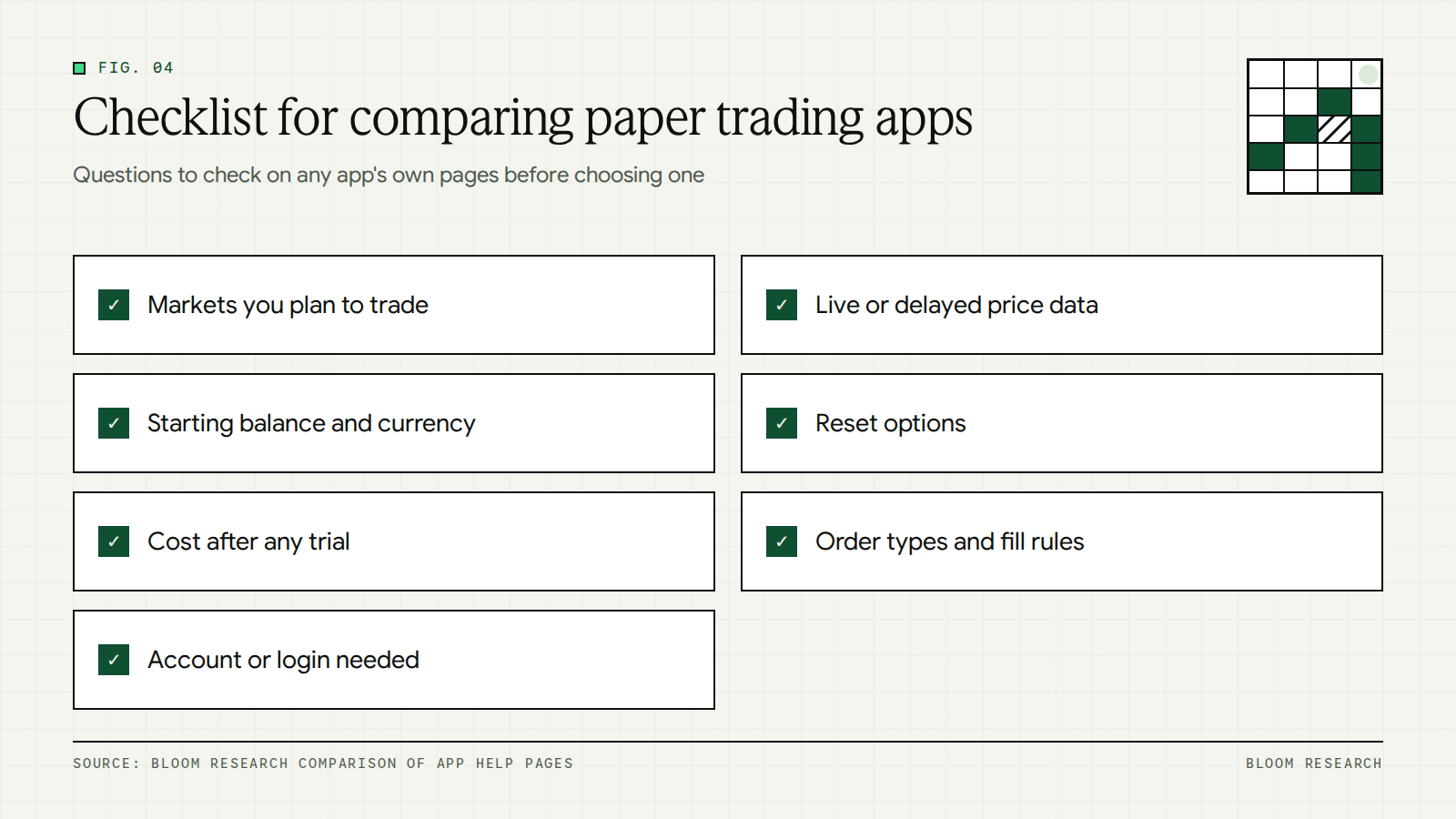
The criteria below come from the columns in the comparison table, and they are questions to check rather than recommendations. Our comparison of the best stock market simulators covers seven simulators by cost, starting virtual cash, assets, price data and who can use them.
- Markets: Sensibull's Google Play listing covers NIFTY, BANKNIFTY and NSE stock options, plus USDINR options. Webull's paperTrade page says US stocks can be paper traded in regular, pre-market, after-hours and overnight sessions. Our guide to crypto paper trading compares the official crypto demo, testnet and paper trading options from Binance, Bybit, Kraken, TradingView and Delta Exchange India.
- Price data: Neostox lists its market prices as delayed by 30 days, while moomoo's US paper trading page says its paper trading uses live market data.
- Virtual balance: Interactive Brokers starts every paper account with USD 1,000,000 of Equity with Loan Value and allows a reset of up to five times the production account's value. Webull lists unlimited virtual funds with a reset at any time, and resetting a TradingView paper account deletes the transaction history, active orders and open positions.
- Cost: Neostox gives new users a free trial, after which an active subscription is needed for paid features. Sensibull has free plans and Pro paid plans.
- Order types and fill rules: TradingView's order ticket offers market, limit and stop orders with stop loss and take profit settings. Webull and Interactive Brokers state the fill rules described in the section above.
- Account or login: Interactive Brokers gives new individual account holders a paper trading account automatically. Sensibull's virtual trading page asks users to log in with a supported broker or with Google, and moomoo's US page says no brokerage account is required.
#From paper trading to small real positions on Bloom
We offer a Paper Trading Challenge for practice with virtual funds, and real positions on Bloom start at $1.
Our Paper Trading Challenge
Our homepage states that the paper trading competition is live, so participants can practice with virtual funds, help shape Bloom and earn points along the way. Bloom is in public beta. The challenge asks participants to execute trades to earn points, keep a 5-day trade streak and climb the weekly leaderboard. Only eligible manual paper trades count toward the challenge.
The weekly leaderboard shows the top 100 of the week, ranked by Bloom Points, and it is paper trading only with no live funds. Rankings use Bloom Points from executed paper trades starting 14 Aug 2026. Creating a paper trading profile earns 100 points, and executed trades earn 2 points each for the first 10, then 4 points each. An accepted bug report earns 200 to 100,000 points, based on the validated severity of the report. The rules and current standings are on our Paper Trading Challenge and weekly leaderboard page.
Moving to a small real position
On Bloom: Our real trades start at $1, we support fractional shares down to six decimal places, and we impose no maximum trade size.
FINRA defines a fractional share as ownership of less than a full share of stock. In FINRA's example, investing $100 in a share that trades at $1,000 gives you 0.1 shares, as FINRA's guide to investing in fractional shares explains. FINRA notes that the availability of fractional share trading varies by brokerage firm, and that some brokerage firms aggregate customers' fractional orders and execute them as orders of whole shares.
What changes when the money is real
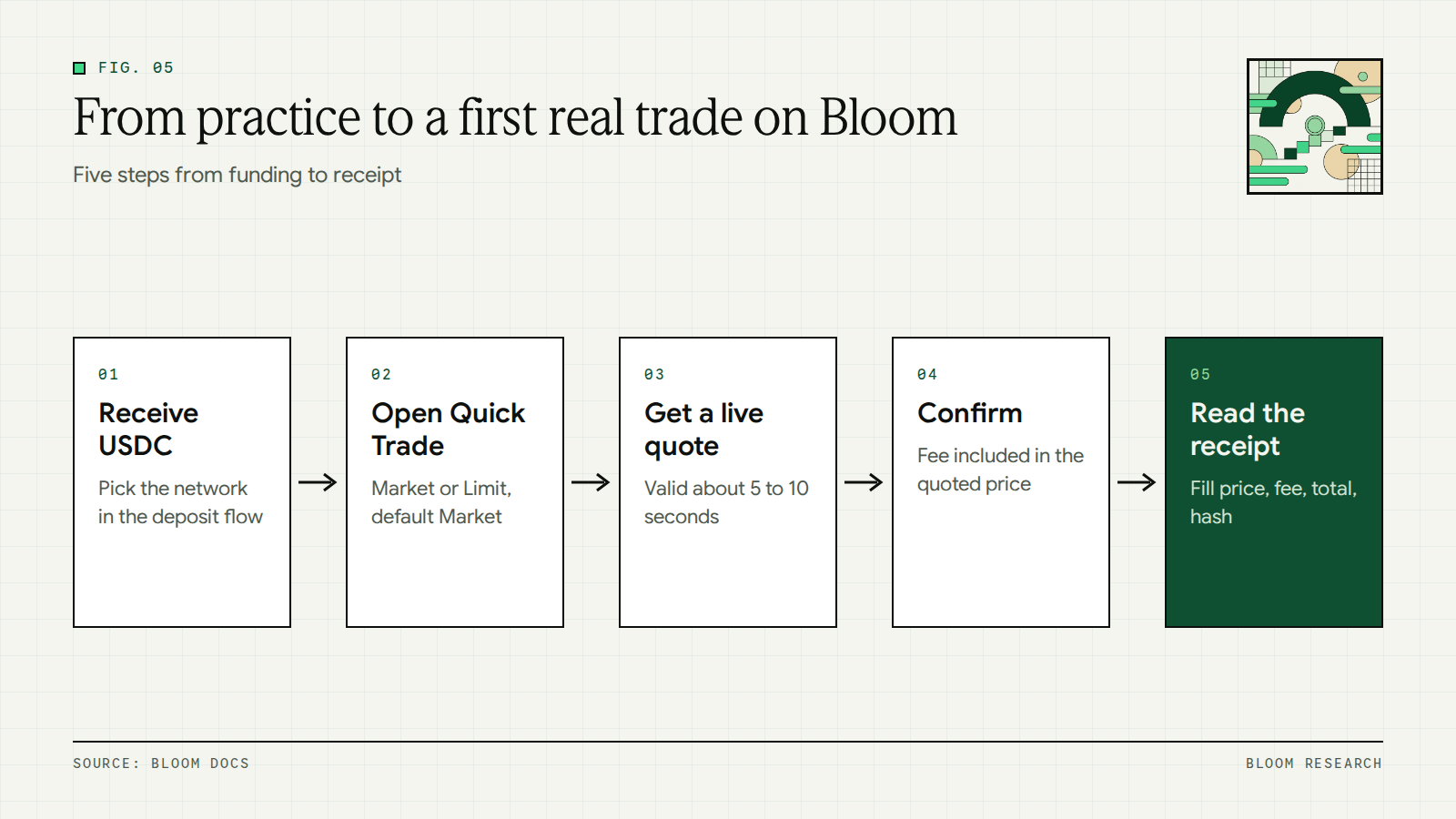
The five steps below follow our docs for a first real trade on Bloom.
- Fund the account by receiving USDC from an external wallet and picking the network in the deposit flow. The funding sheet only shows methods that work on your device, and balances are per chain at the wallet level, as our page on networks supported for USDC deposits explains.
- Open the Quick Trade sheet with Market and Limit orders and choose Market or Limit, with Market as the default. The limit price input suggests the last traded price (LTP) and LTP minus 1%, 5% or 10%, and Take Profit and Stop Loss are placed as resting orders that trigger when the price reaches the target.
- Accept the quote. RFQ (Request-For-Quote) is our execution model, in which a regulated tokenized security issuer returns a live quote, typically valid for 5 to 10 seconds. Slippage tolerance is the maximum acceptable drift between quote and execution, and the default is 0.5%, as the page on how RFQ execution works sets out.
- Check the fee. The trading fee ranges from 0.10% to 0.20%, with 0.20% by default, and drops as your 14-day trading volume grows. The quoted price already includes the fee, and the sheet shows a fee breakdown with platform fee and network gas, as our pricing and fees documentation and the VIP fee tiers on our pricing page show.
- Read the receipt. Within about 1 second, a receipt shows the fill price, fee, total and on-chain transaction hash, as our first trade guide describes.
As noted above, we queue stock orders placed outside market hours for the next market open. Webull's paper fills use the last price in real-time quotes, while our live trades use an issuer's quote that is typically valid for 5 to 10 seconds. These are different mechanisms, so a first real position shows a live quote, a fee breakdown and an on-chain receipt that a simulator's fill rule does not include.
#Start with a small position on Bloom
The most relevant next pages are our Paper Trading Challenge, for practice with virtual funds, and our first trade guide, which covers the flow from picking an asset to the receipt with a $1 minimum trade. Trading carries risk, including the loss of principal, and market, smart contract, custody, bridging and liquidity risks apply, as our risk disclosure sets out. We do not offer our product or services in the United States or in other restricted jurisdictions, as our service availability page states.
Frequently asked questions
Is paper trading free?
Several apps state that paper trading costs nothing. TradingView describes its simulator as having no fees, moomoo's US paper trading page says it is free to use, Webull lists paperTrade as free, and FrontPage's Google Play listing calls it a free paper trading app for India. Neostox gives new users a free trial, after which an active subscription is needed for its paid features. Sensibull has free plans and Pro paid plans.
Is paper trading illegal in India?
SEBI's circular of May 24, 2024 observed that some platforms offer virtual trading based on real time share prices. It requires stock exchanges, clearing corporations, depositories and registered intermediaries to ensure no real time price data is shared with third parties, except for orderly functioning of the market or regulatory requirements, and allowed education data with a lag of 1 day. A circular of May 8, 2026 set a 30-day lag for sharing and usage of educational price data from July 1, 2026.
Can I paper trade on Zerodha?
Zerodha's support portal states that Zerodha does not offer demo accounts for paper trading. It adds that a demo version of Kite with dummy data is available. Sensibull's virtual trading page asks users to log in with Zerodha, or with Angel One, Upstox or ICICI Direct, or to sign in with Google. Angel One's Sensibull page states that Sensibull lets users practice strategies with virtual funds in paper trading mode.
Which paper trading apps use live prices?
moomoo's US paper trading page says it uses live market data. Webull says paper orders are processed and filled against real-time data. Interactive Brokers states that simulated execution prices are determined by real market prices and sizes. FrontPage's Google Play listing says its simulator uses live NSE market prices. Neostox's FAQ states that market prices on Neostox are delayed by 30 days.
How much virtual money do paper trading apps give?
Interactive Brokers states that all paper trading accounts start with USD 1,000,000 of paper trading Equity with Loan Value. moomoo's US page lists $1 million in virtual funds for stocks or options and $10 million for futures. Webull lists unlimited virtual funds. FrontPage's Google Play listing gives ₹10 lakh in virtual money, and Neostox offers ₹5 lakh to start. The TradingView and Sensibull pages we reviewed do not state a starting amount.
How do I move from paper trading to real trades on Bloom?
Our Paper Trading Challenge is live: you practice with virtual funds, and a weekly leaderboard shows the top 100 ranked by Bloom Points, with no live funds. For real trades, the minimum trade size is $1 and fractional shares are supported down to six decimal places. In Quick Trade you choose Market or Limit, a live quote is typically valid for 5 to 10 seconds, and the trading fee is 0.10% to 0.20%. We do not offer our product or services in the United States or other restricted jurisdictions.
Can I make 1000 rupees per day from trading?
We do not predict trading returns, and none of the apps in this comparison states a daily return. The SEC's publication Day Trading: Your Dollars at Risk states that day traders typically suffer severe financial losses in their first months of trading. It also states that day traders have high expenses, paying their firms large amounts in commissions, for training and for computers. A paper trading result reflects one app's simulated fill rules and does not predict a live result.