

What Is RFQ Trading? How Request for Quote Trading Works
What is RFQ trading? Learn what request for quote means, how it works in bonds and swaps, the NSE RFQ platform, RFQ vs order book and AMM, and RFQ on Bloom.
Key takeaways
- RFQ means request for quote: a requester asks for a quote for a specific instrument, size and side, and the quote is executable only by the requester.
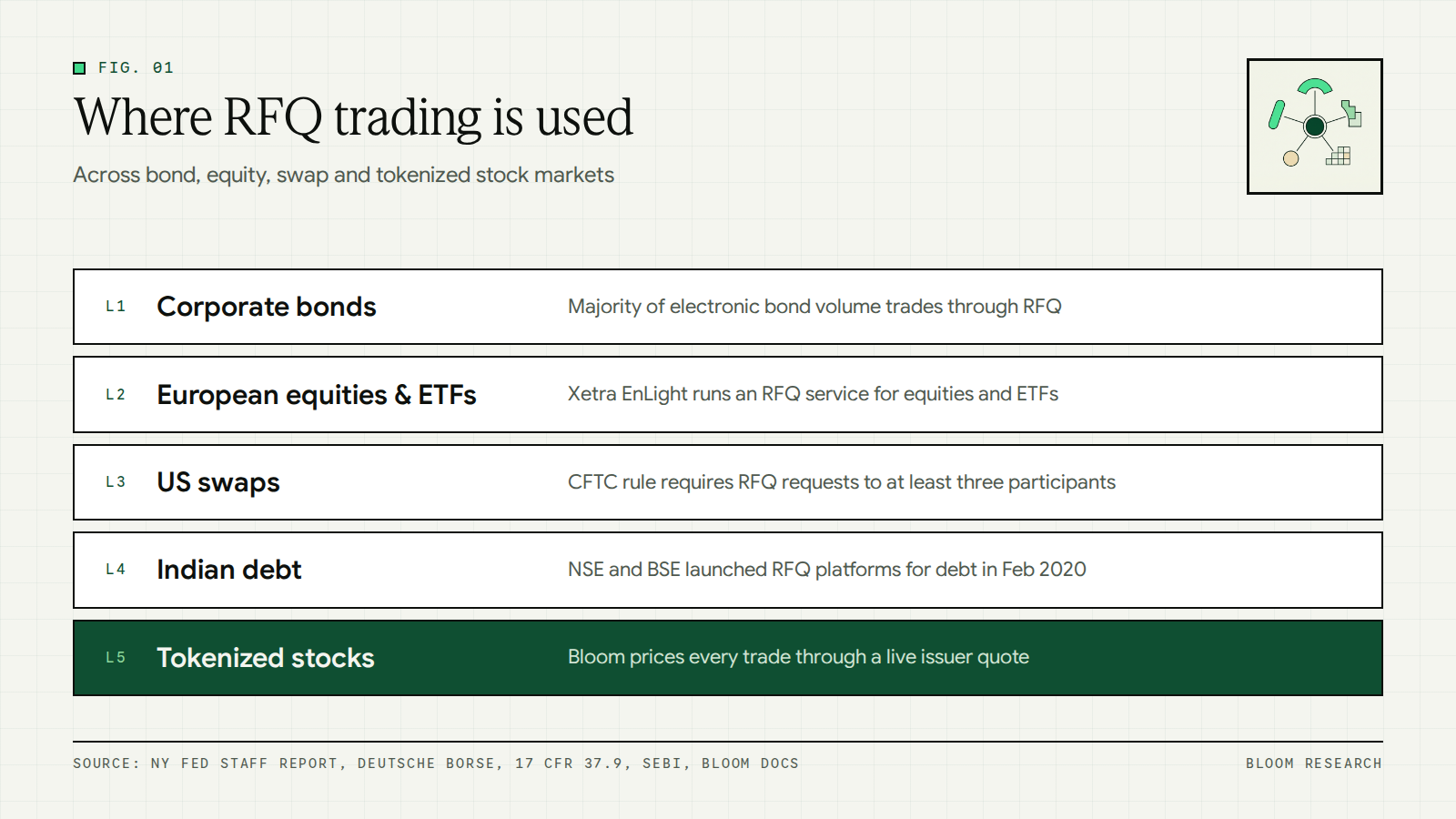
- RFQ is the main electronic protocol for dealer-to-customer bond trading, is offered for European equities and ETFs, and under CFTC rules a swap RFQ goes to no less than three market participants.
- With SEBI approval, NSE and BSE launched RFQ platforms for debt securities in February 2020 to bring transparency to over-the-counter deals that were negotiated bilaterally.
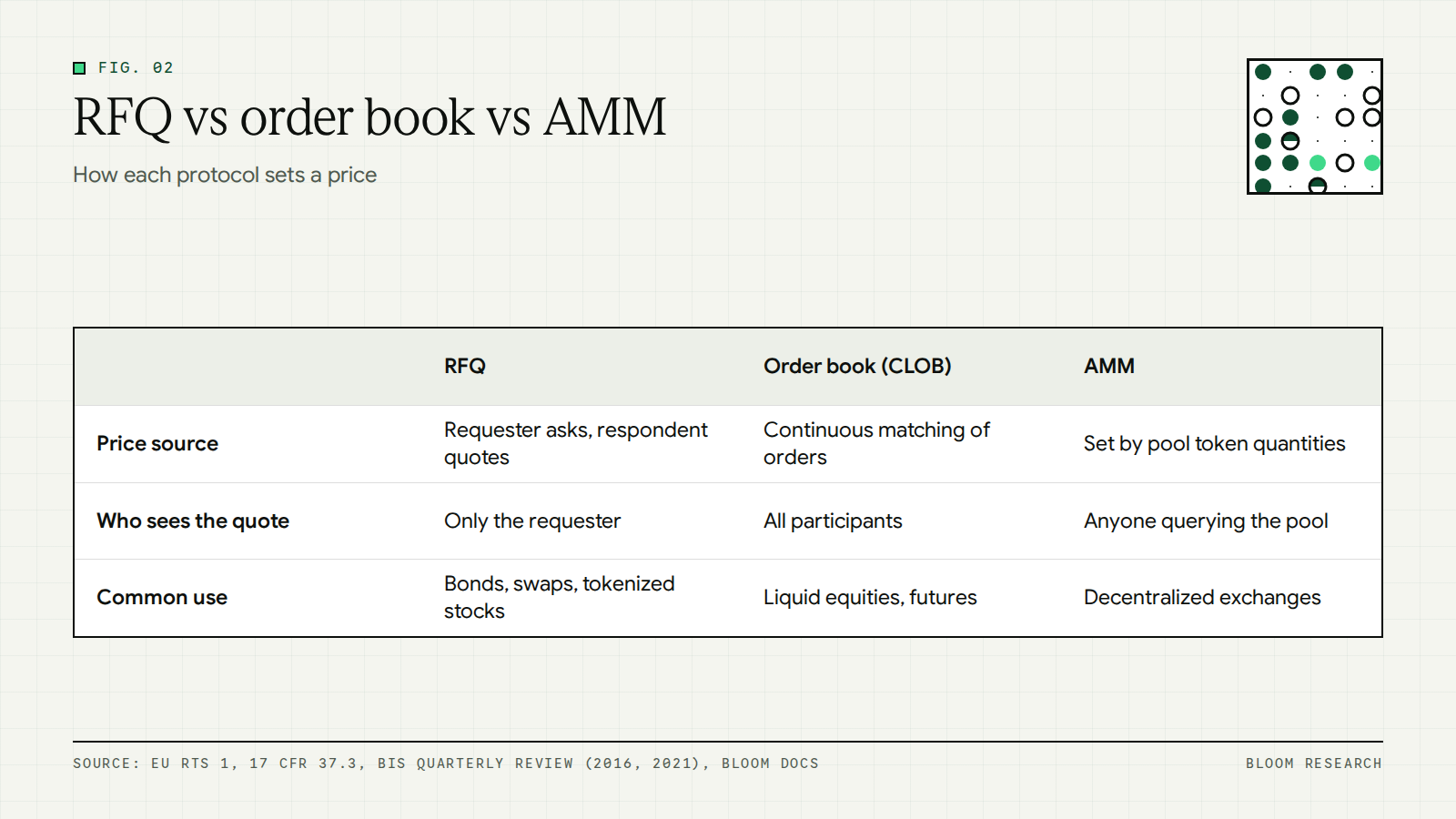
- An order book matches buy and sell orders continuously, an AMM sets relative prices on the basis of pool quantities, and RFQ returns a quote in response to a request.
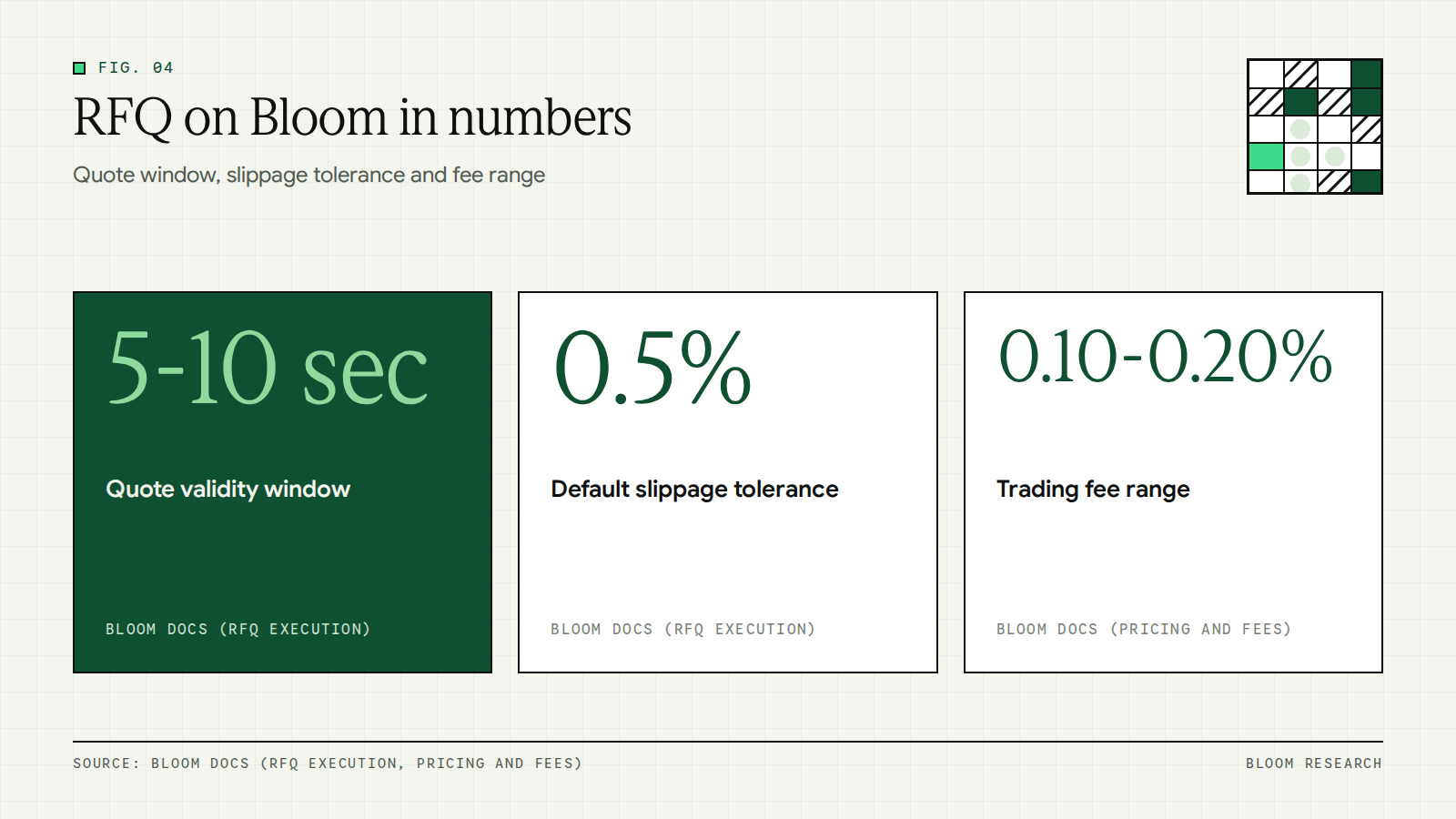
- On Bloom, a regulated tokenized security issuer returns a live quote typically valid for 5 to 10 seconds, the fee is included in the quoted price, and default slippage tolerance is 0.5%.
RFQ trading (request for quote) is a way of trading in which you ask one or more liquidity providers for a price for a specific size and side, and only you can accept the quote that comes back. RFQ is common in bond, ETF and swap markets, and it is also the execution model for every trade on Bloom: a regulated tokenized security issuer returns a live quote and the trade settles back-to-back, as set out in how RFQ execution works on Bloom.
The assets we offer are tokenized stocks, covered in our guide to tokenized stocks: on-chain tokens backed 1:1 by shares that regulated tokenized security issuers hold in custody. This guide covers RFQ in traditional markets, India's NSE RFQ platform, how RFQ compares with order books and AMMs, and our own RFQ flow.
#What is RFQ trading?
The legal definition used in the European Union comes from Commission Delegated Regulation (EU) 2017/587 of 14 July 2016, known as RTS 1, which was adopted under MiFIR. Under the EU's RTS 1 definition of a request for quote trading system, quotes are provided in response to a request for quote submitted by one or more members or participants. The quote is executable exclusively by the requesting member or participant. That requester may conclude a transaction by accepting the quote or quotes provided to it on request.
RTS 1 sets transparency requirements for trading venues and investment firms in shares, depositary receipts, exchange-traded funds, certificates and other similar financial instruments.
Definition: RFQ (request for quote) is a trading protocol in which a requester asks one or more liquidity providers for a quote for a specific instrument, size and side. The quote is executable only by the requester, who may accept it to conclude a transaction.
In our glossary definition of RFQ, RFQ is the execution model on Bloom. A tokenized security issuer returns a live quote, you accept within a short window, and the trade settles back-to-back.
RFQ meaning: what does RFQ stand for
RFQ stands for request for quote, the term RTS 1 uses for the request a member or participant submits to a trading system. In US federal procurement the term has a different legal effect: under FAR 13.004, a quotation is not an offer and cannot be accepted by the Government to form a binding contract. In an RFQ trading system, by contrast, the quote is executable by the requesting participant, who may accept it to conclude a transaction.
#How does RFQ work?
A 2020 Federal Reserve Bank of New York staff report names the two sides of an RFQ. The participant seeking liquidity is the initiator, and the participants asked to quote are the respondents. A quote is the bid or offer a respondent submits, including trade size and price.
The steps below describe a generic RFQ, not any single venue:
- The initiator transmits a request for a quote to buy or sell a specific instrument, with the trade size.
- One or more respondents may reply; respondents are under no obligation to respond, and the quotes they submit are for the soliciting party only.
- The initiator may conclude a transaction by accepting one of the quotes provided on request.
- Acceptance forms the deal: SEBI says the acceptance of a quote by a participant is considered mutual agreement between the parties for the given deal.
- Clearing and settlement follow; SEBI describes the Indian exchange RFQ platform as using straight-through processing of clearing and settlement to complete a trade.
Over-the-counter (OTC) deals are negotiated bilaterally between two parties, as SEBI describes them. The staff report says that, unlike voice OTC markets, initiators can broadcast buying or selling to more than one participant simultaneously.
The EU adds a pre-trade transparency rule. RTS 1 says a trading venue operating a request for quote (RFQ) system should at least make public the firm bids and offer prices, or actionable indications of interest, and the depth attached to those prices. The venue must publish them no later than the time when the requester is able to execute a transaction under the system's rules.
Key point: In an order book, all market participants can enter bids and offers, observe bids and offers entered by other participants, and transact on them. In RFQ, the quote is executable exclusively by the requesting participant.
#Where RFQ is used in traditional markets
Corporate bonds and fixed income
FINRA says most corporate bonds trade in the over-the-counter (OTC) market. A Federal Reserve Bank of New York staff report on corporate bond trading systems, Staff Report No. 938 from August 2020 by NY Fed and FINRA economists, says a majority of electronic corporate bond volume is executed pursuant to RFQ protocols. It describes an RFQ protocol as the electronic equivalent of a voice OTC market.
A March 2016 BIS Quarterly Review article reports that dealer-to-customer fixed income platforms are usually based on the RFQ trading protocol, a multilateral electronic version of OTC trading. In the survey it cites, the dealer-to-customer market relies predominantly on RFQ, which accounted for more than 95% of trades on multi-dealer platforms. By comparison, about 90% of trades on dealer-to-dealer platforms were executed via central limit order books (defined below).
The same BIS article says new fixed income trading protocols are largely based on variants of RFQ. It gives the reason: the illiquidity of some fixed income assets makes them unsuitable for CLOBs.
ETFs and equities
RFQ is also offered for European equities and ETFs. Deutsche Börse's Xetra EnLight offers a Request for Quote (RFQ) service that is fully integrated into the T7 trading system. It enables off-book trading in equities, ETFs and exchange-traded products (ETPs).
Swaps: the CFTC request-to-three rule
In the United States, RFQ appears in the rules of the Commodity Futures Trading Commission (CFTC) for swaps. A swap execution facility (SEF) is a trading venue for swaps governed by Part 37 of the CFTC's rules, titled Swap Execution Facilities.
CFTC rule 37.9 on RFQ systems for swaps covers swaps subject to the trade execution requirement, called Required Transactions. Each Required Transaction that is not a block trade shall be executed on a swap execution facility through an Order Book or a Request for Quote System that operates in conjunction with an Order Book.
The rule defines a Request for Quote System as one in which a market participant transmits a request for a quote to buy or sell a specific instrument to no less than three market participants, all of whom may respond. The three market participants shall not be affiliates of or controlled by the requester, and shall not be affiliates of or controlled by each other. These conditions apply to Required Transactions on a SEF, not to every swap and not to stocks.
#NSE's RFQ platform for debt securities in India
The NSE RFQ platform is the Request for Quote (RFQ) system of the National Stock Exchange of India, which NSE describes as a trade execution platform launched in 2020 as per the guidance from the regulator. SEBI Chairman Ajay Tyagi launched NSE's Request for Quote Platform for Debt Securities on 4 February 2020 at BKC, Mumbai. According to SEBI's October 19, 2022 circular on the RFQ platform, NSE and BSE both launched RFQ platforms in February 2020 with SEBI approval. SEBI states that the platforms were launched to bring transparency to over-the-counter deals that were negotiated bilaterally.
SEBI describes RFQ as an electronic platform for multi-lateral negotiations on a centralized online trading platform. The platform uses straight-through processing of clearing and settlement to complete a trade. On the Indian platforms, SEBI calls the participant seeking quotes the Initiator and the participant responding to the request the Responder.
The Initiator can send a request in one of two modes. In one-to-one (OTO) mode, the quote is placed to an identified counterparty, and in one-to-many (OTM) mode, it is placed to all the participants. SEBI says the quotes are bilaterally negotiated between the counterparties based on specified parameters. The acceptance of a quote by a participant is considered mutual agreement between the parties for the given deal.
| Feature | Detail | Source |
|---|---|---|
| Launched | February 2020 | NSE; SEBI circular of October 19, 2022 |
| Instruments | Corporate bonds, securitised debt instruments, municipal debt securities, government securities, state development loans, treasury bills, commercial paper and certificates of deposit | SEBI circular; NSE |
| Quote modes | One to One (OTO) and One to Many (OTM) | SEBI circular |
| Who can access | Regulated entities, listed corporates, institutional investors and All India Financial Institutions directly; retail investors only through eligible trading members | NSE |
| Settlement | Existing CBRICS mechanism using DVP-1; T+0 for bonds, CP and CD, and T+1 for all instruments | NSE |
| Days | Monday to Friday, from 9:00 am | NSE |
NSE's page on the Request for Quote platform lists the eligible participants, the settlement mechanism and the trading hours for each instrument. Eligible trading members are SEBI stockbrokers registered under the debt segment of NSE.
Who must use RFQ in India
SEBI has mandated registered mutual funds and portfolio management services to undertake a specified percentage of their secondary market corporate bond trades through the RFQ platforms of stock exchanges. SEBI's August 7, 2023 circular requires foreign portfolio investors (FPIs) to undertake at least 10% of their secondary market corporate bond trades by value on these RFQ platforms. The FPI requirement applies on a quarterly basis, effective October 1, 2023.
SEBI's October 19, 2022 circular also allowed stock brokers registered under the debt segment to place or seek bids on the RFQ platform on behalf of clients. This option came into force on January 1, 2023. It was added to the existing option of placing bids in a proprietary capacity.
Note: The NSE RFQ platform is for debt instruments such as corporate bonds, government securities and commercial paper. It does not list shares, and it is a separate system from the quotes that price tokenized US stocks on our platform.
Our India page lists the US stocks and ETFs available from India on Bloom.
#RFQ vs order book vs AMM
A central limit order book (CLOB) is a trading protocol in which market participants submit limit orders that are stored in a queue based on predefined rules, according to the BIS. RTS 1 describes a continuous order book system as one that uses an order book and a trading algorithm, operated without human intervention, to match sell orders with buy orders by price on a continuous basis. Under the CFTC rule, an order book includes a system where all participants can enter bids and offers, observe the bids and offers of others and transact on them. Our guide on pre-market trading explains how orders are matched in the pre-market session.
An automated market maker (AMM) is a protocol that decentralised exchanges (DEXs) use in place of limit order books and the dealership model, according to the BIS Quarterly Review of December 2021. In an AMM, liquidity providers place crypto assets in a liquidity pool, which other traders can buy from or sell into. Relative prices are set on the basis of the quantities in the pool, and one popular type uses a constant product function in which the amount of token X times the amount of token Y equals a constant.
The same BIS article states that certain features of AMMs expose liquidity-takers to market manipulation on DEXs, such as front-running. The BIS Quarterly Review article on automated market makers adds that the assets traded via AMM protocols are expanding, ranging from non-fungible tokens to tokenized equity shares.
RFQ also exists in DeFi protocols. The 0x Protocol V4 documentation lists two order types, Limit and RFQ, and describes RFQ orders as a stripped down version of standard limit orders with a leaner settlement process. 0x describes its RFQ as connecting directly with professional market makers who provide quotes to traders.
We are multi-chain, and trading balances and tokenized stock holdings are held per chain at the wallet level across the networks we support.
Key point: In an order book, participants can see and transact on bids and offers entered by others. An AMM sets relative prices from the quantities in a liquidity pool, while an RFQ system returns a quote that only the requester can accept.
Last look and firm quotes
Last look is a practice used in electronic trading where a market participant has a final opportunity to accept or reject a trade request made on its quoted price. This definition comes from the GFXC guidance on last look, published in August 2021. Principle 17 of the FX Global Code says participants employing last look should be transparent regarding its use and provide appropriate disclosures to clients.
If last look is used, the Code says it should be a risk control mechanism to verify validity and/or price. The FX Global Code is a set of global principles of good practice in the wholesale foreign exchange market, last updated in December 2024. It does not impose legal or regulatory obligations on market participants.
The EU definition of an RFQ system in RTS 1 sets out who can act on a quote. Under RTS 1, the quote is executable exclusively by the requesting member or participant. The requester may conclude a transaction by accepting the quote or quotes provided to it on request.
#Why tokenized stock platforms use RFQ
A December 2021 BIS Quarterly Review article says that in DeFi, the sheer volume of orders "would render the management of an on-chain limit order book very costly." The same article says decentralized exchanges use automated market maker protocols instead of limit order books and the dealership model. It also says the crypto assets traded through AMM protocols are expanding, from non-fungible tokens to tokenized equity shares.
Our model uses RFQ instead. Bloom is a DEX, and every trade executes via RFQ through regulated tokenized security issuers. A tokenized security issuer is a regulated firm that holds the underlying shares in custody 1:1 to back the on-chain tokens. Each token is backed 1:1 by a real share held at a regulated US broker-dealer such as Alpaca Markets or Interactive Brokers.
Issuers price quotes against the live underlying market. Back-to-back settlement means that when you accept a quote, the trade is settled against the underlying instrument. As a result, your fill closely tracks the prevailing market price at execution time.
In a January 28, 2026 statement, SEC staff said the format of a security, onchain or offchain, does not affect how the federal securities laws apply. The SEC staff statement on tokenized securities also says holders of third-party tokenized securities may be exposed to risks of that third party, such as bankruptcy.
#How an RFQ trade works on Bloom
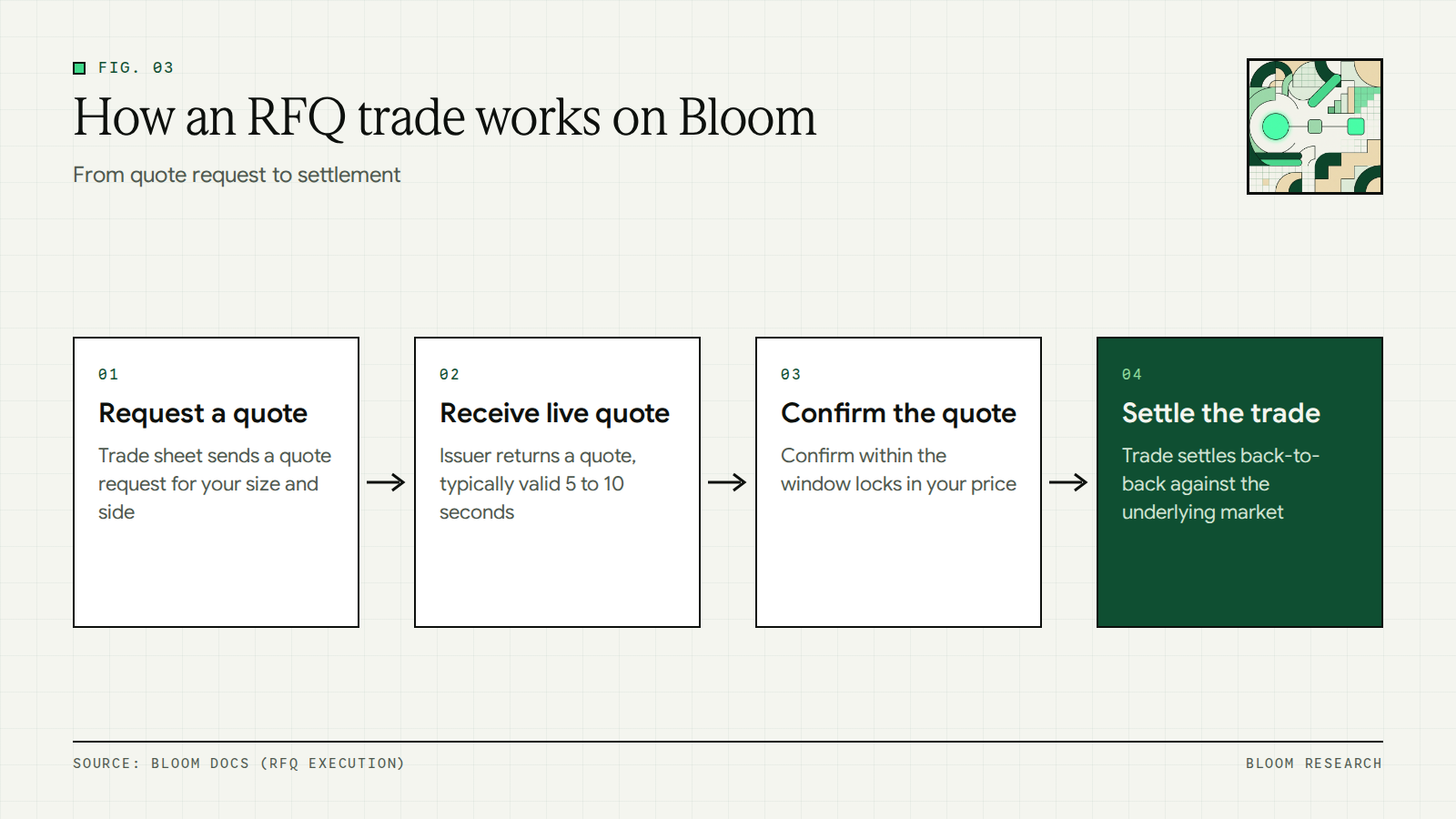
Our RFQ execution docs describe four steps for every trade. The same flow applies to buys and sells.
- Opening the trade sheet sends a quote request for your size and side.
- A regulated tokenized security issuer returns a live quote in milliseconds, typically valid for 5 to 10 seconds.
- Tapping Confirm within the quote window commits the trade at that price or within your slippage tolerance.
- The trade settles back-to-back against the underlying primary market, and the on-chain token transfers to or from your wallet.
After you tap Confirm, the order routes to a regulated tokenized security issuer via RFQ. Within about 1 second you see the receipt with the fill price, fee, total and on-chain transaction hash. Sell follows the same RFQ flow as buy. By default, tapping Confirm submits the trade immediately. You can turn on a Face ID, Touch ID or passkey prompt before every trade in Account Security.
Our Quick Trade sheet has a Market or Limit control that defaults to Market. It shows a live quote that refreshes about every 10 seconds, with a validity timer and a Refresh control. Every market order moves through the states quote_requested, quote_received, awaiting_confirm, soft_cancel and submitted, and ends as filled, partial_filled, queued or failed_execution.
What the RFQ depth pane shows
On Bloom: RFQ depth is the pane on the asset terminal that shows RFQ liquidity at each price grouping. It looks like a traditional order book ladder for familiarity, but every level is what the RFQ desk would quote for that notional amount, not a resting limit order from another user. Clicking a level pre-fills the trade ticket's price.
Our trade screen therefore shows issuer quotes, not other users' orders. The two order types also work through RFQ. A market order is an order at the current quoted price, and it executes immediately during market hours. A limit order is an order at a price you specify; it is held server-side and routed to RFQ when the live quote reaches your target. You can cancel a limit order any time before it fills.
Fees, slippage and pending trades
The trading fee on Bloom ranges from 0.10% to 0.20%, with 0.20% as the default rate. The fee drops toward 0.10% as your 14-day trading volume grows through the VIP tier ladder. As our docs on how our trading fee is included in the quote explain, the "You will receive" line is the final amount that goes to your wallet.
The full VIP ladder appears in our full fee schedule. The trade sheet also has a fee breakdown that shows the platform fee and network gas.
Slippage tolerance is the maximum acceptable drift between quote and execution. The quote may move slightly between request and confirmation, so the setting is always shown on the trade sheet. The default is 0.5%, and you can change it to 0.1%, 1% or a custom value.
If the market moves beyond your tolerance during the quote window, the trade stays in a pending state. It remains pending until you cancel it.
Timing also affects execution. Stock and ETF orders placed overnight, on weekends or on holidays are queued server-side and execute automatically at the next market open. Pre-market and after-hours orders route to the extended session, may partially fill, and the remainder is queued.
After you confirm during off-hours, the receipt says the order has been queued and gives an estimated execution time. You receive a push notification when the order fills. Queued orders appear in Portfolio under Orders until they are filled, partially filled or canceled.
For assets with continuous markets, orders fill immediately at the prevailing RFQ price regardless of time of day. Our docs on our trading hours and queued orders list each state. Our guide to what happens to orders placed on weekends covers the weekend case in more detail.
#Risks and a checklist before you accept a quote
Important: The tokenized security issuers that quote prices may withdraw liquidity in extreme conditions. When this happens, the trade sheet will not return a quote and you cannot execute until liquidity returns. Asset prices can also move against you, including overnight gaps that may exceed your slippage tolerance.
Our risk disclosure summarizes market risk, smart contract risk, custody risk, bridging and chain risk, and liquidity risk. The full risk disclosure is published in our legal terms.
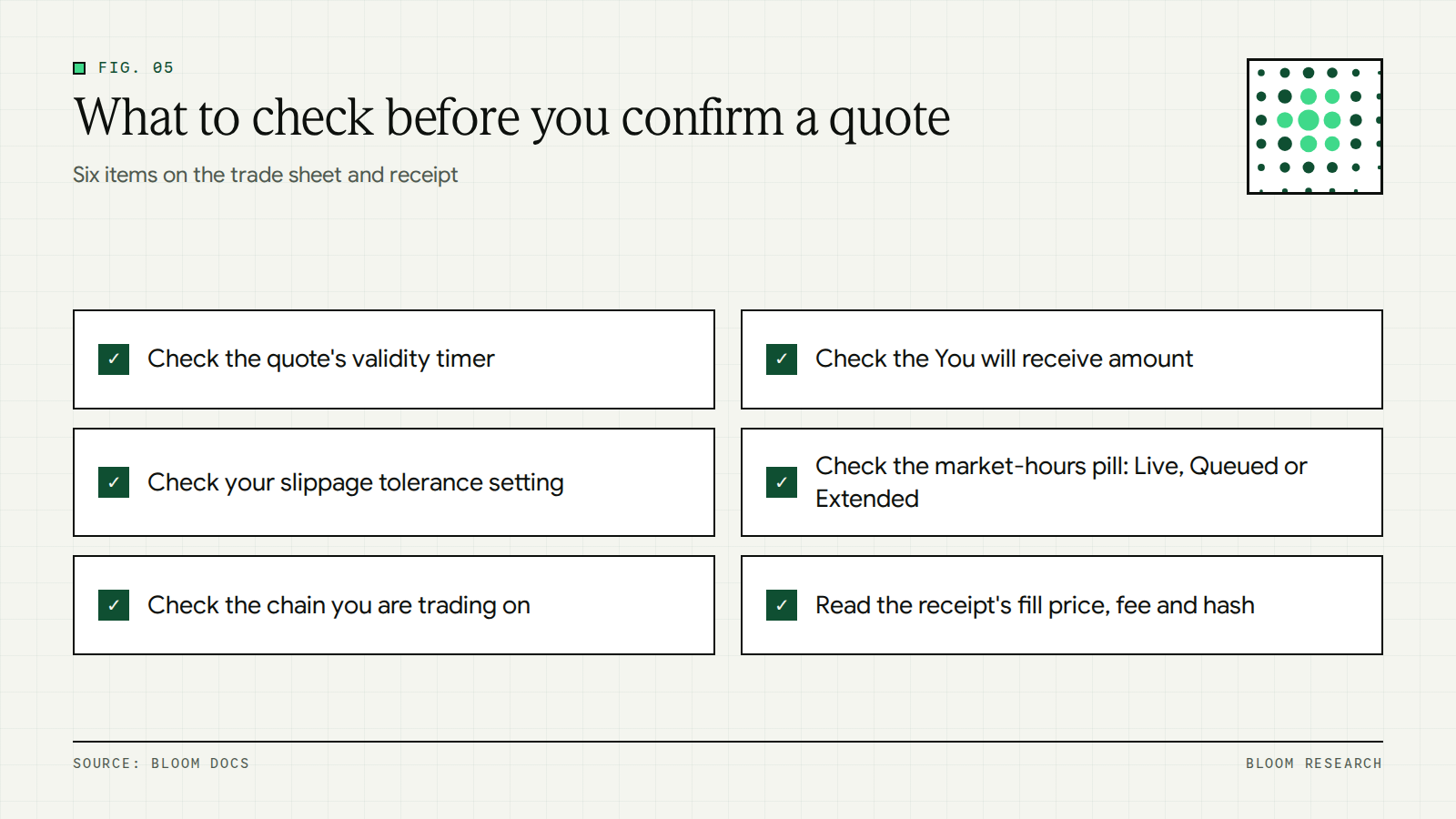
The trade sheet and receipt show these items before and after you tap Confirm:
- The quote's validity timer next to the live quote.
- The "You will receive" amount, which already includes the fee.
- Your slippage tolerance setting, 0.5% by default.
- The market-hours pill, which reads LIVE, Queued or Extended hours.
- The chain you are trading on, since balances and holdings are per-chain.
- The receipt's fill price, platform fee and on-chain transaction hash.
Our explainer on how paper trading works covers practice without real money. Our guide to paper trading apps compared reviews apps by markets, balance, cost and data.
Trading on Bloom carries risk, including the loss of principal. We do not offer our product or services to users in the United States or in other restricted jurisdictions; see our page on service availability.
The full live catalog of tradeable assets is published on our markets page. Tapping any row opens Asset detail, and tapping Buy in its sticky bar opens the trade sheet with a live quote.
Frequently asked questions
What is an RFQ in trading?
An RFQ, or request for quote, is a trading system in which quotes are provided in response to a request submitted by one or more members or participants. The quote is executable exclusively by the requesting participant, who may conclude a transaction by accepting it. Respondents are under no obligation to respond, and the quotes they submit are for the soliciting party only.
What does RFQ stand for?
RFQ stands for request for quote. In trading, EU RTS 1 defines a request for quote trading system as one where quotes are provided in response to a request submitted by members or participants, and the quote is executable exclusively by the requester. In US federal procurement the term works differently: under FAR 13.004, a quotation is not an offer and cannot be accepted by the Government to form a binding contract.
What is the NSE RFQ platform?
The NSE Request for Quote (RFQ) platform is a trade execution platform for debt instruments, launched on 4 February 2020. It covers corporate bonds, government securities, treasury bills, commercial papers, certificates of deposit and other debt. A participant seeking quotes is the Initiator and can quote One to One (OTO) or One to Many (OTM). Retail investors access it only through eligible trading members, and trades settle through CBRICS using DVP-1 on T+0 or T+1.
How does RFQ work step by step?
An initiator sends a request to buy or sell a specific instrument with a trade size. Respondents may reply with quotes that are for the initiator only, and the initiator may accept one to conclude a transaction. On Bloom, opening the trade sheet sends a quote request for your size and side, a tokenized security issuer returns a live quote, and tapping Confirm within the quote window commits the trade at that price or within your slippage tolerance.
What is the difference between RFQ and an order book?
In an order book, all market participants can enter bids and offers, observe those entered by others and transact on them, and a trading algorithm matches buy and sell orders on a continuous basis. In RFQ, a quote is provided on request and is executable only by the requester. On Bloom, the RFQ depth pane looks like an order book ladder, but every level is what the RFQ desk would quote, not a resting limit order from another user.
Why do tokenized stock platforms use RFQ?
A BIS Quarterly Review article from December 2021 says the sheer volume of orders "would render the management of an on-chain limit order book very costly." On Bloom, trades execute via RFQ through regulated tokenized security issuers who hold the underlying shares in custody 1:1. Quotes are priced against the live underlying market, and the trade settles back-to-back against the underlying instrument, so the fill closely tracks the prevailing market price at execution time.
What is last look in RFQ trading?
Last look is a practice in electronic trading where a market participant has a final opportunity to accept or reject a trade request made on its quoted price. The FX Global Code says participants employing last look should be transparent about its use and provide appropriate disclosures to clients. The Code is a set of global principles of good practice in the FX market and does not impose legal or regulatory obligations.