
Tokenized Stocks: The Complete 2026 Guide to How They Work
Tokenized stocks are blockchain tokens that represent or track company shares. Our 2026 guide covers how they work, structures, legal status, risks and buying.
Key takeaways
- Investor.gov defines tokenized securities as financial instruments, such as stocks, bonds or fund interests, formatted as or represented by a crypto asset recorded on a blockchain.
- The rights a holder gets depend on the structure: custodial or backed tokens, synthetic tokens or issuer-native shares, as grouped in the SEC staff statement of January 28, 2026.
- In 2026 SEC staff stated that a security's onchain or offchain format does not affect the federal securities laws, and the SEC approved a Nasdaq proposal for tokenized trading and settlement.
- ESMA reports that the outstanding value of tokenized equities grew from about EUR 0.3bn at end-2024 to about EUR 1.9bn by end-June 2026.
- On Bloom, each token is backed 1:1 by a real share held in custody at a regulated US broker-dealer, and the minimum trade is $1.
Tokenized stocks are blockchain tokens that represent shares of a listed company or give exposure to their price. Investor.gov describes tokenized securities as financial instruments formatted as or represented by a crypto asset recorded on a blockchain. The structure behind each token decides which rights the holder gets, what backs the token and which third party the holder depends on.
On Bloom, each token is backed 1:1 by a real share held in custody at a regulated US broker-dealer such as Alpaca Markets or Interactive Brokers. Our doc on how a tokenized stock works on Bloom covers the product in more detail. This guide covers the definition, the mechanics, the three main structures, the 2026 legal status, sourced market size, the risks, a comparison with other instruments and how to buy.
#Tokenized stocks: the definition
In a statement dated January 28, 2026, SEC staff define a tokenized security as a security formatted as or represented by a crypto asset. The record of ownership is maintained in whole or in part on or through one or more crypto networks. The SEC's Investor.gov page on tokenized securities uses a similar definition and lists stocks, bonds and fund interests as examples of the underlying instruments.
A tokenized stock is a tokenized security whose underlying instrument is a share in a company. Investor.gov notes that tokenized securities are also called digital securities. The market also uses the term tokenized equities, and tokenized US stocks when the underlying share is listed in the United States. ESMA reports that tokenized equity activity is concentrated in a limited number of large US-listed technology firms.
Definition: A tokenized stock is a blockchain token that represents a share of a listed company or gives exposure to it. Its record of ownership is kept in whole or in part on a crypto network.
Tokenized stocks meaning in plain terms
When you buy AAPL on Bloom, you receive an on-chain token backed 1:1 by a real AAPL share held in custody at a regulated US broker-dealer. The token is held in your own embedded wallet, so you retain custody of it.
The token's on-chain value is called its NAV, and it reflects the share price, accrued dividends and corporate actions. Tokenized assets on Bloom use the underlying ticker only, such as AAPL. We do not claim ownership of, affiliation with, or endorsement by any underlying issuer or listed company.
#How tokenized stocks work
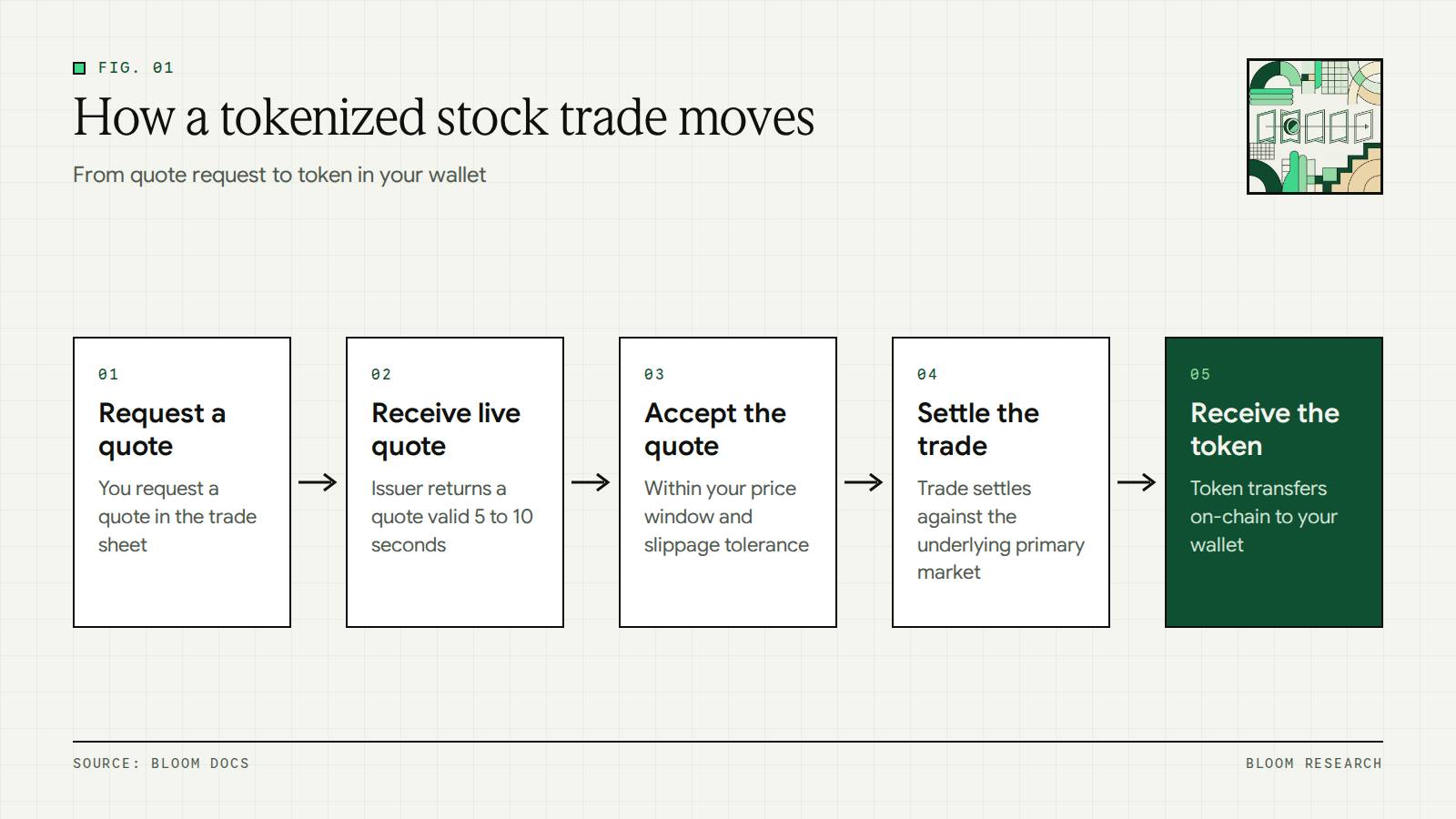
A tokenized stock has four working parts: issuance, custody and backing, minting and redemption, and on-chain settlement. On Bloom, trades execute through RFQ (request for quote), where you ask for a price and a regulated tokenized security issuer returns a live quote. One buy follows five steps:
- You open the trade sheet, which sends a quote request for your size and side.
- A regulated tokenized security issuer returns a live quote, typically valid for 5 to 10 seconds.
- You tap Confirm within the quote window, which commits the trade at that price or within your slippage tolerance.
- The trade settles back-to-back against the underlying primary market.
- The on-chain token transfers to your wallet.
Our RFQ execution doc sets out this lifecycle and how quotes stay close to the underlying market.
Custody and 1:1 backing
The shares backing our tokens are held in segregated customer accounts at regulated US broker-dealers such as Alpaca Markets and Interactive Brokers. Customer assets at these brokers are held separately from the broker's own funds. Our page on custody and backing explains this arrangement.
An on-chain attestation publishes the live token supply, the attested broker balance and the backing ratio for every asset. The backing ratio should be 1.0 or higher at all times.
Minting and redemption
An authorized participant (AP) is a regulated entity authorized to mint and burn tokens against custody, as defined in our glossary. Minting creates new tokens against shares held in custody. Redemption, also called burning, removes tokens against custody.
On Bloom, the mint/redeem partner contracts are the authorized-participant gateway that the broker partner uses to mint and burn tokens against custody.
On-chain settlement versus T+1
T+1 means a trade settles one business day after the trade date. Under the SEC's T+1 settlement rule, the standard settlement cycle for most broker-dealer securities transactions was shortened from T+2 to T+1, with a compliance date of May 28, 2024.
On Bloom, the on-chain token transfers to your wallet as part of the trade settlement. Within about 1 second you see a receipt with the fill price, fee, total and on-chain transaction hash. ESMA notes that many tokenized equities use hybrid settlement models, where the token transfer happens on-chain while cash settlement often remains off-chain.
Our guides to the tokenized stock lifecycle from mint to redemption and to RFQ trading cover these steps in more depth.
#Three tokenized stock structures: backed, synthetic and native
The SEC staff statement on tokenized securities of January 28, 2026 groups tokenized securities into two categories. The first is securities tokenized by or on behalf of their issuers, and the second is securities tokenized by third parties unaffiliated with the issuers. SEC staff observed two third-party models: custodial tokenized securities and synthetic tokenized securities. Together these give three structures:
- Custodial or backed tokens: the crypto asset represents the holder's indirect interest in the underlying security through a security entitlement, which is an interest in a security held through an intermediary. ESMA calls these wrapped structures, where tokens represent a claim on, or economic exposure to, underlying shares held by a trusted party. ESMA says tokenized equities have predominantly developed through wrapped structures, while native issuance remains rare. In wrapped structures legal ownership remains off-chain, so token transfers do not convey legal title.
- Synthetic tokens: a linked security issued by a third party provides synthetic exposure to a referenced security. It is not an obligation of the issuer of the referenced security and confers no rights or benefits from that issuer. A security-based swap typically does not convey any equity, voting, information or other rights in the referenced security. Investor.gov says the rights of a synthetic token holder may differ significantly from those of a traditional owner of the underlying security.
- Issuer-native tokenized shares: the company itself or its agent issues the security directly on a blockchain. Investor.gov says this security carries the same legal rights, including voting, dividends and ownership, as a traditional share of the same class.
SEC staff state that the format in which a security is issued, onchain or offchain, does not affect application of the federal securities laws. SEC staff also note that holders of third-party tokenized securities may be exposed to risks of the third party, such as bankruptcy. Every Bloom token is backed 1:1 by a real share held in regulated custody, not a synthetic or derivative position. Our comparison of tokenized stocks, stock perps and synthetic stocks covers how backing, leverage, funding rates and liquidation differ across these products.
Our comparison of xStocks, Ondo and Dinari sets out the legal wrapper, custody, mint and redeem process and eligibility rules of three tokenized stock issuers. Our guide to what xStocks are explains who issues and backs the xStocks tokens traded on Kraken and Bybit, and our guide to how Ondo Global Markets tokenized stocks work covers how Ondo tokens are structured, backed, minted and redeemed.
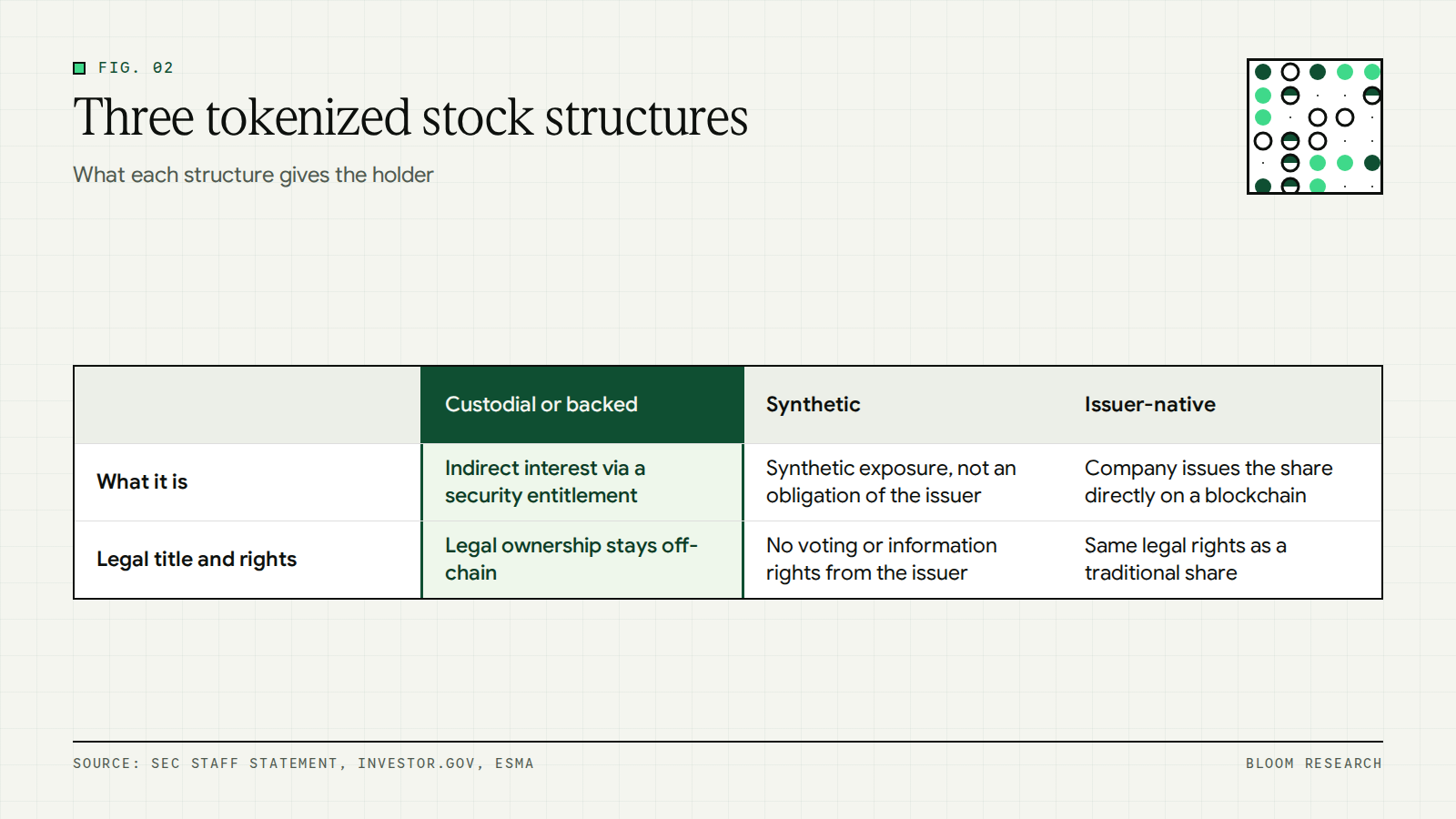
Key point: The rights a holder gets depend on the structure behind the token, not on the word "tokenized". An issuer-native share carries the same legal rights as a traditional share of the same class, while a synthetic token holder's rights may differ significantly.
#Are tokenized stocks legal? Regulation in 2026
Whether tokenized stocks are legal depends on how the token is structured and on the investor's jurisdiction. No single global rule covers every product or every country. In their Statement on Tokenized Securities of January 28, 2026, SEC staff said the format of a security, onchain or offchain, does not affect how the federal securities laws apply. The sections below set out the published positions in the United States, the European Union and India.
United States
On March 17, 2026, the SEC issued an interpretation clarifying how the federal securities laws apply to certain crypto assets and related transactions. The CFTC joined the SEC's March 17, 2026 interpretation.
The January staff statement also sets a limit on some third-party tokens. A third party may not offer or sell a crypto asset representing a security-based swap to persons who are not eligible contract participants, unless a Securities Act registration statement is in effect and the transactions happen on a national securities exchange. Under the Commodity Exchange Act, an eligible contract participant is classified by its regulated status or by the amount it invests on a discretionary basis. The CFTC describes persons outside that category as retail customers.
The Depository Trust Company (DTC) holds securities in custody, and DTCC says DTC custodies assets valued at over $114 trillion. A no-action letter is a response from SEC staff that, when the request is granted, says the staff would not recommend enforcement action against the requester based on the facts described. In December 2025, DTC received a no-action letter authorizing a defined tokenization service for three years.
That authorization covers a defined set of highly liquid assets, including the constituents of the Russell 1000, ETFs tracking major indices and US Treasury bills, bonds and notes. DTCC's May 2026 update planned initial, limited production trades in July 2026 and a launch of the service in October 2026. DTCC says the service will tokenize DTC-custodied assets that provide the same entitlements, investor protections and ownership rights as assets held in traditional form.
Investing.com reported, citing Reuters, that on March 18, 2026, the SEC approved a Nasdaq proposal to allow certain stocks to be traded and settled in tokenized form, with settlement through DTC. Nasdaq had filed the proposal in September to let listed stocks and exchange-traded products trade on its main market in traditional or tokenized form. ESMA also lists the New York Stock Exchange announcing a platform for trading and onchain settlement of tokenized securities in January 2026.
We do not offer our product or services to users in the United States or in other restricted jurisdictions, as set out on our service availability page.
European Union
The Markets in Crypto-Assets Regulation (MiCA) is the EU regulation for crypto-assets, and it entered into force in June 2023. According to ESMA's MiCA overview, the regulation covers crypto-assets that are not currently regulated by existing financial services legislation.
ESMA also points to the DLT Pilot Regime regulation as part of the EU's approach to tokenization, where DLT stands for distributed ledger technology. ESMA describes this approach as providing greater legal and regulatory clarity. In its September 2026 risk monitor, ESMA notes that wrapped arrangements may add layers of intermediation, complexity for investors and new counterparty dependencies. Those dependencies include tokenization platforms and underlying asset custodians.
India
The Liberalised Remittance Scheme (LRS) is the RBI scheme that sets how much resident individuals can send abroad. Under LRS, resident individuals, including minors, can remit up to USD 250,000 per financial year (April to March) for any permissible current or capital account transaction. The RBI's LRS FAQ lists investment among capital account transactions.
Tax collected at source (TCS) is an amount banks collect on outward foreign remittances made under LRS. From April 1, 2026, TCS on other LRS purposes, such as investing, is nil up to ₹10 lakh and 20% above ₹10 lakh. These rates follow the Finance Act, 2026 read with the Income Tax Act, 2025. The TCS amount can be claimed as a credit while filing the return of income.
Schedule FA is the Schedule Foreign Assets section of the Indian income tax return. The CBDT says compliance with Schedule FA is mandatory under the Black Money (Undisclosed Foreign Income and Assets) and Imposition of Tax Act, 2015.
Because we settle in USD stablecoins, an investor in India holds INR/USD exchange-rate exposure in addition to the price movement of the stock itself. Our India page also notes that the treatment of tokenized securities can differ from that of directly held shares. Our guide to investing in US stocks from India covers brokers, GIFT City receipts, mutual funds and tokenized stocks, with LRS, TCS and tax for each route.
Important: Remittance, tax, reporting and KYC rules in the investor's country apply to every route, including tokenized stocks.
#Tokenized stocks market size and adoption in 2026
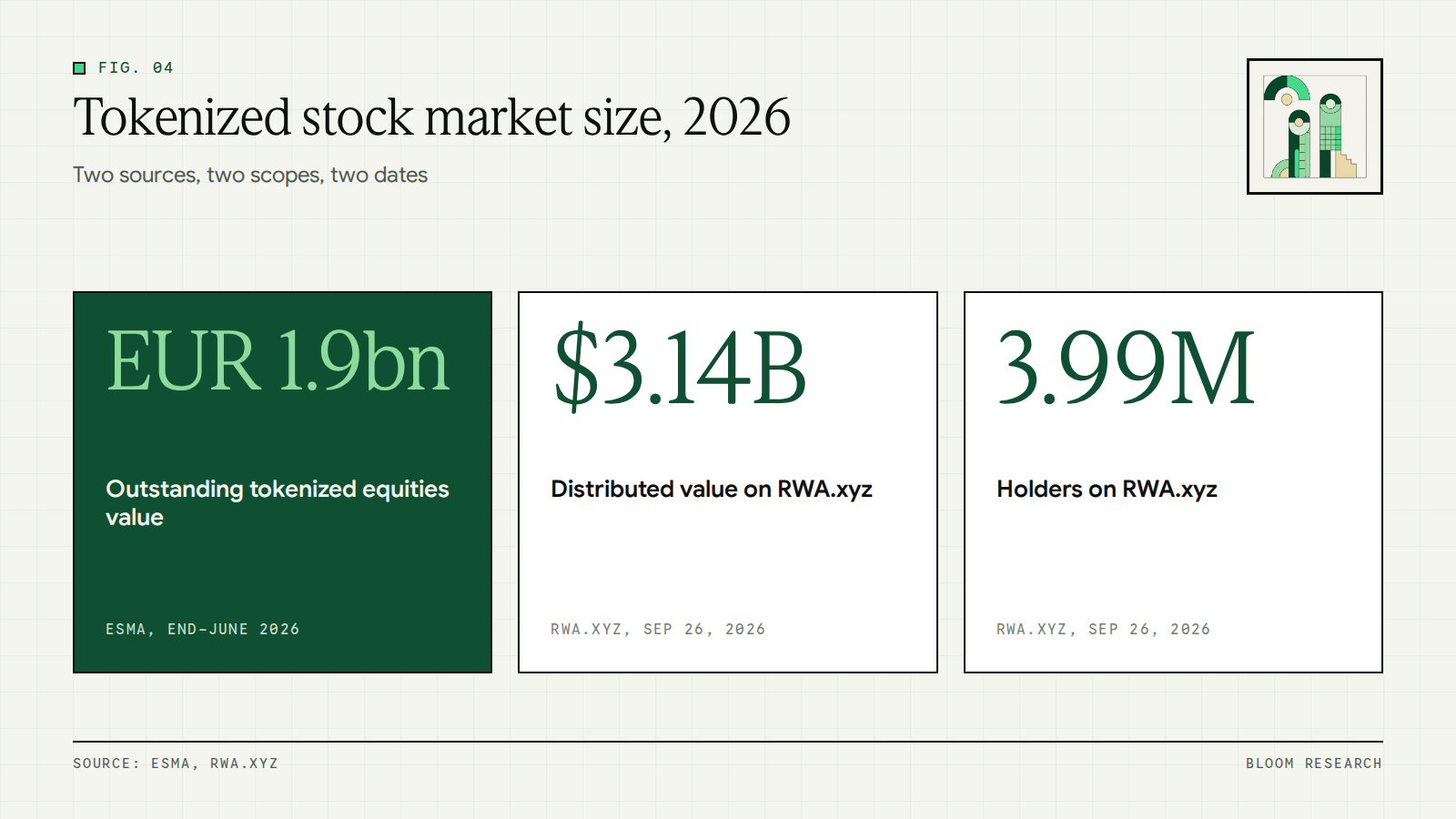
ESMA's September 2026 risk monitor, the TRV Risk Monitor No. 2, 2026 published on September 10, 2026, tracks the outstanding value of tokenized equities. That value grew from about EUR 0.3bn at end-2024 to about EUR 1.9bn by end-June 2026, a 6.5-fold increase over eighteen months. ESMA adds that activity is concentrated in a limited number of large US-listed technology firms. It also says tokenized equities remain negligible relative to global equity markets.
The RWA.xyz tokenized stocks dashboard, read on September 26, 2026, showed a distributed value of $3.14B and 3.99M holders. Its scope covers tokenized public equities, including listed stocks and ETFs, issued natively onchain or represented synthetically. The two sources measure different things, on different dates, in different currencies and with different scopes. We give each figure with its own date and source, and the two are not added together.
From stock tokens in 2021 to exchange pilots in 2026
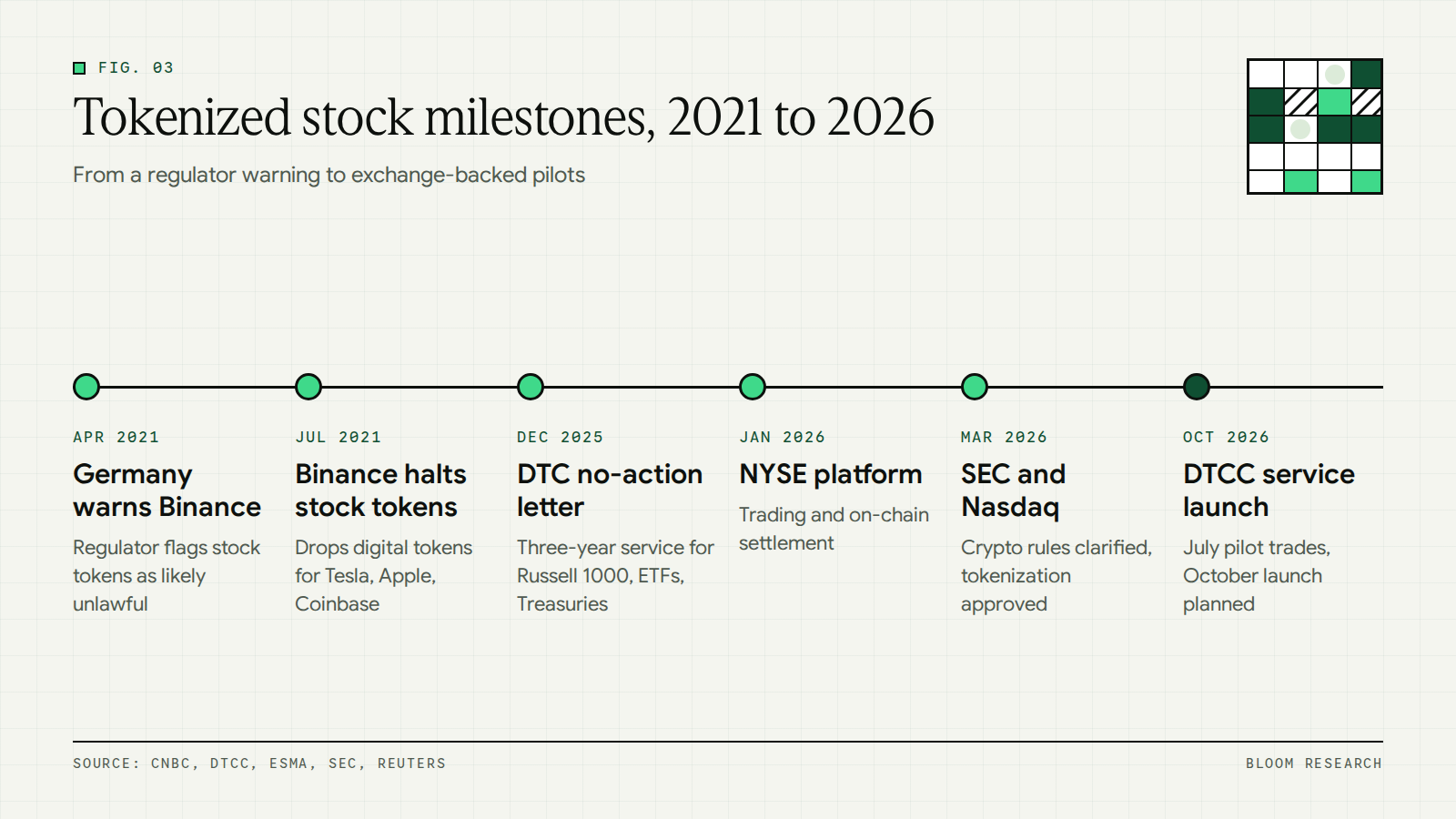
Earlier stock token offerings drew attention from regulators. In April 2021, Germany's financial watchdog warned that Binance had likely violated securities rules with the launch of its stock tokens. CNBC reported in July 2021 that Binance would no longer offer digital versions of stocks like Tesla, Apple and Coinbase.
DTC received its SEC no-action letter in December 2025, and the New York Stock Exchange announced its tokenized securities platform in January 2026. SEC staff published their statement on tokenized securities on January 28, 2026, and the SEC approved the Nasdaq proposal in March 2026. DTCC plans to launch its tokenization service in October 2026, and the timeline figure above shows these dates in order.
#Benefits and risks of tokenized stocks
The benefits and risks of tokenized stocks depend on the structure behind the token, so a custodial or backed token, a synthetic token and an issuer-native share each carry a different mix.
Benefits
- Fractional access: on Bloom the minimum trade is $1, and fractional shares are supported down to six decimal places.
- A token in your own wallet: a tokenized stock on Bloom can be held, sent, traded, lent, borrowed against or used as liquidity across DeFi (decentralized finance), meaning financial applications that run on public blockchains.
- On-chain transparency: proof of reserves is an independent third-party attestation that publishes share balances on-chain in real time. As our proof of reserves doc shows, each attestation publishes token supply, attested broker balance and a backing ratio for every asset, and every corporate-action adjustment is observable on-chain through the token contract.
- Automatic corporate actions: dividends are used to buy more underlying shares, and stock splits, spin-offs, mergers and name changes are reflected in the on-chain value of the token. ESMA notes that smart contracts can support the automation of corporate actions such as dividend payments or stock splits.
ESMA says tokenization is often associated with extended trading hours and cross-border participation, and that these accessibility benefits are tangible but also reflect broader digitalization. It adds that fractional ownership can also be achieved through existing financial innovations.
Risks
- Issuer and counterparty risk: SEC staff say holders of tokenized securities issued by a third party may be exposed to risks of that third party, such as bankruptcy, that a holder of the underlying security would not necessarily face. ESMA adds that wrapped arrangements may introduce new counterparty dependencies, including tokenization platforms and underlying asset custodians.
- Custody risk: investor-protection arrangements apply within the jurisdictional limits of each broker, and that protection is not unlimited. If we discontinue operations, our security agent GenTwo works with the custodian to redeem tokens against the underlying shares, but redemption depends on the continued operation of the broker partner.
- Smart contract risk: every contract is audited, and no audit eliminates risk entirely. ESMA notes that errors in smart contract code can result in erroneous transfers or misallocation of rights, and that such errors can be difficult to reverse. A smart contract audit is an independent review of contract code before deployment, and our smart contract audits page lists the token, mint/redeem and proof-of-reserves attestation contracts that Sherlock audits, with a re-audit after every material change.
- Liquidity risk: the tokenized security issuers that quote prices may withdraw liquidity in extreme conditions, and no quote returns until liquidity returns. ESMA notes that representations of the same equity that are not fully fungible can fragment liquidity across venues.
- Price divergence: overnight gaps may exceed your slippage tolerance, which is the maximum acceptable drift between quote and execution, 0.5% by default on Bloom. ESMA says fragmented liquidity could affect price discovery, market depth and execution quality, particularly in periods of stress.
- Rights: SEC staff say a security-based swap, one form of synthetic exposure, typically does not convey any equity, voting, information or other rights in the referenced security. ESMA notes that in wrapped structures legal ownership remains off-chain, so token transfers do not convey legal title. On Bloom, the token tracks the economic value of the share, meaning its price, dividends and corporate actions.
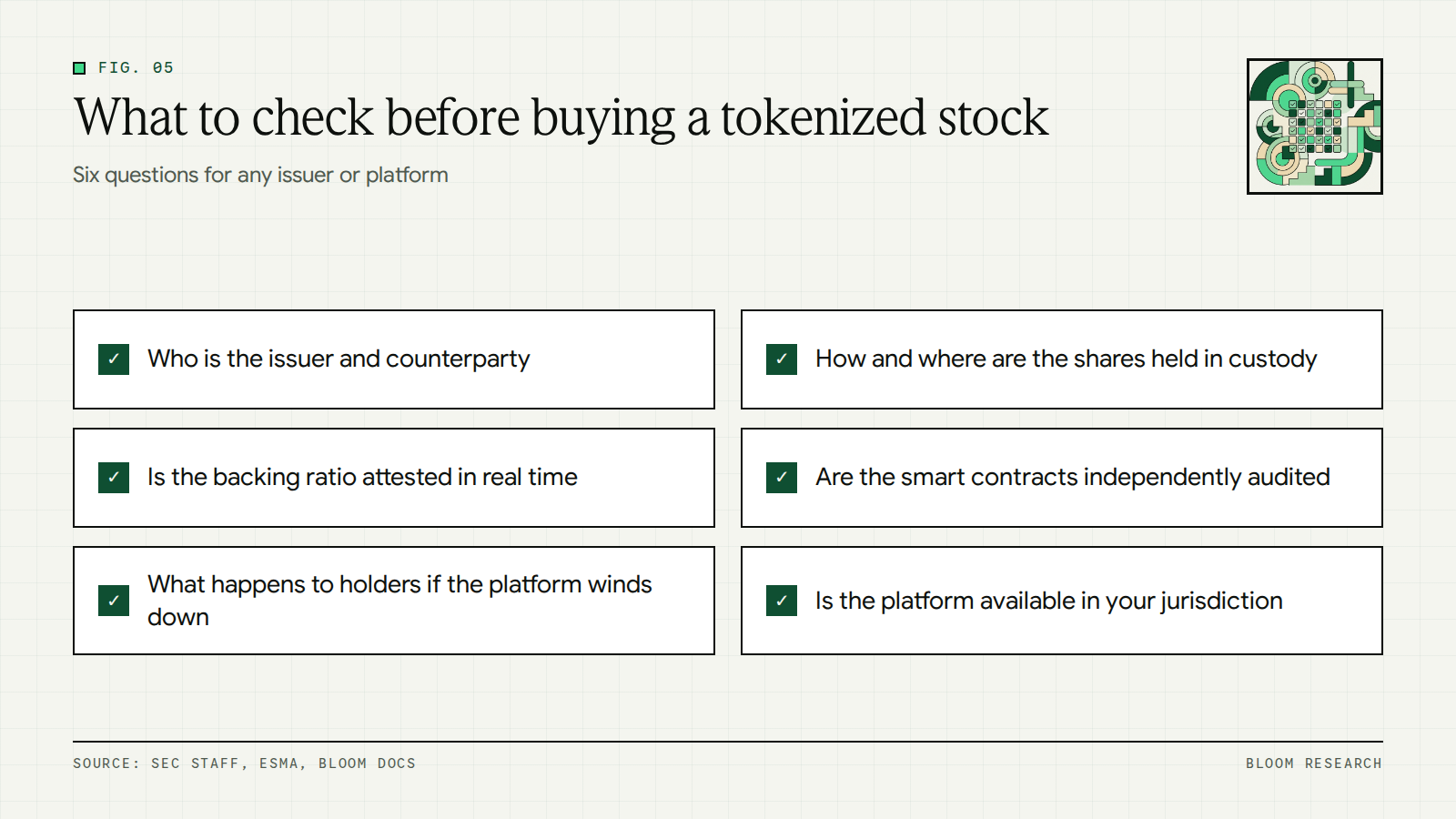
Why it matters: Before buying a tokenized stock on any platform, check who issues the token, where the underlying shares are held, whether and how often reserves are attested, which contracts were audited, what happens to tokens if the platform stops operating, and whether the service is offered where you live.
#Tokenized stocks vs traditional shares, ETFs and CFDs
The table below sets a tokenized stock on Bloom beside three related products. Investor.gov's ETF definition describes an ETF (exchange-traded fund) as an exchange-traded investment product that must register with the SEC as an open-end investment company or sometimes as a unit investment trust. The FCA describes a CFD (contract for difference) as a complex, leveraged derivative, and the FCA's CFD rules limit the leverage offered to UK retail consumers.
| Product | What it is | Settlement or delivery | Leverage | Source |
|---|---|---|---|---|
| Tokenized stock on Bloom | Token backed 1:1 by a real share held at a regulated US broker-dealer | On-chain transfer to your wallet, receipt in about 1 second | None on the token; not a synthetic or derivative position | Bloom docs |
| Traditional share | A share of ownership in a company | T+1 for most broker-dealer trades since May 28, 2024 | Depends on the account type | Investor.gov, SEC |
| ETF | Exchange-traded product registered with the SEC as an open-end investment company or unit investment trust | T+1 for most broker-dealer trades since May 28, 2024 | Depends on the account type | Investor.gov, SEC |
| CFD | A complex, leveraged derivative | No share is delivered; the position is a derivative | Between 30:1 and 2:1 for UK retail consumers | FCA |
Investor.gov says common stock entitles owners to vote at shareholder meetings and receive dividends. On Bloom, a dividend raises the token's NAV instead of paying cash, as covered above.
We also offer tokenized US ETFs, including broad-market and sector ETFs such as SPY, QQQ and VOO. Our guide to tokenized ETFs backed by SPY and QQQ shares explains how these tokens work and how dividends, custody and trading hours are handled.
#How to buy tokenized stocks on Bloom
Tokenized stocks are also listed on other venues, each with its own issuer, custody and eligibility rules; our guide on where to buy tokenized stocks on Bloom, Coinbase, Binance, Bybit and Kraken compares them side by side. Our comparison of the best tokenized stock platforms covers availability in India and the UK, issuer, custody, trading hours, fees and number of assets on each platform.
- Sign in with Privy using Apple, Google, email, a passkey or an external wallet. Privy provisions an embedded wallet using multi-party computation (MPC), so no single party, including us, holds your complete private key.
- Add funds, for example by receiving USDC from an external wallet; the funding sheet only shows methods that work on your current device. Per-chain crypto deposits have a minimum of $10 to $50 depending on the chain and asset, and your trading balance is a unified USD balance backed 1:1 by USDC and USDT. Balances are per chain, the deposit screen lists the supported chains at runtime, and our smart contract addresses are published for Arbitrum One, chain ID 42161.
- Pick a stock or ETF from the assets we list: single-listed US equities on NYSE, NASDAQ and AMEX, and US ETFs.
- Open the trade sheet, which shows a live quote, your slippage tolerance and a fee breakdown. The trading fee ranges from 0.10% to 0.20% based on 14-day trading volume, 0.20% by default, and the quoted price already includes it. Network gas is charged per trade, as our pricing page shows.
- Confirm the trade. You get an on-chain receipt within about 1 second, as the first-trade guide shows. If the market is closed, the order is queued and executes automatically at the next market open.
- Hold, sell or withdraw. Dividends and corporate actions such as splits, spin-offs, mergers and name changes are reflected in the token's NAV, as how we handle dividends and corporate actions explains.
On Bloom: Reserves are independently attested in real time by Accountable, a third-party proof-of-reserves provider. The Transparency page shows the live token supply, attested broker balance and backing ratio for every asset.
#Where to go next
Every stock and ETF we offer appears in the full list of tokenized stocks on our markets page. To practice with virtual funds first, our paper trading guide explains how paper trading works.
Trading on Bloom carries risk, including the loss of principal, and market, smart contract, custody, bridging and liquidity risks apply, as our risk disclosure sets out. We do not offer our product or services to users in the United States or in other restricted jurisdictions, as the service availability section of our legal page states.
Frequently asked questions
What are tokenized stocks?
Tokenized stocks are blockchain tokens that represent shares of a listed company or give exposure to their price. In a statement of January 28, 2026, SEC staff define a tokenized security as a security formatted as or represented by a crypto asset, with the record of ownership maintained in whole or in part on one or more crypto networks. Investor.gov notes that tokenized securities are also called digital securities.
Is it safe to buy tokenized stocks?
Tokenized stocks carry risks that depend on the structure. SEC staff note that holders of third-party tokenized securities may be exposed to risks of the third party, such as bankruptcy. On Bloom, investor-protection arrangements apply within the jurisdictional limits of each broker and are not unlimited. Every contract is audited, but no audit eliminates risk entirely, and the issuers that quote prices may withdraw liquidity in extreme conditions. Our transparency page shows the live token supply, attested broker balance and backing ratio for every asset.
Where can I buy tokenized stocks?
You can buy tokenized stocks on Bloom, where each token is backed 1:1 by a real share held in custody at a regulated US broker-dealer such as Alpaca Markets or Interactive Brokers. The minimum trade is $1, and no maximum is imposed by the platform. We do not offer our product or services to users in the United States or in other restricted jurisdictions, so availability depends on where you live.
Are tokenized stocks legal?
Legal status depends on the structure of the token and on the investor's jurisdiction. SEC staff stated on January 28, 2026 that the onchain or offchain format of a security does not affect application of the federal securities laws. In March 2026 the SEC approved a Nasdaq proposal to allow certain stocks to be traded and settled in tokenized form. In the EU, MiCA covers crypto-assets not currently regulated by existing financial services legislation. We do not offer our services in the United States.
Do tokenized stocks pay dividends?
It depends on the structure. Investor.gov says issuer-native tokenized shares carry the same legal rights, including dividends, as a traditional share of the same class, while the rights of a synthetic token holder may differ significantly. On Bloom, when the underlying company pays a dividend, the cash is used to buy more of the underlying shares, and the on-chain NAV of the token increases to reflect the added shares per token.
What is the difference between a tokenized stock and a CFD?
The FCA describes contracts for difference (CFDs) as complex, leveraged derivatives that are typically offered to retail consumers through online trading platforms. FCA rules limit CFD leverage for UK retail consumers to between 30:1 and 2:1, depending on the volatility of the underlying asset. On Bloom, every token is backed 1:1 by a real share held in regulated custody, not a synthetic or derivative position.
Can I buy tokenized US stocks from India?
Under the Liberalised Remittance Scheme (LRS), resident individuals can remit up to USD 250,000 per financial year for permissible current or capital account transactions. From April 1, 2026, banks apply TCS on other LRS purposes, such as investing, at nil up to ₹10 lakh and 20% above ₹10 lakh. CBDT says accurate Schedule FA reporting of foreign assets is mandatory. Because we settle in USD stablecoins, an India investor also holds INR/USD exchange-rate exposure.