
Ondo Global Markets Explained: How Its Tokenized Stocks Work
Ondo Global Markets, now called Ondo Stocks, explained: how Ondo tokenized stocks are structured, backed, minted and redeemed, who can buy them, and when.
Key takeaways
- Ondo Global Markets is the former name of Ondo Stocks, the platform through which Ondo Global Markets (BVI) Limited issues tokenized US stocks and ETFs such as TSLAon.
- Each Ondo tokenized stock is a structured note from a BVI special purpose vehicle, backed 1:1 plus a buffer by shares held at US-registered broker-dealers, with Ankura Trust Company as Security Agent.
- Holders get economic exposure with dividends reinvested net of withholding tax, but no voting or other shareholder rights, and one token can represent more than one share over time.
- Direct minting and redemption start at $1.00, use USDon or USDC, and run 24/5 from Sunday 8:05 pm to Friday 7:59 pm ET, with Off-Hours trading for select assets.
- Tokens are offered only to eligible non-US persons under Regulation S; UK residents must qualify as Professional Clients or Qualified Investors, and India is not named on Ondo's prohibited or restricted lists.
Ondo Global Markets is Ondo Finance's platform for tokenized US stocks and ETFs, and Ondo's website now calls it Ondo Stocks. Its tokens, such as TSLAon for Tesla, are issued by Ondo Global Markets (BVI) Limited and offered only to eligible investors outside the United States.
This guide explains how Ondo tokenized stocks work, using Ondo's own documentation and announcements as checked on September 28, 2026. We run Bloom, a separate app for tokenized US stocks, and we cover the wider category in our complete guide to tokenized stocks. Here we focus on Ondo's legal structure, backing, minting, pricing, hours, chains and eligibility, with notes for readers in India and the United Kingdom.
#What is Ondo Global Markets?
Ondo Global Markets is a tokenization platform that provides onchain exposure to publicly traded securities, including stocks and ETFs. The FAQ on Ondo's product page asks "What is Ondo Stocks (previously known as Ondo Global Markets)?", so both names refer to the same platform. In this guide, Ondo GM, Ondo Global Markets and Ondo Stocks all mean that one platform.
Each token adds the suffix on to the stock ticker, so the Ondo tokenized stock for Tesla (TSLA) is called TSLAon.
Ondo announced the launch on September 3, 2025. Non-US investors could then buy and sell tokenized versions of 100+ US stocks and ETFs, with a stated plan to scale to over 1,000 by year-end. The tokens launched on Ethereum, with BNB Chain and Solana listed as coming soon.
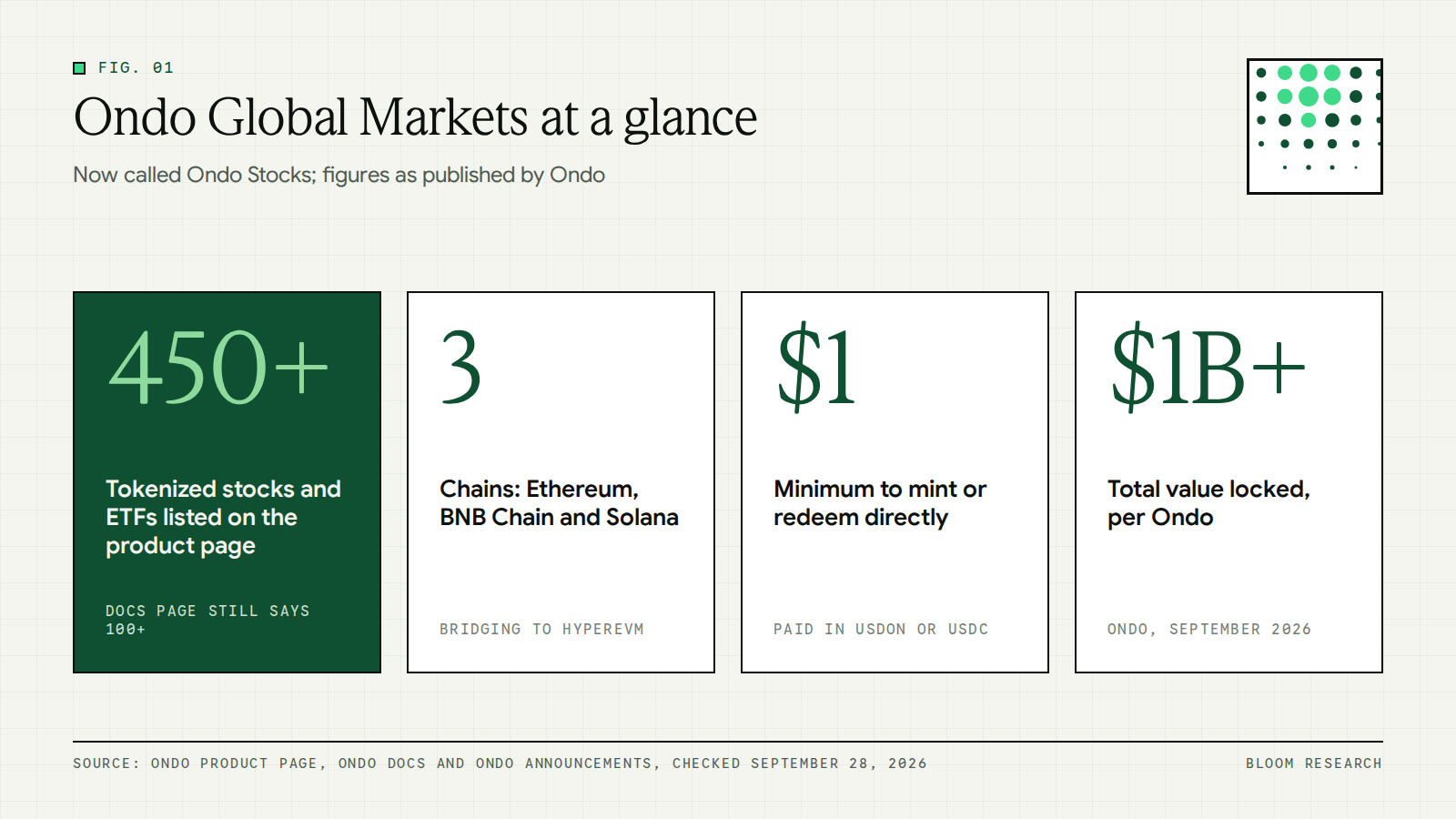
As of September 28, 2026, Ondo's product page lists 450+ tokenized stocks and ETFs, while the Available Assets page in its docs still says 100+. Both pages point to Ondo's web app for the complete list. The docs add that Ondo currently tokenizes only securities trading on the NYSE and NASDAQ exchanges.
Ondo Global Markets at a glance
The table below summarizes the main terms from Ondo's docs and product page.
| Item | What Ondo publishes |
|---|---|
| Issuer | Ondo Global Markets (BVI) Limited, a bankruptcy-remote SPV in the British Virgin Islands |
| Legal form | Structured note (a debt instrument); holder rights governed by Swiss law |
| Backing | Fully backed 1:1 by the underlying securities plus a buffer, and cash in transit |
| Custody | One or more US-registered custodial broker-dealers |
| Verification and Security Agent | Ankura Trust Company |
| Chains | Ethereum, BNB Chain and Solana, with bridging to HyperEVM |
| Direct trading hours | 24/5, generally Sunday 8:05 pm to Friday 7:59 pm ET, plus Off-Hours trading for select assets |
| Minimum | $1.00 to mint or redeem |
| Fees | No mint or burn fees; the quote spread is retained by the platform; investors pay their own gas |
| Who can mint or redeem | Eligible non-US persons who complete onboarding, including KYC |
#How Ondo tokenized stocks are structured
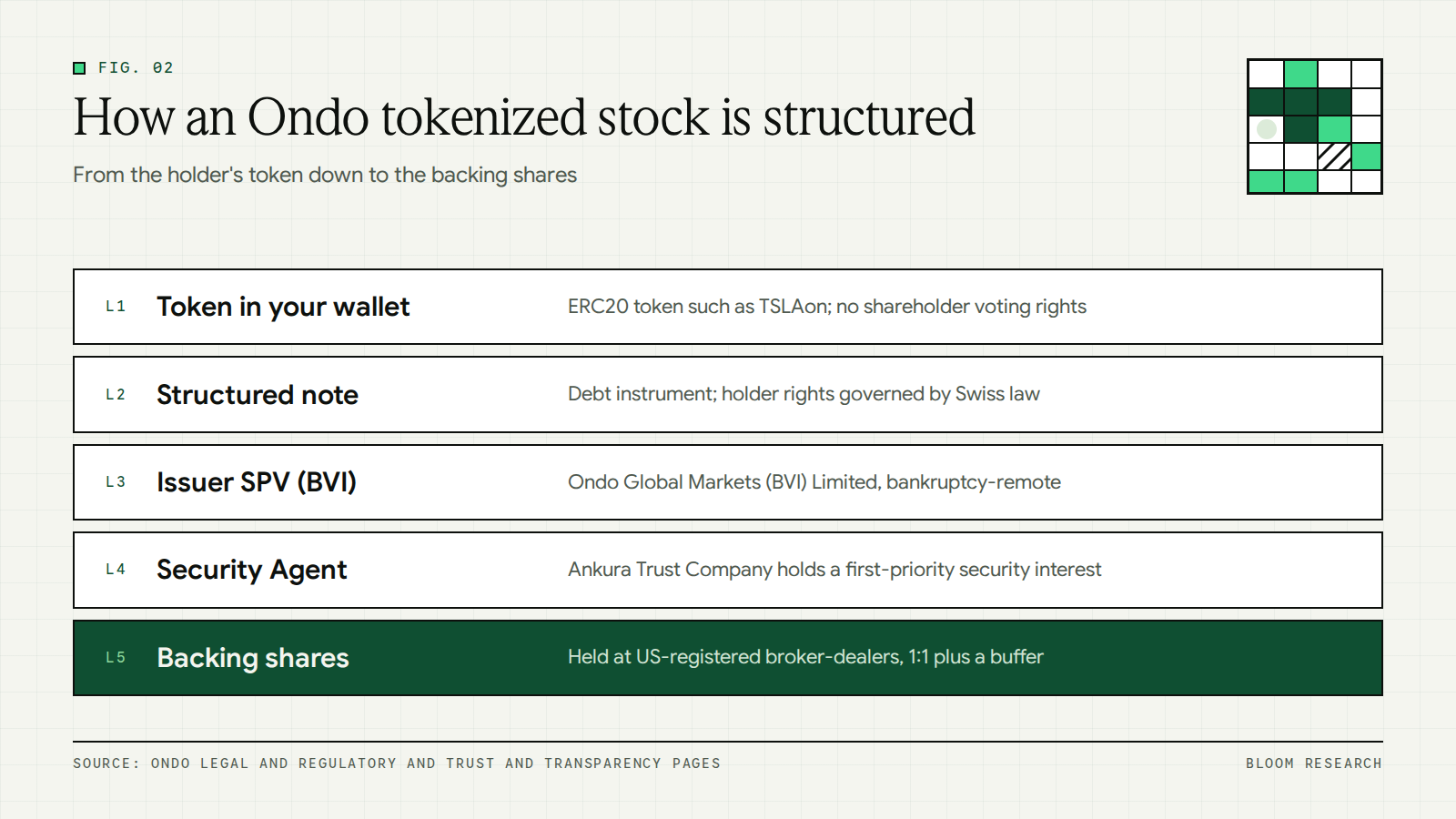
Ondo's Legal and Regulatory page says each token is "a structured note: a debt instrument issued by Ondo Global Markets (BVI) Limited". The amount payable to the note holder changes with the value of the underlying asset, including corporate actions such as dividends, spin-offs and acquisitions.
Definition: A structured note is a debt instrument whose payout is linked to the value of another asset. For an Ondo tokenized stock, that asset is the corresponding US stock or ETF.
The issuer is a bankruptcy-remote special purpose vehicle (SPV) organized in the British Virgin Islands. An SPV is a separate legal entity set up for a narrow purpose. Ondo's Trust page says this SPV is wholly separate from Ondo Finance Inc. and the Ondo Foundation group, and its board includes an independent director.
Tokenholder rights and obligations are governed by Swiss law under the issuer's Sales Terms. Ondo's Secondary Market Restrictions page adds that disputes involving the issuer are resolved by arbitration seated in Zurich, Switzerland.
Ondo Global Markets (BVI) Limited is 90.01% owned by Flux Finance Inc., a wholly owned subsidiary of the Ondo Foundation, and 9.99% owned by Ondo Finance Inc. Ondo Finance Inc. serves as the technology and service provider to the issuer.
The issuer relies on Regulation S, an exemption from registration under the US Securities Act of 1933. Under it, Ondo sells tokens only to persons located outside the United States who are not US persons, are not acting for a US person and are not placing a buy order from the United States. The general mint, settle and redeem cycle for tokenized shares is covered in our guide to the tokenized stock lifecycle.
What a holder owns and what a holder does not
Ondo's overview says the tokens give economic exposure to the underlying asset, not direct title to it. Eligible holders who have completed onboarding can redeem tokens for cash or stablecoins at the then-value of the underlying assets. They receive no shareholder voting rights, statutory information rights or other shareholder rights from the company that issued the shares.
The underlying shares are held in the name of, or for the benefit of, the issuer, so holders do not appear on the share register. Holders do have a first-priority perfected security interest in those assets. A security agent is a third party that holds that interest for noteholders and can enforce it if the issuer defaults.
US regulators have addressed third-party structures of this kind. In a January 28, 2026 SEC staff statement on tokenized securities, the SEC's Divisions of Corporation Finance, Investment Management and Trading and Markets said the format of a security, onchain or offchain, does not affect how federal securities laws apply. The staff also said holders of third-party tokenized securities may be exposed to risks of the third party, such as bankruptcy.
Key point: An Ondo tokenized stock is a note issued by a BVI company, not a share of the underlying company. It tracks the share's economic value and carries a claim on collateral, but it carries no voting or other shareholder rights.
#How Ondo backs its tokens: custody, agents and reporting
Ondo's Trust and Transparency page says every token is fully backed by its underlying stock or ETF, together with cash in transit. The issuer must also keep additional collateral above this full backing at all times, so its obligations to tokenholders are overcollateralized.
The same page says all holdings are held with one or more US-registered custodial broker-dealers. Ondo's product page also names US-chartered national trust companies as possible holders of the underlying assets.
Ankura Trust Company acts as both Verification Agent and Security Agent. As Verification Agent, it reviews and verifies the existence and amounts of the underlying securities daily. As Security Agent, it can take possession of the collateral, exchange it for cash and distribute the proceeds to tokenholders in specified events of issuer default.
Ondo lists three kinds of reporting on its Trust page:
- Daily reports on the holdings and net asset value (NAV) of the product, independently reviewed by Ankura Trust.
- Monthly reconciliation reports, made public by the 20th of the following month.
- Annual financial audits by an independent audit firm, made available to investors.
Spearbit and Cyfrin have audited the token smart contracts. Ondo's Trust page also describes a contractually obligated insurance fund from the Ondo Foundation, through Flux Finance, Inc., to further collateralize the issuer's obligations to tokenholders. The launch post adds that the underlying backing securities are never lent out without express tokenholder consent.
#How minting and redemption work on Ondo Stocks
Minting creates a new token when an investor buys directly from the issuer, and redemption returns the token to the issuer for its value. On Ondo Stocks, only eligible users who have successfully completed onboarding can mint or redeem directly on the platform.
All tokens bought from the platform are purchased with USDon, Ondo's native stablecoin. The platform's stablecoin swapper converts USDC to USDon 1:1 for mints, and converts USDon back to USDC 1:1 for redemptions, inside the same transaction.
USDon and the steps to mint and redeem
USDon is a stablecoin backed 1:1 by a US dollar in one of Ondo Stocks' brokerage accounts. When a holder sells a token for USDC, the platform first redeems it for USDon and then swaps that for USDC, all in one atomic transaction. An atomic transaction either completes every step or none of them.
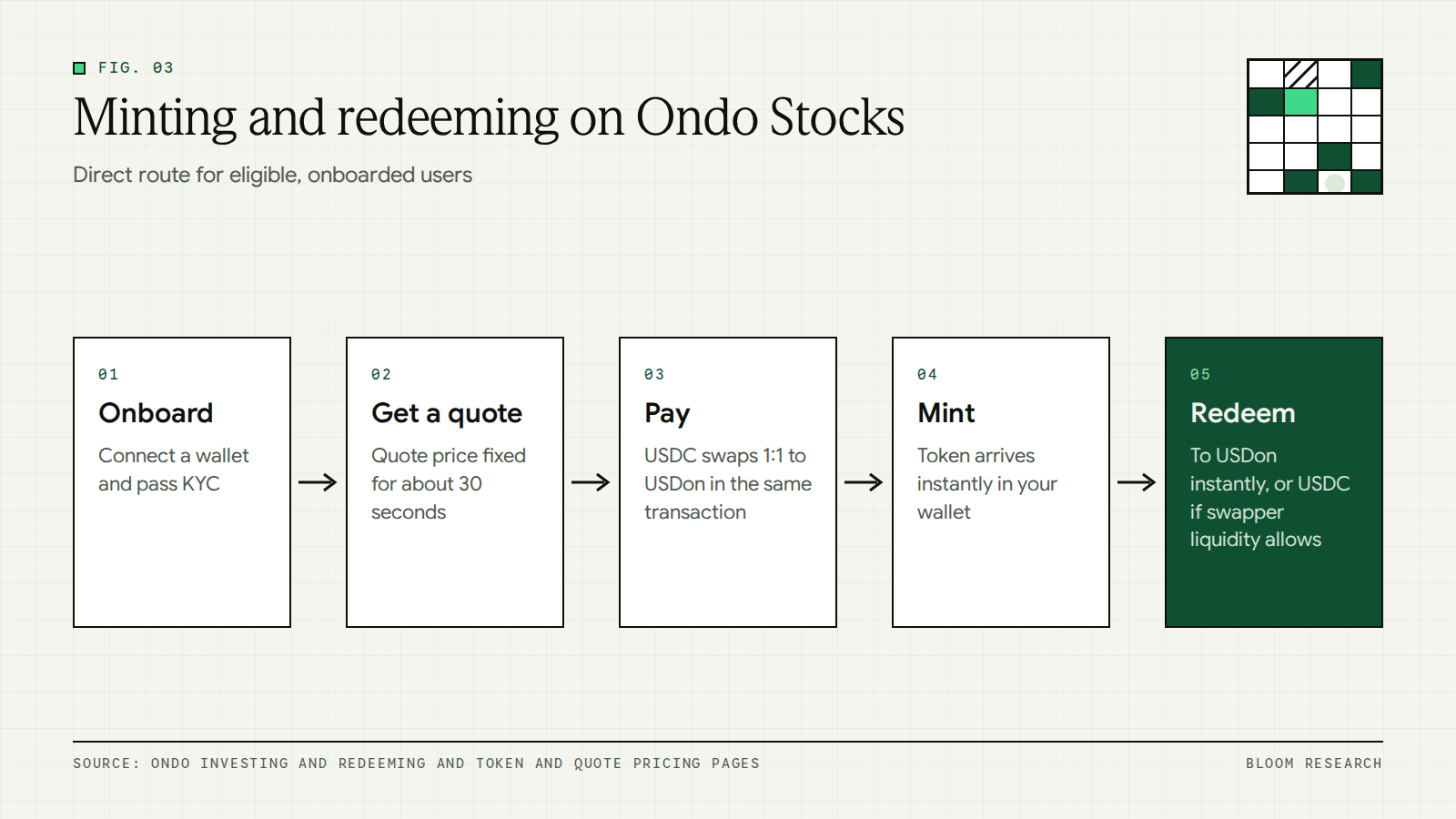
Ondo's Investing and Redeeming page and product page describe the direct purchase and sale in these steps:
- Connect a wallet to Ondo's web app and complete the onboarding process.
- Request a quote for a token and size; Ondo says the quote price is fixed for about 30 seconds.
- Pay with USDC or USDon; the swapper converts USDC to USDon 1:1 and USDon buys the token.
- Receive the token in the same transaction, since Ondo says minting of new tokens is instant.
- To exit, redeem to USDon, which is always instant, or to USDC, which is instant when the swapper has enough liquidity.
The minimum to invest or redeem is $1.00, and investors can buy less than one full token. Buying tokens directly by bank wire is not currently supported. Buying USDon by bank wire is available only to those investing $500,000 or more, and redemptions to USD by bank wire are unavailable for now.
The instant USDC route has one limit: the swapper must hold enough of the other token. Users are not whitelisted by default to swap between USDon and USDC on their own, and the swapper does not currently have a user interface.
How it works: In Ondo's own AAPL example, the Ondo Stocks platform acquires AAPL through a US-registered broker-dealer. The underlying shares are held with a regulated custodian, and the user receives a fully backed AAPLon token.
Ondo charges no mint or burn fees. The quoted price may be slightly more or less than the price at which Ondo Stocks buys or sells the underlying stock, and Ondo Stocks retains any difference and any fees. Investors pay their own gas, and other parties may charge fees on tokens bought in the secondary market.
#How Ondo prices tokens: total return and corporate actions
Ondo designs each token as a total-return tracker of its underlying security. The token price therefore reflects both price movements and reinvested dividends or interest, net of withholding tax.
Definition: A total-return tracker is an asset designed to mirror the complete performance of another asset. It captures price changes plus income such as dividends or interest, assuming that income is reinvested.
Ondo's pricing page gives a simplified example with a stock called ACME and a token called ACMEon, both starting at $100. ACME pays a $10 dividend and, for ease of math, Ondo assumes 50% withholding, so $5 buys 0.05 more shares. One ACMEon token then represents 1.05 shares, and if ACME rises to $110, the token moves from $105 to $115.50.
Ondo therefore says the token price will not match the underlying share price over time. The shares per token for each asset are published onchain and shown in Ondo's web app.
On Solana and BNB Chain, supported wallets and explorers apply a display multiplier. With a multiplier of 1.05, a holding shown as 1 token at $105 appears instead as 1.05 displayed units at $100 each. Ondo says this changes only the display, not the onchain balance or the economic exposure.
Withholding tax and other corporate actions
Dividends reach the issuer net of withholding tax, and the issuer is a BVI entity. For dividends from US companies the rate is 30%, so a $1 AAPL dividend would be reinvested as $0.70. Distributions from US fixed-income ETFs are also subject to 30%, though some portions, such as US Treasury interest, may be exempt.
Ondo withholds no other taxes, such as capital gains or income tax, and withholds nothing when tokens are redeemed. Its Fees and Taxes page says each investor is solely responsible for understanding, reporting and fulfilling their own tax obligations.
Trading in a stock or ETF may pause from 7:50 pm to 8:10 pm ET on the day before a dividend ex-date. When a fixed-income ETF's distribution is not yet known, the platform halts trading until the amount can be incorporated. Corporate actions and material news announced while US markets are closed may not appear in token pricing until they are processed.
We handle dividends in a similar economic way: dividends are reinvested into the token's NAV on Bloom, and there is no separate cash distribution to your wallet.
#Ondo trading hours: 24/5 sessions and Off-Hours trading
Ondo's Market Hours page says the platform is generally open from 8:05 pm ET Sunday to 7:59 pm ET Friday when US markets are open, in four sessions:
- Pre-Market: 4:01 am to 9:29 am ET.
- Core Session: 9:31 am to 3:59 pm ET.
- Post-Market: 4:01 pm to 7:59 pm ET.
- Overnight: 8:05 pm to 3:55 am ET.
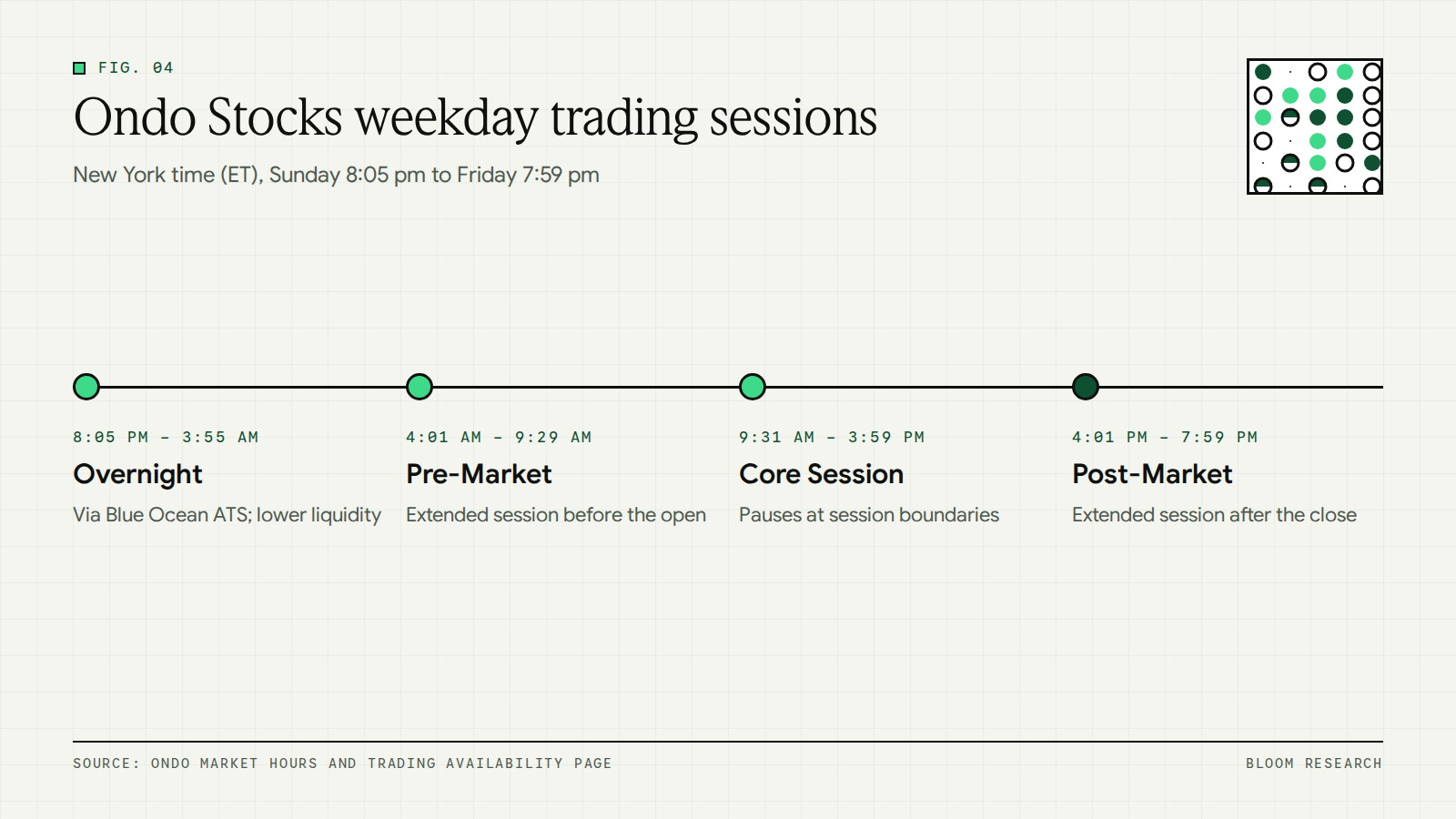
The gaps between sessions exist because Ondo may halt trading for a few minutes before and after each new session begins at the underlying venue. The page also mentions 1-5 minute pauses. Trading is halted on NYSE market holidays, during maintenance, and when proprietary risk control thresholds are met.
For the overnight session, Ondo says it uses Blue Ocean, an alternative trading system (ATS). According to the Blue Ocean ATS FAQ, it matches orders in US National Market System stocks from 8:00 pm to 4:00 am ET, Sunday to Thursday.
Overnight liquidity is generally lower, so bid-ask spreads can be wider and maximum order sizes smaller than in other sessions. Ondo says the same caveats apply in the Off-Hours session, and are typically more pronounced there.
Note: The Off-Hours session runs when US markets are fully closed, mainly from Friday evening until Sunday evening and on US market holidays, including early-close days. Only a select set of assets is enabled, such as AAPLon, NVDAon, SPYon, QQQon and TSLAon, on Ethereum, BNB Chain and Solana.
Each Off-Hours asset has its own trading limit, set conservatively and separate from its regular-session limits. When an asset reaches that limit, quote requests may be declined until the limit frees up.
How Ondo's hours relate to US exchange sessions
The NYSE hours and calendars page sets the core trading session at 9:30 am to 4:00 pm ET. Ondo's core window starts one minute later and ends one minute earlier because of its session-boundary pauses. Our guide to US stock market hours lists these sessions in IST, GMT, CET and other time zones.
US exchanges have no Saturday session, as our guide on how weekend trading of US stocks works explains. On Bloom, orders placed outside market hours are queued and execute at the next open.
#Chains, partners and where Ondo tokens trade
Ondo tokenized stocks launched on Ethereum and have since expanded to other networks. Ondo's announcements give these dates:
- Ethereum: live at launch on September 3, 2025.
- BNB Chain: announced on October 29, 2025, with access to over 100 tokenized US stocks and ETFs.
- Solana: announced on January 21, 2026, bringing 200+ tokenized US stocks and ETFs.
- HyperEVM: supported through bridging, according to Ondo's Technical page.
The tokens are ERC20 compliant and transferable, so any smart contract or externally owned wallet, such as MetaMask or Trust Wallet, can hold them. Custodians including BitGo, Fireblocks, Zodia and Ledger also support them. Ondo notes that most centralized exchange custodial accounts, such as Binance and Coinbase, do not yet support holding them.
On February 24, 2026, Ondo announced ten tokens on Binance Alpha, including AAPLon, NVDAon and SPYon. On September 22, 2026, Ondo announced Ondo Stocks on near.com and NEAR Intents, starting with 20 assets, and described the platform as having $1B+ in TVL and $26B+ in trading volume.
Ondo's product page says the tokens are used as collateral for lending and borrowing on Morpho and for perps trading on Ondo Perps. It also lists venues such as 1inch Fusion, UniswapX, MetaMask, Gate, Blockchain.com, KuCoin and MEXC.
Buying a token on a third-party venue does not make a holder eligible to redeem it. Ondo says holders who have not completed onboarding can only keep their tokens or transfer or sell them on a secondary market where permitted. Our guide to where tokenized stocks can be bought covers venues across issuers.
#Who can buy Ondo tokenized stocks: eligibility and restricted jurisdictions
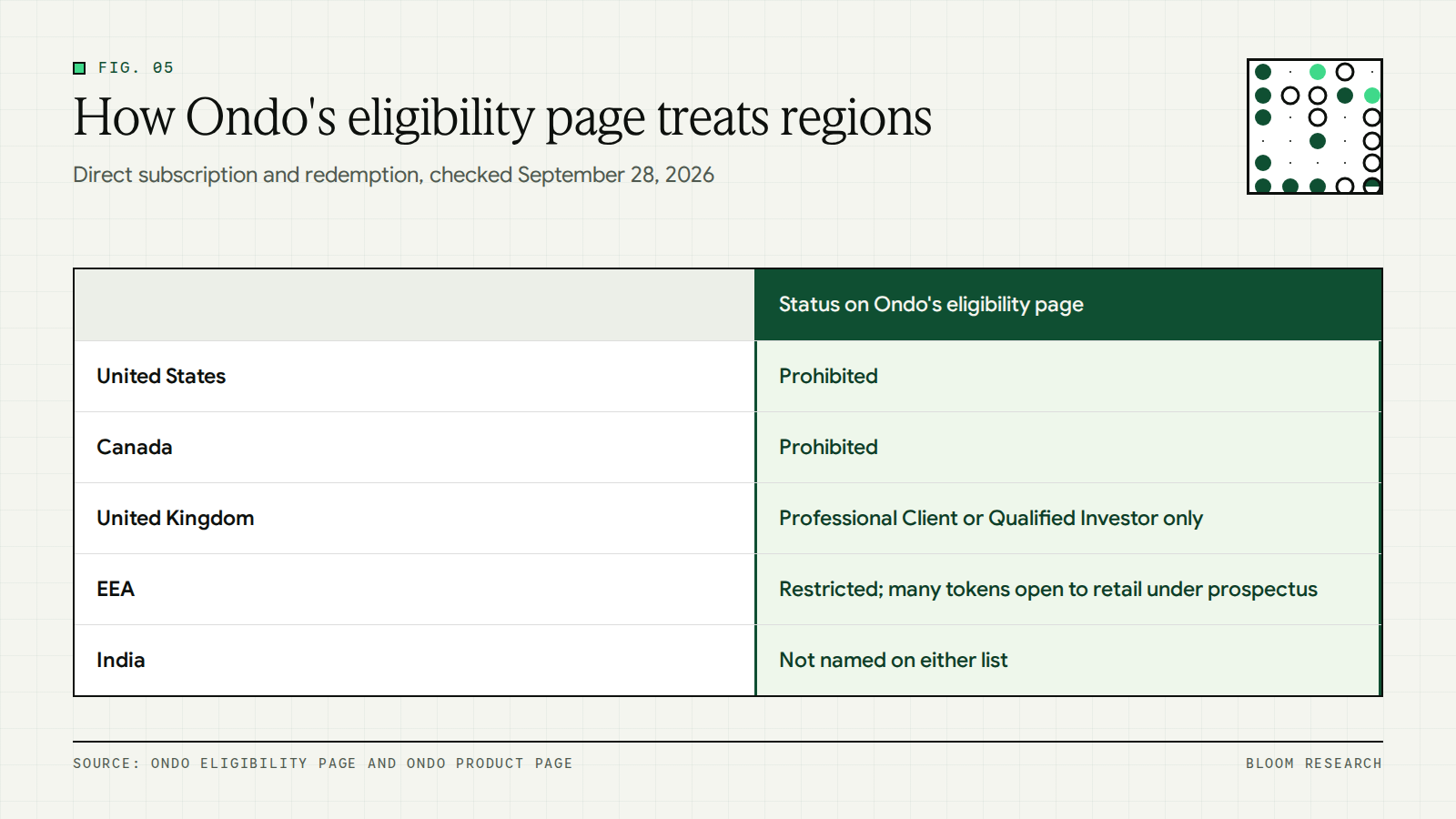
Ondo Stocks are offered only outside the United States and only to eligible non-US persons. Ondo's Eligibility page then sorts jurisdictions into two groups.
Persons in prohibited jurisdictions cannot subscribe for, acquire or redeem the tokens. The list includes Afghanistan, Belarus, Canada, Cuba, Iran, Russia, Syria and the United States, among others. The issuer may also refuse persons if it decides their activity may violate laws, sanctions or its governing documents.
Persons in restricted jurisdictions must meet a local investor-status test before tokens are issued to them. The restricted list covers Brazil, the European Economic Area, Hong Kong, Malaysia, Singapore, Switzerland and the United Kingdom. In the EEA, a base prospectus approved by the Financial Market Authority Liechtenstein makes many Ondo Stocks available to both professional and retail investors.
Important: Ondo's Onboarding and KYC page says that, at present, onboarding is open to institutional participants only. It says onboarding for retail users and individuals will be available through Ondo's web app in the near future.
Know your customer (KYC) checks verify a person's identity before a firm serves them. Ondo's onboarding confirms that an applicant is not a US person, not in a restricted jurisdiction and not sanctioned, and adds identity verification (KYC) and anti-money-laundering (AML) checks. Ondo uses Persona for KYC, aims to review materials within 3-4 business days, and then allowlists approved wallet addresses.
What the eligibility page says for India
India is not named in either the prohibited list or the restricted table on Ondo's Eligibility page, as checked on September 28, 2026. Ondo adds that the issuer also imposes eligibility criteria under its know-your-customer policies, so onboarding still decides who can mint or redeem.
Indian residents who invest abroad do so under the Liberalised Remittance Scheme (LRS), the Reserve Bank of India framework for outward remittances by resident individuals. The RBI's LRS FAQ allows up to USD 250,000 per financial year for permitted current or capital account transactions, including investment. Our India page notes that treatment of tokenized securities can differ from directly held shares.
What the eligibility page says for the United Kingdom
For the United Kingdom, Ondo requires a person to be a Professional Client under MiFID II or a Qualified Investor under the Prospectus Regulation. Ondo's product page states that in the UK the tokens are offered and sold only to qualified investors or professional clients.
A professional client is a client that is either a per se professional client or an elective professional client. The FCA's COBS 3.5 rules on professional clients set a quantitative test for elective status that requires at least two of three criteria. These are an average of 10 transactions of significant size per quarter over the previous four quarters, a financial instrument portfolio above EUR 500,000, and at least one year of professional work in the financial sector. Our United Kingdom page notes that because we settle in US-dollar stablecoins, a sterling-based investor also holds GBP/USD exposure.
#How we structure tokenized stocks on Bloom
We run a separate tokenized stock product, and our docs explain how a tokenized stock works on Bloom. Each Bloom asset is an on-chain token backed 1:1 by a real share in custody at a regulated US broker-dealer such as Alpaca Markets or Interactive Brokers. The token is held in your own embedded wallet.
Our custody and backing page explains that if Bloom discontinues operations, the security agent GenTwo works with the custodian to redeem tokens against the underlying shares. Reserves are attested in real time by Accountable, a third-party provider, and our proof of reserves documentation shows live token supply, attested broker balance and backing ratio for every asset.
On Bloom: Every trade is priced by RFQ, where a regulated tokenized security issuer returns a live quote typically valid for 5 to 10 seconds. Dividends are used to buy more underlying shares, and the token's NAV rises instead of paying cash.
We offer US stocks listed on NYSE, NASDAQ and AMEX and US ETFs such as SPY, QQQ and VOO. Our documentation of available assets sets out how new listings are added, and the live markets page shows every asset you can trade today.
#Risks to understand before holding Ondo tokenized stocks
Ondo's own documents describe several risks and limits that apply to its tokens:
- Holders receive no shareholder voting, information or other shareholder rights, and the token price diverges from the share price over time.
- The issuer does not guarantee that any secondary market exists or will exist, or that there will be sufficient liquidity in it.
- Redemption requires the holder to pass the issuer's KYC checks, and the issuer may refuse a redemption on legal or compliance grounds.
- Payments by the issuer are limited to sums recovered from the collateral for the tokens, and purchasers have no further recourse to the issuer.
- Trading can halt for corporate actions, risk limits, maintenance and holidays.
Trading tokenized stocks on Bloom carries risk, including loss of principal, and market, smart contract, custody, bridging and liquidity risks apply, as set out in our risk disclosure.
We do not offer our product or services in the United States or other restricted jurisdictions; our service availability page explains how access is limited by region. Nothing in this guide is investment, legal or tax advice.
Frequently asked questions
What does Ondo Global Markets do?
Ondo Global Markets is the platform Ondo Finance uses to offer tokenized US stocks and ETFs to eligible investors outside the United States. Ondo's website now calls it Ondo Stocks, previously known as Ondo Global Markets. The tokens carry an on suffix, such as TSLAon for Tesla, and are issued by Ondo Global Markets (BVI) Limited, a special purpose vehicle in the British Virgin Islands.
Is Ondo Global Markets the same as Ondo Stocks?
Yes. The FAQ on Ondo's product page refers to Ondo Stocks as previously known as Ondo Global Markets, so both names describe the same tokenization platform. The issuer of the tokens is still called Ondo Global Markets (BVI) Limited. Ondo's documentation now sits under the Ondo Stocks section of its docs site.
Are Ondo tokenized stocks backed by real shares?
Ondo's docs say each token is fully backed 1:1, plus a buffer, by the corresponding underlying securities held via a regulated custodial broker-dealer, together with cash in transit. Ankura Trust Company verifies the holdings daily and, as Security Agent, holds a first-priority security interest in them for tokenholders. The token itself is a structured note, not a share.
Do Ondo tokenized stocks pay dividends or give voting rights?
Ondo tokenized stocks do not pay cash dividends to holders. Dividends are reinvested into the underlying stock, net of withholding tax, which is 30% for dividends from US companies because the issuer is a BVI entity. Holders receive no shareholder voting rights, statutory information rights or other shareholder rights from the company that issued the underlying shares.
Who can buy Ondo tokenized stocks directly from Ondo?
Only eligible non-US persons who complete Ondo's onboarding, including KYC and AML checks, can mint or redeem directly. Persons in prohibited jurisdictions such as the United States, Canada and Russia cannot. In restricted jurisdictions such as the United Kingdom, investors must meet a status test such as Professional Client. Ondo's onboarding page says onboarding is currently open to institutional participants only.
When can Ondo tokenized stocks be minted and redeemed?
Ondo's Market Hours page says the platform is generally available from 8:05 pm ET on Sunday through 7:59 pm ET on Friday whenever US markets are open, across pre-market, core, post-market and overnight sessions. A select set of assets can also trade in an Off-Hours session on weekends and US market holidays. Tokens can be transferred and traded peer-to-peer 24/7, subject to the operation of the platforms involved.