Where to Buy Tokenized Stocks in 2026: 5 Venues Compared
Where to buy tokenized stocks in 2026: Bloom, Coinbase, Binance, Bybit and Kraken compared by issuer, custody, hours, withdrawals and excluded regions.
Key takeaways
- As of September 26, 2026, tokenized stocks are offered on Bloom, as Coinbase tokenized stocks on Base, as Binance bStocks, and as xStocks on Bybit and Kraken.
- All five venues exclude US persons, and Bybit's xStocks FAQ, last updated July 30, 2026, lists India among the regions where xStocks trading is not available.
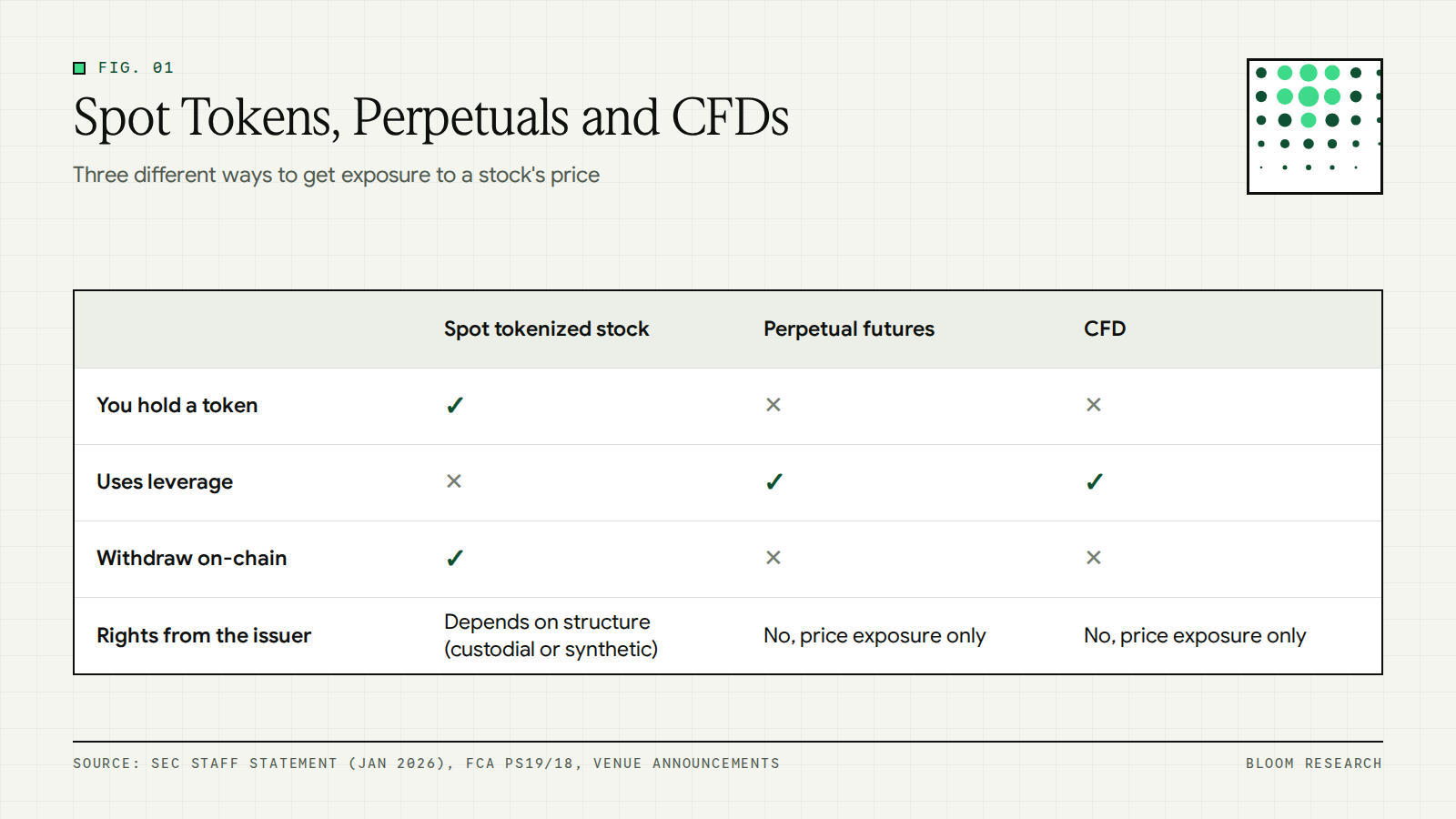
- Spot tokenized stocks differ from stock perpetual futures and CFDs, which are leveraged derivatives that give price exposure rather than a token backed by a share.
- Structures differ: our tokens are backed 1:1 by real shares, Binance bStocks are certificates backed 1:1 by shares, and Kraken says xStocks provide synthetic exposure with no voting rights.
- Indian residents remit funds for overseas investment under the LRS; from April 1, 2026 banks apply TCS at 20% above ₹10 lakh a year, and CBDT says Schedule FA reporting is mandatory.
As of September 26, 2026, the answer to where to buy tokenized stocks covers five venues: our platform, Bloom, Coinbase tokenized stocks on its Base network, Binance bStocks, and xStocks on Bybit and Kraken. Each venue is open only to eligible users outside the United States. The products differ in issuer, custody, trading hours, on-chain withdrawal and excluded countries, and some venues also list stock perpetual futures, which are derivatives and not tokens.
This guide assumes the basics covered in our guide to what tokenized stocks are. It explains the product types, compares where to trade tokenized stocks in a side-by-side table, and describes each venue. It then sets out a checklist, the India rules and the main risks.
#Where to buy tokenized stocks in 2026: the short answer
Five venues list tokenized US stocks for eligible users outside the United States as of September 26, 2026:
- Bloom: our tokenized US stocks and ETFs, each backed 1:1 by a real share at a regulated US broker-dealer, not offered in the United States. Our doc on how a tokenized stock works on Bloom covers the product.
- Coinbase: tokenized US stocks issued by Coinbase on Base, starting with AAPL, NVDA, META and GOOGL on August 24, 2026, for eligible investors outside the US.
- Binance: bStocks issued by BTech Holdings Limited, a Binance group affiliate, admitted to trading on June 12, 2026, for eligible users in permitted jurisdictions.
- Bybit: xStocks issued by Backed, listed on the Bybit Spot platform since June 30, 2025, not offered in the United States.
- Kraken: xStocks issued by Backed Assets (JE) Limited, with 100 xStocks listed as of March 18, 2026, for non-US clients in select countries.
Key point: All five venues exclude users in the United States or US persons. Each venue publishes its own eligibility rules, and the lists name different countries.
Our comparison of the best tokenized stock platforms covers availability in India and the UK, issuer, custody, trading hours, fees and number of assets on each platform. Our guide to how Ondo Global Markets tokenized stocks work covers another issuer, Ondo, including how its tokens are backed and who can buy them.
#Spot tokens, perpetual futures and CFDs are different products
A spot tokenized stock is a token you buy and hold that is backed by, or tracks, a share. Investor.gov describes tokenized securities as financial instruments, such as stocks, bonds or fund interests, formatted as or represented by a crypto asset recorded on a blockchain.
Perpetual futures, or perps, are derivatives with no expiry date that track a price and are traded with leverage. On February 24, 2026, Kraken launched tokenized equity perpetual futures for eligible non-US clients in over 110 countries, with leverage up to 20x. Bybit's TradFi perpetual contracts, launched in April 2026, are USDT-settled derivatives that track traditional asset prices, with up to 10x leverage. Coinbase launched stock perpetual futures on March 20, 2026, which give leveraged, synthetic exposure to US stocks and are not available to US persons.
A perp position is a derivative contract, not a token you can withdraw to a wallet. Kraken's disclosure states that trading derivatives involves a high level of risk and that you may lose more than your initial investment.
The FCA describes contracts for difference (CFDs) as complex, leveraged derivatives typically offered to retail consumers through online trading platforms. Under the FCA's rules on CFDs, firms must limit leverage for UK retail consumers to between 30:1 and 2:1, depending on the volatility of the underlying asset. Bybit TradFi lets users trade gold, forex, stock CFDs, indices and commodities from the Bybit app.
Backed tokens and synthetic exposure
In the SEC staff statement on tokenized securities, dated January 28, 2026, SEC staff describe two models in which a third party tokenizes securities issued by another person. These are custodial tokenized securities and synthetic tokenized securities. In the custodial model, the crypto asset represents the holder's indirect interest in the underlying security through a security entitlement.
In the synthetic model, a linked security issued by the third party provides synthetic exposure to a referenced security. SEC staff say it is not an obligation of the referenced security's issuer and confers no rights or benefits from that issuer.
Venue wording differs across these models. Kraken says each xStock is backed 1:1 by the underlying equity. Kraken's support page also says xStocks provide synthetic exposure to the value of the stock, with no voting rights and no legal claims to the underlying company shares.
Binance says each bStock is backed 1:1 by an underlying share held with a regulated custodian, and also says bStocks are not stocks or shares. Bybit's xStocks FAQ says xStocks do not grant holders voting rights, dividend entitlements or legal claims to the underlying shares.
ESMA reports that tokenized equities have mostly developed through wrapped structures, in which tokens represent a claim on, or economic exposure to, underlying shares held by a trusted party. Because legal ownership remains off-chain in these structures, ESMA notes that token transfers do not convey legal title.
#Tokenized stocks exchange comparison: five venues side by side
The table below uses each venue's published information as of September 26, 2026, and any cell without a source reads Not stated.
| Venue | Product | Issuer and structure | Custody of underlying shares | Withdraw on-chain | Trading hours | Excluded regions (as published) |
|---|---|---|---|---|---|---|
| Bloom | Tokenized US stocks and ETFs | Tokens backed 1:1 by real shares | Regulated US broker-dealers such as Alpaca Markets or Interactive Brokers | Yes: tokens are held in your own wallet and can be sent | Follows the underlying market; off-hours orders queue to the next open | United States and other restricted jurisdictions |
| Coinbase | Tokenized US stocks on Base | Issued by Coinbase under ADGM regulation, backed 1:1 | Alpaca, in a bankruptcy-remote structure | Yes: transferable with no whitelisted wallets | 24/7 in on-chain AMM pools | US; eligible jurisdictions outside the US only |
| Binance | bStocks | Certificates issued by BTech Holdings Limited, backed 1:1 | A regulated custodian | Yes: self-custody through BNB Chain-compatible wallets | 24/7 | US persons; permitted jurisdictions only |
| Bybit | xStocks (spot) | Issued by Backed Assets (JE) Limited | Regulated custodians in Switzerland and the US | Yes: Solana and Mantle networks | 24/7 on Bybit Spot | Bybit's list includes India, the UK and the EEA |
| Kraken | xStocks | Issued by Backed Assets (JE) Limited, backed 1:1; synthetic exposure, no voting rights | Not stated | Yes: Solana or Ethereum wallets | 24/5 on Kraken; 24/7 on-chain after withdrawal | US, Canada, UK, Australia and prohibited regions |
Note: Not stated means the sources we checked do not state it, not that the feature is absent. Eligibility lists change, so the current page of each venue governs: Kraken's support article was last updated July 29, 2026 and Bybit's xStocks FAQ on July 30, 2026.
On our platform, each asset has a trading session inherited from its underlying instrument, and orders placed outside market hours are queued and execute at the next open. Orders in extended sessions may partially fill, and assets with continuous markets fill immediately at the prevailing RFQ price, as our trading hours doc explains.
Our guide on how weekend orders work for US stocks covers how trading outside US exchange sessions works.
#Bloom: 1:1 backed tokens in your own wallet
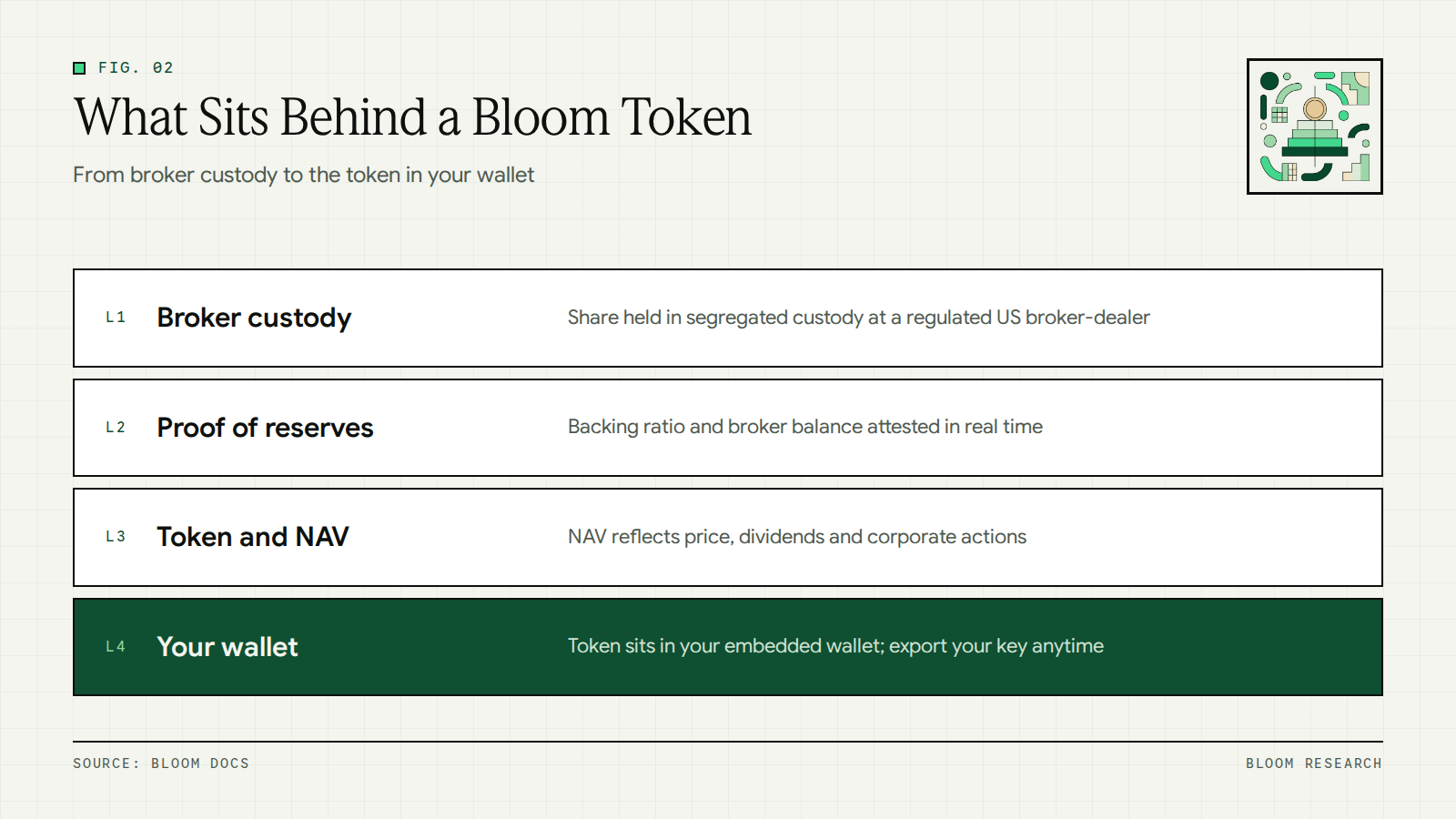
Each asset on our platform is an on-chain token backed 1:1 by a real share held in custody at a regulated US broker-dealer such as Alpaca Markets or Interactive Brokers. Customer assets are held separately from the broker's own funds, as our custody and backing doc explains.
Proof of reserves is a public record showing that the assets behind a token exist. Our reserves are attested in real time by Accountable, a third-party proof-of-reserves provider. For every asset, the attestation publishes the live token supply, the attested broker balance and a backing ratio that should be 1.0 or higher at all times, as described in how our proof of reserves works.
The token is held in your own embedded wallet, so you retain custody of it. You can export your private key at any time from Account, Security, as our embedded wallet doc describes and hold or send the token. The chains supported at any given moment are listed on the deposit screen at runtime, and our smart contract addresses are on Arbitrum One, chain ID 42161.
When an underlying company pays a dividend, the cash is used to buy more of the underlying shares, and the token's on-chain NAV increases. Stock splits, spin-offs, mergers and name changes are also reflected in NAV, as set out in how dividends and corporate actions work on Bloom.
The minimum trade is $1. Our trading fee ranges from 0.10% to 0.20% and drops as your 14-day trading volume grows. The quoted price already includes the trading fee, and network gas is charged per trade, as shown in our pricing and VIP tiers.
On Bloom: If we discontinue operations, a designated security agent, GenTwo, works directly with the custodian to redeem outstanding tokens against the underlying shares. That redemption depends on the continued operation of the broker partner.
#Coinbase tokenized stocks on Base
On August 24, 2026, Coinbase launched tokenized US stocks on its Base blockchain for eligible investors outside the US, starting with Apple, Nvidia, Meta and Alphabet. More stocks will follow the initial batch, according to CoinDesk's report on the Coinbase launch.
A token standard is a shared rule set for how tokens are created and transferred. The Base blog says the tokens are issued by Coinbase on the B20 standard, which extends the ERC-20 standard. The shares go to Alpaca, a regulated broker and custodian, in a bankruptcy-remote structure supervised by the regulatory authority of Abu Dhabi Global Market (ADGM), a financial center in Abu Dhabi with its own regulator.
The tokens can be held, transferred and traded with no whitelisted wallets, and they can trade 24/7 across always-on AMM pools. An automated market maker (AMM) pool is a smart contract that prices trades from the ratio of two tokens it holds. Dividends and splits are handled by an on-chain multiplier.
Two Coinbase products are separate from these tokens. On December 17, 2025, Coinbase Capital Markets launched stock and ETF trading for US Coinbase users, with FINRA regulatory oversight. On March 20, 2026, Coinbase launched stock perpetual futures, which give leveraged, synthetic exposure to US stocks and are not available to US persons.
#Binance tokenized stocks: from 2021 stock tokens to bStocks
Binance stock tokens in 2021
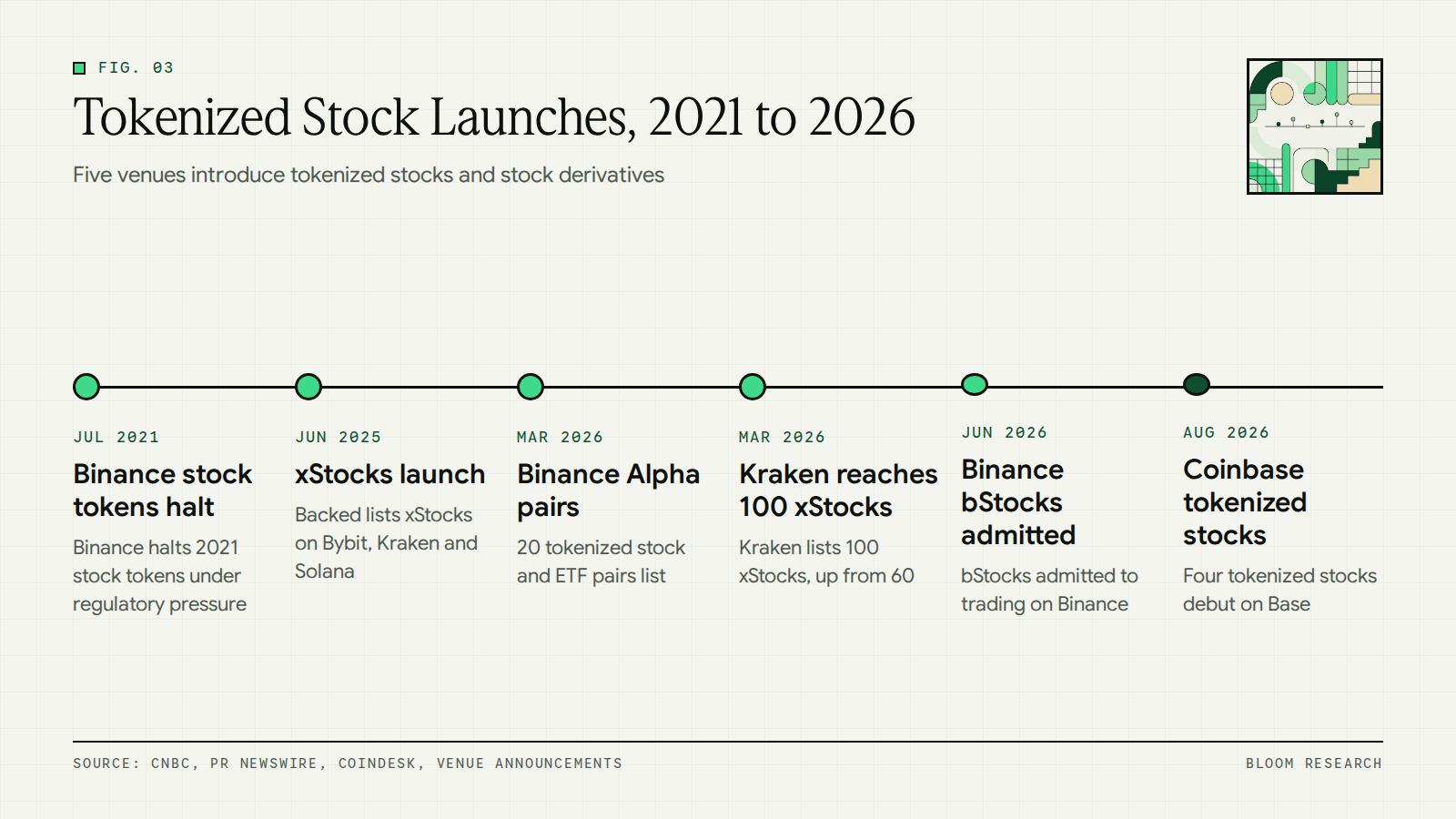
In April 2021, Germany's financial watchdog warned Binance that it had likely violated securities rules with the launch of its stock tokens. CNBC's 2021 report, dated July 16, 2021, said Binance would no longer offer digital versions of stocks like Tesla, Apple and Coinbase as it faced growing pressure from regulators.
bStocks and Binance Alpha in 2026
On March 9, 2026, Binance announced 20 tokenized securities pairs on Binance Alpha, including AAPLon and SPYon. On June 1, 2026, Binance introduced US equities trading for eligible users, covering more than 7,000 US-listed stocks and ETFs. Its broker-dealer, Nest Trading Limited, routes orders to Alpaca for execution, clearing, settlement and custody.
On June 12, 2026, Binance Exchange admitted bStocks to trading, according to Binance's bStocks announcement. bStocks are issued by BTech Holdings Limited, a Binance group affiliate, after ADGM's Financial Services Regulatory Authority approved the issuer's prospectuses. Each bStock is a Certificate backed 1:1 by an underlying share held with a regulated custodian, and Binance states that bStocks are not stocks or shares.
bStocks are standard BEP-20 tokens on BNB Chain, and BEP-20 is that chain's token standard. Eligible users can trade them 24/7, hold them on Binance, or self-custody them through BNB Chain-compatible wallets. Self-custody means the holder, not the venue, controls the private key that moves an asset. Users can convert between supported underlying equities and bStocks at a 1:1 ratio with zero conversion fees, and fractional shares start from $5.
The first listings were Circle (CRCLB), Micron (MUB), NVIDIA (NVDAB), Sandisk (SNDKB) and Tesla (TSLAB). Tokenized securities are available only to eligible users in permitted jurisdictions, and bStocks are not offered in the United States or to US persons.
Important: Binance Alpha tokens and bStocks are different products with different withdrawal rules. Alpha Assets cannot be withdrawn from the Binance Exchange, while bStocks can be self-custodied through BNB Chain-compatible wallets.
#Bybit tokenized stocks (xStocks)
According to the June 2025 xStocks launch announcement, Backed launched xStocks on June 30, 2025 with over 60 tokenized stocks on Bybit, Kraken and the Solana blockchain. The issuer is Backed Assets (JE) Limited, a Jersey private limited company, and each xStock is issued as an SPL token, the Solana token standard. Our guide to what xStocks are explains how xStocks are issued, backed and redeemed and how dividends and stock splits are handled.
xStocks trade 24/7 on the Bybit Spot market, and deposits and withdrawals are supported via the Solana and Mantle networks. A Bybit Learn article says xStocks are supported by regulated custodians in Switzerland and the US, and that Bybit does not guarantee the delivery or redemption of the underlying shares.
Bybit's FAQ says xStocks do not grant holders any voting rights, dividend entitlements or legal claims to the underlying shares, and corporate actions may be reflected through an on-chain multiplier. A trading fee applies to xStocks pairs, starting at 0.2000% maker and taker at VIP 0.
According to the FAQ last updated July 30, 2026, xStocks trading is not available in Bybit's service-restricted countries, in a named list that includes India and the United Kingdom, or in the European Economic Area. Bybit TradFi perpetual contracts, USDT-settled with up to 10x leverage, and stock CFDs are derivatives.
#Kraken tokenized stocks (xStocks)
Kraken offers xStocks via Payward Digital Solutions Ltd., which is licensed to conduct digital asset business by the Bermuda Monetary Authority. Kraken states that xStocks are not and will not be registered with any local securities regulators. Since September 10, 2025, EU clients are served by a Payward entity regulated by CySEC, the Cyprus securities regulator.
There are 100 xStocks listed on Kraken as of March 18, 2026, up from 60 at launch. Kraken says each xStock is backed 1:1 by the underlying equity, and its support page says xStocks provide synthetic exposure to the value of the stock, with no voting rights and no legal claims to the underlying company shares.
xStocks trade 24/5 on Kraken, and weekend trading is in development. When withdrawn to a self-hosted Solana or Ethereum wallet, xStocks can be traded 24/7 on-chain. Purchases start at $1, and there are no trading fees when buying with USDG or USD on Kraken, though a spread may be included in the price.
Kraken's xStocks availability page says xStocks are not available in the United States, Australia, Canada, the UK and prohibited regions. EEA clients must pass a questionnaire and can then trade xStocks using fiat only.
#How to evaluate a tokenized stocks venue: a checklist
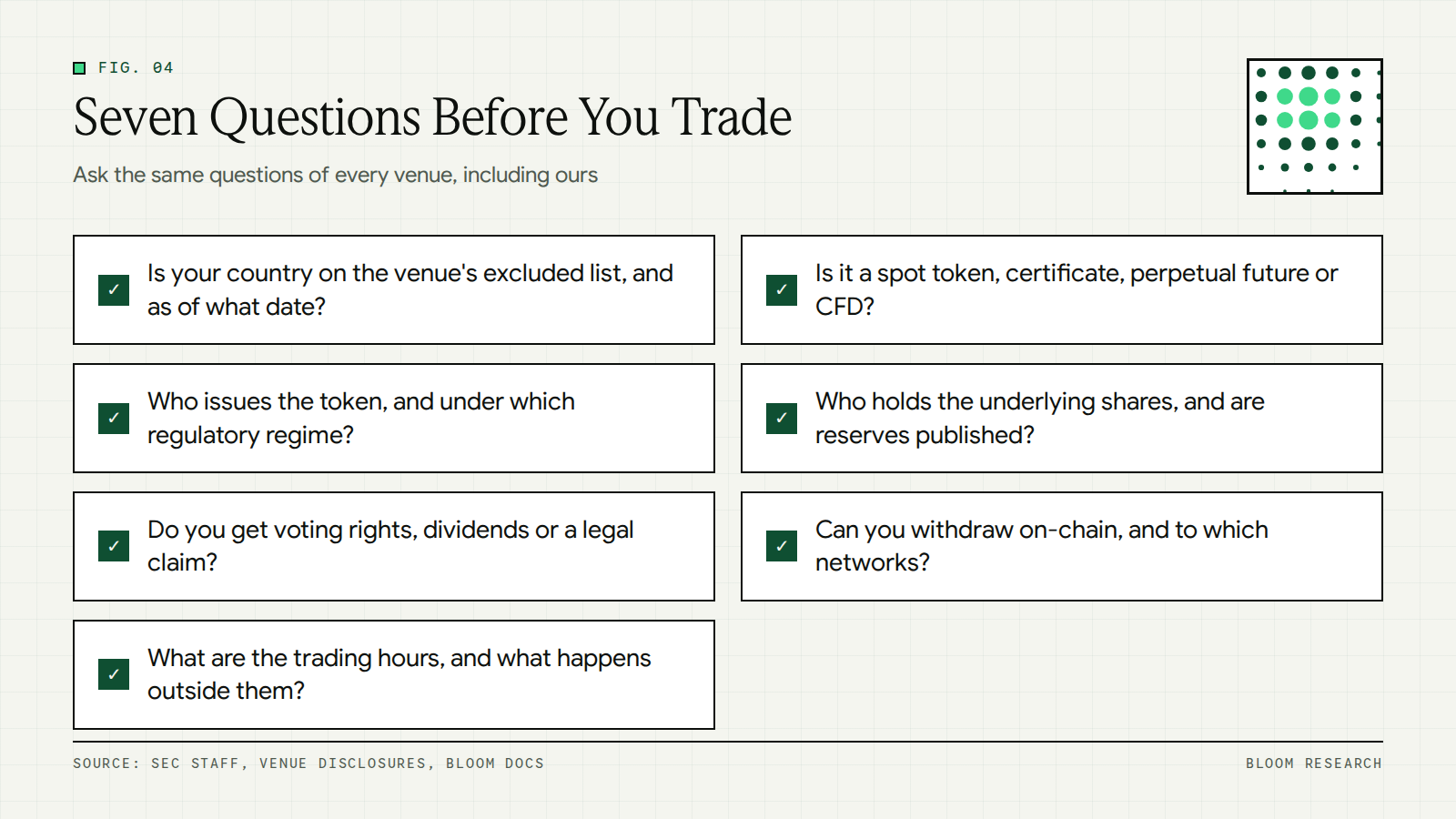
The same seven questions apply to every venue in this guide, including ours, when deciding where to buy tokenized stocks. Each item names a published source.
- Eligibility: check whether your country is on the venue's excluded list, and note the date of that list. Kraken support, last updated July 29, 2026, says xStocks are not accessible in the US, Canada, UK or Australia. Our page on where Bloom is available states that we do not offer our product or services in the United States or other restricted jurisdictions.
- Product type: confirm whether the product is a spot token, a certificate, a perpetual future or a CFD. SEC staff say a linked security issued by a third party provides synthetic exposure to a referenced security and confers no rights or benefits from the issuer of that security. Coinbase says its stock perpetual futures give leveraged, synthetic exposure to publicly listed US stocks.
- Issuer and regulator: find out who issues the token and under which regime. Kraken says xStocks are issued by Backed Assets (JE) Limited, a Jersey private limited company. Binance says bStocks followed approval of the issuer's prospectuses by ADGM's Financial Services Regulatory Authority. Our comparison of xStocks, Ondo and Dinari sets out the issuer entity, legal wrapper and custody arrangements of three tokenized stock issuers.
- Custody and backing: identify who holds the underlying shares and whether reserves are published. Each of our tokens is backed 1:1 by a real share held in custody at a regulated US broker-dealer such as Alpaca Markets or Interactive Brokers. Our on-chain attestation publishes live token supply, attested broker balance and backing ratio for every asset. Our catalog covers the US stocks and ETFs we list, including ETFs such as SPY, QQQ and VOO. Bybit says xStocks are supported by regulated custodians in Switzerland and the US.
- Rights: check whether the holder receives voting rights, dividends and a legal claim. The venue sections above set out what each product's issuer says about these rights. When a company behind one of our tokens pays a dividend, the cash is used to buy more of the underlying shares and the token's on-chain net asset value (NAV) increases.
- On-chain withdrawal and networks: check whether the token can leave the venue, and on which networks. Kraken support says xStocks can be withdrawn to a compatible Solana or Ethereum wallet, and Bybit's FAQ says deposits and withdrawals of xStocks are supported via the Solana and Mantle networks. Our token is held in your own embedded wallet, so you retain custody.
- Hours: check when orders fill and what happens outside those hours. Bybit's FAQ says xStocks are available for trading 24/7 on the Bybit Spot market. On our platform, orders outside market hours are queued and execute at the next open, extended sessions may partially fill, and assets with continuous markets fill 24/7.
#Buying tokenized stocks from India: LRS, TCS and Schedule FA
For readers in India deciding where to buy tokenized stocks, Bybit's xStocks FAQ, last updated July 30, 2026, lists India among the regions where xStocks trading is not available. The Kraken, Binance and Coinbase sources we reviewed do not name India, so eligibility has to be checked directly with each venue. As our India page explains, because we settle in USD stablecoins, an investor holds INR/USD exchange-rate exposure in addition to the price movement of the stock itself.
The Liberalised Remittance Scheme (LRS) lets resident individuals, including minors, remit up to USD 250,000 per financial year (April to March) for any permissible current or capital account transaction. Capital account transactions include investment. The individual designates a branch of an authorized dealer (AD) bank for all capital account remittances, and the RBI FAQ sets a minimum of one year of holding that bank account before the remittance. The remitter also furnishes Form A-2 on the purpose of the remittance and declares that the funds belong to them, as the RBI's LRS FAQ sets out.
Tax collected at source (TCS) is tax that the bank collects on an LRS remittance. From April 1, 2026, banks apply TCS on other LRS purposes, such as investment, at nil up to ₹10 lakh and 20% above ₹10 lakh, according to a bank's notice on the 2026 TCS rates. The threshold applies across all LRS remittances in a financial year, and credit for the TCS amount can be claimed while filing the income tax return.
Schedule FA is the foreign assets schedule of the Indian income tax return. The CBDT's reminder on foreign asset reporting states that accurate Schedule FA and foreign source income reporting is mandatory under the Black Money Act, 2015. Our India page also notes that the treatment of tokenized securities can differ from that of directly held shares. For other routes, see our guide to investing in US stocks from India.
Important: The LRS limit, TCS and Schedule FA reporting apply to the resident individual who remits and holds the assets, whichever venue or token is used. Nothing in a tokenized product changes LRS, TCS or reporting obligations.
#Is it safe to buy tokenized stocks? The main risks
SEC staff say holders of third-party tokenized securities may be exposed to risks of the third party, such as bankruptcy. Investor.gov's page on tokenized securities says the rights, obligations and benefits of a synthetic tokenized security holder may differ significantly from those of a traditional owner of the underlying security.
- Issuer and custodian dependence: counterparty risk is the risk that a party a product depends on, such as an issuer or custodian, fails to meet its obligations. ESMA says wrapped arrangements may introduce additional layers of intermediation and new counterparty dependencies, including tokenization platforms and underlying asset custodians.
- Rights that differ from shares: Binance says bStocks do not allow holders to directly own a share or stock in the underlying listed company.
- Smart contract errors: ESMA's September 2026 risk monitor says errors in smart contract code can result in erroneous transfers or misallocation of rights, and that such errors can be difficult to reverse because many blockchains are immutable.
- Liquidity fragmentation: trading in one equity is split across several token versions and venues. ESMA says that where these are not fully fungible, liquidity may become fragmented across venues, which could affect price discovery, market depth and execution quality, particularly in periods of stress.
- Leverage in perpetual futures and CFDs: Kraken's disclosure for its perpetual futures says trading derivatives involves a high level of risk and you may lose more than your initial investment. The FCA requires firms offering CFDs to UK retail consumers to limit leverage to between 30:1 and 2:1, depending on the volatility of the underlying asset.
What our risk disclosure covers
Our risk disclosure lists market risk, smart contract risk, custody risk, bridging risk and liquidity risk, and states that trading carries risk, including the loss of principal. Investor-protection arrangements apply within the jurisdictional limits of each broker, and protection is not unlimited. Redemption depends on the continued operation of the broker partner.
Why it matters: The structure behind a token decides whose risks the holder carries.
#Where to go next
Tokenized stocks carry market, custody, smart contract and liquidity risk, and you can lose money. We do not offer our product or services in the United States or other restricted jurisdictions; see our legal page for terms.
The live list of tokenized US stocks and ETFs is on our markets page. The steps on how to place a first trade show a minimum trade of $1 and a receipt with the fill price, fee, total and on-chain transaction hash within about 1 second.
Frequently asked questions
Where are tokenized stocks offered?
As of September 26, 2026, tokenized stocks are offered on our platform, Bloom, as Coinbase tokenized stocks on Base, as Binance bStocks, and as xStocks on Bybit and Kraken. Each venue is open only to eligible users outside the United States, and each publishes its own list of excluded countries. Bybit's xStocks FAQ, last updated July 30, 2026, lists India among the regions where xStocks trading is not available.
Is it safe to buy tokenized stocks?
No tokenized stock is free of risk. SEC staff say holders of third-party tokenized securities may be exposed to risks of the third party, such as bankruptcy, and Investor.gov says the rights of a synthetic tokenized security holder may differ significantly from those of a traditional owner. Our risk disclosure lists market, smart contract, custody, bridging and liquidity risk, and trading carries risk including the loss of principal.
What are tokenized stocks?
Investor.gov defines tokenized securities, also called digital securities, as financial instruments such as stocks, bonds or fund interests that are formatted as or represented by a crypto asset recorded on a blockchain or similar distributed ledger. A tokenized stock is a tokenized security whose underlying instrument is a company share. Our pillar guide to what tokenized stocks are covers the structures and mechanics in more detail.
Can US residents buy tokenized stocks on these venues?
No. We do not offer our product or services to users in the United States or in other restricted jurisdictions. Kraken says xStocks are not accessible in the US or to US persons, and xStocks are not offered in the United States. Binance does not onboard or service US persons, and Coinbase tokenized stocks are only available in eligible jurisdictions outside the US.
Can I withdraw tokenized stocks to my own wallet?
It depends on the venue. On Bloom, the token is held in your own embedded wallet, and you can hold it or send it. Kraken supports xStocks withdrawals to Solana or Ethereum wallets, Bybit supports xStocks withdrawals on the Solana and Mantle networks, Binance bStocks can be self-custodied through BNB Chain-compatible wallets, and Coinbase tokenized stocks can be transferred with no whitelisted wallets. Binance Alpha assets cannot be withdrawn from Binance Exchange.
Are Bybit xStocks available in India?
Bybit's xStocks FAQ, last updated July 30, 2026, lists India among the countries and regions where xStocks trading is not available. The same list includes the United Kingdom, Australia, Japan and every country of the European Economic Area. This is Bybit's published list as of that date, and the information in this guide is current as of September 26, 2026.
Are stock perpetual futures the same as tokenized stocks?
No. Stock perpetual futures are derivatives that give leveraged price exposure, not tokens backed by a share. Coinbase describes its stock perpetual futures as giving leveraged, synthetic exposure to US stocks. Kraken lists tokenized equity perpetual futures with leverage up to 20x, and Bybit's TradFi perpetual contracts are USDT-settled derivatives with up to 10x leverage. Kraken states that derivatives traders may lose more than their initial investment.