
What Is xStocks? Tokenized Equities on Kraken and Bybit
What is xStocks? How Backed's tokenized stocks work, who issues and backs them, how dividends are handled, and how xStocks trade on Kraken and Bybit in 2026.
Key takeaways
- xStocks are tokenized US stocks and ETFs issued by Backed Assets (JE) Limited, a Jersey special purpose vehicle, and each xStock is a tracker certificate collateralized 1:1 by the underlying equity.
- An xStock gives economic exposure to a share but no voting rights and no legal claim to the underlying shares, according to the xStocks documentation and Kraken's risk disclosure.
- Dividends are reinvested net of withholding taxes and, like stock splits, are reflected through a multiplier that adjusts token balances, so holders receive no cash dividends.
- On December 2, 2025, Kraken announced it had agreed to acquire Backed Finance AG, the company driving the issuance of xStocks.
- Kraken's xStocks FAQ, last updated September 18, 2026, excludes the US, Canada, the UK and Australia, and Bybit's FAQ, last updated July 30, 2026, lists India, the UK and the EEA among excluded regions.
xStocks are tokenized versions of US stocks and ETFs issued by Backed, where each token is collateralized 1:1 by the underlying equity and trades on exchanges such as Kraken and Bybit or directly on public blockchains. The name refers to this tokenized equity product, not to a stock marketplace or a brokerage account. An xStock gives economic exposure to a share, but the issuer states that it does not convey shareholder rights such as voting rights.
We build Bloom, a platform for tokenized US stocks and ETFs, and in this guide we quote the issuer's documentation and the exchanges' own help pages for each term. For the general model behind the category, see our complete guide to tokenized stocks. This post focuses on one product line: what xStocks are, how they work, and how Kraken and Bybit offer them.
#What is xStocks?
According to the issuer's FAQ, xStocks are permissionless tokenized representations of publicly traded stocks and ETFs. Each xStock provides economic exposure to a specific underlying equity and is fully collateralized 1:1 by that asset. The underlying securities are held with regulated custodians under a bankruptcy-remote structure.
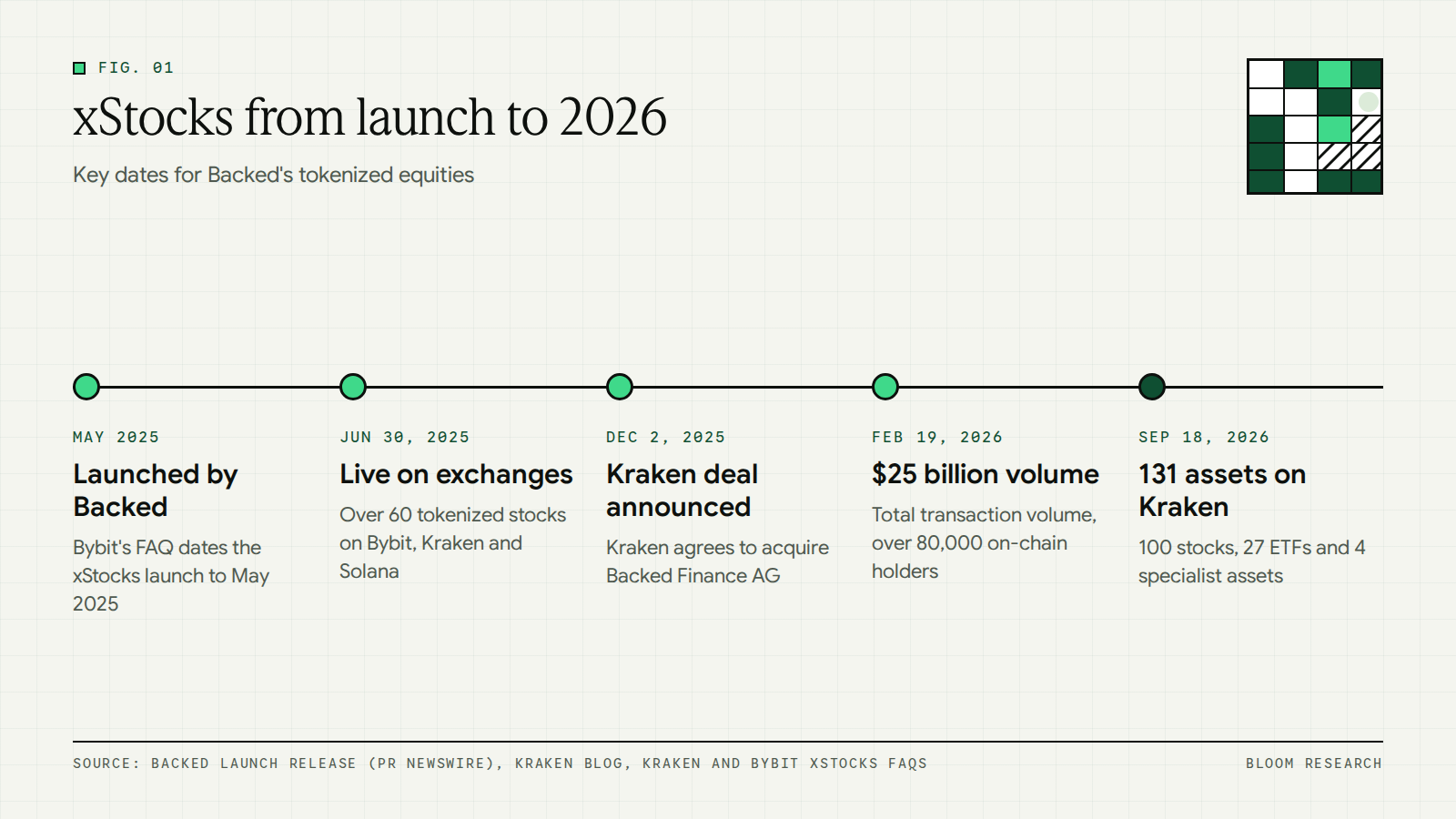
Bybit's FAQ says Backed launched the product in May 2025. According to Backed's launch release of June 30, 2025, the tokens went live that day with over 60 tokenized stocks, including Apple, Amazon and Microsoft, on Bybit, Kraken and the Solana blockchain. The same release named Bybit, Chainlink, Raydium, Jupiter and Kamino as new members of the xStocks Alliance, a group of exchanges, chains and DeFi protocols that support the tokens.
The product has grown since launch. On February 19, 2026, Kraken reported that xStocks had passed $25 billion in total transaction volume across centralized exchanges, decentralized exchanges and mint and redemption activity. That figure included more than $3.5 billion in on-chain activity from over 80,000 unique on-chain holders. Kraken's xStocks FAQ, last updated September 18, 2026, lists 131 assets in total: 100 stocks, 27 ETFs and 4 specialist assets.
Who issues xStocks
xStocks are issued by Backed Assets (JE) Limited, a Jersey-based special purpose vehicle dedicated solely to the issuance and redemption of xStocks. The issuer's documentation states that the company is registered with the Jersey Financial Services Commission (JFSC) and holds the consents required to issue security tokens. The same documentation classifies each xStock as a bearer debt instrument called a tracker certificate.
Definition: A tracker certificate is a structured financial instrument whose value follows an underlying asset, which for each xStock is one specific stock or ETF.
For distribution in the EU and EEA, the products are governed by a base prospectus approved by the Liechtenstein Financial Market Authority (FMA) under the EU Prospectus Regulation. That approval is passportable across the European Economic Area, which lets licensed third-party distributors offer them to retail clients. The issuer also notes that other jurisdictions may classify xStocks differently, including as crypto assets.
Who owns xStocks: Kraken's agreement to acquire Backed
On December 2, 2025, Kraken announced that it had agreed to acquire Backed Finance AG, which it described as the company driving the issuance of xStocks. In that announcement, Kraken said xStocks surpassed $10 billion in combined exchange and on-chain trading volume within six months of their debut earlier in 2025. Kraken also stated that Backed's team and infrastructure will become part of Kraken.
Backed co-founder Adam Levi said in the same announcement that Backed was founded in 2021. Kraken said the deal unifies issuance, trading and settlement for xStocks, and that it plans to integrate xStocks more deeply into its product suite, including Krak, its global money app.
#How xStocks work: issuance, redemption and trading
The issuer's documentation on how the tokens work describes two layers. The primary issuance layer is where tokens are issued or redeemed with the issuer. The secondary permissionless layer is where tokens move freely across exchanges, wallets and DeFi protocols, with different access rules and hours.
The primary market: issuance and redemption
The primary market is where xStocks are issued or redeemed through direct interaction with the issuer. Access requires KYC and AML onboarding, which are the identity and anti-money-laundering checks a regulated firm runs on its clients. Once onboarded, a direct client can issue or redeem with stablecoins or with the underlying equity through an in-kind flow called xPort.
Primary issuance and redemption operate 24/5, aligned with the underlying equity market. If interacting directly with the issuer, the minimum transaction size is $5,000. Retail users are legally permitted to redeem directly with the issuer, subject to KYC requirements and that minimum, but the xStocks FAQ adds that in practice most users access liquidity through secondary markets.
Market makers connect the two layers. Bybit's FAQ explains that market participants issue and redeem tokens with the issuer based on supply and demand. When the price of an xStock on Bybit deviates from the underlying stock's price on exchanges such as the NYSE or Nasdaq, arbitrageurs are incentivized to close the gap. For the general cycle of minting, settling and redeeming a tokenized share, see our tokenized stock lifecycle guide.
The secondary market: exchanges, wallets and DeFi
Once issued, the tokens can trade freely on supported exchanges and DeFi platforms without direct interaction with the issuer. Secondary trading can occur 24/7, depending on the platform. The xStocks FAQ states that secondary market pricing is determined by supply and demand on each platform and that the issuer does not control it.
The token formats are what let xStocks move between venues and wallets:
- On Solana, xStocks use the SPL Token-2022 standard, a Solana token program.
- On Ethereum and other EVM-compatible chains, xStocks use the ERC-20 token standard.
- The docs list native issuance on Ethereum, Solana, Arbitrum, Mantle, TON, Ink and other EVM-compatible networks.
- The xStocks CCIP bridge allows movement between supported networks without selling and buying the asset.
Bridging does not change the product, according to the xStocks documentation; it only changes the network on which the token resides.
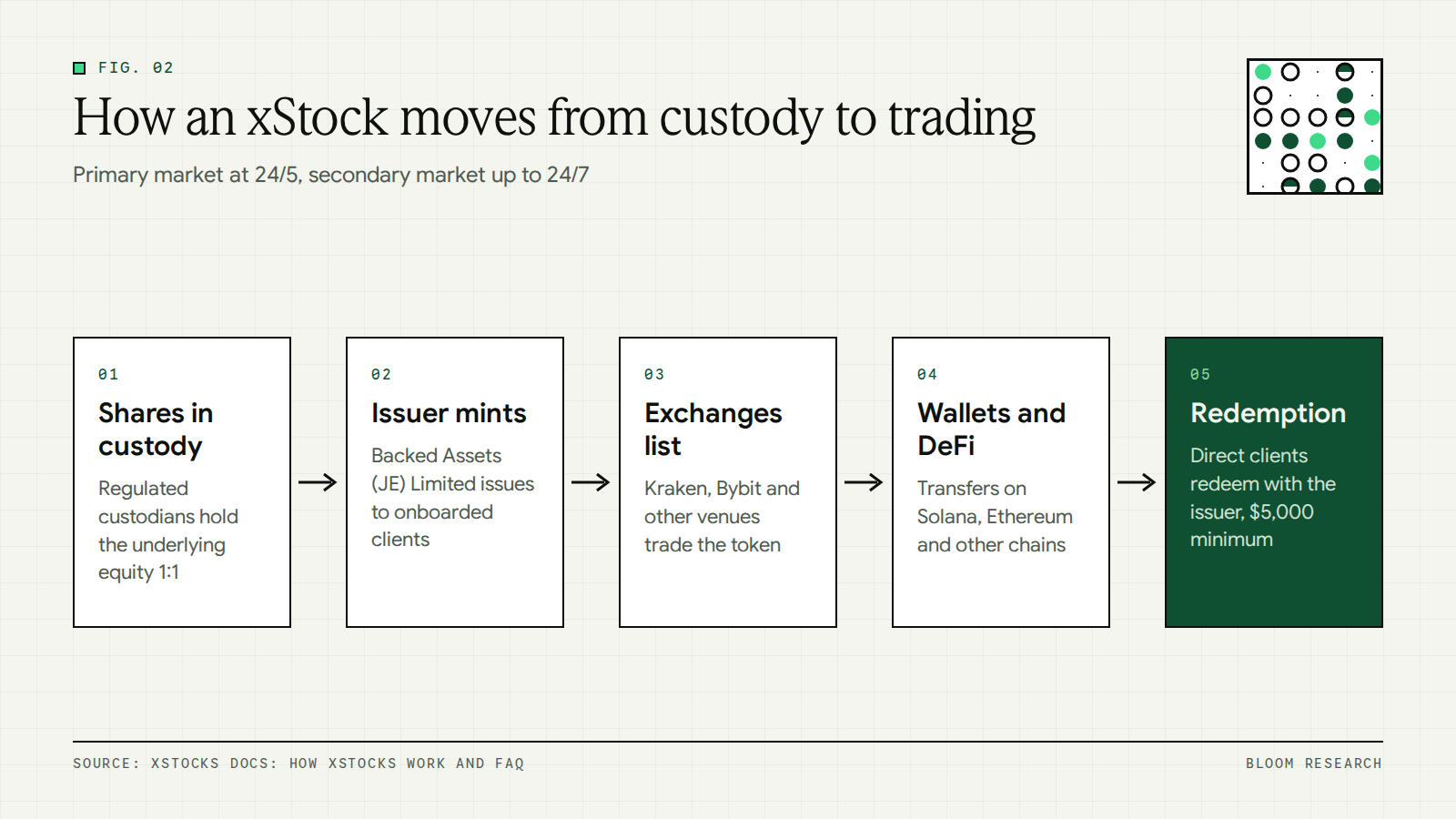
Key point: xStocks run on two schedules. Issuance and redemption with the issuer operate 24/5 in line with the US market, while trading between holders can occur 24/7 on platforms that support it.
The Kraken and Bybit sections below cover each exchange's hours, fees and eligibility. For how a tokenized stock tracks its underlying share on our platform, our tokenized stocks explainer describes the model we use on Bloom.
#What holding an xStock gives you and what it does not
An xStock follows the economic value of one stock or ETF, but it is a different legal instrument from the share itself. Kraken's risk disclosure for the product states that holders do not have ownership in any of the underlying stock. It adds that holders have no voting rights, distribution entitlements or legal claims to the underlying stocks or any residual assets if the underlying company is liquidated.
Bybit's FAQ uses similar wording. It also states that investing in the tokens does not entitle holders to receive any information from the issuer or sponsor of the underlying stocks. The list below sets out what the issuer and the two exchanges say an xStock includes and excludes:
- Included: economic exposure to one specific stock or ETF, collateralized 1:1 by that asset.
- Included: dividends reinvested through a multiplier, net of applicable withholding taxes.
- Included: ownership recorded on a public blockchain, where the token itself is the certificate.
- Not included: voting rights or legal claims to the underlying company shares.
- Not included: transfer to a traditional brokerage account, which Kraken's FAQ rules out for brokers such as IBKR.
Kraken's disclosure also notes that all such investments are subject to fees set out in the Base Prospectus for each xStock. As a result, the return on an xStock will not be identical to the return from holding the underlying stock over the same period. The xStocks legal overview cites the Swiss DLT Act as the basis for treating blockchain records as valid evidence of title, and states that holding the token constitutes holding the instrument.
Key point: Holding an xStock means holding a tracker certificate issued by Backed Assets (JE) Limited. It follows the share's economic value, but the issuer and Kraken both state that it is not direct equity ownership and carries no voting rights.
#How xStocks are backed and held in custody
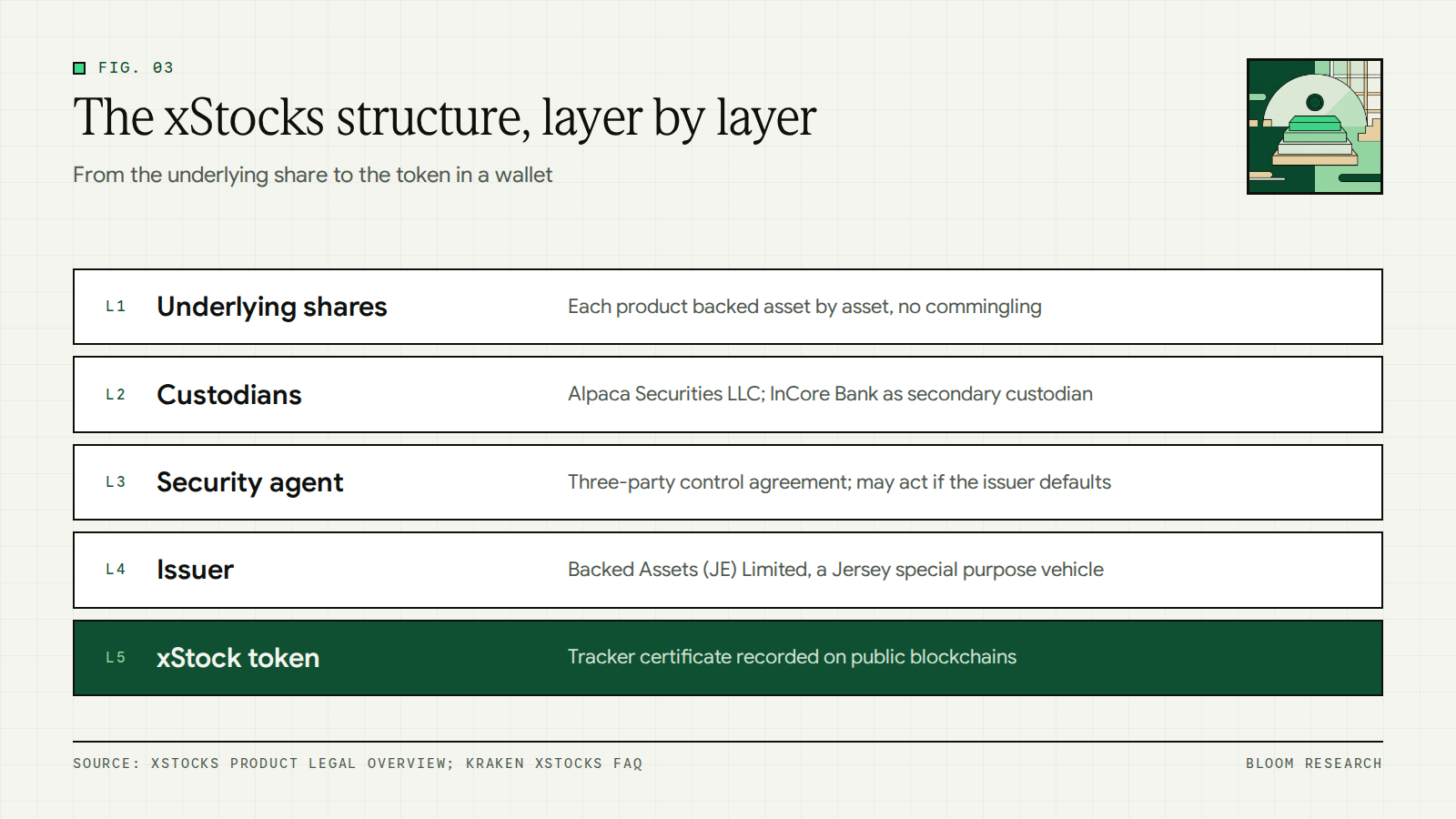
The xStocks product legal overview states that every xStock is fully collateralized by the corresponding underlying asset. Collateral is held with regulated custodians and brokers, each product is backed on an asset-by-asset basis, and dedicated sub-accounts are used to ensure segregation. No commingling of collateral between products occurs, so tokens referencing one equity are backed solely by that specific equity.
Kraken's xStocks FAQ names the custodians. It states that the underlying shares are held by Alpaca Securities LLC, which is FINRA-regulated and a SIPC member, with supplemental coverage by Lloyd's of London up to $175 million in aggregate. The same FAQ lists InCore Bank as a secondary custodian.
The security agent and what happens if the issuer defaults
A security agent is an independent party that can act over the collateral on behalf of token holders. In the xStocks structure, collateral accounts are governed by a three-party Account Control Agreement between the issuer, the custodian or broker, and an independent Security Agent. The Security Agent has visibility over collateral accounts and may assume control if token holders' rights, as defined in the prospectus, are not being upheld.
In the event of issuer default, the legal overview states that the Security Agent may take control of the collateral accounts, liquidate the underlying assets and distribute proceeds to token holders in accordance with the prospectus terms. Kraken's risk disclosure adds that Backed is exposed to the credit risk of the institutions that hold its cash, crypto and securities. It states that the insolvency of such an institution may result in delayed or impossible access to the underlying stocks.
Proof of reserves and audits
Proof of reserves is a public record of the assets held against the tokens in circulation. The xStocks FAQ says collateral backing is publicly verifiable, with proof of reserves information available through the xStocks DeFi portal. Kraken's FAQ adds that proof of reserves is published weekly on-chain and verified by third-party auditors, and it lists quarterly ISAE 3000 assurance audits.
On Bloom: Each of our assets is an on-chain token backed 1:1 by a real share in custody at a regulated US broker-dealer such as Alpaca Markets or Interactive Brokers, as our custody and backing page explains. If we discontinue operations, our security agent GenTwo works with the custodian to redeem tokens against the underlying shares.
Our reserves are attested in real time by Accountable, a third-party proof-of-reserves provider. The Transparency page in our app shows live token supply, attested broker balance, backing ratio and a link to the on-chain attestation contract for every asset, and our proof of reserves page explains how that attestation works. Our security overview covers custody, wallet and keys, smart contracts and continuity protection.
#Dividends, stock splits and the xStocks multiplier
xStocks handle corporate actions through rebasing, a mechanism that adjusts token balances when the underlying share changes. The xStocks guide to dividends and stock splits calls this adjustment the multiplier. Every xStock launches with a multiplier of 1.0, meaning one token represents the value of one share, and the multiplier tracks the cumulative effect of all corporate events over the life of the token.
When a company pays a dividend, the custodian receives the cash, and the dividend is reinvested into additional shares of the same stock, net of applicable withholding taxes. Kraken's FAQ describes the rebasing calculation as the net dividend, after 30% US withholding tax, divided by the closing price of the underlying share on the prior day. Stock splits raise the multiplier proportionally, reverse splits lower it, and no action is required from token holders.
| Corporate event | Multiplier before | Multiplier after | Equity value per token |
|---|---|---|---|
| Apple pays a dividend | 1.0 | 1.008 | 1.008 AAPL |
| 4-for-1 stock split | 1.008 | 4.032 | 4.032 AAPL |
| 2-for-1 reverse split | 4.032 | 2.016 | 2.016 AAPL |
The table reproduces the worked example in the xStocks documentation, which applies a dividend, a 4-for-1 split and a 2-for-1 reverse split to one AAPL token in sequence. The way the multiplier appears depends on the chain. On EVM chains such as Ethereum, the smart contract adjusts balances automatically; on Solana, the on-chain balance stays constant and a multiplier stored in token metadata is applied for display, and TON works in a similar way.
How it works: The multiplier is one number per xStock that converts the on-chain token amount into the equity it represents. Kraken's FAQ uses a separate, simplified illustration in which a dividend equivalent to 0.1 shares moves the multiplier from 1.0 to 1.1, so one on-chain AAPLx token shows as 1.1 AAPLx. The size of each move depends on the dividend, as the worked example above shows.
The multiplier can also change order sizes on Kraken. Kraken's FAQ says an xStock order quantity is divided by the multiplier and rounded to 8 decimal places to get the on-chain token quantity, so the final displayed amount can differ slightly from the amount ordered. Bybit's FAQ states that dividends are not paid separately as cash distributions to token holders.
On Bloom, dividends are used to buy more underlying shares and the token's NAV, its on-chain value, rises, with no separate cash distribution. Splits, spin-offs, mergers and name changes are also reflected in NAV, as our page on dividends and corporate actions describes.
#xStocks on Kraken
Kraken's xStocks FAQ, last updated September 18, 2026, says xStocks are available to eligible non-US clients in 110+ countries. They are not accessible to US persons or in the US, Canada, the UK or Australia. Ten xStocks trade 24/7 on Kraken Pro: TSLAx, QQQx, SPYx, NVDAx, CRCLx, AAPLx, HOODx, MSTRx, GLDx and GOOGLx.
All other xStocks trade 24/5 on Kraken and are not available on weekends. When withdrawn to a self-hosted wallet, xStocks can be traded 24/7 on-chain through DEX integrations. Withdrawals are supported to compatible wallets on Solana, Ethereum, TON or Ink.
Clients can buy them with fiat, crypto or stablecoins, including USDC and USDG, while USDT is not directly supported. Fractional purchases start at $1. Kraken lists no trading fees when purchasing xStocks with USDG or USD, standard Instant Buy fees for other assets, and a spread that may be included in the price. On the Kraken Pro spot order book, makers receive a 2 bps rebate and takers pay 10 bps, and a fixed 1% trading fee applies when converting xStocks.
According to Kraken's availability page, last updated June 18, 2026, xStocks are offered to eligible Kraken clients via Payward Digital Solutions Ltd., a company licensed to conduct digital asset business by the Bermuda Monetary Authority. Kraken states that xStocks will not be registered with any local securities regulators. Clients in the EEA must pass a questionnaire and can then buy, sell and convert xStocks using fiat only.
#xStocks on Bybit
Bybit's xStocks FAQ, last updated July 30, 2026, describes Bybit as a secondary market where users trade the tokens on the Spot market 24/7. Only users who have completed Standard Identity Verification or Business Verification are eligible to trade xStocks. Users deposit or transfer USDT to a Unified Trading Account to buy, and the fee at VIP 0 is 0.2000% for both makers and takers.
Bybit caps holdings at 300,000 USDT equivalent per token, and once that limit is hit, users cannot place new orders to increase the position. xStocks cannot be redeemed on Bybit. The FAQ states that only professional and retail clients who are onboarded with Backed and have completed KYC and AML can redeem directly with Backed at net asset value, subject to additional fees.
Deposits and withdrawals on Bybit are supported via the Solana and Mantle networks. Bybit also lists TradFi perpetual contracts and MT5 CFDs next to xStocks. Its FAQ describes both as derivative contracts based on price movements with no ownership, while xStocks are designed to be 1:1 backed by real shares.
Kraken and Bybit xStocks terms side by side
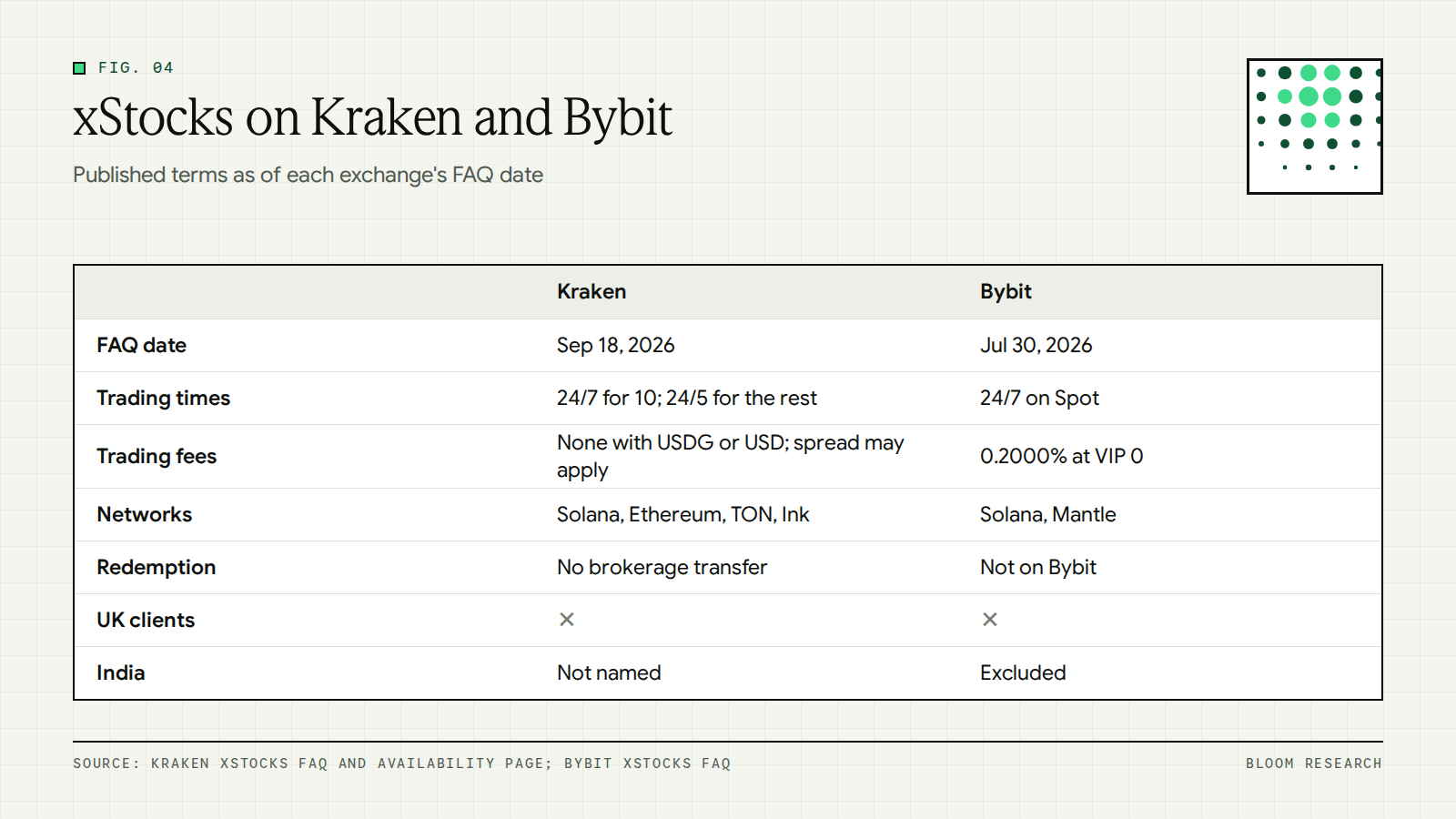
Each row below uses the exchange's own FAQ as of the date shown.
| Term | Kraken | Bybit |
|---|---|---|
| Source date | FAQ last updated September 18, 2026 | FAQ last updated July 30, 2026 |
| Trading times | 24/7 for 10 xStocks on Kraken Pro; 24/5 for the rest | 24/7 on the Bybit Spot market |
| Funding | Fiat, crypto or stablecoins; USDT not directly supported | USDT in a Unified Trading Account |
| Trading fees | None with USDG or USD, spread may apply; Kraken Pro 2 bps maker rebate, 10 bps taker | 0.2000% maker and taker at VIP 0 |
| Withdrawal networks | Solana, Ethereum, TON or Ink | Solana and Mantle |
| Redemption | Cannot be transferred to a brokerage account | Cannot be redeemed on Bybit |
| Excluded regions named | US, Canada, UK, Australia and prohibited regions | Includes India, the UK and all EEA countries |
For venues that list other tokenized stock products, such as Coinbase and Binance, see our comparison of where to buy tokenized stocks.
#Can you buy xStocks in India or the UK?
Bybit's list, last updated July 30, 2026, names India and the United Kingdom among the countries and regions where xStocks trading is not available, along with every country in the European Economic Area. Kraken's availability page names the United States, Australia, Canada, the UK and prohibited regions.
Kraken's list of prohibited regions, last updated September 16, 2026, does not include India. Because the Kraken xStocks pages we checked do not name India, readers in India need to confirm eligibility with Kraken directly. For readers in the UK, both exchanges exclude the United Kingdom as of the dates above.
Residents of India who invest abroad do so under the Liberalised Remittance Scheme (LRS), the RBI framework for sending money overseas. According to the RBI's LRS FAQ, resident individuals can remit up to USD 250,000 per financial year, April to March, for permissible current or capital account transactions, which include investment. Banks apply tax collected at source (TCS) on other LRS purposes, such as investing, at nil up to ₹10 lakh and 20% above ₹10 lakh in a financial year. Standard Chartered's notice on the changes effective April 1, 2026 shows this rate unchanged; the change cut TCS on education and medical remittances above ₹10 lakh from 5% to 2%.
As our India page notes, the treatment of tokenized securities can differ from that of directly held shares. Because we settle in USD stablecoins, an investor in India also holds INR/USD exchange-rate exposure in addition to the price movement of the stock itself.
Important: Eligibility lists change, so the current page of each venue governs. Every reader remains responsible for their own country's remittance, tax, KYC and reporting rules.
#Risks to understand before buying xStocks
Kraken's risk disclosure states that investment in xStocks involves a high degree of risk and may result in the total loss of invested capital. It lists exposure to the market risks of the underlying companies and to the financial and operational risks of Kraken as broker and initial custodian. It also lists the financial and operational risks of Backed as issuer, liquidity risk, operational risk and regulatory risk.
In a staff statement on tokenized securities of January 28, 2026, SEC staff said holders of third-party tokenized securities may be exposed to risks of the third party, such as bankruptcy.
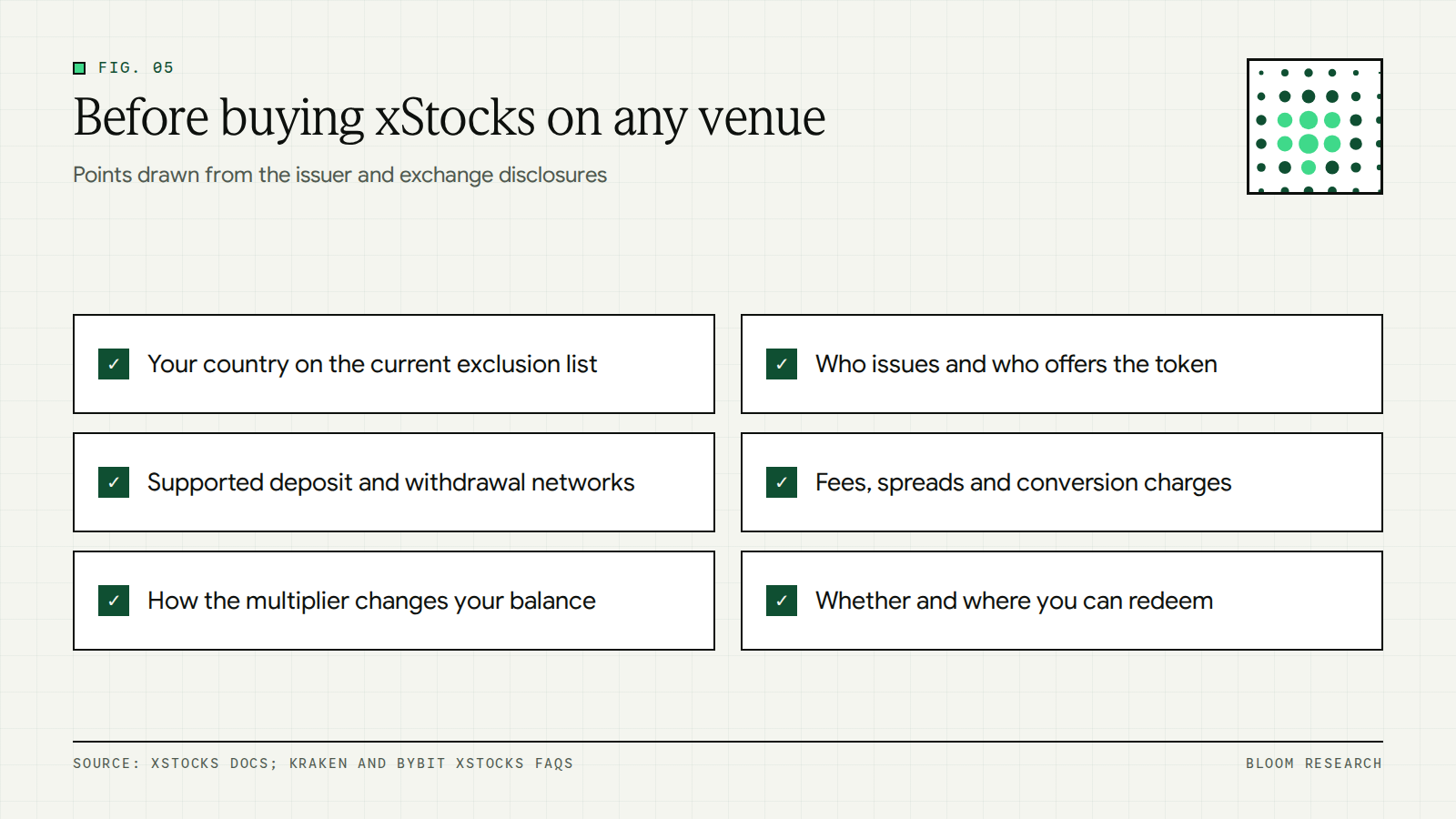
The issuer and exchange disclosures above point to these checks before buying xStocks on any venue:
- Whether your country appears on the venue's current exclusion list, and the date of that list.
- Which entity issues the token and which entity offers it to you.
- Which networks the venue supports for deposits and withdrawals.
- How the venue charges fees, including spreads and conversion fees.
- How dividends and splits change your balance through the multiplier.
- Whether and where the token can be redeemed.
Trading on Bloom also carries risk, including the loss of principal. Our risk disclosure lists the market, smart contract, custody, bridging and liquidity risks that apply to our tokenized stocks.
#How xStocks compare with tokenized stocks on Bloom
Each of our tokens is also backed 1:1 by a real share held in custody at a regulated US broker-dealer, and the token is held in your own embedded wallet. On Bloom, orders placed outside market hours are queued and execute at the next open, extended sessions may partially fill, and assets with continuous markets fill immediately.
Our list of available assets covers US stocks listed on NYSE, NASDAQ and AMEX and US ETFs such as SPY, QQQ and VOO. You can browse them on the markets page in our app.
On Bloom: We do not offer our product or services to users in the United States or in other restricted jurisdictions. Our service availability page has the current list.
Frequently asked questions
How do xStocks work?
xStocks work in two layers. In the primary market, onboarded clients issue or redeem tokens with the issuer, Backed Assets (JE) Limited, 24/5 and with a $5,000 minimum. In the secondary market, the tokens trade on exchanges such as Kraken and Bybit, in wallets and in DeFi protocols, 24/7 depending on the platform. Bybit says arbitrageurs are incentivized to close any gap between an xStock's price and the underlying stock's price.
Who issues xStocks and are they regulated?
xStocks are issued by Backed Assets (JE) Limited, a Jersey-based special purpose vehicle registered with the Jersey Financial Services Commission. Each xStock is a bearer debt instrument classified as a tracker certificate. For the EU and EEA, the products follow a base prospectus approved by the Liechtenstein Financial Market Authority. Kraken offers xStocks through Payward Digital Solutions Ltd., licensed by the Bermuda Monetary Authority, and states that xStocks are not registered with local securities regulators.
Who owns xStocks?
xStocks are issued by Backed Assets (JE) Limited. On December 2, 2025, Kraken announced that it had agreed to acquire Backed Finance AG, which it described as the company driving the issuance of xStocks, and said Backed's team and infrastructure will become part of Kraken. People who hold the tokens hold tracker certificates, not shares in the underlying companies.
Do xStocks pay dividends?
Not as cash. The xStocks documentation says dividends on the underlying equity are reinvested into more of the same asset, net of applicable withholding taxes, and reflected through a multiplier that raises token balances. Kraken's FAQ says there is no separate cash credit, and Bybit's FAQ says dividends are not paid separately as cash distributions to token holders.
What are the fees for xStocks on Kraken and Bybit?
Kraken's xStocks FAQ, last updated September 18, 2026, lists no trading fees when buying xStocks with USDG or USD, though a spread may be included in the price, and a fixed 1% fee on conversions. On Kraken Pro, makers receive a 2 basis point rebate and takers pay 10 basis points. Bybit's xStocks FAQ, last updated July 30, 2026, lists a 0.2000% maker and taker fee at VIP 0.
Can I buy xStocks in India?
Bybit's xStocks FAQ, last updated July 30, 2026, lists India among the countries and regions where xStocks trading is not available. Kraken's xStocks pages exclude the US, Canada, the UK and Australia and do not name India, so eligibility has to be confirmed with Kraken directly. Resident individuals in India remit funds for overseas investment under the RBI's Liberalised Remittance Scheme, up to USD 250,000 per financial year.
Can xStocks be redeemed for real shares?
Only through the issuer. The xStocks documentation says onboarded direct clients can redeem with stablecoins or with the underlying equity through an in-kind flow, subject to KYC and a $5,000 minimum. Bybit says xStocks cannot be redeemed on Bybit, and Kraken's FAQ says xStocks cannot be transferred to a traditional brokerage account.