
Tokenized Stock Lifecycle: Mint, Settle, Hold and Redeem
The tokenized stock lifecycle step by step: how a share is minted as a token, settled back-to-back, held with NAV and proof of reserves, then sold or redeemed.
Key takeaways
- The tokenized stock lifecycle on Bloom has six stages: fund, quote, mint, settle, hold, and sell or redeem, and each stage leaves a record you can check, such as a transaction hash or a contract address.
- A regulated issuer returns an RFQ quote that is typically valid for 5 to 10 seconds, and the trade settles back-to-back against the underlying primary market.
- Tokens are minted and burned through the authorized-participant gateway, which the broker partner uses to mint and burn tokens against custody.
- Dividends and corporate actions are reflected in the token's on-chain NAV, and a third-party attester publishes reserve balances on-chain in real time.
- If we discontinue operations, the security agent GenTwo has standing authority to direct the custodian to redeem outstanding tokens against the underlying shares, and redemption depends on the continued operation of the broker partner.
The tokenized stock lifecycle is the sequence that turns a purchase in the US stock market into an on-chain token in your wallet and, when you sell, turns it back. On Bloom, a regulated tokenized security issuer quotes the trade via RFQ (request for quote), the trade settles back-to-back against the underlying primary market, and the on-chain token transfers to your wallet. The matching share is held in a segregated customer account at a regulated US broker-dealer.
A tokenized stock on Bloom is an on-chain token that represents one share of a real stock, backed 1:1 by an actual share held in custody at a regulated broker-dealer. This guide covers each stage of the tokenization process, from minting and settlement to holding, selling and redemption, using the wording of our docs. For the basics of the asset itself, read our complete guide to what tokenized stocks are.
#The tokenized stock lifecycle in six stages
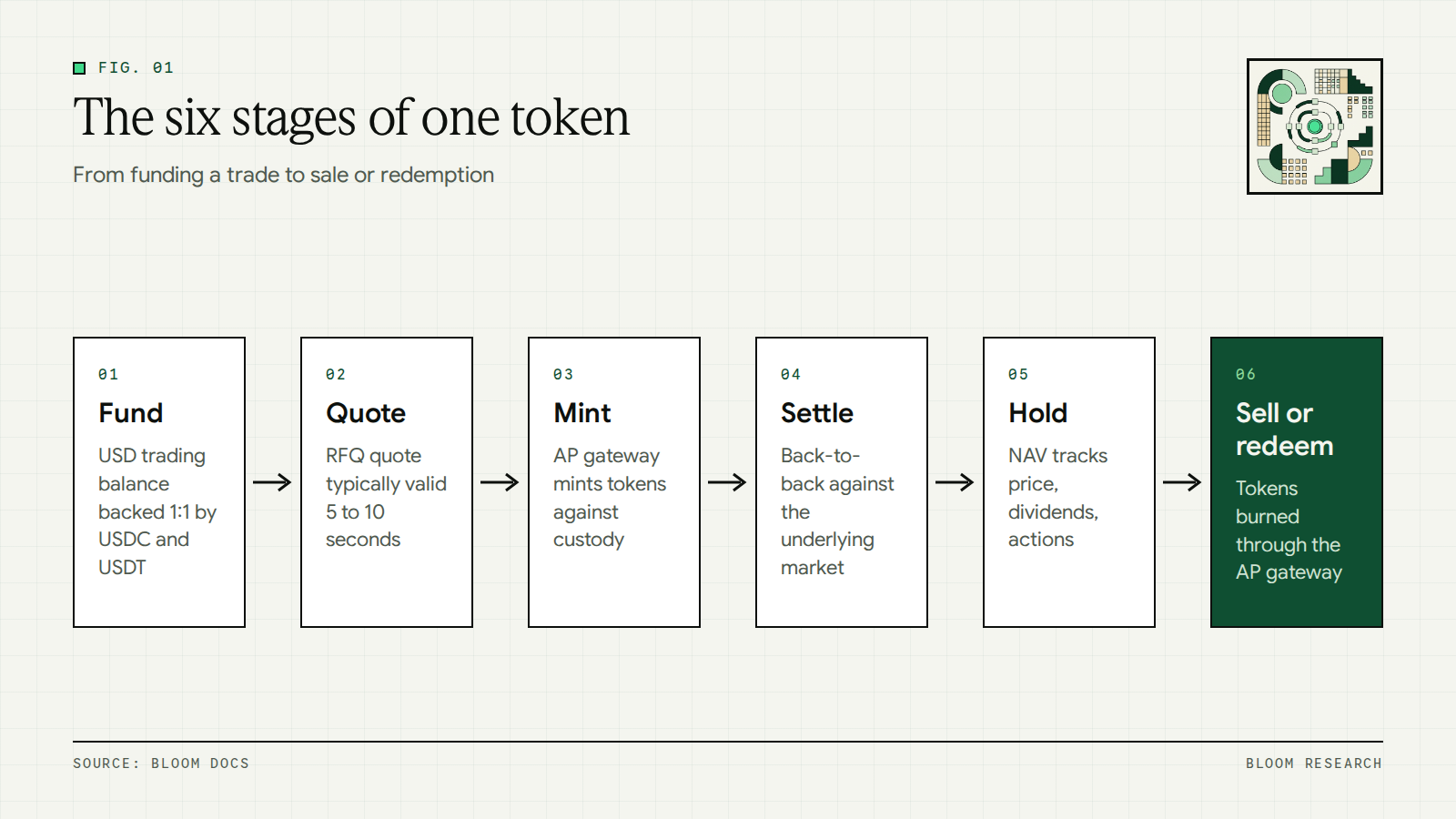
The six stages are fund, quote, mint, settle, hold, and sell or redeem. Each stage leaves a record you can check. Every trade receipt shows the on-chain transaction hash, the Transparency page lists each asset's contract address with an explorer link, and the on-chain attestation publishes the live token supply and attested broker balance for every asset.
| Stage | What happens on Bloom | Where you can check it |
|---|---|---|
| Fund | Your USD trading balance is credited by an authorized partner and is backed 1:1 by USDC and USDT | Balance pill and deposit sheet |
| Quote | A regulated issuer returns a live quote, typically valid for 5 to 10 seconds | Trade sheet |
| Mint | Tokens are minted through the authorized-participant gateway against custody | Contract addresses on the Transparency page |
| Settle | The trade settles back-to-back against the underlying primary market and the token transfers to your wallet | Receipt with transaction hash |
| Hold | The on-chain NAV reflects price, dividends and corporate actions, and attested balances are published on-chain in real time | Token contract and attestation data |
| Sell or redeem | You sell through the same RFQ flow, and tokens are burned through the gateway against custody | Receipt and Portfolio |
The token's value follows the share it represents at every stage after settlement. Our doc on how our tokenized stocks track the underlying share explains that each token tracks the underlying share's price and absorbs dividends and corporate actions into its on-chain NAV.
#The parties and layers behind one tokenized share
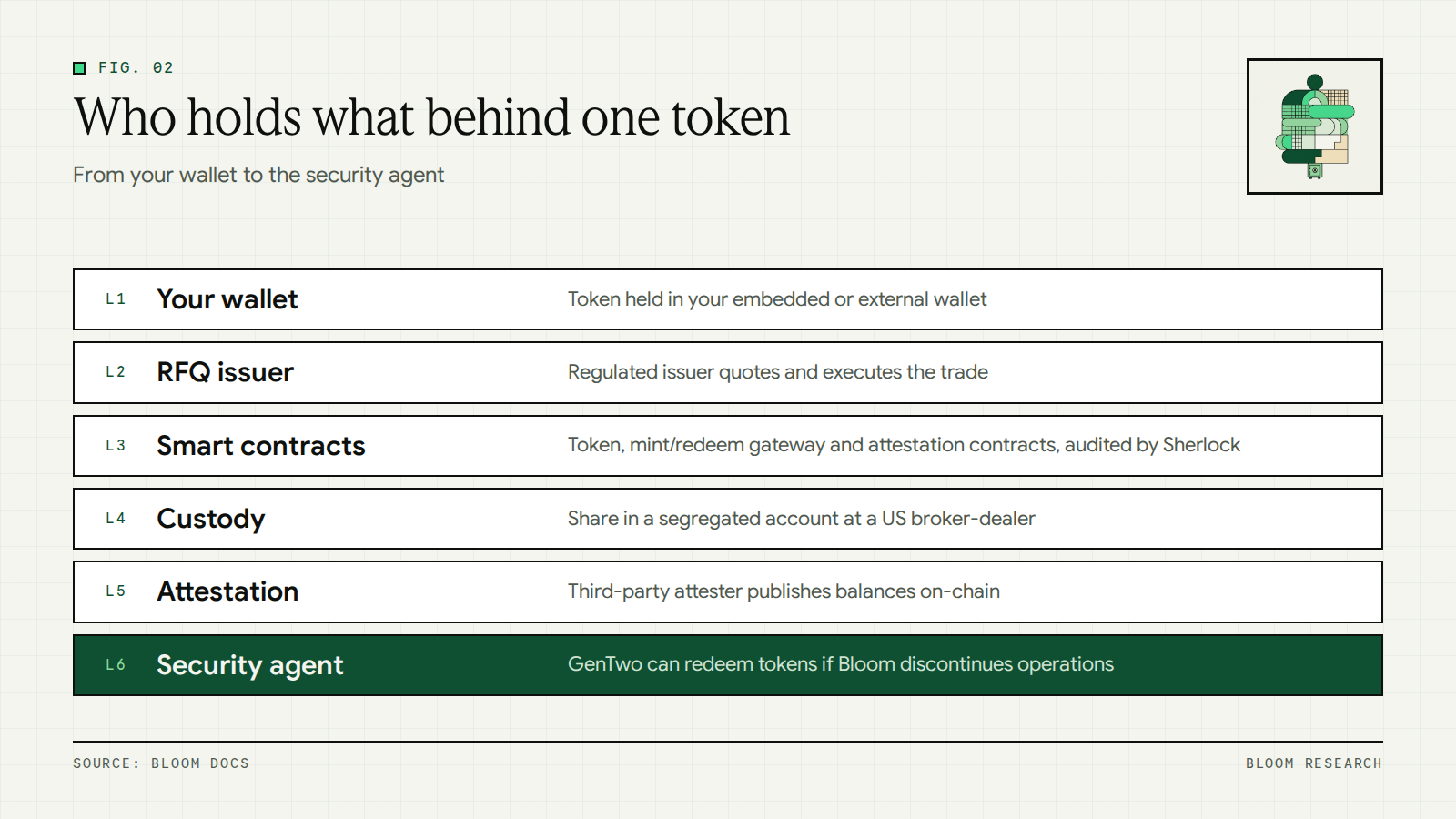
One tokenized share involves several parties: your wallet, a regulated RFQ issuer, an authorized participant, smart contracts, a custodian and a third-party attester. Security on Bloom sits on four layers: custody, smart contract, wallet and operational. Our doc on the four layers of our security model describes each layer.
The token is held in your own embedded wallet. Privy provisions this wallet using multi-party computation, which means no single party, including us, holds your complete private key. Our guide to self-custody and custodial wallets compares who holds the private key in each model and how MPC wallets differ from both. The regulated tokenized security issuers quote and execute trades via RFQ, while the underlying shares are held with the custodian.
Definition: An authorized participant (AP) is a regulated entity authorized to mint and burn tokens against custody. It is the on-chain gateway through which underlying shares enter and leave the tokenized supply.
On Bloom, the mint/redeem partner contracts implement that gateway. The Transparency page also lists SeriesManager, the asynchronous deposit and redemption order book. Sherlock audits the token, mint/redeem and attestation contracts, as covered below. Our glossary of trading and custody terms defines the other terms used in this guide.
Custodial and synthetic tokenized securities
In a statement dated January 28, 2026, SEC staff in the Divisions of Corporation Finance, Investment Management and Trading and Markets define a tokenized security as a security formatted as or represented by a crypto asset. The record of ownership is maintained in whole or in part on or through one or more crypto networks. The SEC staff statement on tokenized securities groups these instruments by who tokenizes them.
An issuer-sponsored tokenized security is one that the issuer itself issues in the format of a crypto asset. The SEC's Investor.gov page on tokenized securities says a security in this model carries the same legal rights, such as voting, dividends and ownership, as a traditional share of the same class. SEC staff add that third parties unaffiliated with an issuer could also tokenize that issuer's security.
In the custodial model, a third party creates a security entitlement formatted as a crypto asset. Investor.gov says the token in this model represents the holder's indirect interest in the underlying security via that security entitlement. Where the third party keeps its records offchain, it uses the onchain records to update the offchain records and record the transfer of the security entitlement.
In the synthetic model, a third party issues a linked security or derivative that provides synthetic exposure to a referenced security. Investor.gov says the rights, obligations and benefits of a synthetic token holder may differ significantly from those of a traditional owner. SEC staff note that a security-based swap typically does not convey any equity, voting, information or other rights with respect to the referenced security.
SEC staff also state that holders of third-party tokenized securities may be exposed to risks of the third party, such as bankruptcy. The onchain or offchain format of a security does not affect application of the federal securities laws. The next section shows where the share behind each Bloom token is held.
Where the underlying share is held
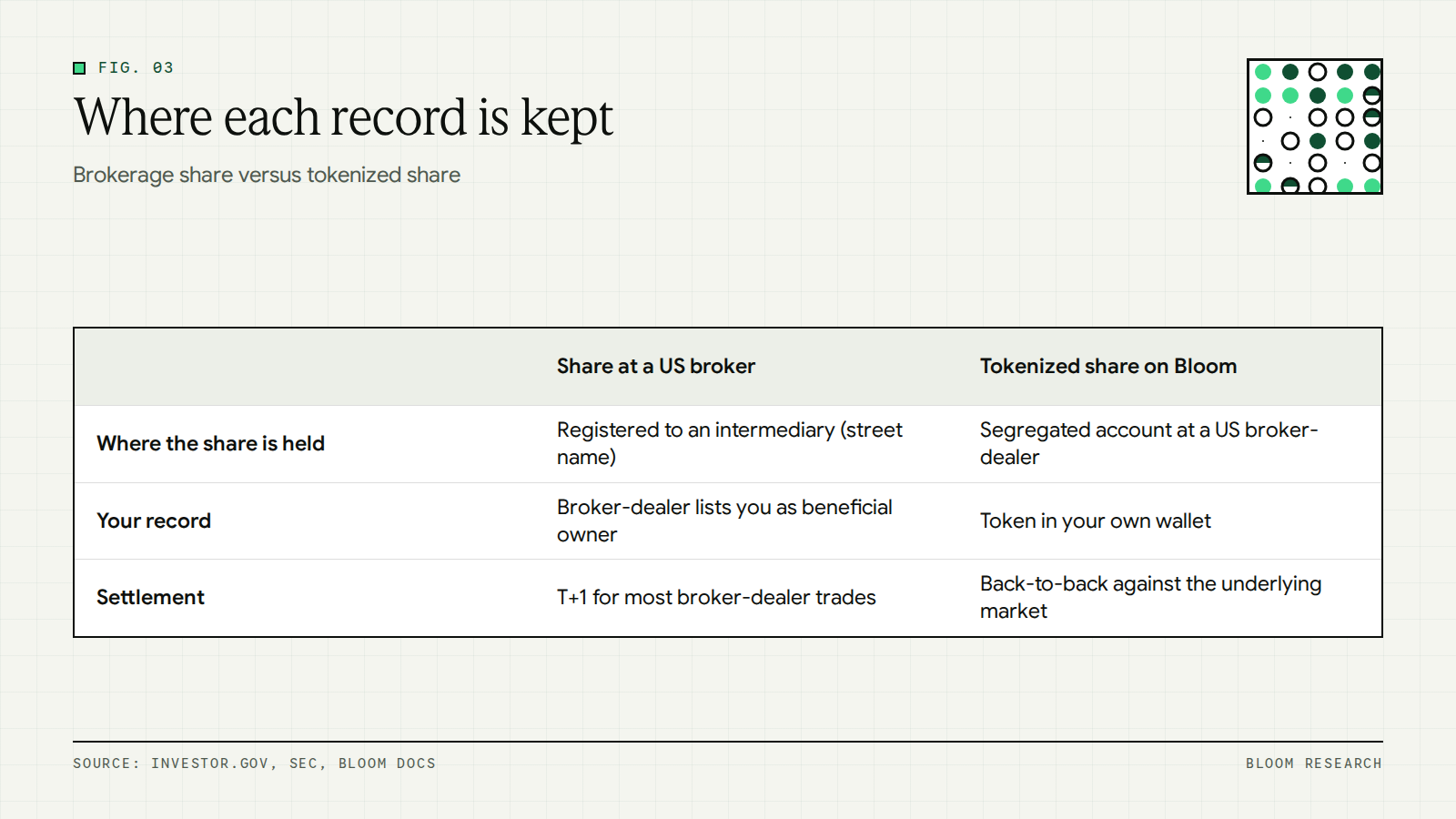
With street name registration, securities are registered on the issuer's books in the name of an intermediary, such as a broker-dealer, a clearing agency or a nominee. The broker-dealer keeps records showing the investor as the beneficial owner, as the Investor.gov bulletin on holding your securities explains.
A segregated customer account is an account in which a broker-dealer keeps custody of customer assets for the benefit of customers, separate from its own business accounts or operations. SIPC's explanation of segregated customer custody describes this requirement.
On Bloom, the underlying shares are held in segregated customer accounts at regulated US broker-dealers such as Alpaca Markets or Interactive Brokers. Customer assets at these brokers are held separately from the broker's own funds. The value of your tokens is held at the custodian, not on our balance sheet, as our page on where our underlying shares are held explains. Accountable, a third-party proof-of-reserves provider, attests reserves in real time, as described on our Security page.
#Minting: how a buy order becomes a token
Stages 2 and 3 of the tokenized stock lifecycle answer how tokenized stocks are created, from funding a balance to receiving a newly minted token. The steps below follow that order.
Funding the trading balance
You can fund your account with Apple Pay, Google Pay, card, bank, or by receiving USDC from any wallet on a supported chain. Your trading balance is the unified USD balance on Bloom, backed 1:1 by USDC and USDT held in custody. Per-chain crypto deposits have a minimum of $10 to $50 depending on the chain and asset, as our guide on how to add funds to your trading balance shows.
The trading balance is a real on-chain ERC-20 token, and an authorized partner credits the equivalent balance to your wallet when you deposit. ERC-20 is a token standard, and the EIP-20 specification describes it as providing basic functionality to transfer tokens.
Our India page for US stocks and ETFs explains that investors in India generally convert rupees into USDC through a locally operating exchange that supports on-chain withdrawals, then move the USDC to a self-custody wallet. Because we settle in USD stablecoins, an investor in India holds INR/USD exchange-rate exposure in addition to the price movement of the stock.
The RFQ quote and your confirmation
RFQ (request for quote) is the execution model on Bloom: a tokenized security issuer returns a live quote, you accept within a short window, and the trade settles back-to-back. Each trade follows four steps:
- Request: opening the trade sheet sends a quote request for your size and side.
- Quote: the tokenized security issuer returns a live quote in milliseconds, typically valid for 5 to 10 seconds.
- Accept: tapping Confirm within the quote window commits the trade at that price or within your slippage tolerance.
- Settlement: the trade settles back-to-back against the underlying primary market, and the on-chain token transfers to your wallet.
Slippage tolerance is the maximum acceptable drift between quote and execution. The default is 0.5%, and you can change it to 0.1%, 1% or a custom value in the trade sheet. The live quote in the trade sheet refreshes about every 10 seconds.
After you tap Confirm, a 5-second soft-cancel window lets you back out without side effect before the trade submits. If the market moves beyond your tolerance during the quote window, the trade stays pending until you cancel it. Order states run from submitted to pending, then to filled, partial_filled, modified or canceled by the user. See how RFQ execution and back-to-back settlement work on Bloom.
The mint and redeem gateway
Minting creates new tokens and burning removes them from supply, and on Bloom both happen against shares held in custody. Underlying shares enter and leave the tokenized supply through the authorized-participant gateway, which the broker partner uses to mint and burn tokens against custody.
Our Transparency page lists the smart contract addresses on Arbitrum One, which uses chain ID 42161. A chain ID is the number that identifies a specific blockchain network. In that table, the Bloom Contract is the mint and redeem partner gateway, the SeriesRegistry holds the program configuration and AP allowlist, and the SeriesManager is the async deposit and redemption order book. The Administrator contract covers roles, pause, blacklist and timelock.
Sherlock audits the gateway, the per-asset token contracts and the proof-of-reserves attestation contract before deployment, and every material change triggers a re-audit, per our page on smart contract audits. We publish deployment addresses per network, with one token contract per tokenized stock or ETF on each chain, in our list of contract addresses.
#Settlement: back-to-back on the underlying market, recorded on-chain
Settlement is the fourth stage of the tokenized stock lifecycle. Back-to-back settlement means the issuer prices your quote against the live underlying market, and the accepted trade is settled against the underlying instrument. As a result, your fill closely tracks the prevailing market price at execution time.
How it works: One buy produces two records. The first is the on-chain token transfer to your wallet, with the transaction hash shown in your receipt within about 1 second. The second is the underlying share held in a segregated customer account at a regulated US broker-dealer, which the third-party attester counts in the attested broker balance and publishes on-chain in real time.
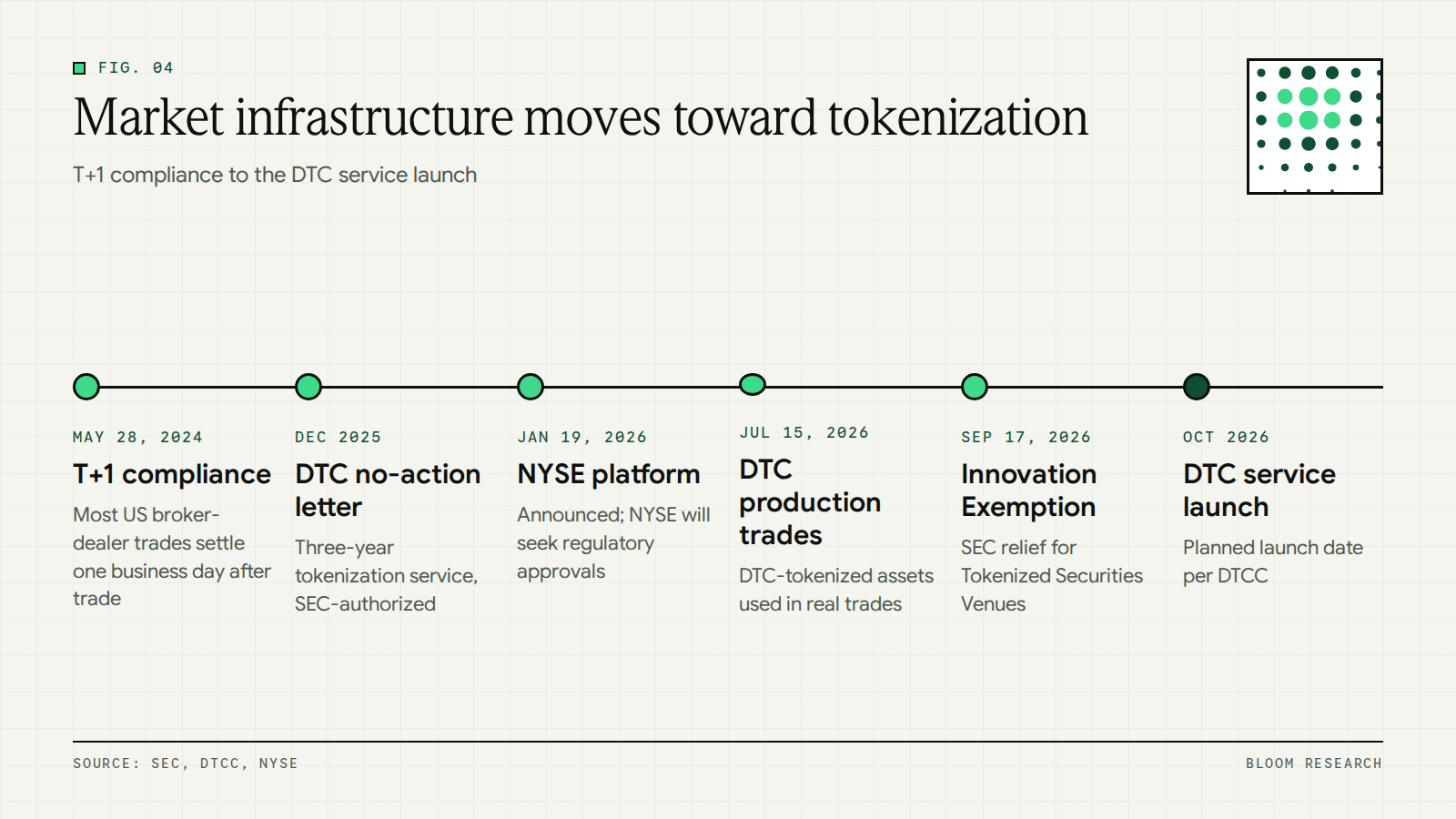
T+1 is a settlement cycle in which a trade settles one business day after the trade date. On February 15, 2023, the SEC adopted rule changes that shortened the standard settlement cycle for most broker-dealer transactions in securities from T+2 to T+1, according to SEC press release 2023-29. The compliance date for those rules was May 28, 2024.
The European Securities and Markets Authority (ESMA) describes the wider market in its TRV Risk Monitor No. 2, 2026. ESMA states that many tokenized equities operate within hybrid settlement models, where the token transfer may happen on chain while cash settlement often remains off-chain and requires reconciliation between infrastructures. ESMA also notes that in wrapped structures legal ownership remains off-chain, so token transfers do not convey legal title.
Your trading balance and tokenized stock holdings are per-chain at the wallet level, and the portfolio aggregates them across chains. Orders submitted overnight, on weekends or on holidays are queued server-side until the next open, as our page on how orders queue outside market hours explains. See also our guide to trading US stocks on weekends.
#How market infrastructure is adding tokenized settlement
US market infrastructure providers and regulators are also building paths for tokenized settlement. None of the projects below involve our tokens.
In December 2025, the Depository Trust Company (DTC) received an SEC no-action letter authorizing a defined tokenization service for DTC Participants and their clients for three years, according to a DTCC release from May 4, 2026. It covers assets including Russell 1000 constituents, ETFs tracking major indices and US Treasury bills, bonds and notes. DTCC says the tokenized DTC-custodied assets will provide the same entitlements, investor protections and ownership rights as the assets held in traditional form.
A DTCC release from July 15, 2026 reports that assets held at DTC were converted into tokens used in real production trades processed on July 15. More than 30 firms took part, and the conversions occurred on Besu and Canton. DTC-held securities can be converted between traditional and tokenized forms, and the DTCC Tokenization Service is planned to launch in October 2026.
On January 19, 2026, the New York Stock Exchange announced it is developing a platform for trading and on-chain settlement of tokenized securities, for which it will seek regulatory approvals.
On September 17, 2026, the SEC issued an order granting temporary, conditional exemptive relief, known as the Innovation Exemption, to Tokenized Securities Venues that trade tokenized NMS stock. A venue must verify that the tokenized NMS stock it offers provides holders the same rights and privileges as traditional NMS stock of an equivalent class. The exemptions expire five years after publication.
ESMA reports that the outstanding value of tokenized equities grew from approximately EUR 0.3bn at end-2024 to around EUR 1.9bn by end-June 2026. It adds that tokenized equities have predominantly developed through wrapped structures, while native issuance by issuers remains rare.
Note: These projects describe tokens that DTC, an exchange or a trading venue would handle under their own frameworks. SEC staff separately describe tokens that third parties unaffiliated with an issuer create for that issuer's security, including a custodial model in which the token represents the holder's indirect interest in the underlying security via a security entitlement.
#Holding: NAV, dividends, corporate actions and proof of reserves
Holding is the fifth stage of the tokenized stock lifecycle: while you hold a tokenized stock, its value follows the underlying share through its NAV. In our glossary, NAV (net asset value) is the on-chain value of a tokenized asset, reflecting price, accrued dividends and corporate actions.
Dividends and corporate actions
When the underlying company pays a dividend, the cash is used to buy more of the underlying shares. The on-chain NAV of the token then increases to reflect the added shares per token, so there is no separate cash distribution. For stock splits, special distributions, spin-offs, mergers and name changes, the on-chain NAV is updated to reflect the action. Our guide to tokenized ETFs backed by SPY and QQQ shares covers how dividends, rebalancing and NAV work for tokenized ETFs.
Every adjustment is observable on-chain through the token contract. The European Securities and Markets Authority (ESMA) notes that smart contracts can support the automation of corporate actions such as dividend payments or stock splits. Our docs explain how dividends and corporate actions are reflected in NAV for each type of event.
On Bloom: A dividend shows up in the token's price through a higher NAV, not as a separate cash payment to your wallet.
Proof of reserves attestation
Proof of reserves is a published record showing that the assets backing a token exist in custody. An attestation is the signed reading of those balances by a third party. For our tokens, the attester reads share balances directly from segregated customer accounts at regulated US broker-dealers such as Alpaca Markets and Interactive Brokers. It then publishes the attested values on-chain in real time.
Our Security page names the attester as Accountable, a third-party proof-of-reserves provider that reads broker balances directly and publishes them on-chain. For every asset, the on-chain attestation publishes these fields:
- Live token supply: total outstanding tokens for the asset across all chains.
- Attested broker balance: the number of underlying shares held in segregated custody.
- Backing ratio: the underlying shares held compared with tokens outstanding, which should be at or above 1.0.
- Attestation timestamp: when the reading was taken.
- Attester signature: cryptographic proof that the data came from the third-party attester.
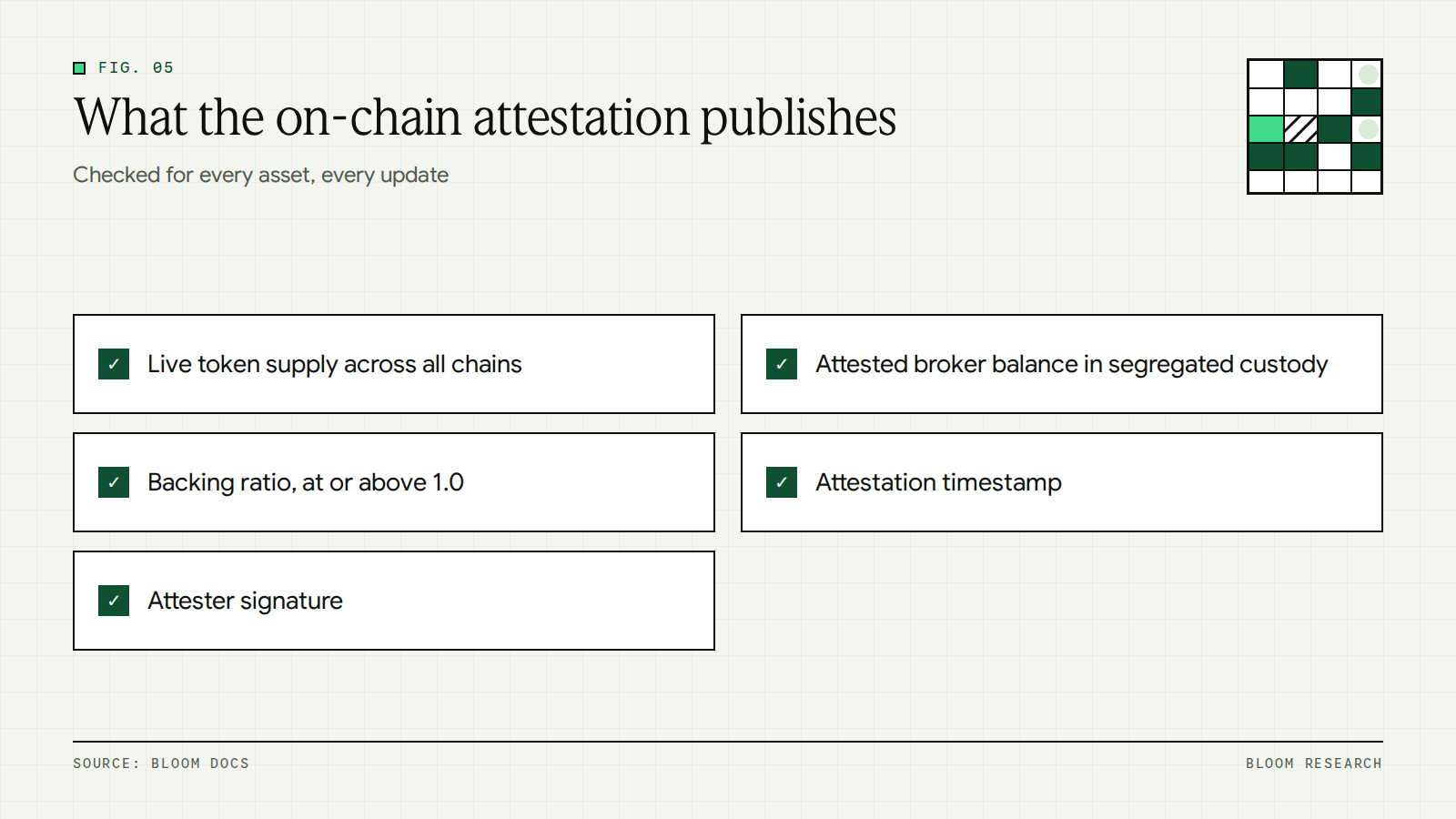
Our Transparency page defines the reserve ratio as underlying held divided by tokens outstanding. A reading at or above 100% means fully backed. From that page you can pull the raw on-chain attestation data directly with any block explorer or RPC client. Our guide to how our proof-of-reserves attestation works lists each field and where it is stored.
The US Public Company Accounting Oversight Board (PCAOB) gives context on what any proof-of-reserve report covers. In a March 8, 2023 investor advisory on third-party proof-of-reserve reports, staff of its Office of the Investor Advocate said these engagements are not audits. The staff added that the procedures likely do not address an entity's liabilities or the rights and obligations of asset holders. Our smart contracts are Sherlock-audited as described above, but no audit eliminates risk entirely.
#Selling, burning and redemption
This section covers selling, burning, and how outstanding tokens are redeemed against the underlying shares if we discontinue operations.
Selling through the same RFQ flow
The fastest way to sell is from the Portfolio holdings tab. Clicking a row opens the trade sheet preset to Sell, with a one-tap Max button to exit your full position. Selling follows the same RFQ flow as buying: live quote, slippage tolerance, biometric confirmation, and a receipt with fill price and fee.
A sale converts the holding into USD trading balance. Sells during market hours fill immediately, and sells outside market hours are queued for the next open. Burning is the removal of tokens from supply. Tokens leave supply through the same AP gateway that mints them. Our docs cover how selling and withdrawing work step by step.
Withdrawing is a separate step
Selling and withdrawing are two separate actions. To withdraw, you enter an amount and choose a destination address, which is validated live against the selected chain. The first withdrawal to a new destination shows a banner asking you to double-check the address.
Withdrawing to an external wallet completes in seconds once the network confirms the transfer. We do not file taxes on your behalf and do not provide tax advice. From Portfolio, you can export a complete CSV of every trade and transaction to share with a tax advisor.
The continuity path if Bloom stops operating
The value of your tokens is held in segregated customer accounts at the custodian, not on Bloom's balance sheet. A security agent is a designated party with standing authority to act on token holders' behalf. Our security agent is GenTwo, and if Bloom discontinues operations, GenTwo works directly with the custodian to redeem outstanding tokens against the underlying shares.
That redemption path is enforced by the on-chain contract. GenTwo is a custody-layer arrangement, not a separate audited contract, and it exercises its standing authority through the mint/redeem partner contract.
Important: Redemption through GenTwo depends on the continued operation of the broker partner. Investor-protection arrangements apply within the jurisdictional limits of each broker, and protection is not unlimited.
Tokenized stock products differ in issuer, custody, trading hours and on-chain withdrawal, and our comparison of venues that offer tokenized stocks sets five venues side by side.
#Risks at each stage of the lifecycle
Each stage of the lifecycle carries its own risks. Our risk disclosure and legal page describe them as follows:
- Quote and settle: asset prices can move against you, including overnight gaps that may exceed your slippage tolerance.
- Quote and settle: the tokenized security issuers that quote prices may withdraw liquidity in extreme conditions, and the trade sheet then returns no quote until liquidity returns.
- Quote and settle: our legal page states that settlement risk and counterparty risk apply.
- Mint and hold: a discovered smart contract vulnerability or an unforeseen interaction with another protocol could affect the value or availability of your tokens.
- Mint and hold: ESMA notes that smart contract errors can cause erroneous transfers and can be difficult to reverse, because smart contracts execute automatically and many blockchains are designed to be immutable.
- Custody: investor-protection arrangements apply within the jurisdictional limits of each broker, and protection is not unlimited.
- Chain and transfers: funds in transit during a chain-level incident may be delayed or, in extreme cases, lost.
SEC staff have also said that holders of tokenized securities issued by a third party may be exposed to risks of that third party, such as bankruptcy. Our full risk disclosure covers each category in detail.
Trading tokenized stocks carries risk, including the loss of principal; this guide is information, not investment advice. We do not offer our product or services in the United States or other restricted jurisdictions, and our service availability page lists where the product is offered.
#Where to check each stage on Bloom
Each stage described in this guide leaves a record you can check. For every asset, our live Transparency page shows the live token supply, the attested broker balance, the backing ratio and a link to the on-chain attestation contract. Each trade receipt shows the action, fill price, fee, total and the on-chain transaction hash. Together, the receipt and the Transparency page connect a single trade to the reserves that back the token.
Frequently asked questions
Are tokenized stocks the same as normal stocks?
Not in every case, because the rights depend on the structure. Investor.gov says an issuer-sponsored tokenized security carries the same legal rights as a traditional share of the same class, a custodial token represents an indirect interest via a security entitlement, and a synthetic token holder's rights may differ significantly. On Bloom, each token represents one share, is backed 1:1 by a share held in custody at a regulated broker-dealer, and tracks price, dividends and corporate actions through its on-chain NAV.
How do I buy tokenized stocks?
On Bloom, you sign in with Privy using Apple, Google, email, a passkey or an external wallet, then fund your USD trading balance, which is backed 1:1 by USDC and USDT. Opening the trade sheet requests a live quote that is typically valid for 5 to 10 seconds, and you tap Confirm within that window. Within about 1 second you see a receipt with the on-chain transaction hash. We do not offer our services in the United States or other restricted jurisdictions.
Is it safe to buy tokenized stocks?
Trading on Bloom carries risk, including the loss of principal. Our risk disclosure lists market, smart contract, custody, bridging and liquidity risks, and notes that investor-protection arrangements apply within the jurisdictional limits of each broker and are not unlimited. Sherlock audits our smart contracts before deployment, and a third-party attester publishes broker balances on-chain in real time. Every contract is audited, but no audit eliminates risk entirely.
How are tokenized stocks minted?
On Bloom, the mint/redeem partner contracts are the AP gateway described above: the on-chain path through which underlying shares enter and leave the tokenized supply. The Transparency page also lists SeriesManager, the asynchronous deposit and redemption order book.
What happens when I sell a tokenized stock?
Selling follows the same RFQ flow as buying: a live quote, slippage tolerance, biometric confirmation and a receipt with the fill price and fee. The sale converts your holding into USD trading balance. Sells during market hours fill immediately, and sells outside market hours are queued for the next open. Selling and withdrawing are two separate actions, so moving funds out of the trading balance is a second step.
How do dividends work on tokenized stocks?
On Bloom, when the underlying company pays a dividend, the cash is used to buy more of the underlying shares. The token's on-chain NAV then increases to reflect the added shares per token, so you see the dividend in the token's price rather than as a separate cash distribution. Stock splits, special distributions, spin-offs, mergers and name changes also update the NAV, and every adjustment is observable on-chain through the token contract.
What happens to my tokens if Bloom stops operating?
If we discontinue operations, the designated security agent, GenTwo, works directly with the custodian to redeem outstanding tokens against the underlying shares for token holders. The value of your tokens is held in segregated customer accounts at the custodian, not on our balance sheet. This redemption depends on the continued operation of the broker partner, so the path relies on the broker continuing to operate.