
xStocks vs Ondo vs Dinari: Tokenized Stock Issuers Compared
xStocks vs Ondo vs Dinari compared from issuer docs: legal wrapper, custody, security agent, chains, eligibility, mint and redeem, dividends and attestations.
Key takeaways
- xStocks are tracker certificates issued by Backed Assets (JE) Limited in Jersey, and Ondo tokenized stocks are structured notes issued by Ondo Global Markets (BVI) Limited.
- Dinari describes a dShare as a token 1:1 backed by a security, with custody at Alpaca Securities LLC and Dinari Securities, LLC as its SEC-registered broker-dealer.
- Dividends differ: xStocks reinvest through a rebasing multiplier, Ondo reinvests and reflects dividends in the token price, and Dinari pays dividends in the USD+ stablecoin.
- Direct minting and redemption requires onboarding with each issuer, and xStocks sets a $5,000 minimum while Ondo sets a $1.00 minimum redemption.
- All three exclude US persons from their non-US offerings, and each publishes its own list of prohibited or restricted jurisdictions.
The xStocks vs Ondo question is about two tokenized stock issuers, and Dinari is the third name that often comes up alongside them. xStocks are issued by Backed Assets (JE) Limited in Jersey, Ondo tokenized stocks by Ondo Global Markets (BVI) Limited, and Dinari dShares through Dinari with its broker-dealer, Dinari Securities, LLC. The three tokens can track the same US share, but they differ in legal form, custody, chains, eligibility and how dividends reach holders.
This comparison uses each issuer's own documentation as published on September 28, 2026, plus FINRA BrokerCheck and SEC staff guidance. It assumes the basics in our guide to what tokenized stocks are, and it covers structure, backing, reserve reporting, mint and redeem, chains, corporate actions and eligibility, with notes for readers in India and the United Kingdom.
#xStocks vs Ondo vs Dinari at a glance
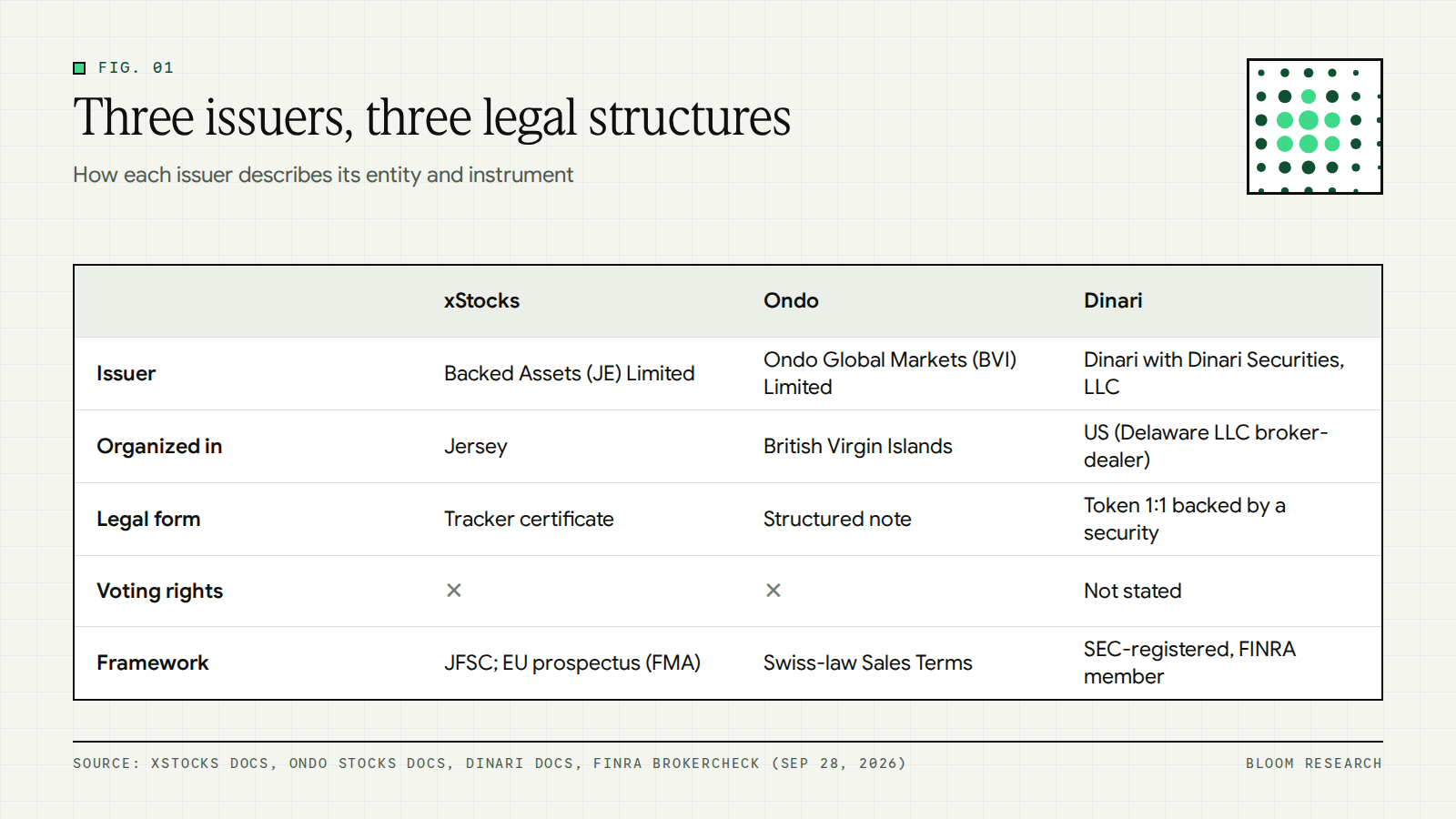
The table summarizes the xStocks vs Ondo differences, and where Dinari fits, as each issuer describes its own product. Wording follows the issuer documents, and a later section covers each row in more detail.
| Topic | xStocks | Ondo | Dinari dShares |
|---|---|---|---|
| Issuer entity | Backed Assets (JE) Limited | Ondo Global Markets (BVI) Limited | Dinari, with Dinari Securities, LLC as broker-dealer |
| Where organized | Jersey, registered with the JFSC | British Virgin Islands | Dinari Securities, LLC is a Delaware LLC |
| Legal form | Bearer debt instrument classified as a tracker certificate | Structured note, a debt instrument | Token 1:1 backed by a security |
| Shareholder voting rights | Not conferred | Not conferred | Not stated; Dinari cites the same economic rights as a broker account |
| Custody of shares | Regulated custodians and brokers, segregated per product | One or more US-registered custodial broker-dealers | Alpaca Securities LLC |
| Security agent | Independent security agent under a three-party agreement | Ankura Trust Company | Not named on the dShares page |
| Chains named in docs | Ethereum, Solana, Arbitrum, Mantle, TON, Ink and other EVM networks | Ethereum, BNB Chain, Solana | Ethereum, Arbitrum One, Avalanche C-Chain, Base, HyperEVM, HyperCore, Plume |
| Direct mint and redeem | Onboarded clients, 24/5, $5,000 minimum | Onboarded clients, instant, $1.00 minimum redemption | Through partner platforms |
| Dividends | Reinvested through a rebasing multiplier | Reinvested and reflected in token price | Paid in the USD+ stablecoin |
| Reserve reporting | Proof of reserves on the xStocks DeFi portal | Daily attestations by Ankura Trust | Reserve audits by a Big 4 accounting firm |
| United States | Not offered to US persons | Not offered to US persons | Separate US customer program through Dinari Securities |
The table covers issuers, not trading venues. Our comparison of where to buy tokenized stocks covers the platforms that list these tokens and the countries each venue excludes.
#What a tokenized stock issuer does
A tokenized stock issuer is the legal entity that creates the token, holds or controls the shares that back it, and owes obligations to token holders. The issuer is different from the venue where a token trades, and it is different from the company whose shares the token tracks.
Definition: To mint is to create new tokens against newly acquired backing assets. To burn is to destroy tokens when they are redeemed, so the circulating supply falls.
Each of the three issuers separates the creation of tokens from the trading of tokens. That split explains why a price on a venue can differ from the price at which an issuer mints or redeems.
Primary market and secondary market
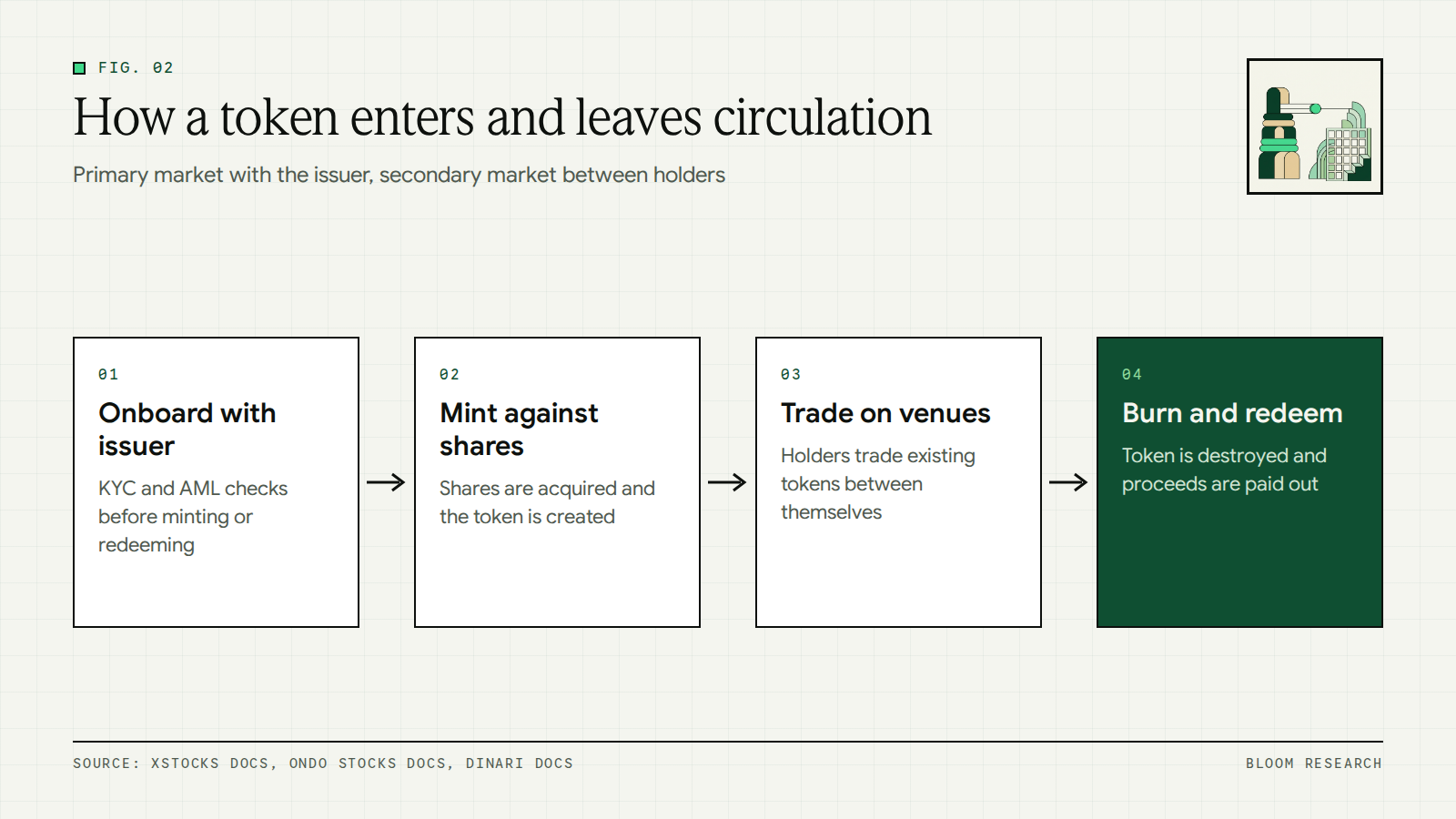
The primary market is where tokens are minted or redeemed directly with the issuer, and the secondary market is where existing tokens change hands between holders. The xStocks docs describe two layers: a primary issuance layer where tokens are issued or redeemed, and a secondary permissionless layer where tokens move across exchanges, wallets and DeFi protocols. The xStocks docs also state that the issuer does not control pricing on secondary markets.
Ondo describes minting and burning as instant, with tokens or stablecoins delivered to the buyer or seller in a single atomic transaction. Dinari states that a mint or a burn occurs only when a corresponding order is complete on a brokerage account. Our explainer on the tokenized stock lifecycle sets out each step from mint to redemption.
#Issuer entity, jurisdiction and legal wrapper
The legal wrapper is the instrument a holder owns, and it sets which rights the holder has. Two terms appear often here. A special purpose vehicle (SPV) is a company set up only to issue and manage one product line. A tracker certificate and a structured note are both debt instruments whose value follows a reference asset, such as a share.
xStocks: Backed Assets (JE) Limited
The xStocks product legal overview says the issuer is Backed Assets (JE) Limited, a Jersey-based SPV dedicated solely to the issuance and redemption of xStocks. It is registered with the Jersey Financial Services Commission (JFSC) and holds the COBO and CGPO consents required to issue security tokens.
Each xStock is a bearer debt instrument classified as a tracker certificate. It gives economic exposure to the underlying equity and does not confer shareholder voting rights. For the EU and EEA, the products are governed by a base prospectus approved by the Liechtenstein Financial Market Authority (FMA) under the EU Prospectus Regulation.
The docs cite the Swiss DLT Act for blockchain registration and state that the token is the certificate. They also note that other jurisdictions may classify xStocks differently, including as crypto assets. On December 2, 2025, Kraken announced that it had agreed to acquire Backed Finance AG, the company driving the issuance of xStocks.
Ondo: Ondo Global Markets (BVI) Limited
Ondo's legal and regulatory page says an Ondo tokenized stock is a structured note, a debt instrument issued by Ondo Global Markets (BVI) Limited. The issuer is a bankruptcy-remote SPV organized in the British Virgin Islands, and tokenholder rights are governed by Swiss law under the issuer's Sales Terms.
The issuer is 90.01% owned by Flux Finance Inc., a wholly owned subsidiary of the Ondo Foundation, and 9.99% owned by Ondo Finance Inc. Ondo Finance, Inc. serves as the technology and service provider to the issuer and is structurally and legally separate from it.
Ondo tokens carry an on suffix, so the token for TSLA is TSLAon, and the product is now called Ondo Stocks. Ondo describes them as total return trackers, so over time one token may give exposure to more than one share. Holders can redeem for the then-value of the underlying assets but receive no shareholder voting rights.
Dinari: Dinari and Dinari Securities, LLC
Dinari describes a dShare as a token 1:1 backed by a security, commonly a US equity. The dShares page says the underlying share is held in a custodial brokerage account in Dinari's name on the holder's behalf. Dinari compares this to shares held in street name by a broker.
Dinari Securities, LLC is described as an SEC-registered, FINRA-member broker-dealer that acquires the underlying security in a custodial brokerage account. FINRA BrokerCheck's record for Dinari Securities, LLC shows a Delaware limited liability company, CRD 329672, with a FINRA approval date of June 20, 2025.
Outside the United States, Dinari's restrictions page says dShares have not been registered under the US Securities Act. They may not be offered or sold in the United States or to a US person absent registration or an exemption.
Key point: In the SEC staff statement on tokenized securities of January 28, 2026, staff said the format of a security, onchain or offchain, does not affect how federal securities laws apply. Staff also said holders of third-party tokenized securities may be exposed to risks of the third party, such as bankruptcy.
Our own doc on how a tokenized stock works on Bloom describes the structure we use, which a later section compares with these three.
#Backing, custody and the security agent
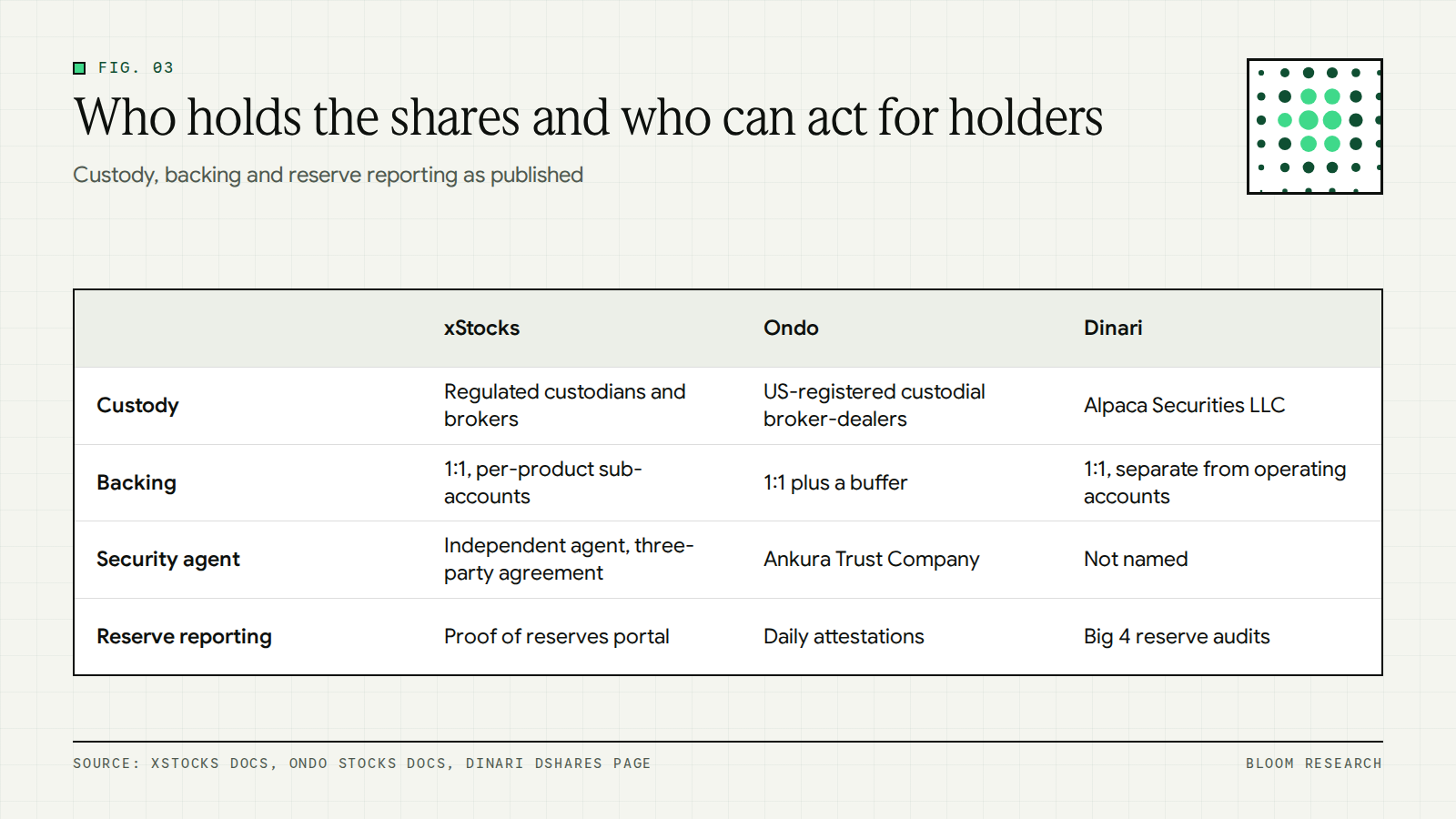
All three issuers say their tokens are backed 1:1, but the paperwork behind that statement differs. A security agent is an independent party that holds rights over the backing assets for token holders and can act if the issuer fails. Whether an issuer names one, and what it may do, is set out in each issuer's documents. Ondo names Ankura Trust Company as its security agent, while the xStocks legal overview refers to an independent security agent without naming one.
The xStocks docs say collateral is held with regulated custodians and brokers on an asset-by-asset basis, in dedicated sub-accounts with no commingling between products. Collateral accounts are governed by a three-party Account Control Agreement between the issuer, the custodian or broker, and an independent security agent. In an issuer default, the security agent may take control of the accounts, liquidate the assets and distribute proceeds under the prospectus terms.
Ondo says its tokens are fully backed on a 1:1 basis plus a buffer, with the securities held through a regulated custodial broker-dealer. The issuer must keep extra collateral above full backing at all times, so its obligations are overcollateralized, meaning the assets held exceed what is owed to holders. Ankura Trust Company, the security agent, holds a first-priority, perfected security interest in this collateral. Ondo also describes a contractually obligated insurance fund from the Ondo Foundation, through Flux Finance, Inc., to further collateralize the issuer's obligations.
Dinari's dShares page says custody is at Alpaca Securities LLC, a FINRA-member broker-dealer, with a corresponding share for every dShare in circulation. The underlying assets are held by this third-party custodial broker, separate from Dinari's operating accounts. The page does not name a security agent.
These arrangements map onto the two third-party models on the Investor.gov page on tokenized securities. In the custodial model, the token represents the holder's indirect interest in the underlying security through a security entitlement. In the synthetic model, a third party issues a linked security or derivative, and the investor has no claims or rights against the issuer of the referenced security.
At Bloom, we back each tokenized share with a share in a segregated customer account at a regulated US broker-dealer such as Alpaca Markets or Interactive Brokers. Our custody and backing doc explains where the shares are held and what the security agent, GenTwo, does if we discontinue operations.
#Attestations, audits and reserve reporting
Proof of reserves is published evidence that the assets backing a token exist in the stated amount. An attestation is a check of those holdings by an outside party at a point in time. The three issuers publish different kinds of evidence, at different frequencies.
The xStocks docs state that collateral backing is publicly verifiable and that proof of reserves information is available through the xStocks DeFi portal.
Ondo publishes daily attestations of its holdings by Ankura Trust Company, acting as an independent third-party verification agent. Ondo also states that monthly reconciliation reports will be made public by the 20th of the following month and that full financial audits will be conducted annually by an independent audit firm. Ondo's smart contracts have been audited by Spearbit and Cyfrin.
Dinari says reserve audits are performed by an independent Big 4 accounting firm to confirm 1:1 backing. Dinari's security docs list smart contract audits by Sherlock on August 11, 2023, by Hacken in December 2023 and December 2024, and by Pashov on December 24, 2024.
In practice: Ondo publishes daily attestations, monthly reconciliations and annual audits. Dinari cites periodic Big 4 reserve audits, and xStocks points to proof of reserves on its DeFi portal. The date of the latest report is separate from the backing claim itself, and the two can be out of step.
We have our reserves attested by Accountable, a third-party proof-of-reserves provider that publishes on-chain. Our proof of reserves doc lists what each attestation contains, and our transparency page shows live token supply, broker balance and backing ratio for every asset. Our smart contract audits page lists the Sherlock audits of our token, mint and redeem and attestation contracts.
#Mint and redeem with the issuer
Buying a token on a venue is a secondary market trade. Minting and redeeming directly with the issuer is a separate process, with its own onboarding and minimums. Minimums differ: xStocks sets $5,000 for a direct transaction, and Ondo sets $1.00 for a redemption.
xStocks
Access to the xStocks primary market requires onboarding with the issuer, including KYC and AML procedures, and wallet addresses must be whitelisted. Issuance and redemption can use stablecoins, or the underlying equity through an in-kind flow called xPort. Primary issuance and redemption operate 24/5, aligned with the underlying equity market.
The minimum transaction size for issuance or redemption with the issuer is $5,000. The docs say retail users may redeem directly, subject to KYC and that minimum, and that most users access liquidity through secondary markets.
Ondo
Ondo tokens bought from the Ondo Stocks platform are purchased with USDon, Ondo's own stablecoin. A stablecoin swapper converts USDC to USDon at 1:1, subject to the swapper holding enough of the other token. Ondo states there are no mint or burn fees, and the minimum redemption to USDon or USDC is $1.00.
Buying or selling directly on the platform requires Ondo's KYC onboarding. The Ondo Stocks overview states that onboarding is currently open only to institutional participants and that onboarding for retail users and individuals is coming soon.
Dinari
Dinari's process starts with an order placed through a partner platform, funded in stablecoin or fiat depending on the partner. Dinari Securities acquires the underlying security, and a 1:1 token is minted to the verified wallet. A holder can trade a dShare 24/5 on integrated marketplaces or burn it for direct redemption, with proceeds returned in stablecoins.
#Chains and transferability
The chain a token is issued on sets which wallets and applications can hold it. Each issuer publishes its own list.
- xStocks: issued natively on Ethereum, Solana, Arbitrum, Mantle, TON, Ink and other EVM-compatible networks, as SPL Token-2022 tokens on Solana and ERC-20 tokens on EVM chains. A CCIP bridge moves xStocks between supported networks.
- Ondo: available on Ethereum, BNB Chain and Solana, and transferable to HyperEVM through a bridge. Ondo lists support from custodians including BitGo, Fireblocks, Zodia and Ledger.
- Dinari: available on Ethereum, Arbitrum One, Avalanche C-Chain, Base, HyperEVM, HyperCore and Plume. Support for Blast and Kinto has been deprecated.
Transfer rules also differ. Dinari says every dShare carries embedded transfer logic, wallets must clear KYC or KYB verification, and jurisdictional logic blocks transfers to restricted regions. The xStocks FAQ describes xStocks as freely transferable on-chain like other tokens.
We track Bloom balances and holdings per chain at the wallet level, and our networks doc explains how deposits and bridging work.
#Dividends, splits and other corporate actions
A corporate action is an event such as a dividend, split or merger that changes what each share represents. The three issuers pass these events to holders in different forms, so the same dividend can show up as more tokens, a higher token price or a stablecoin payment.
Rebasing is a mechanism that changes token balances by a multiplier so that balances keep tracking the underlying shares. The xStocks docs say every xStock launches with a multiplier of 1.0, and dividends are reinvested, net of withholding taxes, into more shares of the same stock. The multiplier rises after a dividend or a split and falls after a reverse split. Activation is set for 00:30 UTC on the day after the ex-date.
The xStocks docs also describe how display differs by chain. On EVM chains, the token contract adjusts balances automatically. On Solana and TON, the on-chain balance stays constant and wallets apply a multiplier stored in the token metadata.
Ondo says dividends are automatically invested back into the referenced stock and reflected in token pricing. On Solana and BNB Chain, wallets that support display scaling show dividend reinvestment in the displayed balance, while the on-chain balance does not change. Ondo states that trading may be paused for a short time around the ex-dividend date.
Dinari pays cash dividends to dShare holders in USD+, its stablecoin, and calculates a per-holder amount with a minimum of $0.10. To qualify, the wallet must be registered with an account, and the account's entity must have a valid KYC. Dinari says splits are mirrored on the dShare balance automatically. On dividends, the Ondo vs Dinari difference is between reinvestment reflected in the token price and a cash payment in USD+.
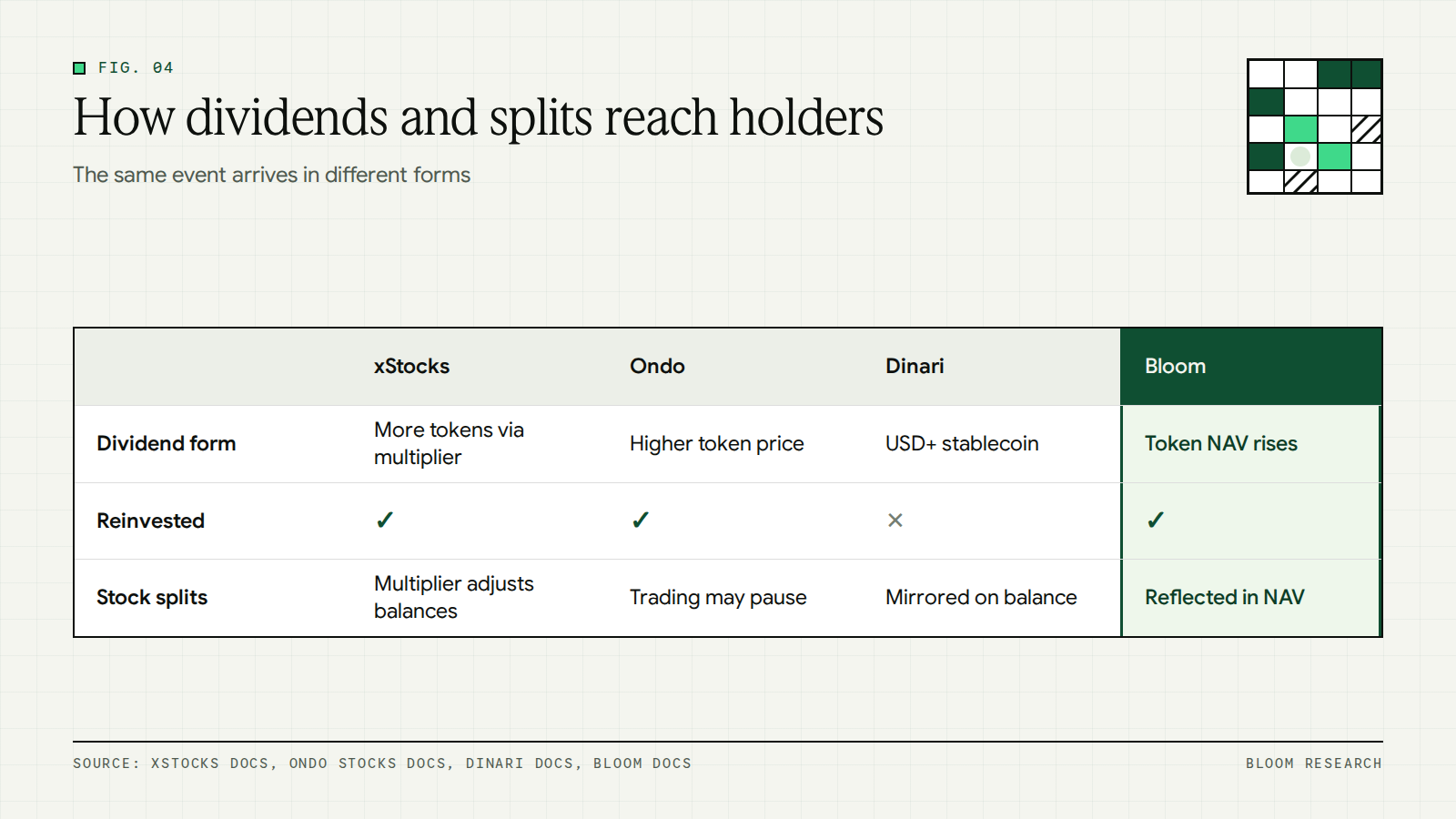
At Bloom, we use dividends to buy more of the underlying shares, so the token's NAV rises, with no separate cash distribution. NAV, or net asset value, is the on-chain value of a tokenized asset reflecting price, dividends and corporate actions. Our dividends and corporate actions doc explains how splits, spin-offs, mergers and name changes are reflected in NAV.
#Eligibility: who can hold, mint and redeem
Each issuer publishes its own restrictions, and a venue that lists a token can add more of its own. In the xStocks vs Ondo comparison, both issuers exclude US persons from their offerings. Regulation S is the exemption under the US Securities Act of 1933 that Ondo relies on to offer tokens only outside the United States.
The xStocks docs say xStocks are not marketed, offered or solicited in the United States, to US persons or in any other prohibited jurisdiction. Distributors are responsible for complying with the rules in the jurisdictions where they operate.
Ondo's issuer offers and sells tokens only in reliance on Regulation S, to persons located outside the United States who are not US persons. Its prohibited list names jurisdictions including the United States, Canada, Russia, Iran and Cuba. For another group, including the EEA, Hong Kong, Singapore, Switzerland and the United Kingdom, buyers must meet a professional, qualified or accredited investor test.
Dinari says dShares are available in 85+ jurisdictions outside the US. Its restrictions page lists Canada as a region where it is securing licensing, and a separate list of unsupported countries that includes Russia, Iran, Ukraine and Venezuela. Dinari also runs a US customer program in which accounts are established and maintained by Dinari Securities, LLC under its clearing relationship with Alpaca Securities, LLC.
What this means for readers in India
India is not named on Ondo's prohibited list or restricted table, or on Dinari's unsupported country list. Venue rules can still exclude India: Bybit's xStocks FAQ, last updated July 30, 2026, lists India among regions where xStocks trading on Bybit is not available.
Under the RBI's Liberalised Remittance Scheme FAQ, resident individuals can remit up to USD 250,000 per financial year, and permitted capital account transactions include investment abroad. From April 1, 2026, banks apply TCS on LRS remittances for purposes such as investing at nil up to ₹10 lakh and 20% above ₹10 lakh, as Standard Chartered India's note on the TCS amendment sets out. Our page on investing from India lists popular US stocks and ETFs for investors in India.
What this means for readers in the United Kingdom
Ondo lists the United Kingdom among jurisdictions where buyers must be a Professional Client under MiFID II or a Qualified Investor under the Prospectus Regulation. The summary thresholds include meeting two of three criteria, such as a EUR 500,000 financial portfolio. Bybit's xStocks FAQ list also includes the United Kingdom, and Dinari's unsupported list does not name it.
#How Bloom tokenized stocks are structured
Our docs describe our own structure in the same terms used above. RFQ, or request for quote, is the execution model we use: a regulated tokenized security issuer returns a live quote, typically valid for 5 to 10 seconds, and the trade settles back-to-back against the underlying market.
On Bloom: Each asset is an on-chain token backed 1:1 by a real share in custody at a regulated US broker-dealer such as Alpaca Markets or Interactive Brokers, in segregated accounts. If we discontinue operations, our security agent, GenTwo, works with the custodian to redeem tokens against the underlying shares. Reserves are attested in real time by Accountable, and our token, mint and redeem and proof-of-reserves contracts are audited by Sherlock. The token is held in your own embedded wallet.
Our RFQ execution doc covers quotes, slippage tolerance and settlement. Our list of available assets covers US stocks on NYSE, NASDAQ and AMEX and US ETFs such as SPY, QQQ and VOO.
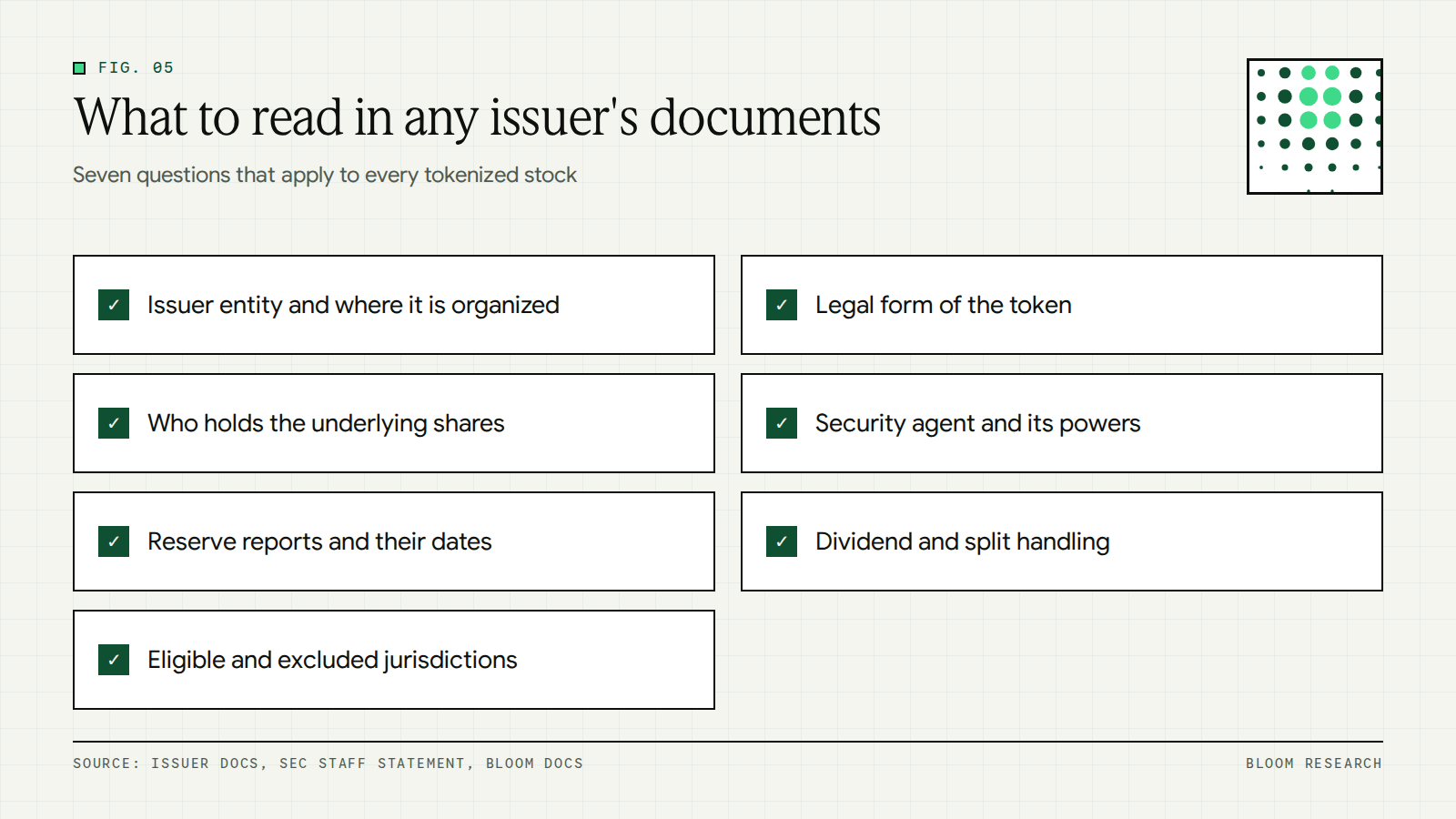
The seven questions behind this xStocks vs Ondo comparison apply to any issuer, including Bloom:
- Who is the issuer, and where is it organized?
- What legal instrument is the token?
- Who holds the underlying shares?
- Who can act for holders if the issuer fails?
- How are reserves reported, and how recent is the latest report?
- How do dividends and splits reach holders?
- Who is eligible, and which jurisdictions are excluded?
#Risks and availability
Important: Tokenized stocks carry market, smart contract, custody, bridging and liquidity risk, and trading carries risk including the loss of principal.
Our risk disclosure sets out each of these risks. We do not offer our product or services in the United States or other restricted jurisdictions, and our service availability doc explains how gating works. Our markets page lists every tokenized stock and ETF you can trade on Bloom.
Frequently asked questions
Who issues xStocks?
xStocks are issued by Backed Assets (JE) Limited, a Jersey special purpose vehicle registered with the Jersey Financial Services Commission. Each xStock is a bearer debt instrument classified as a tracker certificate that gives economic exposure to one underlying equity and confers no shareholder voting rights. On December 2, 2025, Kraken announced that it had agreed to acquire Backed Finance AG, the company driving the issuance of xStocks.
Who issues Ondo tokenized stocks?
Ondo tokenized stocks are issued by Ondo Global Markets (BVI) Limited, a bankruptcy-remote special purpose vehicle organized in the British Virgin Islands. Each token is a structured note, a debt instrument, and tokenholder rights are governed by Swiss law under the issuer's Sales Terms. Ondo Finance, Inc. serves as the technology and service provider to the issuer and is legally separate from it.
What are Dinari dShares?
Dinari describes a dShare as a token 1:1 backed by a security, commonly a US equity. The underlying share is held in a custodial brokerage account at Alpaca Securities LLC in Dinari's name on the holder's behalf. Dinari Securities, LLC, an SEC-registered, FINRA-member broker-dealer, acquires the underlying security, and dShares are reached through Dinari's partner platforms.
Do tokenized stocks from these issuers pay dividends?
Each issuer handles dividends differently. xStocks reinvest dividends, net of withholding taxes, into more shares and adjust balances through a rebasing multiplier. Ondo reinvests dividends and reflects them in the token price. Dinari pays cash dividends in its USD+ stablecoin to qualifying holders. At Bloom, we use dividends to buy more of the underlying shares, so the token NAV rises.
Can I redeem xStocks or Ondo tokens directly with the issuer?
Only after onboarding. xStocks require KYC and AML onboarding and whitelisted wallets, operate issuance and redemption 24/5 and set a $5,000 minimum transaction size. Ondo requires its KYC onboarding, sets a $1.00 minimum redemption to USDon or USDC, and its overview says onboarding is currently open only to institutional participants.
Can you buy these tokenized stocks in the USA?
xStocks are not marketed, offered or solicited in the United States or to US persons, and Ondo offers its tokens only under Regulation S to persons outside the United States. Dinari's non-US dShares follow the same restriction, and Dinari runs a separate US customer program through its broker-dealer. We do not offer our product or services in the United States.
Are xStocks, Ondo and Dinari available in India?
Bybit's xStocks FAQ, last updated July 30, 2026, lists India among regions where xStocks trading on Bybit is not available. India is not named on Ondo's prohibited list or Dinari's unsupported country list. Indian residents who invest abroad remit funds under the Liberalised Remittance Scheme, and banks apply TCS at 20% above ₹10 lakh a year from April 1, 2026.