
Self-Custody vs Custodial Wallets: What You Actually Control
Self custody vs custodial wallet: who holds the private key, what the SEC and the FTX case show about each model, how MPC wallets differ, and our model.
Key takeaways
- The self custody vs custodial wallet difference is who controls the private key: a third-party custodian such as a crypto exchange, or you.
- The SEC says a lost private key means permanently losing access, and a custodian that is hacked, shuts down or goes bankrupt can cost you access.
- In the FTX case, the CFTC alleged that customer assets described as segregated were commingled with Alameda, causing the loss of over $8 billion in customer deposits.
- MPC wallets split a private key into shares held by independent parties, so no single party can sign alone; on Bloom, no single party, including us, holds your complete key.
- Controlling a wallet is separate from the asset a token represents: our tokenized stocks sit in your wallet, while the underlying shares are held at regulated US broker-dealers.
The self custody vs custodial wallet choice is a choice about who holds the private key. In a custodial wallet, a third party such as a crypto exchange manages and controls access to the keys; in a self-custody wallet, you manage the keys and have sole control over access. For investors in India, the choice appears early: our India country page notes that funding generally means converting rupees into stablecoins on a locally operating exchange, then moving the USDC to a self-custody wallet under your own keys.
This self custody vs custodial wallet guide compares both models using regulator and court records. It also covers multi-party computation (MPC) wallets, a design that splits control of one key, and the difference between controlling a wallet and controlling the asset a token represents. For how tokenized stocks work in general, see our complete guide to tokenized stocks.
#Self custody vs custodial wallet: the short answer
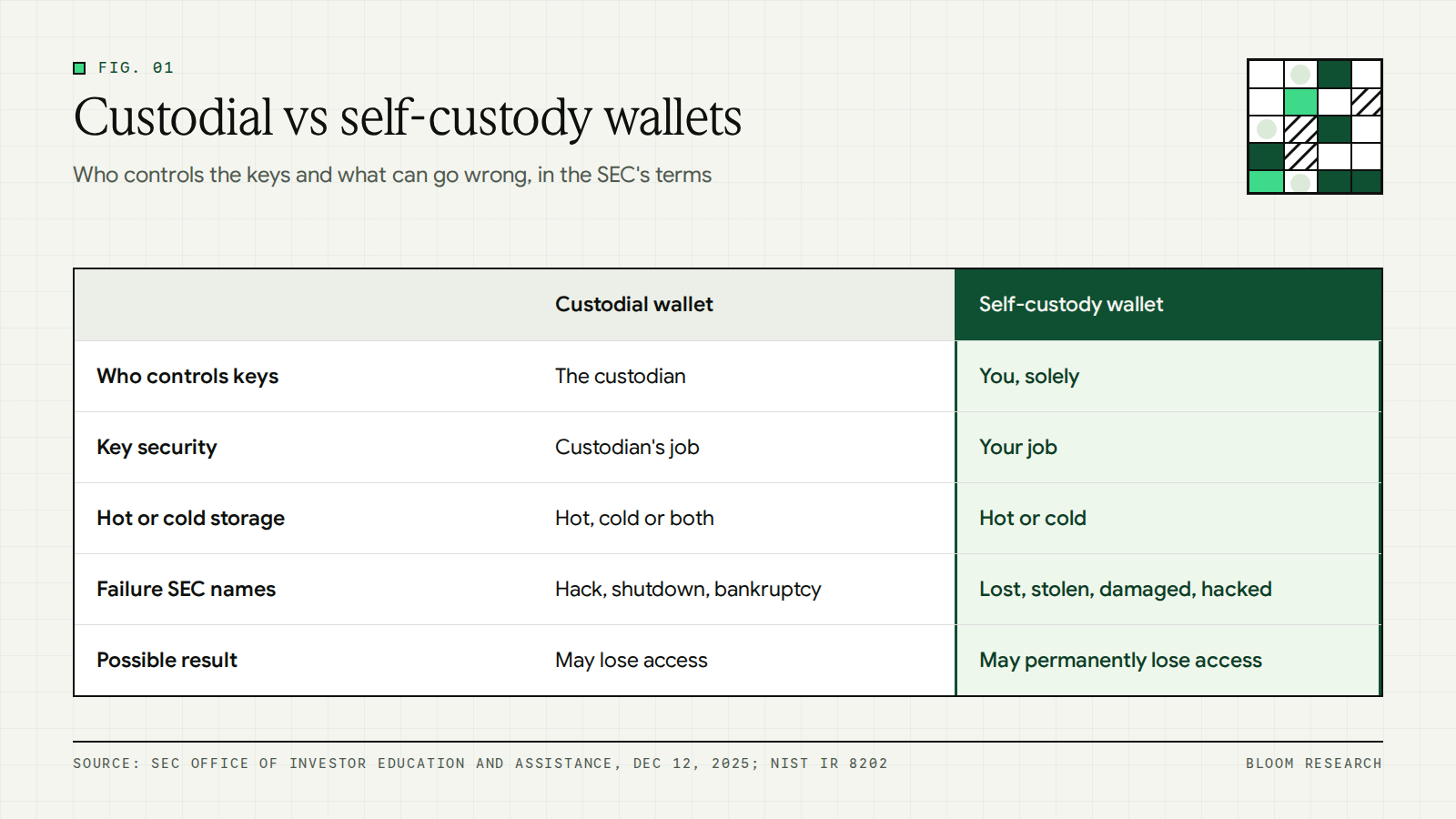
The SEC's Office of Investor Education and Assistance published a bulletin on crypto asset custody basics for retail investors on December 12, 2025. It describes two models and the main risk in each.
Definition: Self-custody means you control your crypto assets and are responsible for managing the private keys to your wallets. Third-party custody means you select a professional custodian or service provider to hold your crypto assets, and that custodian manages and controls access to the private keys.
The SEC names crypto exchanges and dedicated crypto asset custody providers as examples of third-party custodians. With self-custody, the bulletin says you have sole control over access to your private keys and sole responsibility for their security. The table sets the two models side by side using the bulletin's wording.
| Question | Custodial (third-party) wallet | Self-custody wallet |
|---|---|---|
| Who controls the private keys | The custodian manages and controls access to the keys | You have sole control over access to the keys |
| Who is responsible for key security | The custodian | You have sole responsibility |
| Hot or cold storage | Custodian accounts may use cold wallets, hot wallets or both | Hot and cold wallet options exist for self-custody too |
| Main failure the SEC names | The custodian is hacked, shuts down or goes bankrupt | Your wallets are lost, stolen, damaged or hacked |
| Result the SEC describes | You may lose access to your crypto assets | You may permanently lose access to your crypto assets |
Neither column is free of risk. The SEC names a way to lose access in each model: a custodian that is hacked, shuts down or goes bankrupt, or your own wallets being lost, stolen, damaged or hacked.
#What a crypto wallet holds
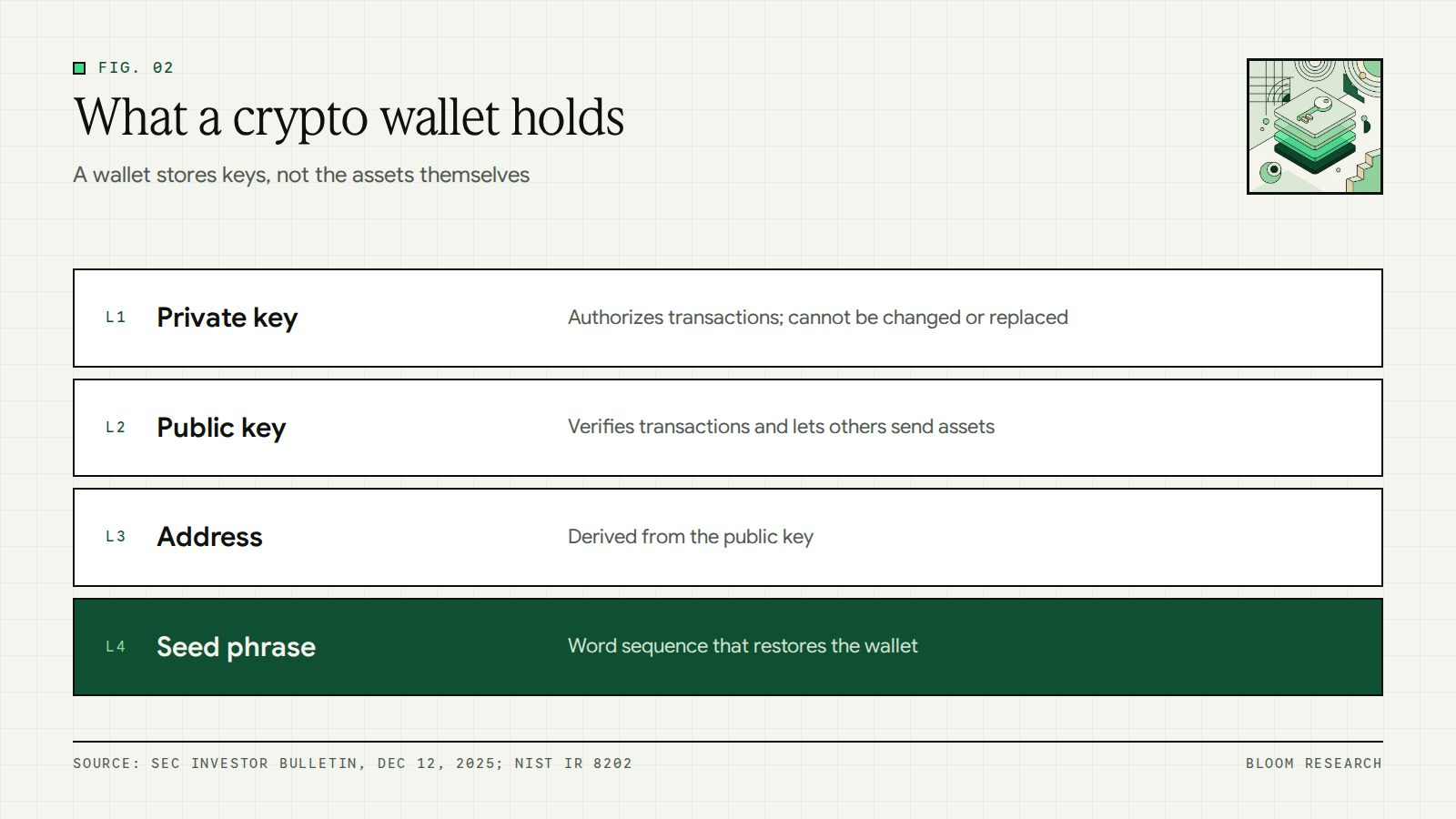
The word wallet suggests a container for coins, but the SEC bulletin says crypto wallets do not store crypto assets themselves. Instead, they store the private keys or passcodes for your crypto assets. Together with the public key, these keys prove your ownership and grant you the rights to send, receive or spend the assets.
This is why the custody question centers on keys. Whoever controls the private key can authorize transactions, regardless of which app or account displays the balance.
Private keys, public keys and addresses
A private key is, in the SEC's words, a randomly generated alpha numeric passcode that allows you to authorize transactions for the crypto asset. The SEC compares it to a password, with one difference that matters: once created, a private key cannot be changed or replaced. If you lose your private key, you permanently lose access to the crypto assets in that wallet.
A public key is a second code used to verify transactions and allow someone else to send crypto assets to your wallet. The SEC compares a public key to the e-mail address to your crypto wallet. It does not allow access to the private key and cannot be used to authorize transactions.
The National Institute of Standards and Technology describes the same split in NIST IR 8202, its blockchain technology overview from October 2018. Private keys are used to digitally sign transactions, public keys are used to derive addresses, and public keys verify signatures generated with private keys. NIST adds that the public key can be made public, but the private key must remain secret for the data to keep its cryptographic protection. Our glossary of product terms defines the terms we use in the product, such as embedded wallet and MPC.
Seed phrases and recovery
Many crypto wallets also generate a seed phrase, also known as a seed recovery phrase, backup seed phrase or mnemonic phrase. The SEC defines it as a random sequence of words that allows you to restore your crypto wallet if you lose it or your private key, or if its hardware or software is damaged or corrupted.
The bulletin asks investors to store the seed phrase in a secure place and not share it with anyone. Its list of general tips repeats the point in one line: never share your private keys or seed phrases.
Key point: In a self-custody wallet, whoever holds the private key or the seed phrase controls the wallet. The SEC says a private key cannot be changed or replaced once created, so there is no password reset for the key itself.
Hot wallets and cold wallets
A hot wallet is a crypto wallet connected to the internet, such as a desktop, mobile or web application. The SEC says hot wallets provide a convenient way to access crypto assets for transactions, but they also expose those assets to cyberthreats.
A cold wallet is typically a physical device that is not connected to the internet, such as a USB drive, an external hard drive or a piece of paper. The bulletin says cold wallets are generally less convenient but generally more secure from cyberthreats than hot wallets. The physical devices can still be lost, damaged or stolen, which may result in a permanent loss of the crypto assets.
Hot and cold describe where keys are stored, not who holds them. The SEC notes that hot and cold wallet options exist for both self-custody and third-party custody.
NIST IR 8202 describes the storage options from the key holder's side. Wallet software can store private keys, public keys and associated addresses; many users store keys on special secure hardware; and others use private key escrow services. NIST notes that these escrow services can also satisfy KYC laws, because users must provide proof of their identity when creating an account.
#What is a custodial wallet
A custodial wallet is an account where a third party holds your crypto assets and manages and controls access to the private keys. The SEC bulletin names crypto exchanges and dedicated crypto asset custody providers as third-party custodians. When you open an exchange account and keep assets there, the exchange is the custodian.
The custodian decides how the keys are stored. The SEC says the accounts custodians use to hold private keys may consist of cold wallets, hot wallets or a combination of both. The customer does not hold those keys; the custodian manages and controls access to them.
If the third-party custodian is hacked, shuts down or goes bankrupt, the bulletin says you may lose access to your crypto assets. For this reason, its checklist for choosing a custodian starts with research: find out how the custodian is regulated, what happens if it fails, and whether it provides insurance for loss or theft.
Rehypothecation and commingling
Two practices affect what a custodial balance represents. The SEC says some custodians use deposited crypto assets as collateral for their own purposes, such as lending, which is sometimes called rehypothecation. To reduce costs, some custodians may also commingle crypto assets, which means pooling them instead of holding them individually for each customer.
The bulletin asks investors to find out whether a custodian engages in either practice and, if so, whether it requires the customer's consent. It also asks how the custodian safeguards assets and private keys, who has access to them, and whether storage is subcontracted to another firm.
Important: The SEC's custodian questions cover rehypothecation, commingling, subcontracted storage, insurance and who has access to the private keys. Each question asks what stands behind an account balance at a custodian.
#What the FTX case showed about custodial wallets
FTX is a documented example of custodial risk, because US regulators and prosecutors published their allegations and the sentencing outcome. The Commodity Futures Trading Commission filed a complaint on December 13, 2022 against Samuel Bankman-Fried, FTX Trading Ltd. and Alameda Research. The complaint alleges that from at least May 2019 through November 11, 2022, Bankman-Fried controlled both FTX.com and Alameda.
According to the CFTC, FTX held itself out as "the safest and easiest way to buy and sell crypto" and represented that customer assets were held in custody by FTX and segregated from FTX's own assets. The complaint alleges that, to the contrary, FTX customer assets were routinely accepted and held by Alameda and commingled with Alameda's funds. It also alleges that FTX code included an "allow negative flag" and an effectively limitless line of credit that allowed Alameda to withdraw billions of dollars in customer assets, and that these features were not disclosed to the public.
The CFTC complaint asserts that the defendants' actions caused the loss of over $8 billion in FTX customer deposits. The agency also cautioned that orders requiring repayment of funds to victims may not always result in the recovery of lost money.
On the same day, the SEC charged Bankman-Fried with defrauding FTX investors. The SEC alleged he promoted FTX as a safe, responsible crypto asset trading platform with automated risk measures to protect customer assets, while concealing the undisclosed diversion of FTX customers' funds to Alameda. The US Attorney for the Southern District of New York unsealed a parallel criminal indictment the same day. On March 28, 2024, the US Department of Justice announced that Bankman-Fried was sentenced to 25 years in prison, and said he had channeled billions of dollars in customer deposits from FTX to Alameda.
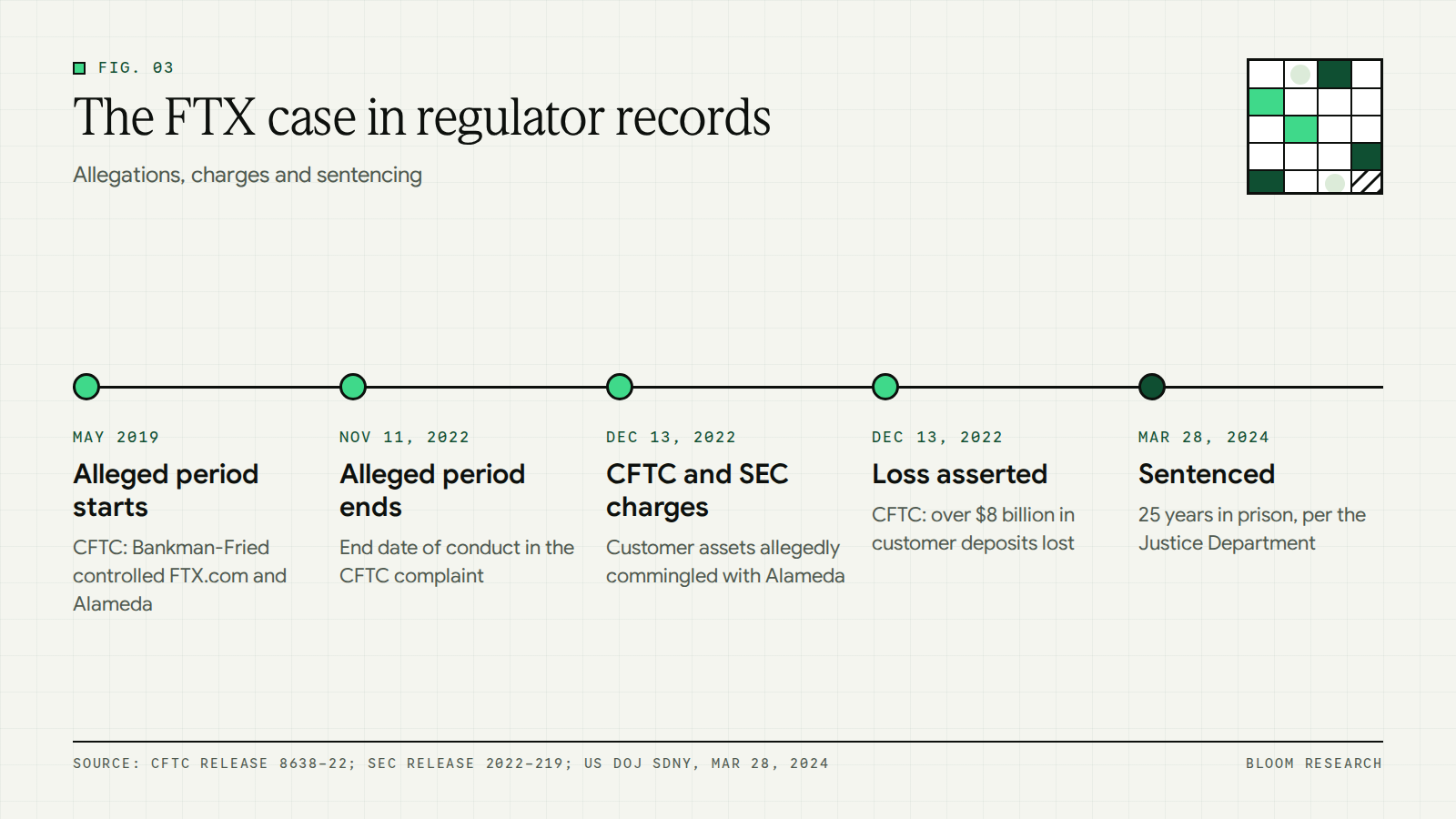
The FTX records match the risks the SEC bulletin lists: customer assets described as held in custody and segregated were, according to the CFTC, commingled with another firm's funds.
#What a self custody wallet gives you and asks of you
The SEC's description of self-custody is the reverse of third-party custody: you, not a custodian, control access to the private keys. The trade-off, in the SEC's words, is sole responsibility for the security of your private keys.
Sole control and sole responsibility
The SEC describes self-custody with two linked phrases: sole control over access to your private keys and sole responsibility for their security. Its questions for self-custody ask whether you are comfortable setting up and maintaining a wallet, which may require some technical savvy, and whether you want sole responsibility for keeping track of private keys and seed phrases.
Cost is part of the choice as well. The bulletin says physical devices for cold wallets typically cost money to purchase, while hot wallets may initially be free, and making transactions using either type typically involves fees.
Why a lost or stolen key cannot be reset
NIST IR 8202 explains why self-custody mistakes are hard to reverse. If a user loses a private key, any digital asset associated with that key is lost, because it is computationally infeasible to regenerate the same private key. If a private key is stolen, the attacker has full access to all digital assets controlled by that key.
NIST adds that because blockchain data cannot generally be changed, once a thief transfers the funds to another account, that transaction generally cannot be undone.
#MPC wallets: a model between the two
A third design splits one key across several parties. Multi-party computation (MPC) is a cryptographic technique that splits a private key into multiple shares held by independent parties. The National Institute of Standards and Technology runs a Multi-Party Threshold Cryptography project on these methods. It describes threshold schemes as applying principles of secure multiparty computation to enable a secure distribution of trust in cryptographic operations, including signatures and key generation.
A threshold signature is a signature that needs a minimum number of key shares, the threshold, to cooperate, so no single share holder can sign on its own. In January 2026, NIST published the final version of NIST IR 8214C, its first call for multi-party threshold schemes.
How it works: In our embedded wallet, MPC splits your private key into multiple shares held by independent parties. A transaction signature requires a threshold of those shares to cooperate, so no single party can sign on its own, and a compromise of one party does not compromise the wallet.
MPC changes who holds the key, not only where it is stored. Our security model documents this wallet layer next to the custody, smart contract and operational layers. The next section describes how our wallet uses MPC, what you can export, and how recovery works.
#Custodial vs non custodial wallet rules in India and the UK
In India, holding crypto for other people is a regulated activity for anti-money laundering purposes. The Financial Intelligence Unit India (FIU-IND) issued AML and CFT guidelines for virtual digital asset service providers in March 2023, after a Central Government notification dated March 7, 2023. The guidelines list five activities that make a business a reporting entity under the Prevention of Money-Laundering Act, 2002 when carried out for or on behalf of another person. One of them is "safekeeping or administration of virtual digital assets or instruments enabling control over virtual digital assets."
That wording covers what a custodial wallet provider does. The same list also covers exchange between virtual digital assets and fiat currencies, and transfer of virtual digital assets. Those match the funding steps on our India page: converting rupees into stablecoins on a local exchange, then moving the USDC to a self-custody wallet.
In the United Kingdom, an FCA statement first published on May 11, 2022 and last updated on February 6, 2026 says the FCA has not been given regulatory oversight over direct investments in cryptoassets. It adds that there are no consumer protections for those who buy cryptoassets and that they are not FSCS protected. Our United Kingdom country page notes that a common path is a Faster Payments or SEPA transfer to a regulated on-ramp that converts pounds to USDC, which is then withdrawn to a self-custody wallet.
Note: On both of our country pages, the funding path starts at an exchange or on-ramp account and ends in a self-custody wallet. The custody question applies at each step: the on-ramp account, the wallet you withdraw to, and the platform you trade on.
#How our wallet model works on Bloom
Our legal page states our position directly: we are non-custodial. Your keys to your embedded wallet belong to you, and we never have access to your keys or to your funds. The rest of this section describes the mechanics behind that statement, using our product documentation.
Signing in and the embedded wallet
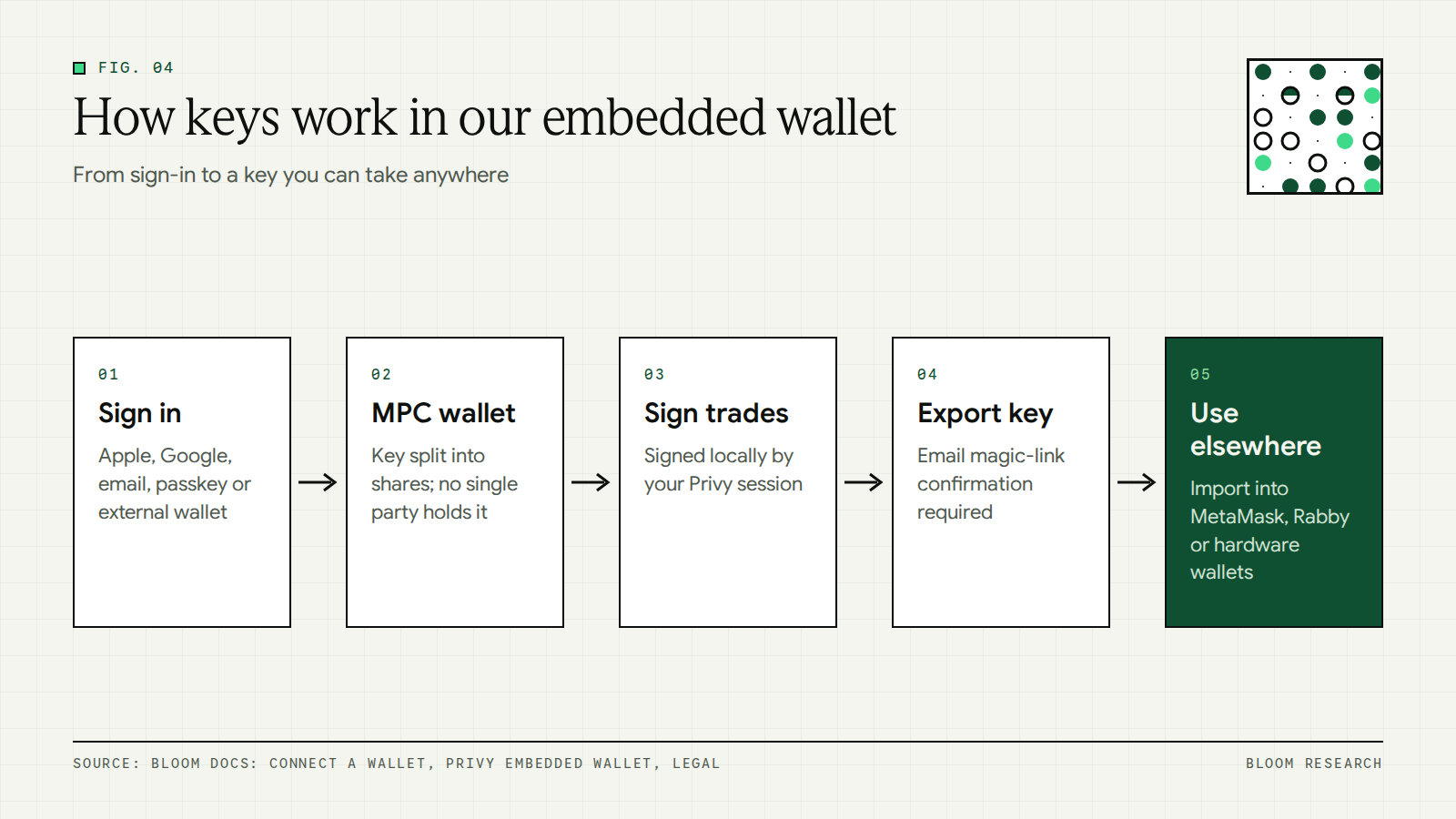
An embedded wallet is a wallet provisioned inside your account at sign-up, with no seed phrase to write down. Our sign-in guide lists five methods: Apple, Google, email magic link, passkey, or an external wallet through WalletConnect. A passkey is a WebAuthn credential bound to a device, which we use as a sign-in and recovery method.
When you sign in, our Privy embedded wallet is provisioned by Privy using multi-party computation for key management. No single party, including us, ever holds your complete private key. Your wallet address appears on your Account page, where you can copy it or view it on a block explorer.
Trade execution is signed locally by your Privy session. An optional biometric or passkey confirmation on every trade can be turned on in Account, Security; it is off by default.
Exporting your key or using an external wallet
You can export your private key at any time from Account, Security. The export is gated by email magic-link confirmation as a second factor. Once exported, the wallet can be imported into a standard wallet such as MetaMask, Phantom, Rabby or a hardware wallet and used independently of Bloom.
You can also skip the embedded wallet. With an external wallet such as MetaMask, Phantom, Coinbase Wallet, Rabby, Trust Wallet or a hardware wallet, that wallet is linked as your authentication method. Your assets remain in the wallet you already control, and every transaction is signed in that wallet's own interface. There is no in-app key export, because the key is already yours, and recovery is whatever your wallet provider offers, such as a seed phrase or hardware key.
If you start with an embedded wallet and later want an external one, you can export the embedded key and import it into the external wallet, and no funds need to move.
Recovery paths and step-up checks
Our recovery and security guide lists four recovery paths: a passkey on a backup device, an email magic link, an optional TOTP authenticator app, and a linked external wallet. TOTP means time-based one-time password, a short-lived code generated by an app such as Google Authenticator, Authy or 1Password.
A second-factor check appears for sensitive account actions: private-key export, sign-in from a new device, suspicious-activity re-authentication and session recovery. There is no value-based step-up, so deposits, withdrawals and trades of any size complete without a second factor tied to the dollar amount. SMS codes are never sent for any flow.
If you lose all enrolled devices and recovery methods at once, the wallet is recoverable only through the cryptographic share recovery mechanisms Privy provides. Exporting the key once gives you a copy that works outside Bloom, which you then protect the same way as any self-custody key.
#Controlling the wallet vs controlling the asset
Holding the key to a wallet and holding the asset a token represents are two different layers. On Bloom, each tokenized stock is an on-chain token in your own embedded wallet, and each token is backed 1:1 by a real share in custody at a regulated US broker-dealer such as Alpaca Markets or Interactive Brokers. Our custody and backing documentation explains that those shares sit in segregated customer accounts, held separately from the broker's own funds.
So the wallet layer is under your keys, while the share layer is held by a broker custodian. The same applies to your USD trading balance: our trading balance documentation says it is backed 1:1 by USDC and USDT held in custody, and it is represented by an on-chain ERC-20 token credited to your wallet by an authorized partner.
Why it matters: A self-custody wallet gives you control of the token. The share behind a tokenized stock is held by a broker custodian, so its backing, segregation and attestation are a separate question from who holds the key.
You can check the share layer yourself. Reserves are attested in real time by Accountable, a third-party proof-of-reserves provider, and our proof of reserves documentation explains the mechanism. Proof of reserves means an independent check that the assets backing a token exist in the stated amount. The Transparency page in the app shows the live token supply, attested broker balance, backing ratio and attestation contract for every asset, and our proof of reserves overview summarizes the same data. If we discontinue operations, the security agent GenTwo works with the custodian to redeem tokens against the underlying shares.
The token, mint-and-redeem, and proof-of-reserves attestation contracts are covered in our smart contract audit history. For how a share becomes a token and back, see our guide to the tokenized stock lifecycle from mint to redeem.
#Questions the SEC lists before choosing a custody model
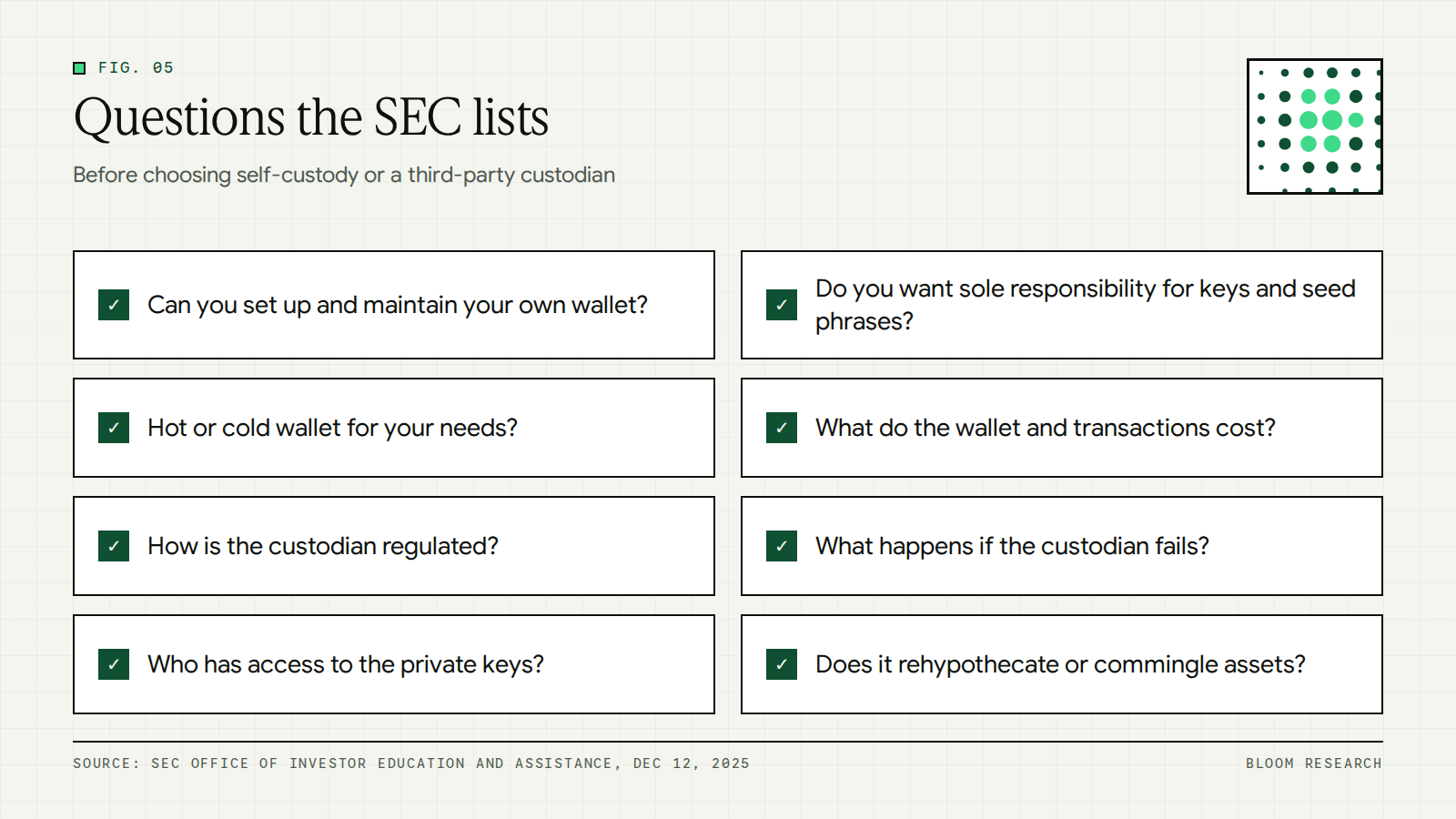
The SEC bulletin closes each custody model with questions for investors. These are the questions it lists for the self custody vs custodial wallet decision, grouped by model.
For self-custody:
- Are you comfortable setting up and maintaining your crypto wallets?
- Do you want sole responsibility for keeping track of private keys and seed phrases?
- Which type of wallet, hot or cold, matches your convenience and security needs?
- What do the wallet and its transactions cost?
For a third-party custodian:
- How is the custodian regulated, and are there complaints about it?
- What happens if the custodian fails, and does it provide insurance for loss or theft?
- Where and how does it store your crypto assets and private keys, and who has access?
- Does it rehypothecate or commingle customer assets, and does it require your consent?
On Bloom: Withdrawing to an external wallet completes in seconds once the network confirms the transfer, as our sell and withdraw guide describes. The first time you withdraw to a new destination, a banner asks you to double-check the address.
Trading on Bloom carries risk, including the loss of principal, and market, smart contract, custody, bridging and liquidity risks apply. Every contract is audited, but no audit eliminates risk entirely; our risk disclosure sets out each risk. We do not offer our product or services to users in the United States or in other restricted jurisdictions, as our service availability page lists. For a summary of how we protect custody, wallets and keys, smart contracts and continuity, see our security overview.
Frequently asked questions
What is a self-custody wallet in crypto?
A self-custody wallet is a wallet where you manage the private keys yourself. The SEC's investor bulletin says that with self-custody you control your crypto assets, have sole control over access to the private keys, and have sole responsibility for their security. Self-custody wallets can be hot wallets connected to the internet or cold wallets such as a physical device that stays offline.
Can I lose my crypto with a non-custodial wallet?
Yes. The SEC says that if your crypto wallets are lost, stolen, damaged or hacked, you may permanently lose access to your crypto assets. NIST IR 8202 explains why: a lost private key cannot be regenerated because it is computationally infeasible, and a thief who holds a private key has full access to the digital assets it controls.
What is a custodial wallet?
A custodial wallet is an account where a third party holds your crypto assets and manages and controls access to the private keys. The SEC names crypto exchanges and dedicated crypto asset custody providers as third-party custodians, and says their accounts may use cold wallets, hot wallets or a combination of both. If the custodian is hacked, shuts down or goes bankrupt, you may lose access.
What happens to a custodial wallet if the exchange fails?
The SEC says you may lose access to your crypto assets if a third-party custodian is hacked, shuts down or goes bankrupt. In the FTX case, the CFTC's December 2022 complaint asserted that the defendants' actions caused the loss of over $8 billion in FTX customer deposits, and the CFTC cautioned that repayment orders may not always result in the recovery of lost money.
Is an MPC wallet self-custody?
It depends on who holds the key shares and whether you can take the full key. On Bloom, our embedded wallet is provisioned by Privy using multi-party computation, and no single party, including us, ever holds your complete private key. You can export your private key at any time from Account, Security, and import it into a standard wallet such as MetaMask, Phantom, Rabby or a hardware wallet.
Are custodial wallet providers regulated in India?
Providers that hold crypto for others fall under India's anti-money laundering rules. FIU-IND's March 2023 AML and CFT guidelines for virtual digital asset service providers list safekeeping or administration of virtual digital assets, or instruments enabling control over them, among the activities covered under the Prevention of Money-Laundering Act, 2002 when carried out for or on behalf of another person.