
Tokenized ETFs: How On-Chain Exposure to SPY and QQQ Works
Tokenized ETFs explained: how tokens backed by SPY and QQQ shares work, what each fund tracks, and how dividends, custody and trading hours are handled.
Key takeaways
- Investor.gov lists tokenized fund shares among tokenized securities and describes three models, issuer-sponsored, custodial and synthetic, whose holder rights differ.
- SPY seeks to track the S&P 500 Index before expenses, while QQQ tracks the Nasdaq-100 Index, the 100 largest non-financial companies listed on the Nasdaq.
- On Bloom, tokenized SPY and QQQ are backed 1:1 by real fund shares held at regulated US broker-dealers, with reserves attested by Accountable.
- Fund distributions on Bloom buy more underlying shares and raise the token's NAV instead of paying cash to the wallet.
- From India, LRS limits, TCS and Schedule FA reporting still apply, and the treatment of tokenized securities can differ from directly held shares.
Tokenized ETFs are on-chain tokens that give economic exposure to shares of an exchange-traded fund, such as SPY or QQQ. This guide explains what the fund share is, the models used to turn a security into a token, and how tokenized SPY and tokenized QQQ work on Bloom. The facts are as published on September 28, 2026.
Our complete guide to tokenized stocks covers the asset class in general. Here we focus on funds. An ETF token adds one extra step of exposure compared with a single-stock token, because the fund itself holds a basket of many companies.
#What are tokenized ETFs?
Tokenized ETFs start with an ordinary fund. The SEC's Investor.gov page on ETFs says an ETF is an exchange-traded investment product that must register with the SEC as an open-end investment company or a unit investment trust. ETFs pool money from many investors and invest it in stocks, bonds or other assets. Each ETF share represents an investor's part ownership of the fund's portfolio and the income that portfolio generates.
A tokenized security is the second concept this guide defines. Investor.gov's page on tokenized securities defines them as financial instruments, such as stocks, bonds or fund interests, that are formatted as or represented by a crypto asset recorded on a blockchain. The same page lists tokenized fund shares among its examples. A tokenized ETF is therefore a token whose value is linked to an ETF share.
Definition: A tokenized security is a stock, bond or fund interest that is formatted as, or represented by, a crypto asset recorded on a blockchain or similar distributed ledger.
According to Investor.gov, an SEC interpretive release of March 17, 2026 states that tokenized securities are securities and are subject to SEC regulation and investor protections. ETF shares themselves trade on an exchange. Investor.gov notes that ETF investors can trade their shares on the market at the market price whenever the market is open, minus any fees.
Three ways a fund share can be tokenized
Investor.gov describes three models for tokenizing a security. The model decides what rights the token holder has.
- Issuer-sponsored: the issuer or its agent issues the security directly on a blockchain. The security carries the same legal rights, such as voting, dividends and ownership, as a traditional share of the same class.
- Custodial: the token represents the holder's indirect interest in the underlying security through a security entitlement. Holding the token is the equivalent of holding the security through a securities intermediary like a broker-dealer.
- Synthetic: a third party issues a linked security or derivative that provides synthetic exposure to a referenced security. The price changes with the referenced security, but the investor has no claims or rights against the issuer of that security.
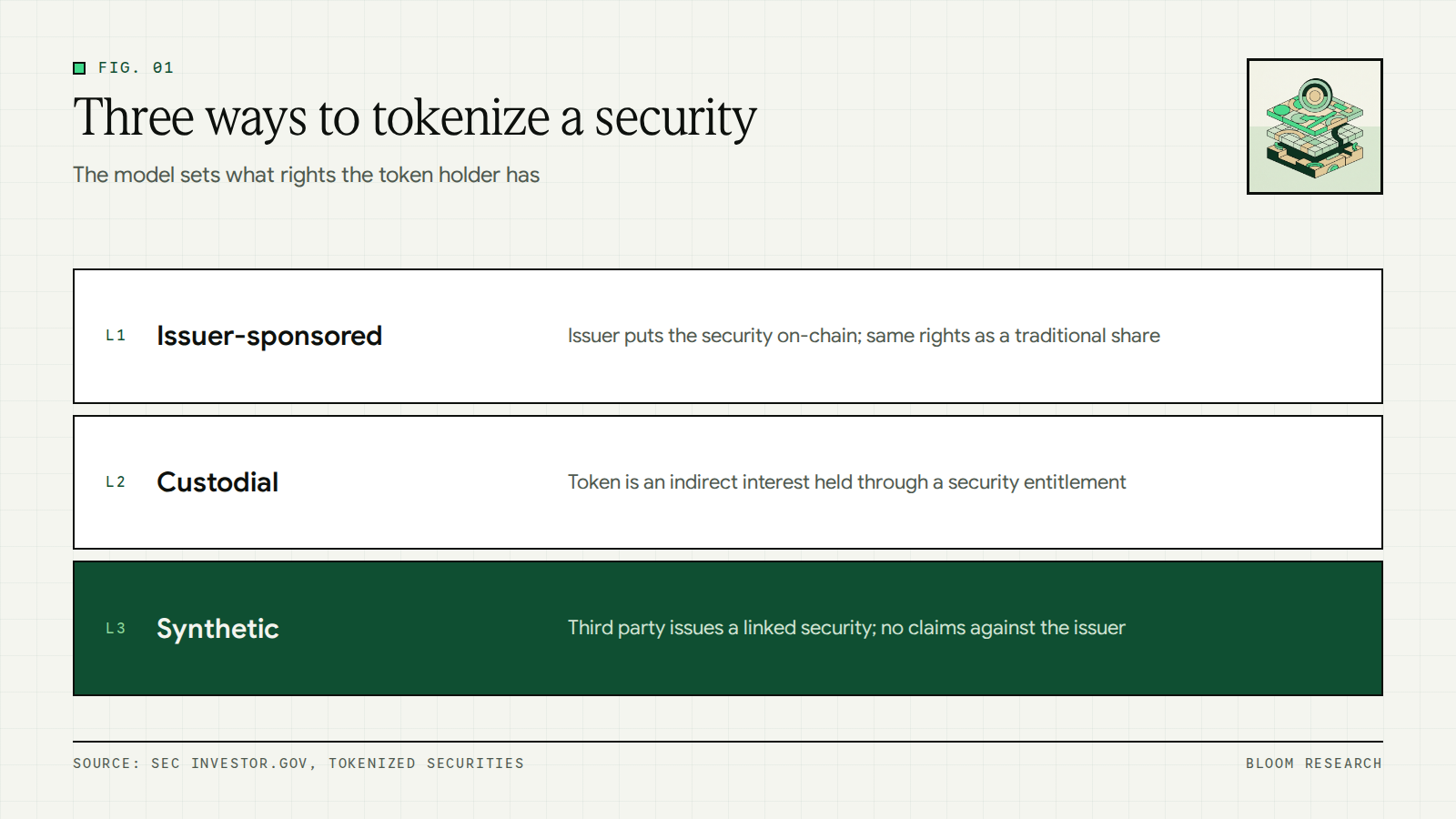
A synthetic tokenized security, in Investor.gov's words, can give rights that differ significantly from those of a traditional owner. The term "spy on chain" is used loosely for tokens built on any of these three models, so the model behind a given token is the first detail to check in its documentation.
#SPY and QQQ: the funds behind the tokens
SPY and QQQ are two different funds that track two different indexes. State Street's SPY fund page says the fund seeks investment results that, before expenses, correspond generally to the price and yield performance of the S&P 500 Index. State Street describes the S&P 500 as designed to measure the performance of the large-cap segment of the US equity market, weighted by float-adjusted market capitalization.
State Street adds that the S&P 500 is a diversified large cap US index that holds companies across all eleven GICS sectors. One SPY share therefore gives exposure to a basket of companies from every sector of that index, which is the main difference from a single-stock token.
State Street also says SPY launched in January 1993 and was the first exchange traded fund listed in the United States. Its shares represent ownership in the State Street SPDR S&P 500 ETF Trust, a unit investment trust. On September 28, 2026, the page listed a gross expense ratio of 0.0945%, a quarterly distribution frequency and NYSE Arca as the exchange.
QQQ tracks the Nasdaq-100 Index, not the S&P 500. Invesco's QQQ page says Invesco QQQ is a passively managed ETF that tracks the Nasdaq-100 index, and that its total expense ratio is 0.18%. Invesco describes the index as the 100 largest non-financial companies listed on the Nasdaq. It says the fund and the index are rebalanced quarterly and reconstituted annually, and it gives an inception date of March 10, 1999.
| Attribute | SPY | QQQ |
|---|---|---|
| Fund name as published | State Street SPDR S&P 500 ETF Trust | Invesco QQQ |
| Index tracked | S&P 500 Index | Nasdaq-100 Index |
| Inception | January 22, 1993 | March 10, 1999 |
| Listing | NYSE Arca | Nasdaq |
| Expense ratio as published | 0.0945% (gross) | 0.18% (total) |
| Distribution frequency | Quarterly | Not stated on the page we reviewed |
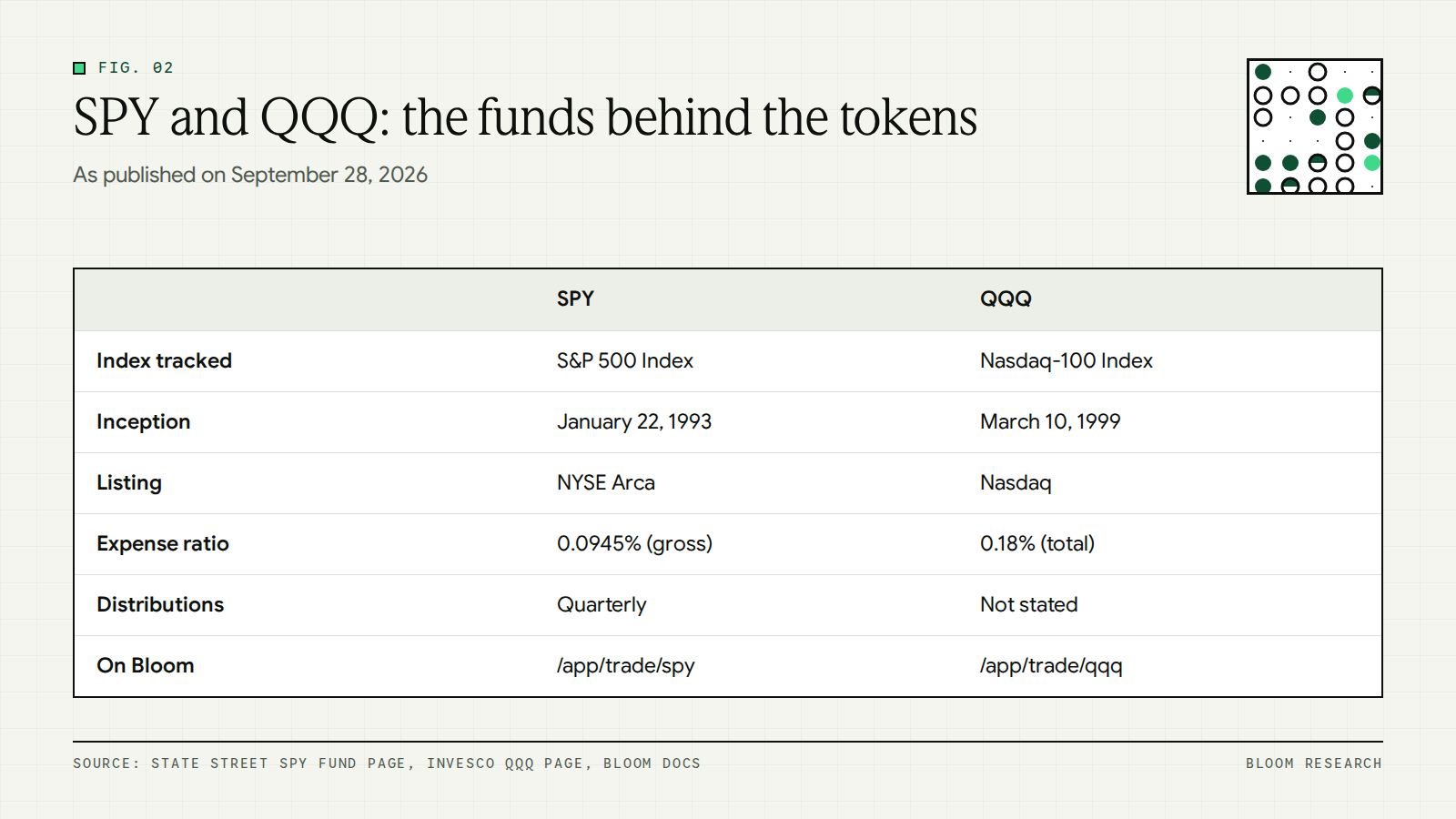
Our SPY vs QQQ comparison page shows both tokenized ETFs side by side, with SPY listed on ARCA and QQQ on NASDAQ. For the stocks inside each index, our S&P 500 index page and our Nasdaq-100 index page list the constituents that are also available on Bloom as single-stock tokens.
Key point: A tokenized SPY or QQQ token follows the price of one fund share. The fund share, in turn, follows its index before expenses, so both the fund's performance and the token's tracking of it affect what the token holder sees.
How ETF shares are created and redeemed
ETF shares enter and leave the market through a small group of firms. Investor.gov defines authorized participants as financial institutions, typically large broker-dealers, that enter into contractual relationships with ETFs to buy and redeem creation units of ETF shares. A creation unit is the large block of fund shares that an authorized participant creates or redeems in one transaction.
Invesco's QQQ page gives the size of that block. It says QQQ shares are not individually redeemable and are redeemed only in Creation Unit aggregations, typically consisting of 50,000 shares. Individual investors therefore buy and sell existing fund shares on an exchange rather than dealing with the fund directly.
A token issuer works at the exchange level in the same way. On Bloom, each tokenized asset is backed 1:1 by a real share held in custody at a regulated US broker-dealer such as Alpaca Markets or Interactive Brokers. A holder of tokenized QQQ owns a token linked to one QQQ share, not a creation unit and not the 100 underlying stocks.
#How tokenized SPY and QQQ work on Bloom
As described above, each tokenized asset on Bloom is backed 1:1 by a real share at a regulated US broker-dealer. For tokenized SPY, the share behind each token is one SPY fund share. For tokenized QQQ, it is one QQQ fund share. The token is held in your own embedded wallet, so you keep custody and can move it or use it across DeFi.
Our assets available page lists US ETFs such as SPY, QQQ and VOO alongside single-listed stocks on NYSE, NASDAQ and AMEX. Every asset uses its underlying ticker only, with no exchange prefix and no country suffix. Our tokenized stocks documentation gives the same rule for asset URLs, so the two funds have detail pages at tokenized SPY on Bloom and tokenized QQQ on Bloom.
Each detail page shows a chart, fundamentals, news, holdings and a Buy and Sell bar. Our SPY vs QQQ comparison lists settlement on Base, Arbitrum and Ethereum for both tokens. It also lists a trading fee of 0.10% to 0.20% and a $1 minimum trade for each.
On Bloom: We handle tokenized SPY and QQQ with the same trade flow as every other asset: an RFQ quote, a 10 to 20 basis point trading fee included in the price, network gas bundled into the same quote, and on-chain settlement into your self-custodied wallet.
New ETFs are added in batches. Each listing needs a custody arrangement at one of the regulated broker partners, a live attestation feed into the proof-of-reserves system, and liquidity coverage from at least one tokenized security issuer.
From quote to wallet: one trade step by step
We execute every trade with RFQ, or request for quote. RFQ is our execution model: a tokenized security issuer returns a live quote, you accept it within a short window, and the trade settles back-to-back. Our RFQ execution documentation describes each step, and a tokenized QQQ purchase follows this sequence.
- You enter an amount from $1. There is no maximum imposed by the platform.
- A regulated tokenized security issuer returns a live quote, typically valid for 5 to 10 seconds.
- The quote already includes the trading fee, and the default slippage tolerance is 0.5%, editable to 0.1%, 1% or a custom value.
- The trade settles back-to-back against the underlying primary market, and the on-chain token transfers to your wallet.
- Within about 1 second you see a receipt with the fill price, fee, total and on-chain transaction hash.
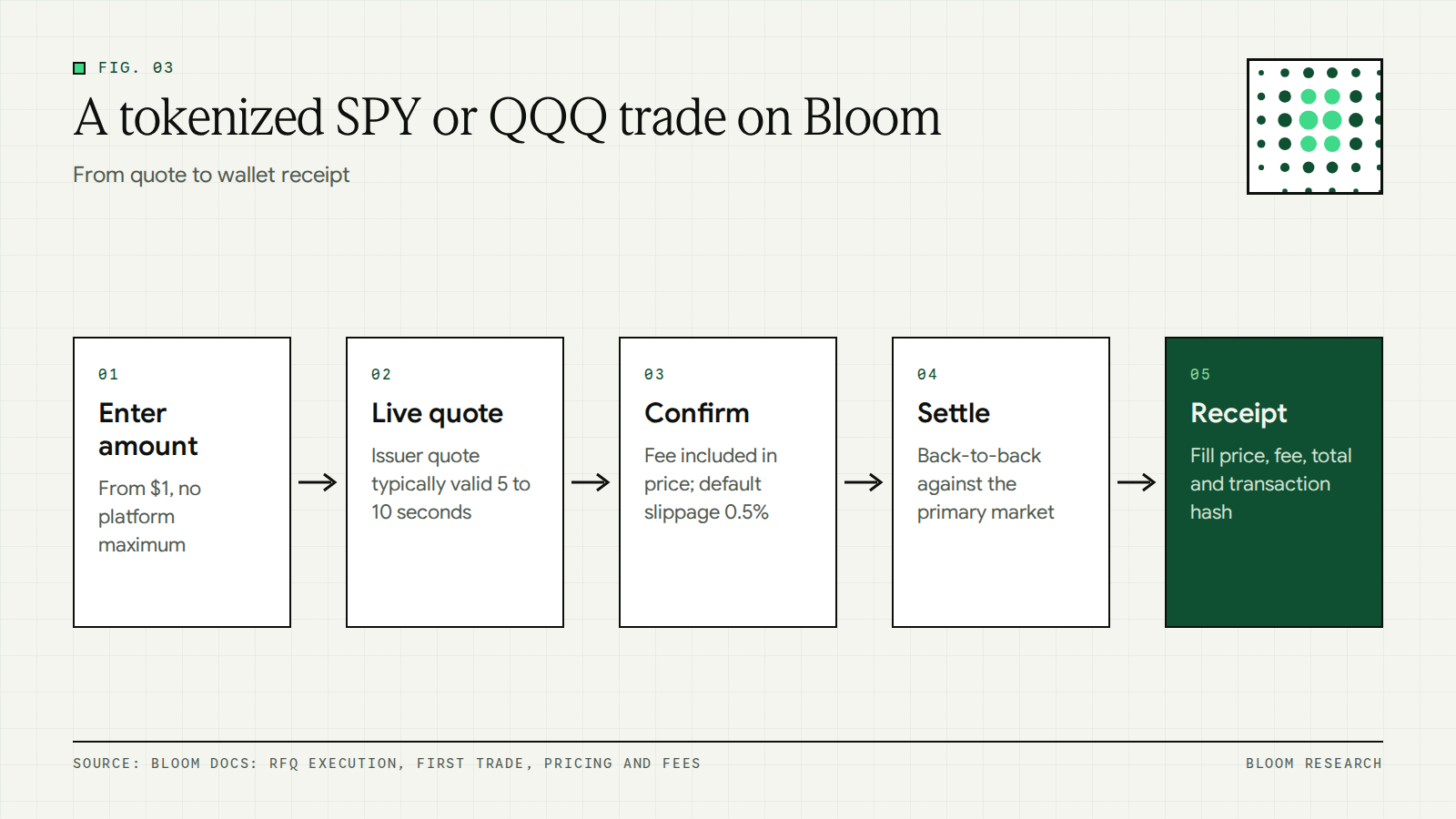
The trading fee is 0.20% by default and drops toward 0.10% as your 14-day trading volume grows through the VIP tier ladder. Selling follows the same RFQ flow in reverse. A limit order is also available: it is held server-side and routed to RFQ when the live quote reaches your target price, and it can be canceled any time before it fills.
#Dividends, rebalancing and NAV
SPY pays distributions, and State Street lists its distribution frequency as quarterly. A tokenized ETF has to pass that value to the token holder in some form. Our dividends and corporate actions documentation explains our method: when the underlying pays a dividend, the cash is used to buy more of the underlying shares, and the token's on-chain NAV rises to reflect the added shares per token.
NAV, or net asset value, is the on-chain value of a tokenized asset, reflecting price, accrued dividends and corporate actions. You see the distribution value in the token's price rather than as a separate cash payment to your wallet. We chose this design because it keeps the product simpler to operate, removes failed-distribution edge cases and gives every holder automatic dividend reinvestment by default. Stock splits, special distributions, mergers and name changes also update the NAV, and every adjustment is observable on-chain through the token contract.
How it works: The fund pays a distribution, the cash buys more fund shares, and each token then stands for slightly more than its earlier share count. No cash arrives in the wallet.
Index changes are handled inside the fund. Invesco says QQQ and the Nasdaq-100 Index are rebalanced quarterly and reconstituted annually, and the fund carries out those trades. The token is backed by QQQ shares, so its holder does not receive or trade the underlying 100 stocks when the index changes.
How two other issuers describe ETF distributions
Other tokenized ETF issuers publish different methods, and their terms describe different rights. We summarize two here from their own documentation, as published on September 28, 2026.
xStocks are issued by Backed Assets (JE) Limited, a Jersey private limited company. The xStocks FAQ says an xStock is a tracker certificate that gives economic exposure to the underlying equity but does not convey shareholder rights, such as voting rights. Dividends received on the underlying are reinvested into additional units of the same asset, net of applicable taxes. This is reflected through rebasing, a mechanism that applies a multiplier to token balances when a corporate action occurs.
Ondo's documentation says dividends are automatically invested back into the referenced stock and reflected in token pricing. It says trading may be paused from 7:50 pm to 8:10 pm the day before a dividend ex-date. For ETFs, Ondo notes that distribution amounts are frequently finalized close to the ex-date, often 1 to 2 business days before, and the platform halts trading until the exact amount is known. Ondo also states that Ondo Stocks are not themselves stocks, ETFs or ADRs and do not give holders rights to hold or receive the underlying assets.
#Custody and proof of reserves
The shares behind tokenized SPY and QQQ on Bloom sit in segregated customer accounts at our broker partners. Customer assets at these brokers are held separately from the broker's own funds. If Bloom discontinues operations, a designated security agent, GenTwo, works directly with the custodian to redeem outstanding tokens against the underlying shares, and it has standing authority to act on token holders' behalf. The redemption path is enforced by the on-chain contract and is independent of our continued operation.
Reserves are independently attested in real time by Accountable, a third-party proof-of-reserves provider that reads broker balances directly and publishes them on-chain. Our proof of reserves documentation says the backing ratio should be at least 1.0 at all times. The Bloom Transparency page shows the live token supply, attested broker balance, backing ratio and a link to the on-chain attestation contract for every asset, including SPY and QQQ.
The token contracts, mint and redeem partner contracts and the proof-of-reserves attestation contract are audited by Sherlock. These checks confirm backing and contract review. They do not remove market risk from the fund itself, which the next sections cover.
#Trading hours for tokenized ETFs
On Bloom, each asset has a primary-market trading session inherited from the underlying instrument. SPY and QQQ are US-listed funds, so their tokens follow US market sessions. The NYSE hours and calendars page lists the core trading session as 9:30 a.m. to 4:00 p.m. ET.
The asset detail header always shows a trading-hours pill, so the current session for SPY or QQQ is visible before you tap Buy. Our trading hours documentation sets out what happens outside that window. If the market is closed, the order is queued and executes automatically at the next market open, and you receive a push notification when it fills. Pre-market or after-hours orders route to the extended session, where they may partially fill, with the remainder queued. Queued orders stay visible in Portfolio, under Orders, until they fill or are canceled.
Other issuers publish different hours for their own tokens. Ondo lists minting and redemption 24/5, from Sunday 8:00 pm ET to Friday 7:59 pm ET, for all assets. It lists 24/7 minting and redemption for six assets, including SPYon and QQQon, subject to exceptions. As noted above, xStocks says its tokens can trade 24/7 on secondary markets, depending on the platform. Those hours describe each issuer's own tokens, and they do not change the hours of the underlying fund on its exchange. Our guide to trading US stocks on weekends covers the US session calendar in more detail.
#Tokenized ETFs compared with other routes from India
Investors in India gain SPY or QQQ exposure through several routes, and each route gives a different kind of holding. Our guide to investing in US stocks from India covers each route in depth. The table below summarizes what the holder owns and how each route is funded.
| Route | What you hold | Funded in | Source |
|---|---|---|---|
| US-listed ETF through an overseas broker | SPY or QQQ shares in a brokerage account | Rupees remitted under LRS | RBI LRS FAQ |
| Indian international mutual fund or fund of funds | Units of an Indian scheme | Rupees | Bajaj AMC, SEBI |
| NSE IFSC Receipts | Receipts issued against US shares bought by market makers | Within LRS limits | NSE |
| Tokenized SPY or QQQ on Bloom | A token backed 1:1 by a real fund share | USD stablecoins, from $1 | Bloom docs |
An Indian international mutual fund works differently from a token. The investor buys units of an Indian scheme in rupees, and the asset management company invests according to the scheme's overseas mandate. Such schemes may invest directly in overseas securities, track an international index or invest through an overseas ETF, within overseas investment limits set by SEBI.
NSE IFSC Receipts are a third structure. Coverage of the 2022 launch, republished on NSE's website, says market makers buy shares in the US and issue receipts against them, and Indian retail investors can transact on the NSE IFSC platform under the LRS limits prescribed by the RBI. The holder has a receipt, not a token and not the share itself.
For the tokenized route, our India country page explains funding. To hold USDC, an investor in India would generally convert rupees into stablecoins through a locally operating exchange that supports on-chain withdrawals, then move the USDC to a self-custody wallet. Because we settle trades in USD stablecoins, an India investor holds INR/USD exchange-rate exposure in addition to the fund's price movement.
Rules that still apply from India
The LRS, or Liberalised Remittance Scheme, is the RBI framework for sending money abroad. The RBI's LRS FAQ says resident individuals can remit up to USD 250,000 per financial year, April to March, for permissible current or capital account transactions, and capital account transactions include investment.
TCS, or tax collected at source, is collected by banks on LRS remittances. From April 1, 2026, banks apply TCS on other LRS purposes, such as investing, at nil up to ₹10 lakh and 20% above ₹10 lakh. The CBDT says accurate Schedule FA reporting of foreign assets is mandatory under the Black Money Act, 2015.
Important: No route to SPY or QQQ removes these obligations. The treatment of tokenized securities can differ from that of directly held shares, and a qualified tax adviser can confirm how the rules apply to a specific holding.
We do not file taxes on your behalf and do not provide tax advice. From Portfolio, you can export a CSV of every trade and transaction to share with a tax adviser.
#Risks specific to tokenized ETFs
A tokenized ETF carries the risks of the fund and the risks of the token structure. Our risk disclosure lists market, smart contract, custody, bridging and liquidity risk. The points below apply to tokenized SPY and QQQ.
- Market risk: asset prices can move against you, including overnight gaps that may exceed your slippage tolerance.
- Tracking at the fund level: SPY and QQQ each seek to follow their index before expenses, so the fund's expense ratio affects the token's value.
- Third-party risk: the SEC staff statement on tokenized securities says holders of third-party tokenized securities may be exposed to risks of the third party, such as bankruptcy.
- Custody limits: investor-protection arrangements apply within the jurisdictional limits of each broker and are not unlimited, and redemption depends on the continued operation of the broker partner.
- Liquidity: the tokenized security issuers that quote prices may withdraw liquidity in extreme conditions.
- Smart contracts: every contract is audited, but no audit eliminates risk entirely.
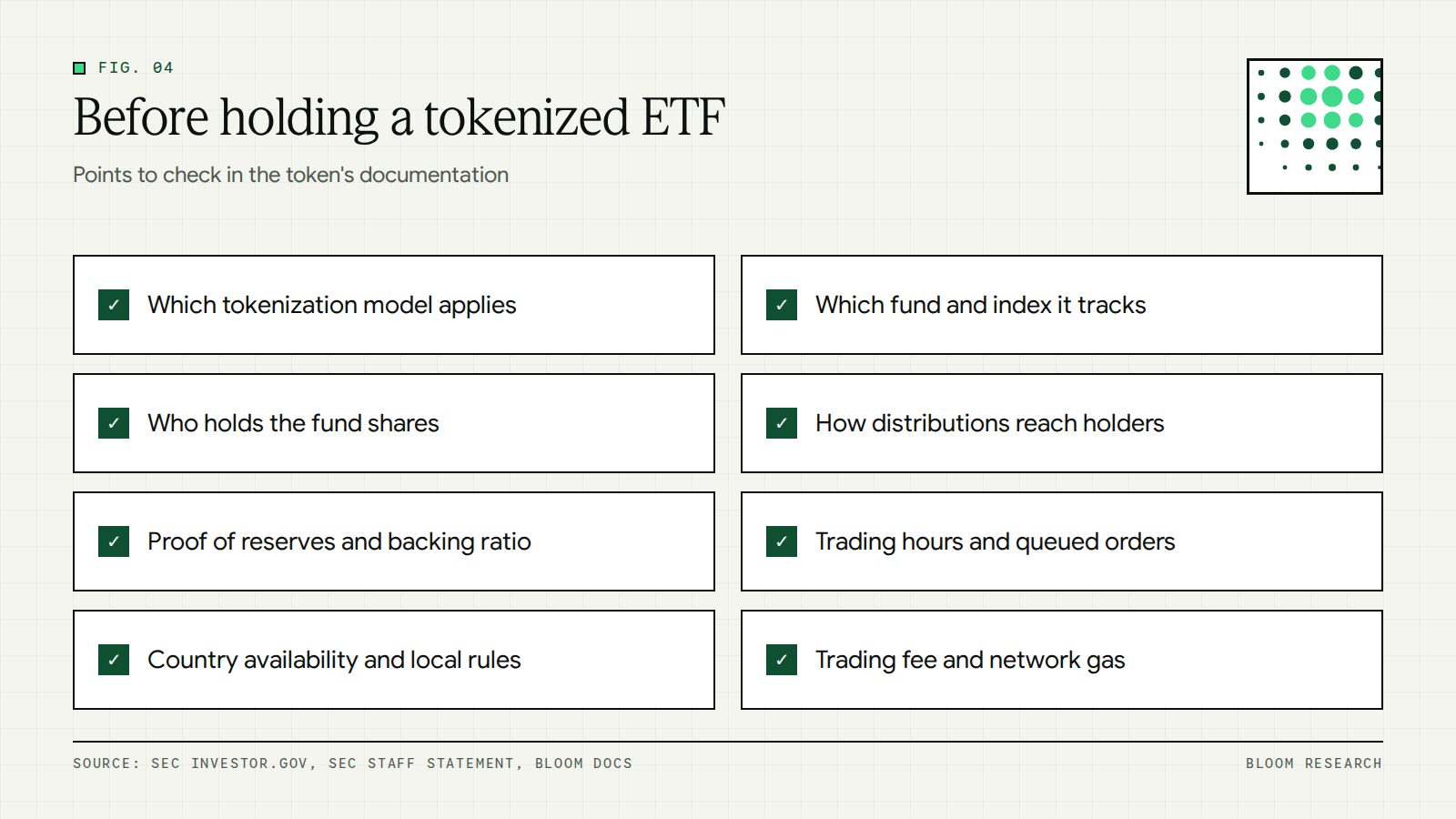
The same SEC staff statement, dated January 28, 2026, says the format of a security, on-chain or off-chain, does not affect application of the federal securities laws.
Note: Fund facts such as expense ratios and distribution schedules come from State Street and Invesco and can change. The fund pages show the current figures.
#Where to see tokenized SPY and QQQ on Bloom
The full live catalog of tradeable assets, including tokenized SPY and tokenized QQQ, is published at our markets page. For two funds that both seek to track the S&P 500, our SPY vs VOO comparison shows tokenized SPY and VOO side by side. Our comparison of tokenized stock venues covers other places that list tokenized stocks.
On each asset page, the chart supports ranges from one day to the full history, and the underlying market session, whether regular, extended or queued, is always visible at the top. The Transparency page described above shows the current backing ratio for both tokens.
We do not offer our product or services to users in the United States or in other restricted jurisdictions, as set out on our service availability page. Trading on Bloom carries risk, including the loss of principal, and nothing in this guide is investment, tax or legal advice.
Frequently asked questions
What is a tokenized ETF?
Tokenized ETFs are tokens recorded on a blockchain whose value is linked to shares of an exchange-traded fund, such as SPY or QQQ. Investor.gov describes three models: issuer-sponsored tokens, custodial tokens that represent an indirect interest through a security entitlement, and synthetic tokens issued by a third party. On Bloom, each tokenized ETF is backed 1:1 by a real fund share held at a regulated US broker-dealer.
Is it safe to buy tokenized stocks?
No tokenized stock or ETF is free of risk. SEC staff say holders of third-party tokenized securities may be exposed to risks of the third party, such as bankruptcy. Our risk disclosure lists market, smart contract, custody, bridging and liquidity risk, and trading carries risk including the loss of principal. Investor-protection arrangements apply within each broker's limits and are not unlimited.
Do tokenized ETFs pay dividends?
It depends on the issuer. On Bloom, when the fund pays a distribution, the cash is used to buy more of the underlying shares and the token's on-chain NAV rises, with no separate cash payment to the wallet. xStocks reinvests dividends through rebasing, net of applicable taxes, and Ondo reinvests dividends and reflects them in token pricing. State Street lists SPY's distribution frequency as quarterly.
What index does QQQ track?
QQQ tracks the Nasdaq-100 Index, not the S&P 500. Invesco describes the Nasdaq-100 as the 100 largest non-financial companies listed on the Nasdaq, and says the fund and the index are rebalanced quarterly and reconstituted annually. SPY is the fund that seeks to track the S&P 500 Index, according to State Street.
Can I buy tokenized SPY from India?
Bloom offers tokenized SPY and QQQ outside the United States and other restricted jurisdictions, and we publish a country guide for India. From India, someone would generally convert rupees into USDC through a locally operating exchange that supports on-chain withdrawals. Indian rules still apply, including the Liberalised Remittance Scheme limit of USD 250,000 per financial year and Schedule FA reporting of foreign assets.
Is a tokenized ETF the same as owning the ETF?
Not always. Investor.gov says an issuer-sponsored security carries the same legal rights as a traditional share of the same class. Holding a custodial token is the equivalent of holding the security through a broker-dealer, while a synthetic token may give rights that differ significantly from those of a traditional owner. xStocks, for example, describes its tokens as tracker certificates without voting rights. The token's own documentation states which model applies.