
Tokenized Stocks vs Stock Perps vs Synthetic Stocks
Stock perps, tokenized stocks and synthetic stocks compared: 1:1 backing, funding rates, leverage, oracle pricing, liquidation and the SEC case over Mirror.
Key takeaways
- Tokenized stocks on Bloom are tokens backed 1:1 by real shares held in segregated custody at regulated US broker-dealers such as Alpaca Markets or Interactive Brokers.
- Stock perps are leveraged derivatives that track a share price; exchange documentation states they do not give holders ownership of the underlying asset.
- Perp funding is a recurring payment between longs and shorts based on the gap between the mark price and the index price.
- Synthetic stock tokens copy a price; the SEC described Mirror Protocol mAssets as security-based swaps in its February 16, 2023 charges.
- Under the RBI LRS FAQ, remittance from India for margins or margin calls to overseas exchanges or counterparties is not available under the Scheme.
Stock perps are perpetual futures contracts that track the price of a share, while tokenized stocks are tokens backed 1:1 by real shares held in custody. Synthetic stocks form a third group: tokens that copy a share price without a share being held for the holder. All three can show the same ticker on a screen, yet they give the holder different rights.
The difference matters for dividends, for losses, and for what happens when a venue closes. Our guide to what tokenized stocks are and how they work covers the backed model in depth. This post places it next to stock perps and synthetic tokens and compares ownership, funding rates, leverage, oracle pricing and liquidation.
We source every external fact from exchange documentation, protocol documentation and regulator releases. The last sections cover the rules that apply to residents of India and how we built Bloom around 1:1 backed tokens.
#Tokenized stocks vs stock perps vs synthetic stocks at a glance
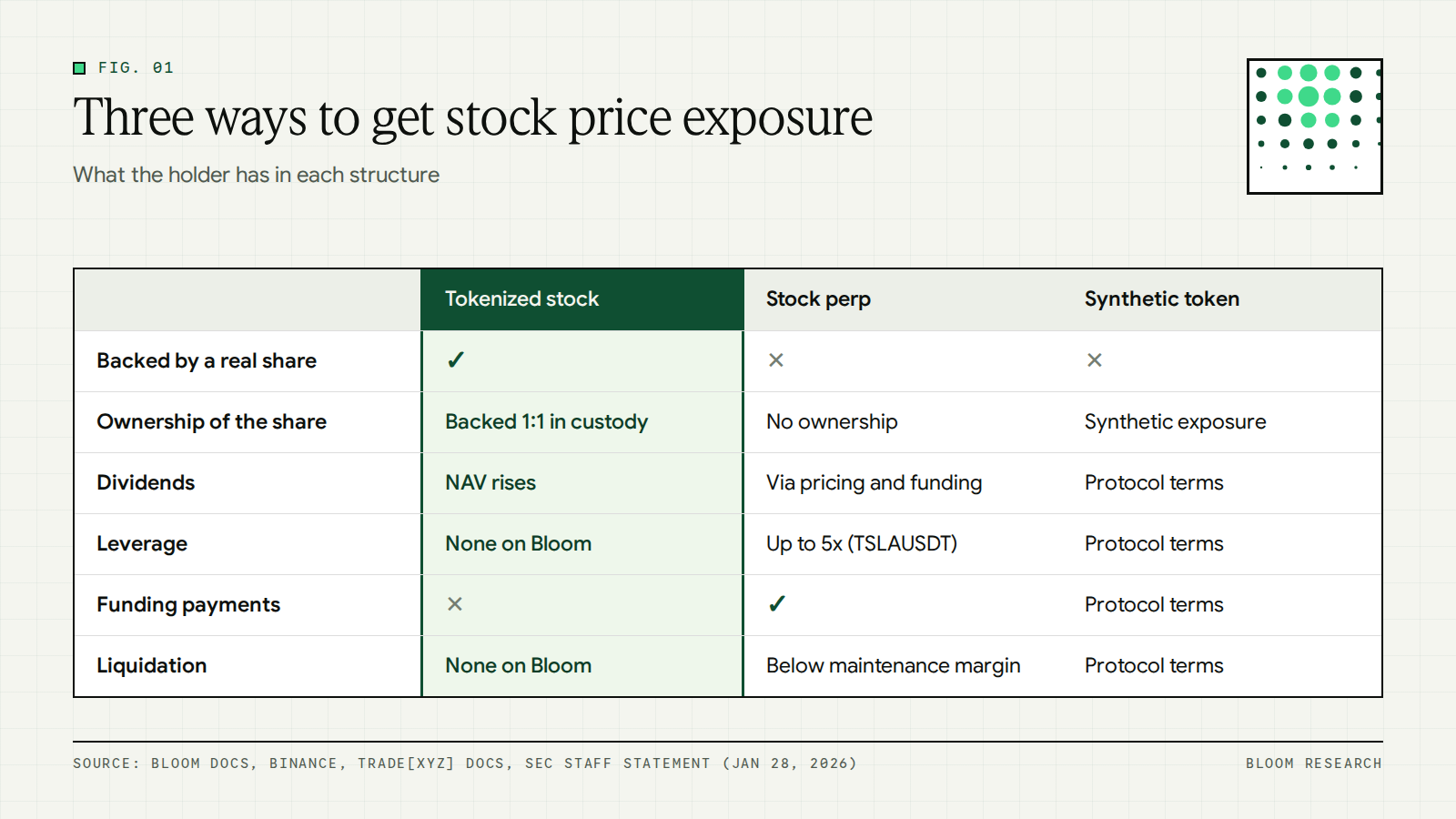
The table below summarizes the structural differences. Each cell reflects the documentation cited later in this post.
| Feature | Tokenized stock (1:1 backed) | Stock perp | Synthetic stock token |
|---|---|---|---|
| What the holder has | A token backed 1:1 by a real share held at a regulated broker-dealer | A leveraged derivative contract that tracks a share price | A token that gives synthetic exposure to a referenced share |
| Ownership rights in the share | Backed by a share in segregated custody | No ownership of the underlying asset | Synthetic exposure only |
| Dividends | Cash buys more shares and the token NAV rises | Not received directly; reflected in pricing and funding | Set by each protocol's own terms |
| Leverage | None on Bloom (spot only) | Up to 5x on the Binance TSLAUSDT contract | Set by each protocol's own terms |
| Funding payments | None on Bloom | Paid between longs and shorts on a schedule | Set by each protocol's own terms |
| Liquidation | None on Bloom | Positions may be liquidated below the maintenance requirement | Set by each protocol's own terms |
The main split is between ownership and price exposure. A backed token is tied to a share that a custodian holds. A perp and a synthetic token pay out according to a price, and neither gives the holder ownership rights in the company.
#How 1:1 backed tokenized stocks work
Definition: A tokenized stock is an on-chain token that represents one share of a real stock and is backed 1:1 by an actual share held in custody at a regulated broker-dealer.
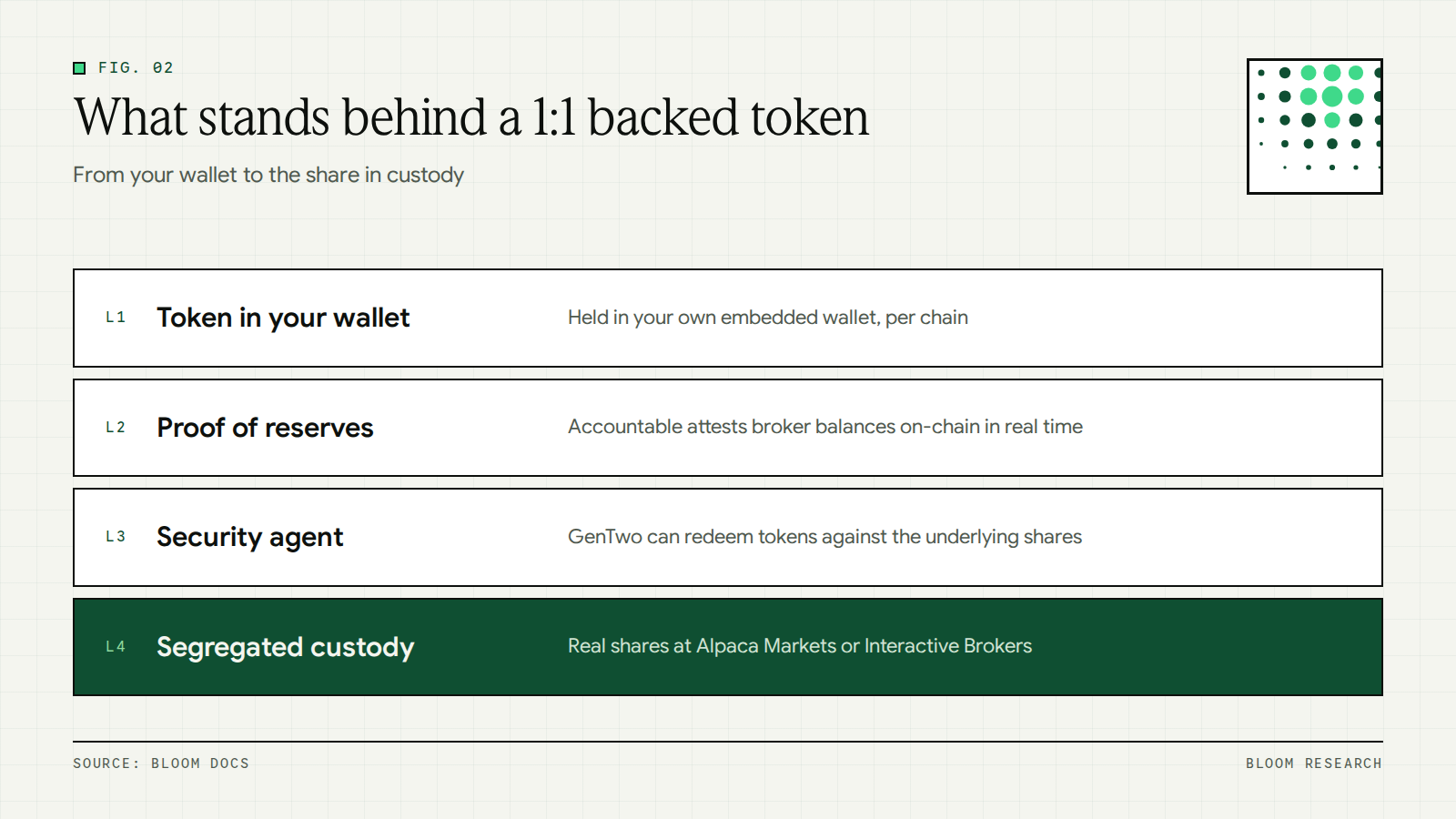
On Bloom, each asset is an on-chain token backed 1:1 by a real share held in custody at a regulated US broker-dealer such as Alpaca Markets or Interactive Brokers. The token tracks the price of the underlying share in real time. Our tokenized stocks documentation sets out the full model.
Because a share stands behind each token, the token's value follows the share and the events that change it. That is a different starting point from a contract whose value depends on a price feed and on the other side of a trade.
Custody, backing and proof of reserves
Customer assets at these brokers are held separately from the broker's own funds. If we discontinue operations, a designated security agent, GenTwo, works directly with the custodian to redeem outstanding tokens against the underlying shares. The security agent has standing authority to act on token holders' behalf, as our custody and backing documentation describes.
Proof of reserves is an independent check that the shares exist. Reserves are attested in real time by Accountable, a third-party provider that reads broker balances directly and publishes them on-chain. Every token outstanding is backed 1:1 by a corresponding share at the broker partner, and anyone can verify this at any time.
The Transparency page shows the live token supply, attested broker balance, backing ratio and a link to the on-chain attestation contract for every asset. Our proof of reserves documentation explains what each attestation contains.
These protections have limits. Investor-protection arrangements apply within each broker's limits and are not unlimited, and redemption through the security agent depends on the continued operation of the broker partner.
Regulators describe this family of products in similar terms. In a staff statement of January 28, 2026, the SEC described a custodial model for tokenized securities. Under that model, a third party tokenizes a security by creating a security entitlement formatted as a crypto asset, which represents the holder's indirect interest in the underlying security.
The same SEC staff statement says the format of a security, on-chain or off-chain, does not affect how the federal securities laws apply. It also notes that holders of third-party tokenized securities may be exposed to risks of the third party, such as bankruptcy.
What a token holder receives
The token is held in your own embedded wallet, so you keep custody and can move it at any time. Bloom is multi-chain, and your trading balance and tokenized stock holdings are per-chain at the wallet level, as our networks supported page shows.
Because every asset is a standard on-chain token in your own wallet, it can be used across DeFi, including lending and borrowing on Aave or Morpho and providing liquidity on Uniswap, Curve or CoW Swap.
NAV (net asset value) is the on-chain value of a tokenized asset, reflecting price, accrued dividends and corporate actions. When the underlying company pays a dividend, the cash is used to buy more of the underlying shares, and the token's NAV increases to reflect the added shares per token.
For other corporate actions, such as stock splits, spin-offs, mergers and name changes, the on-chain NAV is updated to reflect the action. Our dividends and corporate actions documentation lists how each event is handled.
The full path of a token, from minting to redemption, is covered in our post on the tokenized stock lifecycle from mint to redeem.
Key point: A backed token holder's exposure is tied to a share held in segregated custody. It does not depend on a counterparty paying out a price difference, which is how perps and synthetic tokens work.
#How stock perps work
Definition: Perpetual futures are derivative contracts that track the price of an underlying asset and have no expiry date. Stock perps, also called equity perps, are perpetual futures whose underlying asset is a listed share.
Stock perpetual futures give price exposure without ownership. Binance describes its TradFi perpetual contracts as USDT-settled contracts that track the price of traditional finance assets without the trader needing to own them. The Binance TradFi perpetual contracts announcement of January 8, 2026 states that these contracts do not represent ownership of the relevant underlying asset.
The trade[XYZ] documentation makes the same point in its risk section. Perpetual contracts provide synthetic price exposure and do not give holders ownership of, or any voting, dividend or other rights in, an underlying asset or issuer.
A perp has two sides. A long position gains when the price rises, and a short position gains when the price falls. Four mechanisms then shape the result: funding, leverage and margin, the oracle and mark price, and the treatment of corporate actions.
Funding rates
A funding rate is the periodic rate that moves value between longs and shorts to keep the perp price close to the underlying price. The Synthetix funding documentation defines funding as a recurring payment between longs and shorts based on the difference between the perp's mark price and the index price of the underlying asset.
The direction of payment depends on the sign of the rate:
- Positive funding means longs pay shorts.
- Negative funding means shorts pay longs.
- The rate is calculated from the premium between the perp's mark price and the index price.
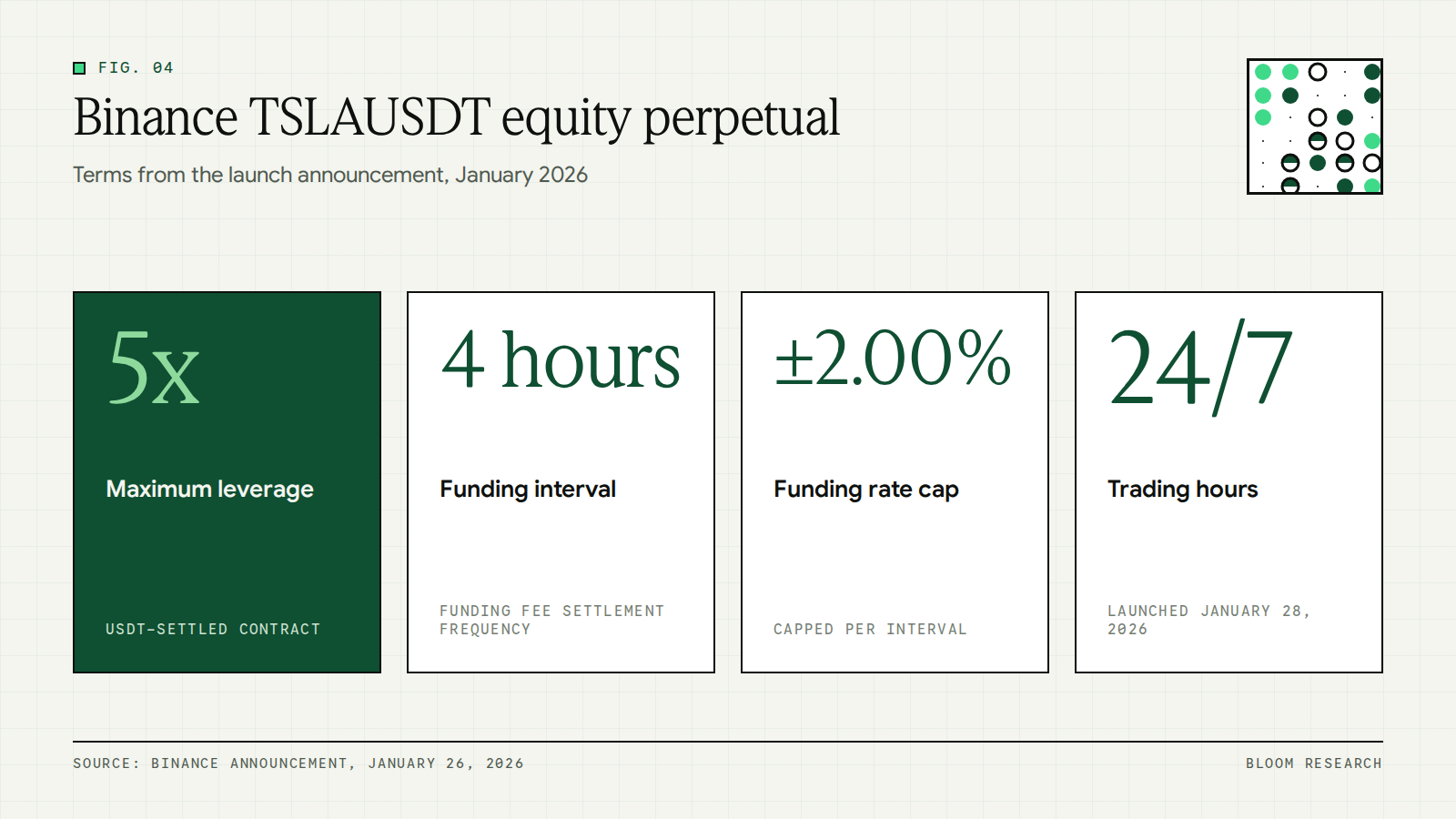
Funding schedules and limits differ by venue. On Synthetix, funding accrues and is paid every hour but is displayed as an annualized 8-hour rate. On the Binance TSLAUSDT contract, funding settles every four hours, and the funding rate is capped at +2.00% and -2.00% per interval. Funding is separate from trading profit and loss, so a position held for a long time pays or receives it at every interval.
Leverage, margin and liquidation
Margin is the collateral a trader posts to open and hold a perp position. Leverage lets the position be larger than the margin behind it. The Binance TSLAUSDT contract is settled in USDT and allows a maximum leverage of 5x.
The trade[XYZ] documentation states that leverage magnifies gains and losses. A relatively small movement in the mark price can exhaust posted margin or materially impair an account.
Liquidation is the forced closing of a position when the account no longer meets its margin requirement. If account equity falls below the applicable maintenance requirement, positions may be liquidated without prior notice. Liquidations use the mark price, which may differ from the last trade or from a price shown on another venue.
If ordinary liquidation is not enough and an account becomes negative, auto-deleveraging may forcibly reduce or close profitable positions on the opposite side of the market. The [trade[XYZ] perpetuals risks and disclaimers](https://docs.trade.xyz/legal-and-disclaimers/perpetuals-risks-and-disclaimers) list these mechanisms in full.
Important: The trade[XYZ] documentation states that perpetual contracts are leveraged derivatives that involve a substantial risk of loss, and that a trader may lose all margin allocated to a position.
Oracle and mark price outside market hours
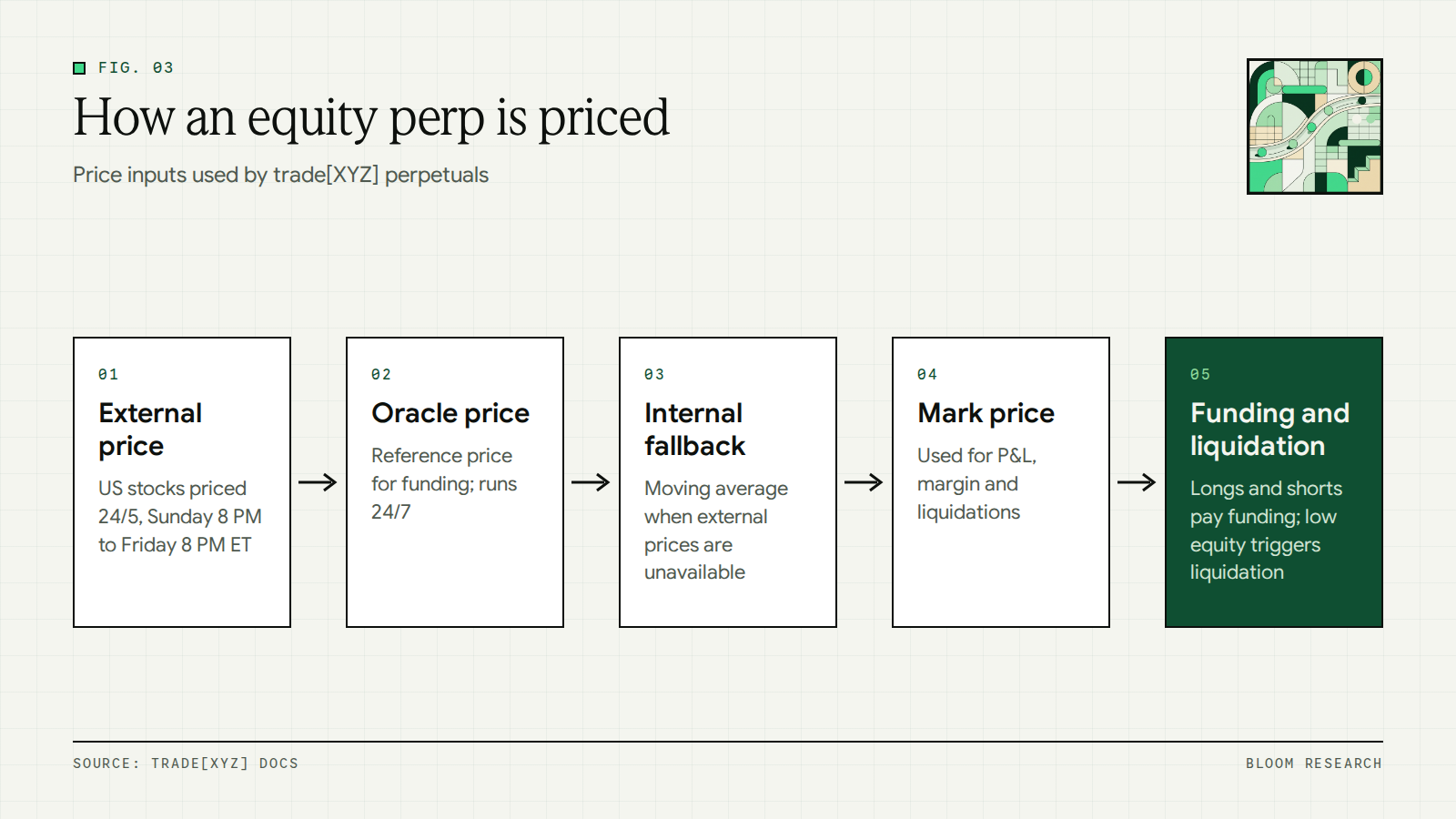
An oracle is the price feed a derivatives venue uses as its reference for the underlying asset. The mark price is a separate price used for profit and loss, margin, liquidations and trigger orders. On trade[XYZ], the oracle serves as the reference price for funding and as an input to the mark price.
US stock exchanges close at night and on weekends, while some stock perps keep trading. The [trade[XYZ] oracle price documentation](https://docs.trade.xyz/perpetuals/mechanics/oracle-price) states that the main requirement for equity perpetuals is an oracle that operates 24/7, beyond the external trading sessions of the underlying asset.
For US stocks, trade[XYZ] derives external prices 24/5, from Sunday 8:00 PM ET to Friday 8:00 PM ET. It aggregates pre-market, market, post-market and overnight sessions, and the overnight session is provided by Blue Ocean ATS. When external inputs are unavailable, the oracle advances via a continuous-time exponentially weighted moving average and returns to the external price when external inputs resume.
Binance uses a comparable approach. Outside traditional market hours, the mark price on its TradFi perps uses a smoothed futures price calculated with an exponentially weighted moving average (EWMA). The Binance TSLAUSDT contract lists its trading hours as 24/7.
Our tokens work differently. Each asset on Bloom follows the primary-market trading session inherited from the underlying instrument, and orders placed outside market hours are queued to execute at the next open. Our trading hours documentation explains the sessions, and our guide to how to trade US stocks on weekends covers overnight and weekend timing.
Dividends and stock splits on a perp
A perp holder does not hold the share, so corporate actions reach the position in a different way. The [trade[XYZ] corporate actions documentation](https://docs.trade.xyz/perpetuals/corporate-actions) states that perpetual holders do not receive dividends directly.
The dividend's economic effect is reflected in pricing and funding through arbitrage between the perpetual and the underlying shares. Funding payments depend on market conditions, and they are not fixed dividend payments.
Stock splits are handled by settlement. trade[XYZ] settles existing positions and reopens the market on the post-split basis, so traders must open new positions after the market reopens. On Bloom, by contrast, splits and other corporate actions are reflected in the token's on-chain NAV.
A current example shows how this works. trade[XYZ] scheduled the suspension of its KIOXIA perpetual and the settlement of all open positions at approximately 06:35 UTC on September 28, 2026, in connection with Kioxia Holdings' 3-for-1 stock split. Settlement closes each position and realizes its profit or loss in USDC, and all outstanding orders, including take-profit and stop-loss orders, are canceled. The notice states that Hyperliquid does not currently support rescaling open positions for a stock split.
#Where equity perps trade in 2026
Equity perps are listed on both centralized exchanges and on-chain venues. Two examples show how the terms are published.
Binance announced its TradFi perpetual contracts on January 8, 2026. According to that announcement, the first contract, XAUUSDT (gold), was made available on January 5, 2026, and XAGUSDT (silver) was listed on January 7, 2026.
Binance Futures launched a USDⓈ-margined TSLAUSDT equity perpetual contract on January 28, 2026 at 14:30 UTC. The underlying asset is Tesla Inc. common stock (Nasdaq: TSLA). The Binance TSLAUSDT launch announcement lists USDT settlement, 5x maximum leverage, a funding cap of +2.00% and -2.00%, funding every four hours and 24/7 trading. It also notes that products may not be available in every region.
On Hyperliquid, trade[XYZ] deploys perpetual markets through HIP-3. Its documentation lists stocks, equity indices, commodities, currencies and pre-IPO markets among them, and its stock markets are grouped into US, Korea, Japan, Hong Kong and China.
The cost structure also differs. A perp position pays or receives funding at every interval for as long as it stays open. On Bloom, the trading fee ranges from 0.10% to 0.20% per trade, and the quoted price already includes it, as our pricing and fees documentation shows.
In practice: A practice account lets a trader test order entry with virtual funds before committing capital. Our guide to paper trading without risking money explains how practice accounts work and where they differ from live trading.
#What synthetic stocks are
A synthetic stock token is a crypto token that copies the price of a share without a share being held for the token holder. In synthetic stocks crypto markets, the token provides synthetic exposure to a referenced security, and no share is held in custody for the holder.
The SEC staff statement of January 28, 2026 describes two synthetic models for tokenizing another company's security:
- Linked security: a third party issues a linked security formatted as a crypto asset, which provides synthetic exposure to a referenced security but is not an obligation of the issuer of that security.
- Security-based swap: a third party issues a security-based swap formatted as a crypto asset.
A security-based swap is a derivative contract whose payments are linked to a security, and US rules restrict who can buy one. Under the SEC staff statement, the third party may not offer or sell the crypto asset representing the security-based swap to persons who are not eligible contract participants unless a Securities Act registration statement is in effect and the transactions are effected on a national securities exchange.
This is the central point in tokenized stocks vs synthetic stocks. A backed token holder's claim runs to a share in custody. A synthetic token holder has only the exposure that the token's own terms provide.
Mirror Protocol and the SEC case
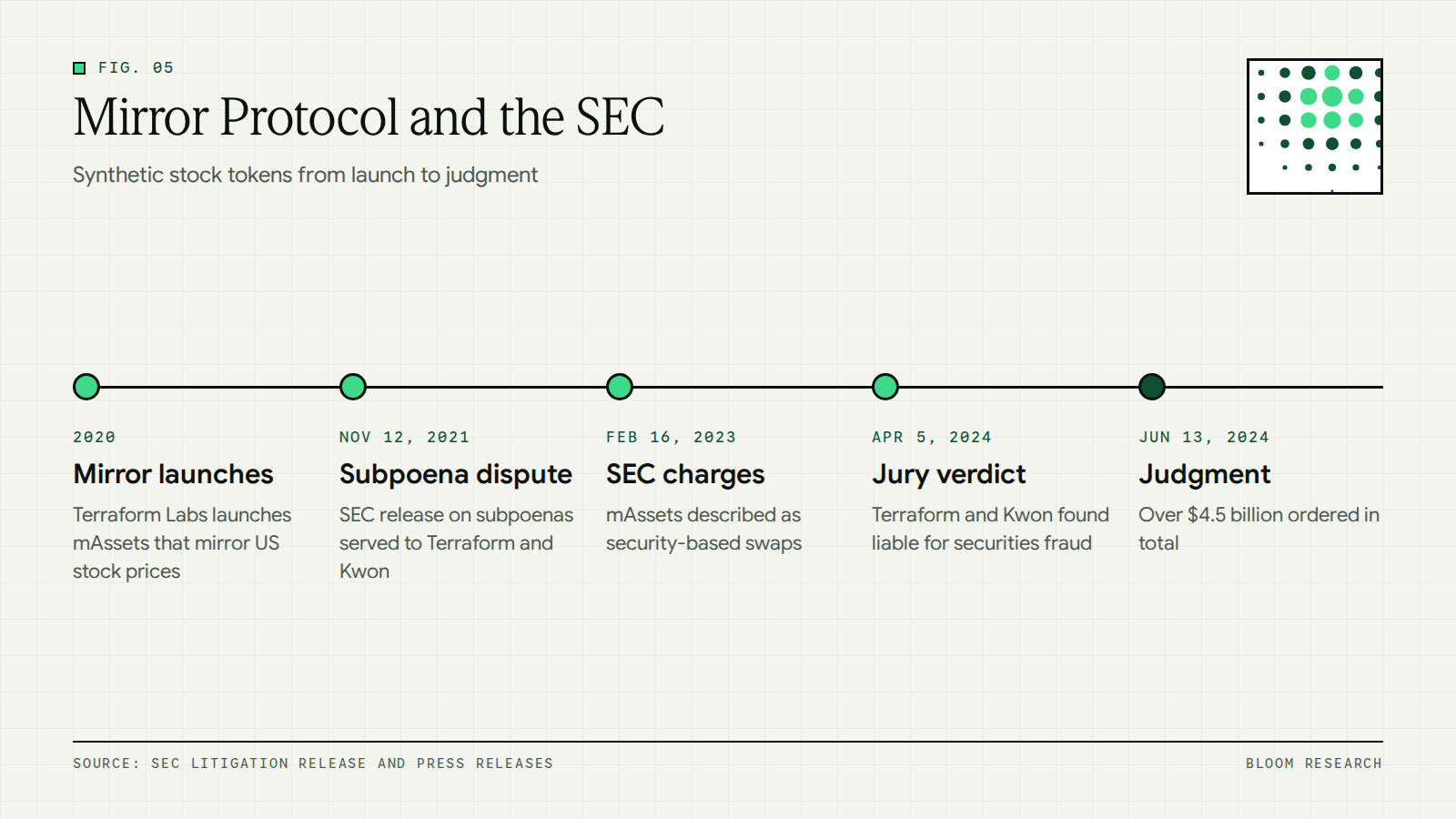
Mirror Protocol is an example of synthetic stock tokens that appears in SEC records. According to an SEC litigation release dated November 12, 2021, Terraform Labs launched the Mirror Protocol in 2020, through which users could create and trade mAssets that mirrored the price of US securities.
The same release states that the SEC was investigating possible violations that included selling security-based swaps outside of a national securities exchange. SEC staff served Terraform Labs and Do Kwon with investigative subpoenas.
On February 16, 2023, the SEC charged Terraform Labs and Do Kwon. The press release described mAssets as security-based swaps designed to pay returns by mirroring the price of stocks of US companies. The complaint charged violations of the registration and anti-fraud provisions of the Securities Act and the Exchange Act.
On April 5, 2024, a jury unanimously found Terraform and Kwon liable for securities fraud. In a press release dated June 13, 2024, the SEC announced that Terraform and Kwon would pay over $4.5 billion in total following the verdict.
Synthetix Synths
Synthetix created synthetic assets called Synths through its legacy systems, including sETH, sBTC and sLINK on Ethereum. The Synthetix legacy Synths page states that the legacy Synth system has been deprecated.
Holders can no longer trade Synths using the legacy Synth system, and Synths are no longer backed by active SNX staking positions. The current Synthetix documentation describes perpetual futures instead. All markets on Synthetix are perpetual futures quoted and settled in USDT on Ethereum Mainnet.
Note: How a regulator classifies a synthetic token depends on its structure. The SEC's 2023 charges described mAssets as security-based swaps, a category that US rules limit for buyers who are not eligible contract participants.
#Ownership, cost and risk side by side
Because the differences appear in each product's documentation rather than on the trading screen, these five questions separate the three structures:
- What does the holder hold: a token backed by a share, a derivative contract, or a synthetic token?
- Who holds the underlying share, if anyone, and can the backing be verified on-chain?
- How is the price set when the US market is closed?
- What triggers liquidation, and can the holder lose all posted margin?
- How are dividends and stock splits handled?
For our tokens, the answers are a token backed 1:1 by a share, segregated custody at a regulated broker-dealer, the underlying session with queued orders, no leverage and no liquidation, and dividends reflected in NAV. For stock perps, the answers come from the exchange's own contract specification and risk disclosures.
For synthetic tokens, the answers depend on the token's legal form and on the protocol that issues it. The Synthetix example shows that a protocol can retire a synthetic system: holders can no longer trade Synths through the legacy system, and the Synths are no longer backed by active staking positions.
#What investors in India should check
Resident individuals in India send money abroad for investment under the Liberalised Remittance Scheme (LRS). Under the RBI's LRS FAQ, resident individuals can remit up to USD 250,000 per financial year for permissible current or capital account transactions.
The same FAQ lists items for which the remittance facility under the Scheme is not available. One of them is remittance from India for margins or margin calls to overseas exchanges or an overseas counterparty. Stock perps are margined products, and the trade[XYZ] documentation states that a trader may lose all margin allocated to a position.
Our India country page describes how investors there generally hold USDC: they convert rupees into stablecoins through a locally operating exchange that supports on-chain withdrawals, then move the USDC to a self-custody wallet. Because we settle in USD stablecoins, an investor in India holds INR/USD exchange-rate exposure in addition to the price movement of the stock itself. The same page notes that the treatment of tokenized securities can differ from that of directly held shares.
#How we built Bloom around 1:1 backed tokens
On Bloom: We built Bloom as a spot venue for tokenized real-asset ownership, not a derivatives venue. There is no leverage, no liquidation and no funding rate, as our Bloom vs Hyperliquid comparison sets out.
Trades on Bloom execute through RFQ (request for quote). A regulated tokenized security issuer returns a live quote, typically valid for 5 to 10 seconds, and the trade settles back-to-back against the underlying primary market. Our RFQ execution documentation describes each step, and our explainer on what RFQ trading is compares it with order books.
Quick Trade is the single trade sheet for every asset, as our Quick Trade documentation shows. The trading fee ranges from 0.10% to 0.20%, with 0.20% as the default and lower rates as 14-day volume grows, as listed on our pricing page. The full list of stocks and ETFs is on our markets page.
Trading on Bloom carries risk, including the loss of principal, and market, smart contract, custody, bridging and liquidity risks apply, as our risk disclosure describes. Bloom is not available in the United States or other restricted jurisdictions; our service availability page lists the current terms.
Frequently asked questions
What are stock perps?
Stock perps are perpetual futures contracts that track the price of a listed share and have no expiry date. Traders post margin, can use leverage, and pay or receive funding. Binance, for example, launched a TSLAUSDT equity perpetual contract on January 28, 2026 with up to 5x leverage and funding every four hours. Exchange documentation states these contracts do not represent ownership of the underlying asset.
What does perps mean in finance?
Perps is short for perpetual futures, also called perpetual contracts. They are derivatives that track the price of an underlying asset without an expiry date. A recurring funding payment between longs and shorts, based on the difference between the perp's mark price and the index price, is used to keep the contract price in line with the spot market.
Are perpetuals better than futures?
Neither is ranked above the other; they differ in structure. A perpetual future has no expiry date and uses a recurring funding payment between longs and shorts, based on the difference between the perp's mark price and the index price, to keep its price in line with the spot market. Each venue sets its own terms, for example 5x maximum leverage and funding every four hours on the Binance TSLAUSDT contract.
What is the difference between tokenized stocks and synthetic stocks?
A 1:1 backed tokenized stock is tied to a real share held in custody, and on Bloom a dividend is used to buy more shares so the token NAV rises. A synthetic stock token only copies a price. The SEC staff statement of January 28, 2026 describes synthetic models as linked securities or security-based swaps, which provide synthetic exposure to a referenced security.
Do stock perps pay dividends?
Not directly. The trade[XYZ] documentation states that perpetual holders do not receive dividends directly, and that the dividend's economic effect is reflected in pricing and funding through arbitrage between the perpetual and the underlying shares. It adds that funding payments depend on market conditions and are not fixed dividend payments.
Can a stock perp position be liquidated?
Yes. The trade[XYZ] risk disclosures state that if account equity falls below the applicable maintenance requirement, positions may be liquidated without prior notice, and that a trader may lose all margin allocated to a position. Liquidations use the mark price, which may differ from the last trade or from prices on other venues.
Can residents of India send margin abroad under LRS?
The RBI's LRS FAQ lists remittance from India for margins or margin calls to overseas exchanges or overseas counterparties among the items for which the remittance facility under the Scheme is not available. The same FAQ sets the LRS limit at USD 250,000 per financial year for permissible current or capital account transactions.