

Stock Market Holidays 2026: Full NYSE and Nasdaq Calendar
Stock market holidays 2026 for the NYSE and Nasdaq: every full closure, the 1:00 p.m. ET early closes, 2027 dates, IST times and how Bloom queues orders.

Key takeaways
- The NYSE and Nasdaq are closed on 10 weekdays in 2026, from New Year's Day on January 1 to Christmas Day on December 25.
- Both exchanges close early at 1:00 p.m. ET on Friday, November 27 and Thursday, December 24, 2026; NYSE late trading sessions on those days end at 5:00 p.m. ET.
- Columbus Day and Veterans Day are federal holidays but are not NYSE holidays, while Good Friday is an NYSE holiday but not a federal holiday.
- The NYSE has already published its 2027 calendar, starting with New Year's Day on Friday, January 1, 2027.
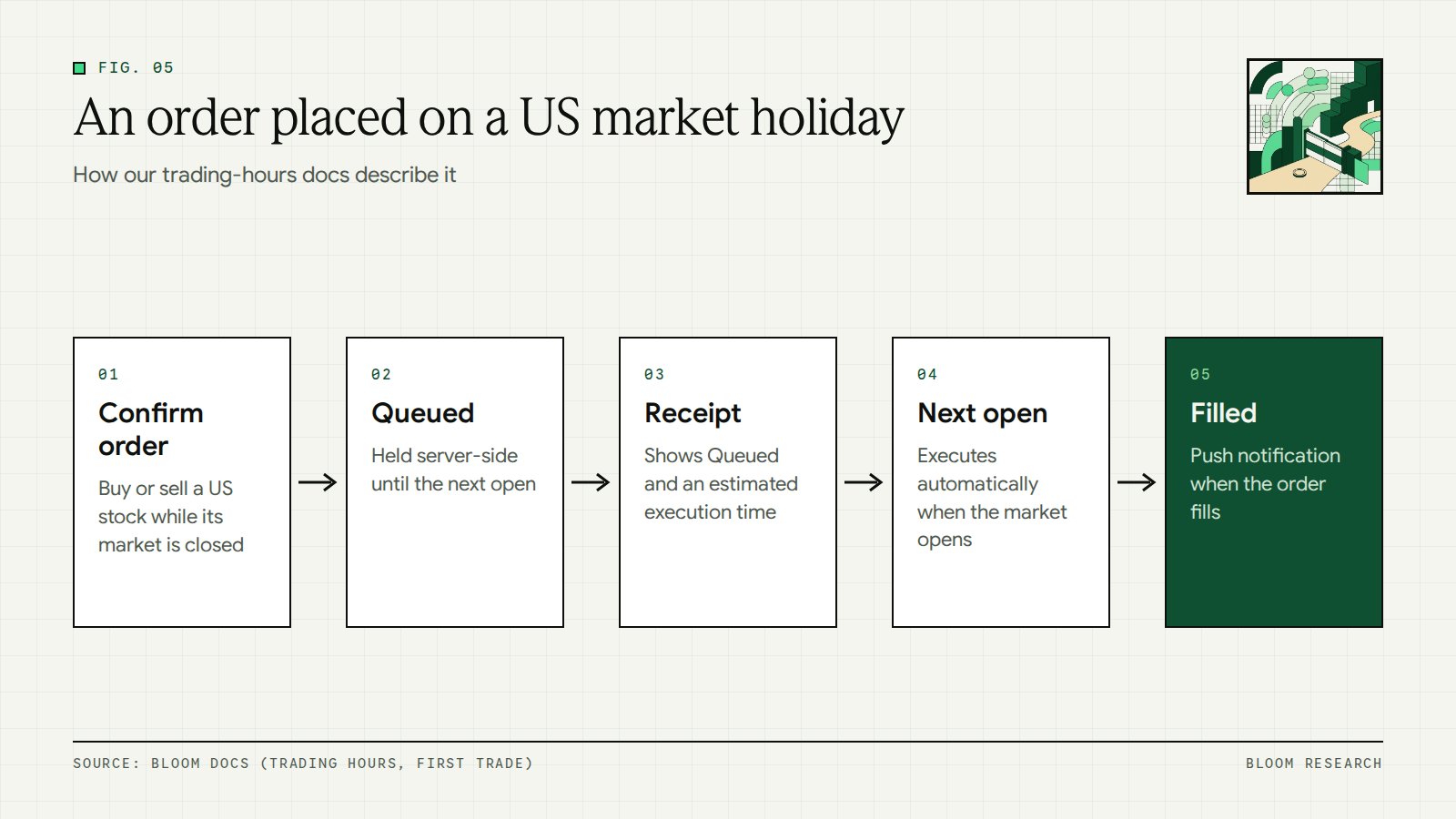
- On Bloom, an order placed on a US market holiday is queued until the next open, and the receipt shows an estimated execution time.
The stock market holidays 2026 calendar for US exchanges has 10 full-day closures on the New York Stock Exchange (NYSE) and Nasdaq, plus two early closes at 1:00 p.m. Eastern Time (ET). This guide covers the US exchanges only, with dates taken from the NYSE and Nasdaq holiday pages and key times converted to Indian Standard Time (IST). For the normal weekday session in every time zone, see our guide to US stock market hours in 2026.
A US market holiday also changes when an order can execute. On Bloom, each asset follows the session of its underlying instrument, and an order placed while that market is closed waits for the next open. Our trading hours and queued orders documentation sets out each session state, and the sections below give the dates.
#Stock market holidays 2026: the full NYSE and Nasdaq list
A market holiday is a weekday on which an exchange does not hold its regular trading session. The NYSE publishes its calendar on its NYSE holidays and trading hours page, which states that all NYSE markets observe the US holidays it lists for 2026, 2027 and 2028. Nasdaq publishes the same 2026 closed dates on the Nasdaq Trader US equity and options holiday schedule.
| Holiday | 2026 date | Day | NYSE and Nasdaq status |
|---|---|---|---|
| New Year's Day | January 1 | Thursday | Closed |
| Martin Luther King, Jr. Day | January 19 | Monday | Closed |
| Washington's Birthday (President's Day on Nasdaq) | February 16 | Monday | Closed |
| Good Friday | April 3 | Friday | Closed |
| Memorial Day | May 25 | Monday | Closed |
| Juneteenth National Independence Day | June 19 | Friday | Closed |
| Independence Day (observed) | July 3 | Friday | Closed |
| Labor Day | September 7 | Monday | Closed |
| Thanksgiving Day | November 26 | Thursday | Closed |
| Day after Thanksgiving | November 27 | Friday | Early close at 1:00 p.m. ET |
| Christmas Eve | December 24 | Thursday | Early close at 1:00 p.m. ET |
| Christmas Day | December 25 | Friday | Closed |
The two exchanges use slightly different names for some dates. The NYSE lists February 16, 2026 as Washington's Birthday, while Nasdaq Trader lists February 16, 2026 as President's Day, closed. Nasdaq Trader also lists July 3, 2026 as Independence Day (Observed), closed, which matches the NYSE entry for the same Friday.
Definition: An observed holiday is a weekday on which a holiday is marked because the actual date falls on a weekend. In 2026, July 4 is a Saturday, so the NYSE lists Independence Day as observed on Friday, July 3.
Holidays still ahead in 2026
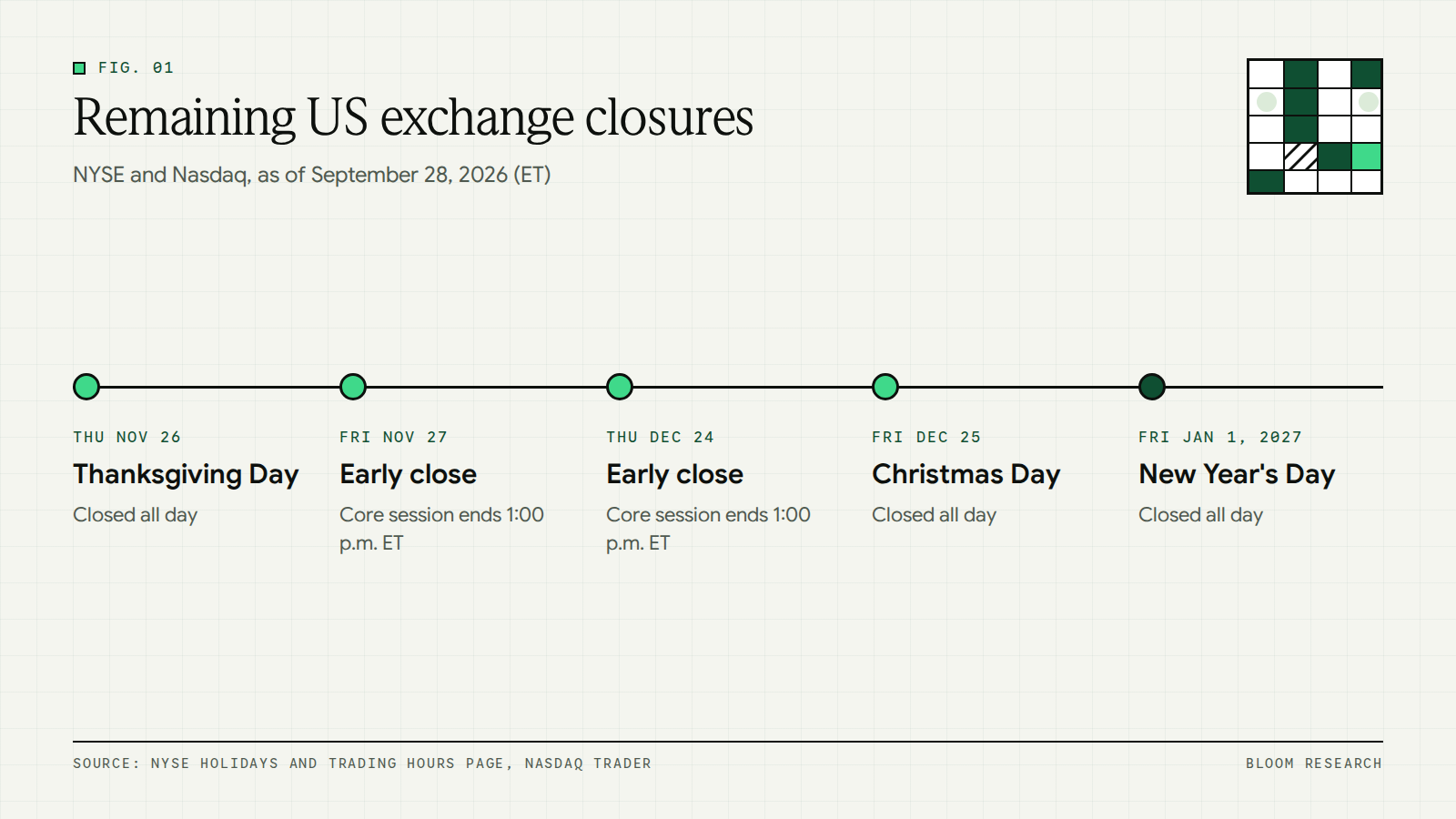
As of September 28, 2026, two full closures and two early closes remain in the NYSE holidays 2026 list. Thanksgiving Day closes both exchanges on Thursday, November 26, 2026. The next day, Friday, November 27, both close early at 1:00 p.m. ET.
Christmas Eve on Thursday, December 24, 2026 is the second early close, again at 1:00 p.m. ET. Christmas Day on Friday, December 25, 2026 is a full closure. The NYSE calendar then lists New Year's Day on Friday, January 1, 2027 as a holiday, so the first trading day of 2027 is Monday, January 4.
#NYSE and Nasdaq early closes in 2026
An early close is a scheduled trading day on which the exchange ends its core session before the usual 4:00 p.m. ET close. The NYSE core trading session normally runs from 9:30 a.m. to 4:00 p.m. ET. On Friday, November 27, 2026, the day after Thanksgiving, each NYSE market closes early at 1:00 p.m. ET, or 1:15 p.m. for eligible options.
The same rule applies on Thursday, December 24, 2026: each NYSE market closes early at 1:00 p.m. ET, with 1:15 p.m. for eligible options. On both days, the late trading sessions of NYSE American Equities, NYSE Arca Equities, NYSE National and NYSE Texas close at 5:00 p.m. ET. On a normal day, those late trading sessions run from 4:00 p.m. to 8:00 p.m. ET.
Nasdaq lists the same two dates. Its 2026 schedule shows an early close at 1:00 p.m. on November 27, 2026 and on December 24, 2026. Nasdaq says it will continue to send alerts to notify customers of days when the market will close early, and that those alerts give full information, including system operating times. For how trading before the open and after the close works, see our guide to pre-market trading hours and risks.
Key point: The NYSE 2026 calendar lists only two early closes: November 27 and December 24. It lists no early close before the July 3 holiday or on New Year's Eve, December 31, 2026.
What an early close changes
On an early close day, the core session ends at 1:00 p.m. ET instead of 4:00 p.m. ET. That makes the core session three hours shorter than on a normal day, while the 9:30 a.m. ET open stays the same.
The late trading sessions on the NYSE equity markets named above end at 5:00 p.m. ET instead of 8:00 p.m. ET. On November 27 and December 24, 2026, both the core session and the late session are therefore shorter than usual.
#Is the stock market open today? How to check any date
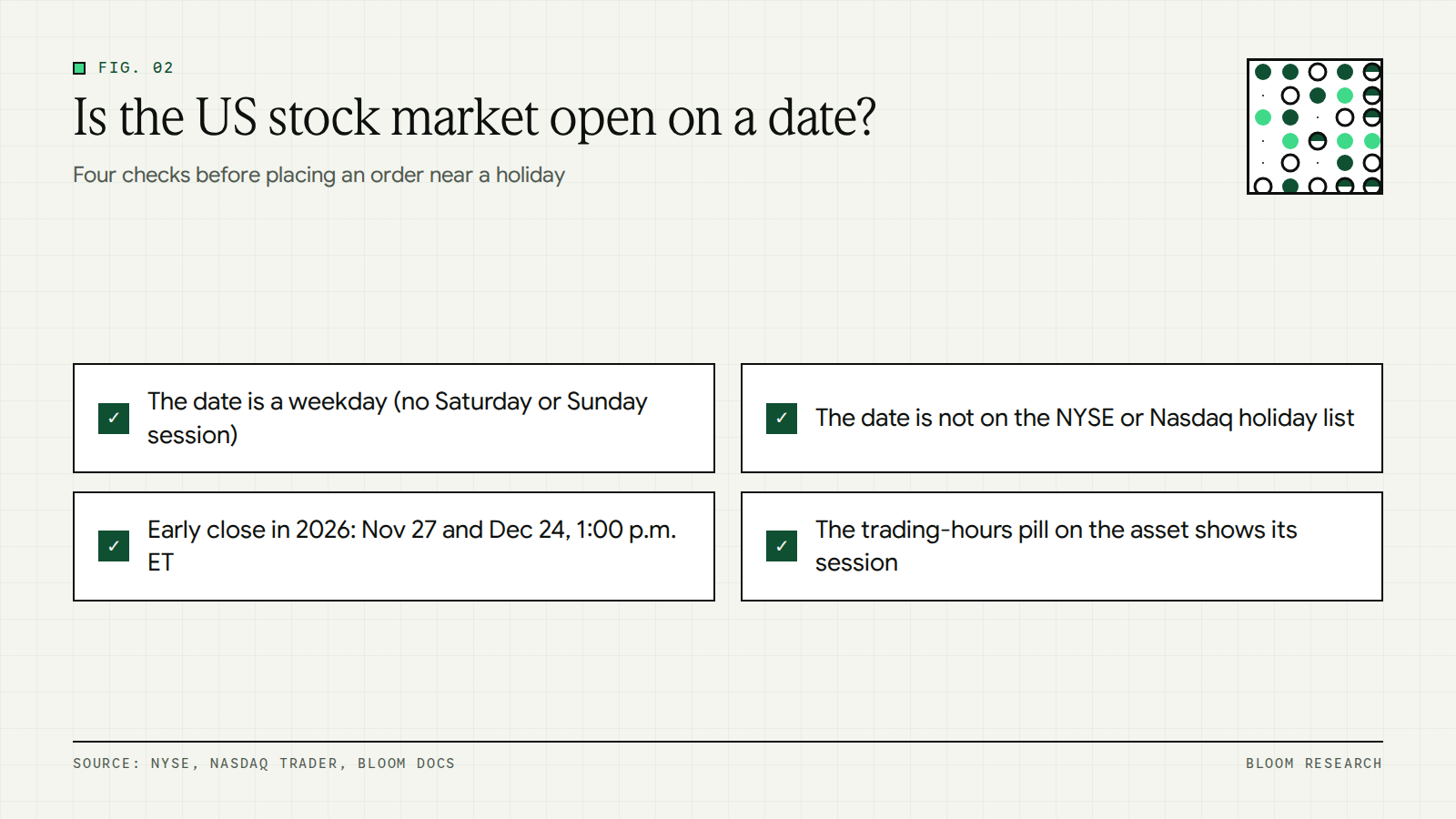
US stock exchanges hold regular sessions on weekdays, except the dates on their holiday lists. To answer "is the stock market open today" for any date, the checks below use the exchange calendars and the session shown in our app.
- Confirm the date is a weekday. US exchanges have no regular session on Saturday or Sunday.
- Check the date against the NYSE and Nasdaq holiday lists above. A listed holiday means no regular session.
- Check whether the date is an early close. In 2026 those are November 27 and December 24, when the core session ends at 1:00 p.m. ET.
- Check the asset itself. The asset detail header on Bloom always shows a trading-hours pill, so the session is visible before you tap Buy.
The full live catalog of tradeable assets on Bloom is published on our markets page with every tradeable stock and ETF. Each asset there has a detail page, and each follows the trading session inherited from its underlying instrument. A US stock listed on the NYSE or Nasdaq therefore follows that exchange's holiday calendar.
Time zones add one more step. A US holiday is set in Eastern Time, so the closed session starts in the evening in India. The India time section later in this guide converts the remaining 2026 dates to IST.
#Why exchange holidays differ from US federal holidays
A federal holiday is a holiday for federal employees set by section 6103(a) of title 5 of the United States Code. The US Office of Personnel Management (OPM) publishes the dates on its federal holidays schedule for 2026 and later years. The OPM 2026 schedule lists 11 holidays, while the NYSE 2026 list has 10 closures, so the federal list and the stock market holidays 2026 list do not match one for one.
Two federal holidays are missing from the NYSE list. Columbus Day falls on Monday, October 12, 2026, and Veterans Day falls on Wednesday, November 11, 2026. Both are on the OPM schedule, and neither appears among the NYSE or Nasdaq holidays 2026 dates, so they are regular trading days on both exchanges.
One exchange holiday is missing from the federal list. Good Friday, April 3, 2026, closed the NYSE and Nasdaq, but the OPM schedule does not include it. The other nine NYSE closures share a date with a federal holiday: New Year's Day, Martin Luther King, Jr. Day, Washington's Birthday, Memorial Day, Juneteenth, Independence Day observed, Labor Day, Thanksgiving Day and Christmas Day.
Names also differ between calendars. OPM uses the name Washington's Birthday because that is the name designated in section 6103(a), and it notes that other institutions may use other names. That is why, as noted above, Nasdaq Trader lists the same Monday as President's Day.
How observed dates work
When a holiday falls on a weekend, calendars move it to a nearby weekday. For most federal employees, a holiday that falls on a Saturday is treated as a holiday on the preceding Friday. July 4, 2026 is a Saturday, so the OPM 2026 schedule lists Independence Day on Friday, July 3, and the NYSE lists Friday, July 3 as Independence Day observed.
The exchange rule is not always the same as the federal one. The NYSE states that because New Year's Day falls on Saturday, January 1, 2028, no New Year's Day holiday is observed. The NYSE 2028 calendar therefore has no closure for New Year's Day, and there is no Friday, December 31, 2027 closure in its place.
#Bond market holidays and SIFMA early closes
The bond market uses a separate calendar. The Securities Industry and Financial Markets Association (SIFMA) publishes holiday recommendations for fixed income markets, and on December 17, 2025 it issued its 2026 and 2027 recommendations for full and early holiday closes in the US, the UK and Japan. The current dates are on the SIFMA US holiday recommendations page.
SIFMA's US list includes the stock exchange holidays, and it adds full closes and more early closes. The table below shows the 2026 dates where the SIFMA fixed income recommendation differs from the NYSE equity calendar.
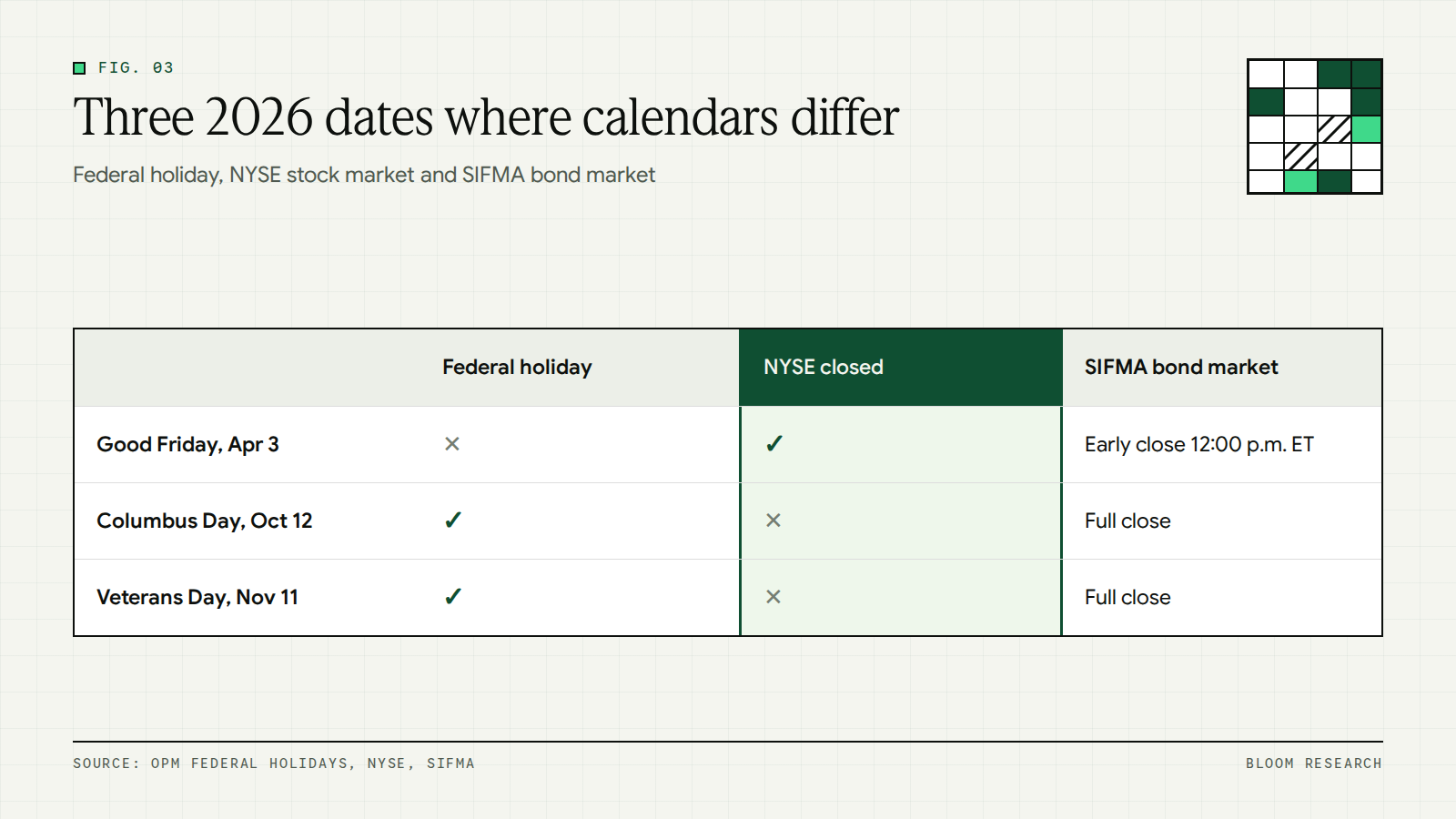
| 2026 date | NYSE and Nasdaq stock market | SIFMA US fixed income recommendation |
|---|---|---|
| Friday, April 3 (Good Friday) | Closed | Early close at 12:00 p.m. ET |
| Friday, May 22 | Not on the holiday list | Early close at 2:00 p.m. ET |
| Thursday, July 2 | Not on the holiday list | Early close at 2:00 p.m. ET |
| Monday, October 12 (Columbus Day) | Not on the holiday list | Full close |
| Wednesday, November 11 (Veterans Day) | Not on the holiday list | Full close |
| Friday, November 27 | Early close at 1:00 p.m. ET | Early close at 2:00 p.m. ET |
| Thursday, December 24 | Early close at 1:00 p.m. ET | Early close at 2:00 p.m. ET |
| Thursday, December 31 | Not on the holiday list | Early close at 2:00 p.m. ET |
Note: SIFMA recommendations cover fixed income trading. The stock exchange calendars from the NYSE and Nasdaq set the sessions for listed stocks and exchange-traded funds (ETFs).
The two calendars can differ on the same day. On Friday, November 27, 2026, the NYSE and Nasdaq close at 1:00 p.m. ET, while SIFMA recommends a 2:00 p.m. ET close for fixed income. On Thursday, December 31, 2026, the NYSE lists no early close, while SIFMA recommends a 2:00 p.m. ET close.
Three-day closures in the 2026 calendar
Eight of the 10 NYSE closures in 2026 fall on a Monday or a Friday. Martin Luther King, Jr. Day, Washington's Birthday, Memorial Day and Labor Day are Mondays. Good Friday, Juneteenth, Independence Day observed and Christmas Day are Fridays.
Each of those dates, together with the adjacent Saturday and Sunday, gives three days in a row with no regular session. The other two closures, New Year's Day on January 1 and Thanksgiving Day on November 26, fall on Thursdays. Our guide to trading US stocks on weekends and weekend order queues covers what happens to orders across a Saturday and Sunday.
#Stock market holidays 2027 already published
The NYSE has published its 2027 and 2028 calendars alongside 2026 on its holidays and trading hours page. Stock market holidays 2027 on the NYSE are listed below, with the day of the week as the NYSE shows it.
| Holiday | 2027 NYSE date |
|---|---|
| New Year's Day | Friday, January 1 |
| Martin Luther King, Jr. Day | Monday, January 18 |
| Washington's Birthday | Monday, February 15 |
| Good Friday | Friday, March 26 |
| Memorial Day | Monday, May 31 |
| Juneteenth National Independence Day (observed) | Friday, June 18 |
| Independence Day (observed) | Monday, July 5 |
| Labor Day | Monday, September 6 |
| Thanksgiving Day | Thursday, November 25 |
| Christmas Day (observed) | Friday, December 24 |
The NYSE 2027 calendar lists one early close. Each NYSE market closes early at 1:00 p.m. ET, or 1:15 p.m. for eligible options, on Friday, November 26, 2027, the day after Thanksgiving. In 2027, Juneteenth, Independence Day and Christmas Day fall on weekends, so the NYSE lists each of them on an observed weekday.
In the 2027 NYSE calendar, five closures fall on a Monday and four fall on a Friday. Thanksgiving Day on Thursday, November 25, 2027 is the only midweek closure, and the NYSE early close follows it on Friday, November 26, 2027.
Key point: The NYSE also lists 2028. It includes an early close at 1:00 p.m. ET on Monday, July 3, 2028 and on Friday, November 24, 2028, and no New Year's Day holiday in 2028.
When we checked on September 28, 2026, the Nasdaq Trader page showed the US Equity and Options Markets Holiday Schedule 2026. For 2027 dates, this guide uses the NYSE page.
#US market holidays and early closes in India time
US exchange calendars are set in Eastern Time, so the dates and times need converting for readers in India. Indian Standard Time (IST) is based on UTC with a +5:30-hour offset and is maintained by the CSIR-National Physical Laboratory, according to a PIB release on Indian Standard Time. Eastern Time has two forms: Eastern daylight time (EDT) is UTC minus 4 hours, and Eastern standard time (EST) is UTC minus 5 hours, per the US Naval Observatory time zone table.
US daylight saving time ends on Sunday, November 1, 2026, and at that time clocks are set back one hour, according to New York City's 311 daylight saving time notice. Every remaining 2026 closure and early close falls after that date, so each one uses EST. IST is 10.5 hours ahead of EST, which puts the 9:30 a.m. to 4:00 p.m. ET regular session at 8:00 p.m. to 2:30 a.m. IST.
Converted with those offsets, the remaining stock market holidays 2026 dates look like this in India:
- Thanksgiving Day, Thursday, November 26: no regular session in the evening of November 26 IST or the early hours of November 27 IST.
- Early close, Friday, November 27: the session runs from 8:00 p.m. to 11:30 p.m. IST, and NYSE late trading sessions end at 3:30 a.m. IST on Saturday, November 28.
- Early close, Thursday, December 24: the same 8:00 p.m. to 11:30 p.m. IST window applies, with NYSE late trading ending at 3:30 a.m. IST on Friday, December 25.
- Christmas Day, Friday, December 25: no regular session that evening in IST; the next regular session starts at 8:00 p.m. IST on Monday, December 28.
- New Year's Day, Friday, January 1, 2027: no regular session that evening in IST; the next one starts at 8:00 p.m. IST on Monday, January 4, 2027.
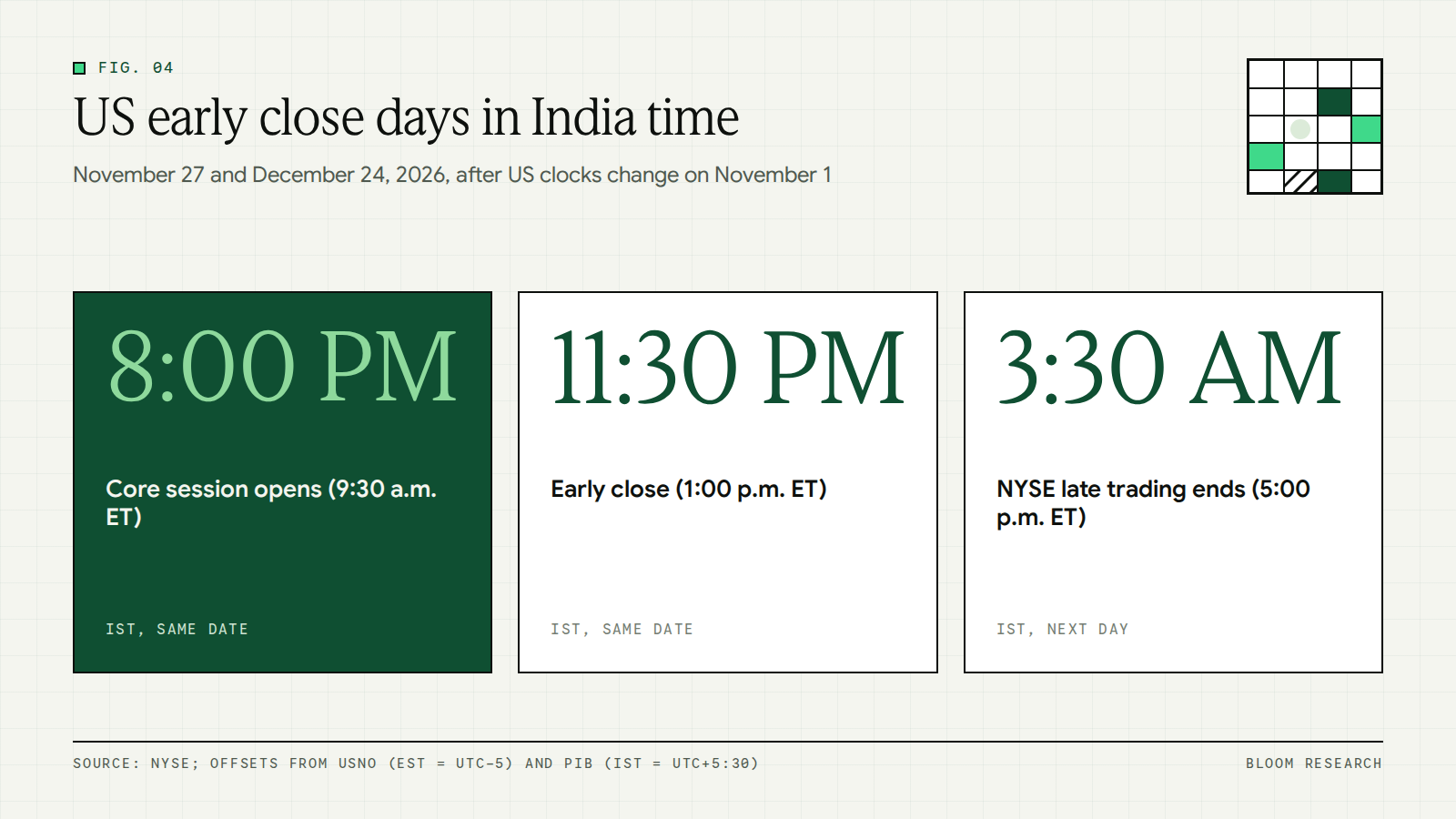
In practice: In India, a US early close falls before midnight IST. On November 27 and December 24, 2026, the US core session lasts from 8:00 p.m. to 11:30 p.m. IST, three hours less than the 8:00 p.m. to 2:30 a.m. IST session on a normal day after November 1.
#What a US market holiday means for trading on Bloom
On Bloom, you can trade tokenized US stocks listed on the NYSE, Nasdaq and AMEX, and US ETFs such as SPY, QQQ and VOO. Each asset has a primary-market trading session inherited from the underlying instrument. When the NYSE or Nasdaq is closed for a holiday, the regular session for the stocks and ETFs that follow it is closed too.
Orders placed on a holiday are queued
A queued order is an order that has been accepted and is waiting for the market to open before it executes. Our trading-hours table lists four states, and one of them covers overnight, weekends and holidays: the order is queued server-side until the next open. The receipt for that state reads Queued, with the time until the market opens.
After you confirm an order during off-hours, the receipt tells you the order has been queued and gives an estimated execution time. If the market is closed, the order executes automatically at the next market open, and you receive a push notification when it fills. Our guide to placing a first trade shows these steps from the trade sheet to the receipt.
Sells follow the same rule. Sells during market hours fill immediately, and sells outside market hours are queued for the next open, as our sell and withdraw documentation describes. On a US holiday, a sell order for a US stock is queued in the same way as a buy.
On Bloom: The trading-hours pill on each asset detail header shows the session before you tap Buy. For assets with continuous markets, orders fill immediately at the prevailing RFQ price regardless of time of day, and the pill on those assets reads LIVE 24/7.
Where the queued order shows
All queued orders are visible in Portfolio, under Orders, with a Queued badge and an estimated execution time. An order keeps that badge until it is filled, partially filled or canceled. The Buy or Sell button copy does not change during off-hours, and queue status is never shown on the button itself.
Our trading-hours documentation lists two more states that apply on any trading day, including an early close day. An order submitted during the pre-market or after-hours extended session routes to that session, may partially fill, and has any remainder queued for the next open. If liquidity is insufficient during hours, an order may partially fill at the available price, with the remainder queued for the next session.
#Price gaps and liquidity around market closures
A price gap is a difference between the last price before a closure and the first price after it. A holiday that falls next to a weekend creates three days with no regular session, and prices can move in that time. Our risk disclosure states that asset prices can move against you, including overnight gaps that may exceed your slippage tolerance or Stop Loss trigger.
Slippage tolerance is the maximum acceptable drift between the quote and the execution price. The default on Bloom is 0.5%, and it can be changed to 0.1%, 1% or a custom value in the trade sheet. A gap larger than that tolerance is one of the market risks the disclosure names.
Liquidity is the second risk. The risk disclosure states that markets can become illiquid, especially outside regular hours, and that an order may queue or partial-fill. It also states that the tokenized security issuers that quote prices may withdraw liquidity in extreme conditions.
Important: Trading on Bloom carries risk, including the loss of principal. Market risk, smart contract risk, custody risk, bridging risk and liquidity risk apply, and a holiday closure does not remove any of them.
#Where to follow US markets on Bloom before and after a holiday
The US stocks and ETFs on the pages below each follow the session of their underlying instrument, including its holiday calendar. You can browse tokenized US stocks and ETFs by sector, see the S&P 500 constituents available on Bloom, or view the Nasdaq-100 stocks tokenized on Bloom. Our list of tokenized ETFs covers broad-market, sector and bond funds, and our side-by-side comparison of two tokenized stocks or ETFs shows pairs such as SPY and QQQ.
Newly listed stocks follow the same calendar as the exchange that lists them. SpaceX Class A shares have traded on Nasdaq under the ticker SPCX since June 12, 2026, as covered in our guide on how to buy SpaceX stock. For investors in India, our page on buying tokenized US stocks from India shows popular stocks and ETFs to buy from India.
Bloom is in public beta. We do not offer our product or services to users in the United States or in other restricted jurisdictions, as set out in our service availability terms. The NYSE and Nasdaq holiday pages remain the primary source for stock market holidays 2026 and later years, and the trading-hours pill on each asset shows the session that applies to it.
Frequently asked questions
Is the stock market open today?
US stock exchanges hold regular sessions on weekdays except the dates on their holiday lists. After September 28, 2026, the NYSE and Nasdaq are closed on Thanksgiving Day, November 26, and Christmas Day, December 25, and they close early at 1:00 p.m. ET on November 27 and December 24. On other weekdays the NYSE core session runs from 9:30 a.m. to 4:00 p.m. ET.
What holidays is the US stock market closed in 2026?
The NYSE and Nasdaq are closed on New Year's Day (January 1), Martin Luther King, Jr. Day (January 19), Washington's Birthday (February 16), Good Friday (April 3), Memorial Day (May 25), Juneteenth (June 19), Independence Day observed (July 3), Labor Day (September 7), Thanksgiving Day (November 26) and Christmas Day (December 25, 2026).
Is the stock market open on Columbus Day and Veterans Day 2026?
Columbus Day on Monday, October 12, 2026 and Veterans Day on Wednesday, November 11, 2026 are on the OPM federal holiday schedule, but neither date is on the NYSE 2026 holiday list. SIFMA, which publishes holiday recommendations for fixed income markets, recommends full closes of US bond markets on both dates.
Does the stock market close early on Christmas Eve 2026?
Yes. Each NYSE market closes early at 1:00 p.m. ET on Thursday, December 24, 2026, or 1:15 p.m. for eligible options, and the NYSE Arca Equities and other NYSE late trading sessions close at 5:00 p.m. ET. Nasdaq also lists a 1:00 p.m. early close on December 24, 2026, and both exchanges are closed on Christmas Day, December 25.
Is the stock market closed on Good Friday 2026?
Yes. The NYSE and Nasdaq were both closed on Good Friday, April 3, 2026. Good Friday is not on the OPM federal holiday schedule, so it is one of the dates where the exchange calendar and the federal calendar differ. For US bond markets, SIFMA recommended a 12:00 p.m. ET early close on April 3, 2026 rather than a full close.
What are the 2027 NYSE holidays?
The NYSE lists these 2027 holidays: January 1, January 18, February 15, Good Friday on March 26, May 31, June 18 (Juneteenth observed), July 5 (Independence Day observed), September 6, November 25 and December 24 (Christmas Day observed). Each NYSE market closes early at 1:00 p.m. ET on Friday, November 26, 2027.
What happens to an order placed on a US market holiday on Bloom?
On Bloom, an order submitted overnight, on a weekend or on a holiday is queued server-side until the next open of the underlying market. The receipt says the order has been queued and gives an estimated execution time, the order appears in Portfolio under Orders with a Queued badge, and you receive a push notification when it fills.
What time is the US early close in India?
US daylight saving time ends on Sunday, November 1, 2026, so the November 27 and December 24 early closes fall under Eastern Standard Time, which is UTC minus 5 hours. IST is UTC +5:30, which puts the 1:00 p.m. ET early close at 11:30 p.m. IST on the same date.