

After-hours trading explained: hours, liquidity and risks
After hours trading explained: US after-hours session times in ET, IST and UK time, how orders match, the risks FINRA and the SEC list, and orders on Bloom.

Key takeaways
- After hours trading in US stocks runs from 4:00 p.m. to 8:00 p.m. ET on Nasdaq and in the Late Trading Sessions of NYSE Arca, NYSE American, NYSE National and NYSE Texas.
- In India the session runs from 1:30 a.m. to 5:30 a.m. IST until November 1, 2026, and from 2:30 a.m. to 6:30 a.m. IST after US clocks change.
- On November 27 and December 24, 2026, US markets close at 1:00 p.m. ET and the NYSE group late trading sessions close at 5:00 p.m. ET.
- FINRA states that prices recorded at 4 p.m. are the official closing prices regardless of extended-hours trading, and the SEC notes that many brokerage firms accept only limit orders.
- FINRA Rule 2265 requires firms to disclose at least six extended-hours risks: lower liquidity, higher volatility, changing prices, unlinked markets, news announcements and wider spreads.
After hours trading is the buying and selling of US stocks after the regular session closes at 4:00 p.m. Eastern Time (ET). On Nasdaq and on four NYSE group equity markets, the after-hours session runs until 8:00 p.m. ET. In India, that window falls from 1:30 a.m. to 5:30 a.m. IST while US daylight saving time is in effect, and from 2:30 a.m. to 6:30 a.m. IST after it ends on November 1, 2026.
This guide covers the evening session: its times in ET, IST and UK time, how after-hours orders are matched, why after-hours prices can differ from the official close, the risks FINRA and the SEC list, and how our trade sheet handles these orders. The morning session has its own guide to pre-market trading hours and risks. For funding, currency and local rules, see our country guide for investors in India.
#What is after-hours trading?
FINRA's investor insight on extended-hours trading, dated July 31, 2024, states that trading which occurs later in the day after regular trading ends is known as post-market or after-hours trading. FINRA gives regular trading hours for listed stocks, as the SEC defines them, as 9:30 a.m. to 4 p.m. ET. It describes after-hours trading as typically defined as taking place from 4 to 8 p.m. ET.
Definition: Extended-hours trading is any trading activity outside regular trading hours, whether in the pre-market, after-hours or overnight periods, as FINRA uses the term. After-hours trading, also called post-market trading, is the part that takes place after regular trading ends.
The session is not identical across the market. The SEC's Investor.gov glossary entry on after-hours trading states that the duration of after-hours trading sessions varies between markets and trading venues. It tells investors to contact their brokerage firms to determine if and when after-hours trading sessions are available.
Brokerage firms also set their own terms. FINRA states that a firm might impose set times for such trading, restrict activity to a specific trading venue, or allow investors to trade only certain products. It adds that some firms might not offer extended-hours trading at all.
Why trading continues after the close
FINRA lists two reasons investors use these sessions: to trade when it is more convenient for their schedules, and to react more quickly to changes in the marketplace. FINRA also states that key corporate events, such as earnings or other significant announcements, normally take place during the extended-hours period. It links that timing to volatility, because some investors react to these events quickly.
Access has widened over time. FINRA notes that changes in the marketplace have led to more widespread trading activity, including by retail investors, outside regular trading hours. The share of volume is still small. In her remarks at the SEC roundtable on 24-hour trading on September 17, 2026, SEC Commissioner Hester Peirce said extended hours trading still accounts for less than 1% of total trading for NMS stocks. She added that it is highly concentrated in a handful of stocks.
#After-hours trading time on Nasdaq and NYSE
The after-hours trading time on the main US stock exchanges is 4:00 p.m. to 8:00 p.m. ET. Each exchange opens the session right after its end-of-day process. On Nasdaq that process is the Nasdaq Closing Cross, and on NYSE markets it is the Closing Auction, both at 4:00 p.m. ET.
| Venue | Session name | After-hours window (ET) |
|---|---|---|
| Nasdaq | Post-Market Hours | 4:00 p.m. to 8:00 p.m. |
| NYSE Arca Equities | Late Trading Session | 4:00 p.m. to 8:00 p.m. |
| NYSE American | Late Trading Session | 4:00 p.m. to 8:00 p.m. |
| NYSE National | Late Trading Session | 4:00 p.m. to 8:00 p.m. |
| NYSE Texas | Late Trading Session | 4:00 p.m. to 8:00 p.m. |
| NYSE (Tape A) | None listed | Core Trading Session ends with the 4:00 p.m. Closing Auction |
The Nasdaq row comes from SEC Release No. 34-105199 on Nasdaq's trading sessions, dated April 10, 2026. The release records that, commencing at 4:00 p.m. with the execution of the Nasdaq Closing Cross, Nasdaq conducts a Post-Market Hours trading session until 8:00 p.m. Under that schedule, the exchange is closed to trading between 8:00 p.m. and 4:00 a.m. ET.
The NYSE rows come from NYSE's holidays and trading hours page. It lists a Late Trading Session from 4:00 p.m. to 8:00 p.m. ET for NYSE American, NYSE Arca Equities, NYSE National and NYSE Texas. For NYSE (Tape A), it lists a Core Trading Session from 9:30 a.m. to 4:00 p.m. ET, a Closing Imbalance Period from 3:50 p.m. and a 4:00 p.m. Closing Auction, with no late session.
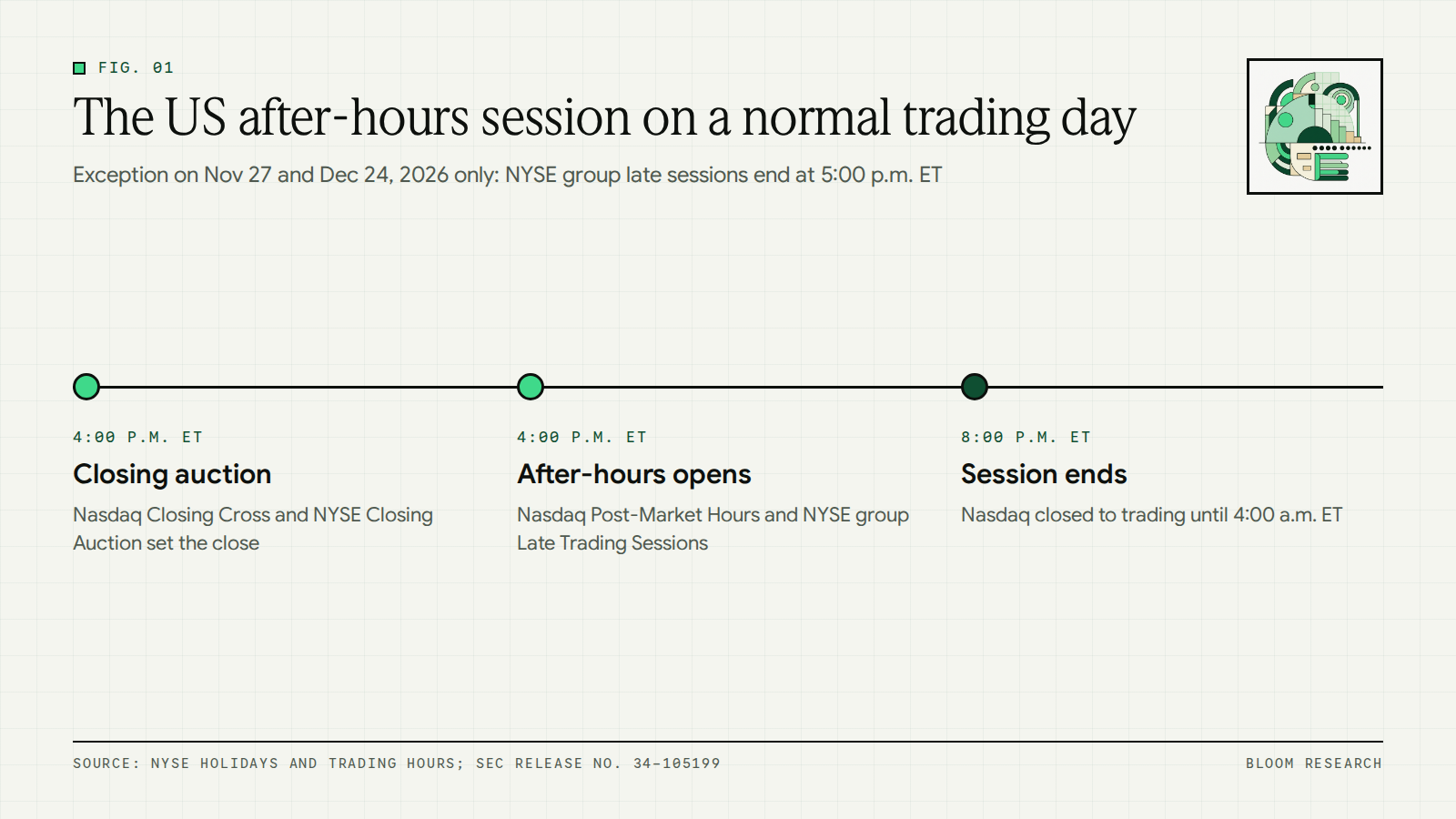
Key point: The after-hours window is 4:00 p.m. to 8:00 p.m. ET on Nasdaq and on the four NYSE group markets with a Late Trading Session. NYSE lists no late session for its Tape A market.
On our platform, each asset follows the trading session of its underlying instrument's primary market. Our Nasdaq-100 page shows which of the 100 largest non-financial Nasdaq names are available on Bloom. Our guide on how to buy SpaceX stock covers SPCX, whose Class A shares have traded on Nasdaq since June 12, 2026.
Early closes and holidays in 2026
Two early closes remain in 2026. NYSE states that each market will close early at 1:00 p.m. ET on Friday, November 27, 2026, the day after Thanksgiving, and on Thursday, December 24, 2026. On those two days, the late trading sessions on NYSE American Equities, NYSE Arca Equities, NYSE National and NYSE Texas close at 5:00 p.m. ET instead of 8:00 p.m.
Nasdaq's 2026 holiday and trading calendar lists the same two early closes at 1:00 p.m. It also lists full closures on Thanksgiving Day, November 26, and Christmas Day, December 25, 2026. Nasdaq states that it will continue to send alerts to notify customers of days when the market will close early, with full information including system operating times.
Nasdaq has also announced a new trading session from 9 p.m. to 4 a.m. ET starting on December 6, 2026. That session falls outside the after-hours window, and our guide to US stock market hours in every time zone covers it with the regular session, holidays and the overnight schedule.
#After-hours trading time in India and the UK
US exchanges publish their session times in Eastern Time, so the local after-hours trading time moves when US or UK clocks change. We convert in two steps. First, ET to UTC with the US Naval Observatory's time zone table, which gives Eastern daylight time (EDT) as UTC minus 4 hours and Eastern standard time (EST) as UTC minus 5 hours. Second, UTC to local time with the Hong Kong Observatory world time list, which lists New Delhi at UTC+5.5 and London at UTC.
Indian Standard Time (IST) does not change during the year. Under NIST's daylight saving time rules, US daylight saving time in 2026 is in effect from March 8 at 2 a.m. to November 1 at 2 a.m. local time. The GOV.UK clock change dates show UK clocks going back on October 25, 2026. GOV.UK calls the period when clocks are 1 hour ahead British Summer Time (BST), and the UK is on Greenwich Mean Time (GMT) after the clocks go back.
Because the UK and US change on different Sundays, autumn 2026 has three periods for the 4:00 p.m. to 8:00 p.m. ET session:
| Trading days in 2026 | US and UK clocks | After-hours in IST | After-hours in UK time |
|---|---|---|---|
| Through Friday, October 23 | EDT and BST | 1:30 a.m. to 5:30 a.m. (next day) | 9:00 p.m. to 1:00 a.m. BST (next day) |
| October 26 to 30 | EDT and GMT | 1:30 a.m. to 5:30 a.m. (next day) | 8:00 p.m. to 12:00 a.m. (midnight) GMT |
| From Monday, November 2 | EST and GMT | 2:30 a.m. to 6:30 a.m. (next day) | 9:00 p.m. to 1:00 a.m. GMT (next day) |
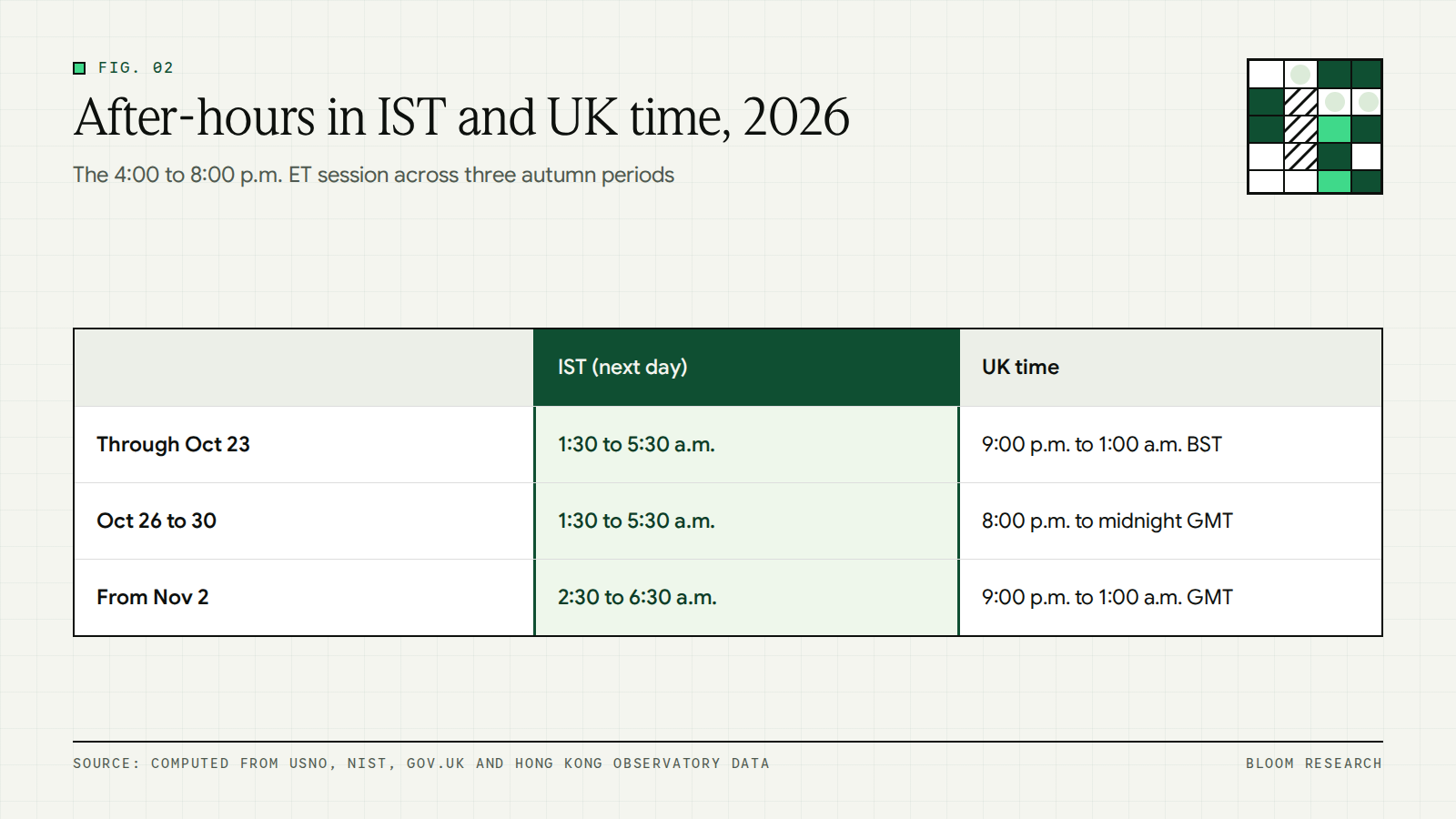
For an investor in India, the after-hours session starts at the US close, 1:30 a.m. IST under EDT or 2:30 a.m. IST under EST. It ends at 5:30 a.m. or 6:30 a.m. IST. In London, the session runs through the late evening and, outside the October 26 to 30 window, past midnight.
In practice: From October 26 to 30, 2026, the UK is on GMT while the US is still on EDT. In that week the after-hours session in London runs from 8:00 p.m. to midnight GMT, one hour earlier than in the weeks before and after it.
Our country guide for investors in the United Kingdom covers what UK investors should know before they fund, including a common path of a Faster Payments or SEPA transfer to a regulated on-ramp that converts pounds to USDC.
After-hours time on early-close days
The two early-close days in 2026 both fall after November 1, when the US is on EST. On November 27 and December 24, 2026, the 1:00 p.m. ET close is 11:30 p.m. IST and 6:00 p.m. GMT. The NYSE group late trading sessions close at 5:00 p.m. ET on those days, which is 3:30 a.m. IST the next day and 10:00 p.m. GMT.
#How after-hours trading works
After-hours stock trading follows different rules from the regular session. The SEC's investor bulletin on extended-hours trading, dated June 6, 2022, states that extended-hours trading may take place on alternative trading systems (ATSs) operated by broker-dealers, on exchanges and on other trading centers. It adds that not all markets available during regular trading hours may be available during extended-hours trading.
Definition: An alternative trading system (ATS) is a trading system operated by a broker-dealer, which the SEC bulletin lists separately from exchanges. An electronic communications network (ECN) is an electronic trading system that, in the SEC's 2008 description, gave individual investors access to after-hours markets.
The SEC's publication on after-hours trading risks, dated November 3, 2008, states that some smaller exchanges offer extended hours. With the rise of ECNs, it says, everyday individual investors can gain access to the after-hours markets. The same publication notes that some firms only allow investors to view quotes from the one trading system the firm uses for after-hours trading.
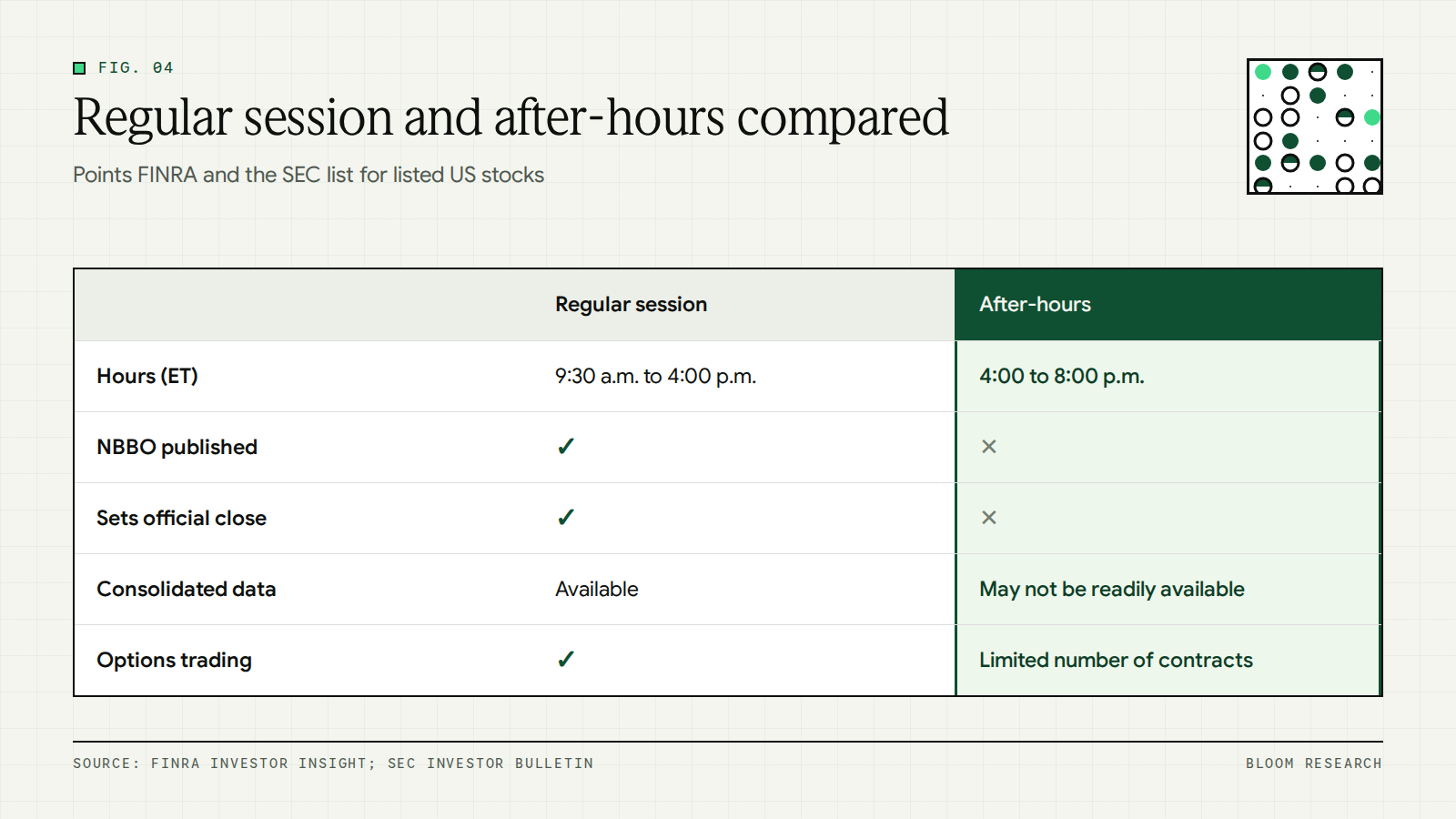
The SEC bulletin states that the rules for extended-hours venues vary and may differ significantly from the rules that apply during regular trading hours. Differences may include the types of orders accepted, the securities that are available to trade, and the presence or absence of market makers. Some rules that apply to the handling of orders during regular trading hours do not apply in extended-hours trading. Consolidated quote and trade data available during regular hours may also not be readily available after the close.
One regular-hours protection is missing. FINRA explains that during regular trading hours, brokerage firms are generally required by SEC rules to fill customer orders for listed stocks at the most favorable price at the time, a reference known as the NBBO. The NBBO is only published during regular trading hours, so this requirement does not apply to extended-hours trading.
Limit orders and order time limits
A limit order is an order to buy or sell at a set price or better. The SEC bulletin states that many brokerage firms currently accept only limit orders in extended-hours trading, in order to protect investors from unexpectedly bad prices. Limit orders can be executed only at the limit price or better, and if the market moves away from the limit price, the order will not be executed.
Unfilled orders need a rule too. The bulletin tells investors to check whether orders not executed during extended-hours trading will be canceled or automatically entered when regular trading hours begin. It also tells them to check whether orders placed during regular trading hours will carry over to extended-hours trading. FINRA adds that firms may have different policies on whether unexecuted extended-hours trades are canceled or carried over to the start of regular trading hours.
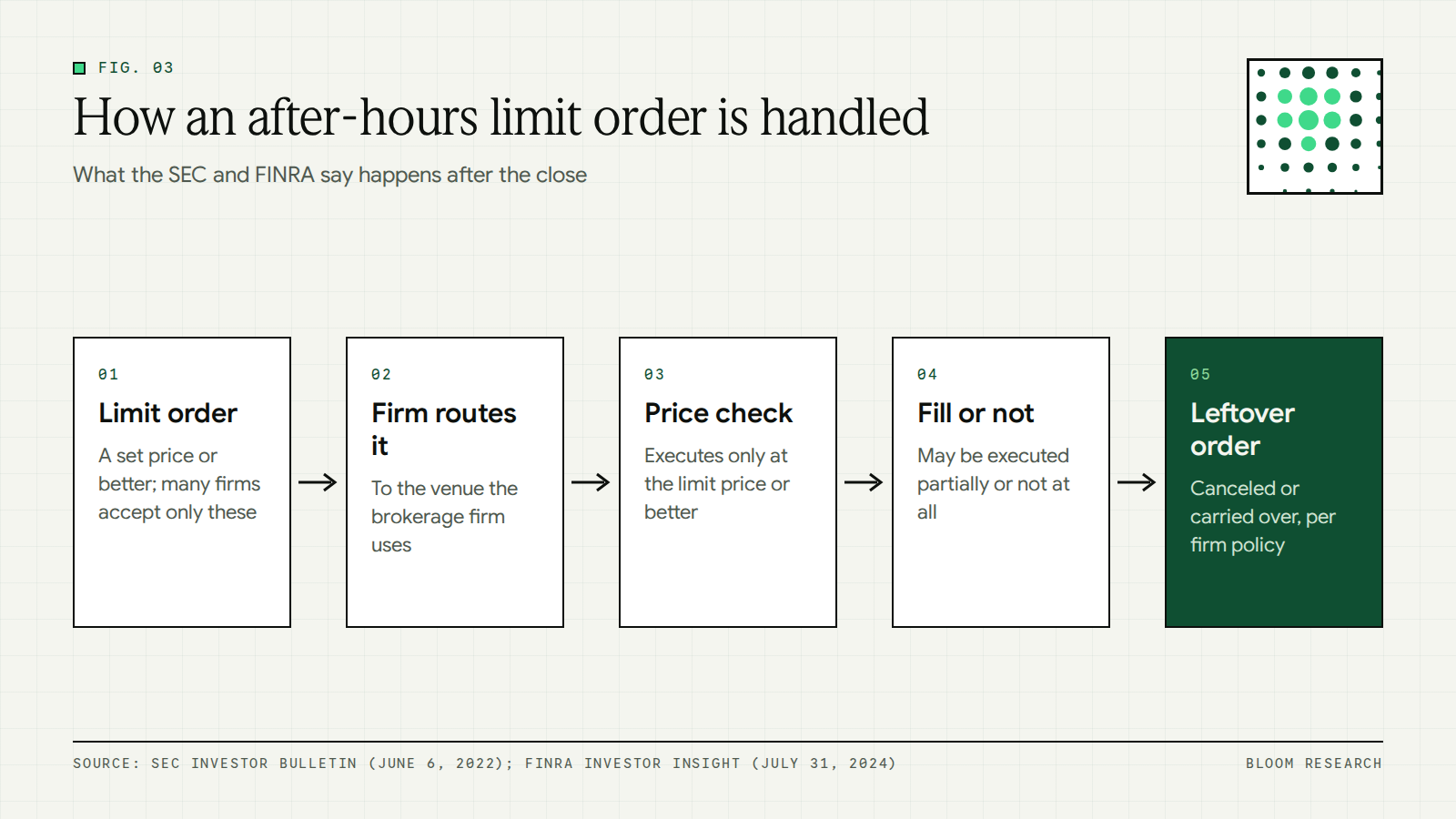
How it works: An after-hours limit order goes from the brokerage firm to the venue the firm uses. It fills only at the limit price or better, can fill partially or not at all, and any unfilled part is then canceled or carried to the next session under the firm's policy.
You can practice order entry before risking real money. Our guide to paper trading with virtual funds covers placing simulated trades to practice order entry, position sizing and reviewing results without risking money.
#Why after-hours prices differ from the close
After-hours prices and the official closing price are separate figures. FINRA states that the share prices recorded at 4 p.m. on the exchanges are the official closing prices for that day, and that extended-hours trading does not change those closing prices or determine the next day's opening prices.
The official closing price matters beyond the quote screen. FINRA states that these official closing prices are what investment funds use to calculate the value of their holdings at the end of regular trading hours.
The next morning starts from a new process. FINRA states that the next day's opening prices are generated based on supply and demand for the securities at or around the time markets open. Pricing dynamics at the open might differ from the prior extended-hours session. FINRA says this creates the risk that the price received during the extended-hours period might be worse than during the following day's regular trading hours.
News released after the close can move after-hours prices. FINRA gives the example of a company that reports disappointing earnings after the market closes and might see a rapid decline in its share price during after-hours trading. It adds that trading might become smoother once investors have had time to absorb more information and regular trading hours resume. The SEC's 2008 publication states that news stories announced after-hours may have greater impacts on stock prices.
#Extended hours trading risks under FINRA Rule 2265
FINRA Rule 2265 states that no member firm shall permit a customer to engage in extended hours trading unless it has furnished that customer a disclosure statement highlighting the risks specific to extended hours trading. The rule's model statement defines regular trading hours as generally the time between 9:30 a.m. and 4:00 p.m. Eastern Standard Time. A firm that writes its own statement must address, at a minimum, six risks:
| Risk named in Rule 2265 | What the model disclosure says |
|---|---|
| Lower liquidity | There may be lower liquidity than in regular hours, so an order may only be partially executed, or not at all |
| Higher volatility | There may be greater volatility in extended hours trading than in regular trading hours |
| Changing prices | Prices may not reflect the prices at the end of regular trading hours or upon the opening the next morning |
| Unlinked markets | Prices on one extended hours trading system may not reflect prices on other systems trading the same securities at the same time |
| News announcements | Issuers normally make news announcements that may affect prices after regular trading hours, which may cause an exaggerated and unsustainable effect on price |
| Wider spreads | Lower liquidity and higher volatility may result in wider than normal spreads |
The news announcements item is the one most specific to the evening session. The rule states that issuers normally make news announcements that may affect the price of their securities after regular trading hours. Combined with lower liquidity and higher volatility, these announcements may cause an exaggerated and unsustainable effect on the price of a security.
The spread, in Rule 2265's words, is the difference in price between what you can buy a security for and what you can sell it for. The SEC bulletin states that reduced trading interest generally results in wider spreads between the bid and ask prices, or no quotes at all.
Risks the SEC adds for after-hours orders
The SEC bulletin lists further points beyond the six in the rule:
- Professional traders: many of the extended-hours traders are professional traders who generally have access to more information than individual investors.
- No trading at all: there may be no market makers actively making markets in most or all stocks, and some stocks may not trade at all during extended-hours trading.
- Volatility controls: certain existing mechanisms that address volatility in specific stocks or in the market as a whole may be limited or not available.
- Options: FINRA adds that options exchanges offer extended-hours trading in only a limited number of options contracts.
Rule 2265 also tells firms to consider added disclosures for product-specific needs. It names exchange-traded funds, options trading, options exercises, and the effect of stock splits or dividend payments during extended-hours trading. FINRA states that all brokerage firms must advise customers of the risks of trading outside of regular trading hours, per FINRA rules.
Important: Extended hours trading risks do not disappear with a limit order. A limit order controls the price, but the order may still be partially executed or not executed at all, and the next open can still be at a different price.
#How after-hours orders work on Bloom
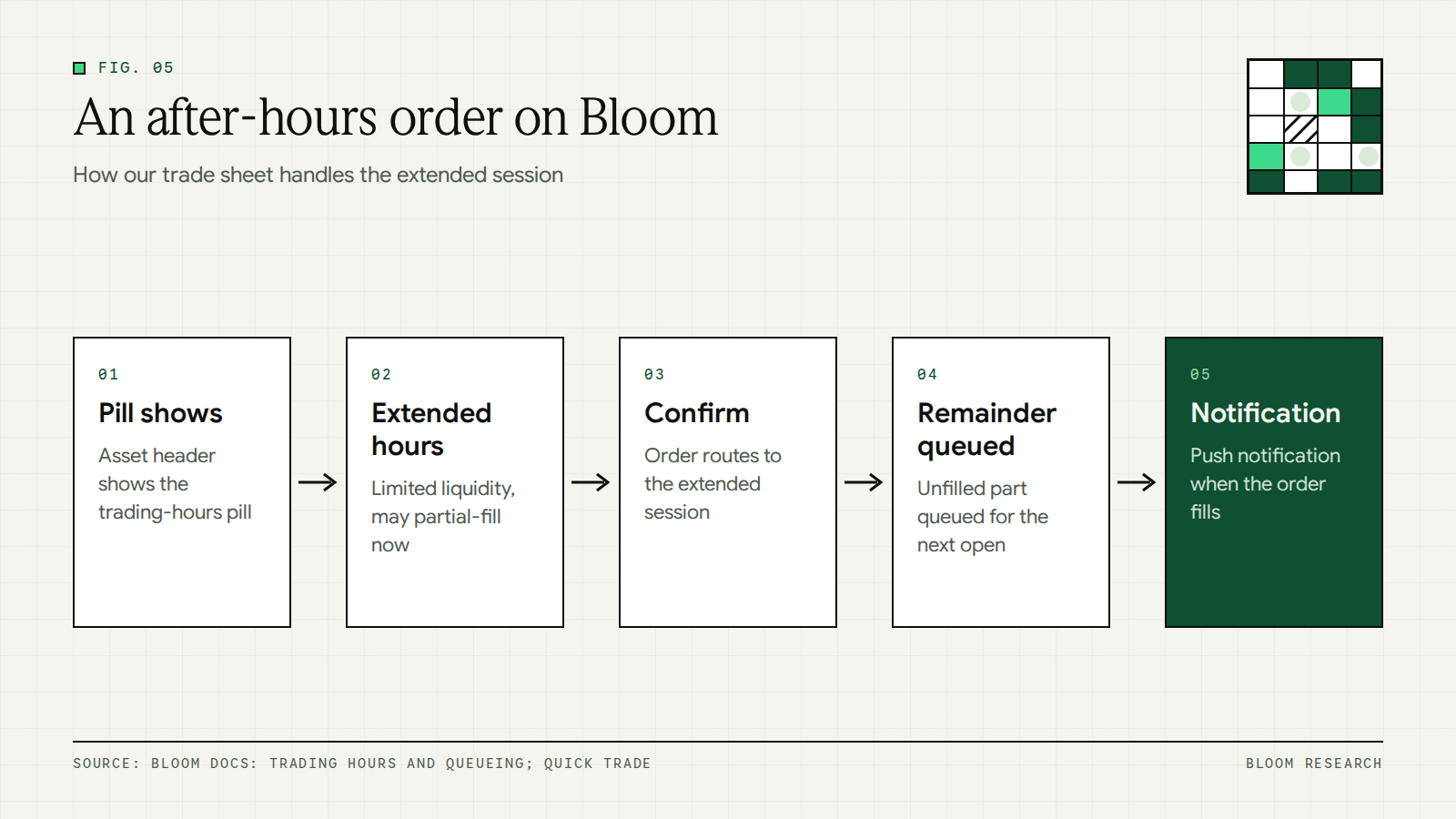
Our trading hours and queueing docs state that each asset has a primary-market trading session inherited from the underlying instrument. The Asset detail header always shows a trading-hours pill, so you know what to expect before tapping Buy. The docs describe four states for an order:
- Regular market hours: the order routes to market, executes and fills.
- Pre-market or after-hours extended session: the order routes to the extended session, may partial-fill, and the remainder is queued for the next open.
- Overnight, weekends and holidays: the order is queued server-side until the next open.
- During hours with insufficient liquidity: a partial fill at the available price, with the remainder queued for the next session.
What the trade sheet shows after the close
The Quick Trade sheet reference lists a market-hours pill at the top of the sheet. In the extended session it reads "Extended hours · limited liquidity · may partial-fill now, remainder at open". The sheet offers Market and Limit orders, with Market as the default.
After you confirm during off-hours, the receipt tells you the order has been queued and gives an estimated execution time. You receive a push notification when the order fills. Queued orders appear in Portfolio, under Orders, until they become Filled, Partially filled or Cancelled. Our Portfolio page docs explain that you can filter orders by Pending, Executed or Cancelled and swipe left on a pending order to cancel it.
For assets with continuous markets, orders fill immediately at the prevailing RFQ price regardless of time of day, and the pill on those assets reads LIVE 24/7. RFQ (request for quote) is our pricing process, in which a regulated tokenized security issuer returns a live quote before you confirm.
On Bloom: Our risk disclosure states that markets can become illiquid, especially outside regular hours, and your order may queue or partial-fill. It also states that asset prices can move against you, including overnight gaps that may exceed your slippage tolerance or Stop Loss trigger.
#Where to find US stocks and ETFs on Bloom
Our Markets catalog lists all tradeable stocks and ETFs, and each asset page shows its trading-hours pill before you tap Buy. You can also browse every tokenized US stock and ETF grouped by sector, the S&P 500 constituents available on Bloom and the ETFs listed on Bloom. Our comparison pages put two tokenized stocks or ETFs side by side.
Trading on Bloom carries risk, including the loss of principal, as our risk disclosure states. We do not provide financial, investment, tax or legal advice, and nothing in this guide is a recommendation to trade in any session.
We do not offer our product or services to users in the United States or in other restricted jurisdictions, as our service availability page explains.
Frequently asked questions
What does after-hours trading mean?
After-hours trading is trading in US stocks after the regular session ends at 4:00 p.m. ET. FINRA describes it as post-market or after-hours trading and gives the typical window as 4 to 8 p.m. ET. It is one part of extended-hours trading, the term FINRA uses for any activity outside regular trading hours, including the pre-market and overnight periods. Brokerage firms set their own rules for access.
What time does after-hours trading end?
On Nasdaq and on the Late Trading Sessions of NYSE Arca Equities, NYSE American, NYSE National and NYSE Texas, after-hours trading ends at 8:00 p.m. ET. In India that is 5:30 a.m. IST the next day until November 1, 2026 and 6:30 a.m. IST after it. On November 27 and December 24, 2026, the NYSE group late sessions close at 5:00 p.m. ET.
What is the after-hours trading time in India?
The US after-hours session runs from 4:00 p.m. to 8:00 p.m. ET. While US daylight saving time is in effect, until November 1, 2026, that is 1:30 a.m. to 5:30 a.m. IST the next day. From November 2, 2026, when the US is on standard time, it is 2:30 a.m. to 6:30 a.m. IST. India does not change its clocks, so only the US change moves these times.
Does after-hours trading affect the opening price?
FINRA states that extended-hours trading does not change the official closing prices recorded at 4 p.m. and does not determine the next day opening prices. Opening prices are generated from supply and demand at or around the open. FINRA notes that pricing at the open might differ from the prior extended-hours session, so a price received after hours might be worse than prices during the next regular session.
What stocks have after-hours trading?
The SEC states that not all markets available during regular trading hours may be available during extended-hours trading, and that some stocks may not trade at all. SEC Commissioner Hester Peirce said on September 17, 2026 that extended hours trading is highly concentrated in a handful of stocks. FINRA adds that options exchanges offer extended-hours trading in only a limited number of options contracts.
Who trades after hours?
FINRA notes that changes in the marketplace have led to more widespread trading activity outside regular hours, including by retail investors. The SEC investor bulletin states that many of the extended-hours traders are professional traders who generally have access to more information than individual investors. Extended-hours trading still accounts for less than 1% of total trading for NMS stocks, according to Commissioner Peirce.
Can I place an after-hours order on Bloom?
Yes, for assets whose primary market has an extended session. Our trading hours docs state that an order submitted in the pre-market or after-hours extended session routes to the extended session, may partial-fill, and any remainder is queued for the next open. The trade sheet shows an extended-hours pill before you confirm. Bloom is not available in the United States or other restricted jurisdictions.