
Liberalised Remittance Scheme (LRS) Explained for US Stocks
The Liberalised Remittance Scheme explained for US stock investors: the USD 250,000 LRS limit, rules, PAN and Form A2, and TCS on foreign remittance in 2026.
Key takeaways
- Under the RBI's Liberalised Remittance Scheme, resident individuals, including minors, can remit up to USD 250,000 per financial year, from April to March, for permissible current and capital account transactions.
- Resident individuals may make overseas portfolio investment, such as buying listed foreign shares, within the overall LRS limit under the Overseas Investment Rules, 2022.
- LRS does not allow remittances for margins or margin calls to overseas exchanges, or for trading in foreign exchange abroad, and PAN is mandatory for every LRS remittance.
- HDFC Bank and Standard Chartered publish TCS from April 1, 2026 on other LRS purposes at nil up to ₹10 lakh in a financial year and 20% above ₹10 lakh.
- Received or unused foreign exchange that is not reinvested must be repatriated within 180 days, and the CBDT treats Schedule FA and Schedule FSI reporting as mandatory under the Black Money Act, 2015.
The Liberalised Remittance Scheme (LRS) is the Reserve Bank of India (RBI) framework that lets resident individuals send up to USD 250,000 abroad in each financial year. It is the scheme a resident Indian uses to fund a purchase of US stocks at an overseas broker. This guide explains the LRS rules that matter to a US stock investor. It covers who can use the scheme, how the limit is counted, what it allows and excludes, the documents your bank asks for, and tax collected at source (TCS) on foreign remittance from April 1, 2026. Our country guide for investors in India lists popular US stocks and ETFs you can buy on Bloom.
We build Bloom, and for the rules below we quote the RBI, the Income Tax Department and the banks that implement them, with the date each source carries. To compare the ways to buy US shares from India, such as overseas brokers, GIFT City receipts, mutual funds and tokenized stocks, our guide on how to invest in US stocks from India sets them side by side.
#What is the Liberalised Remittance Scheme?
The legal framework for foreign exchange in India is the Foreign Exchange Management Act, 1999 (FEMA), which came into force on June 1, 2000. Under FEMA, every foreign exchange transaction is either a current account transaction or a capital account transaction. The RBI describes current account transactions as those that do not alter a resident's assets or liabilities outside India, and it lists investment among capital account transactions.
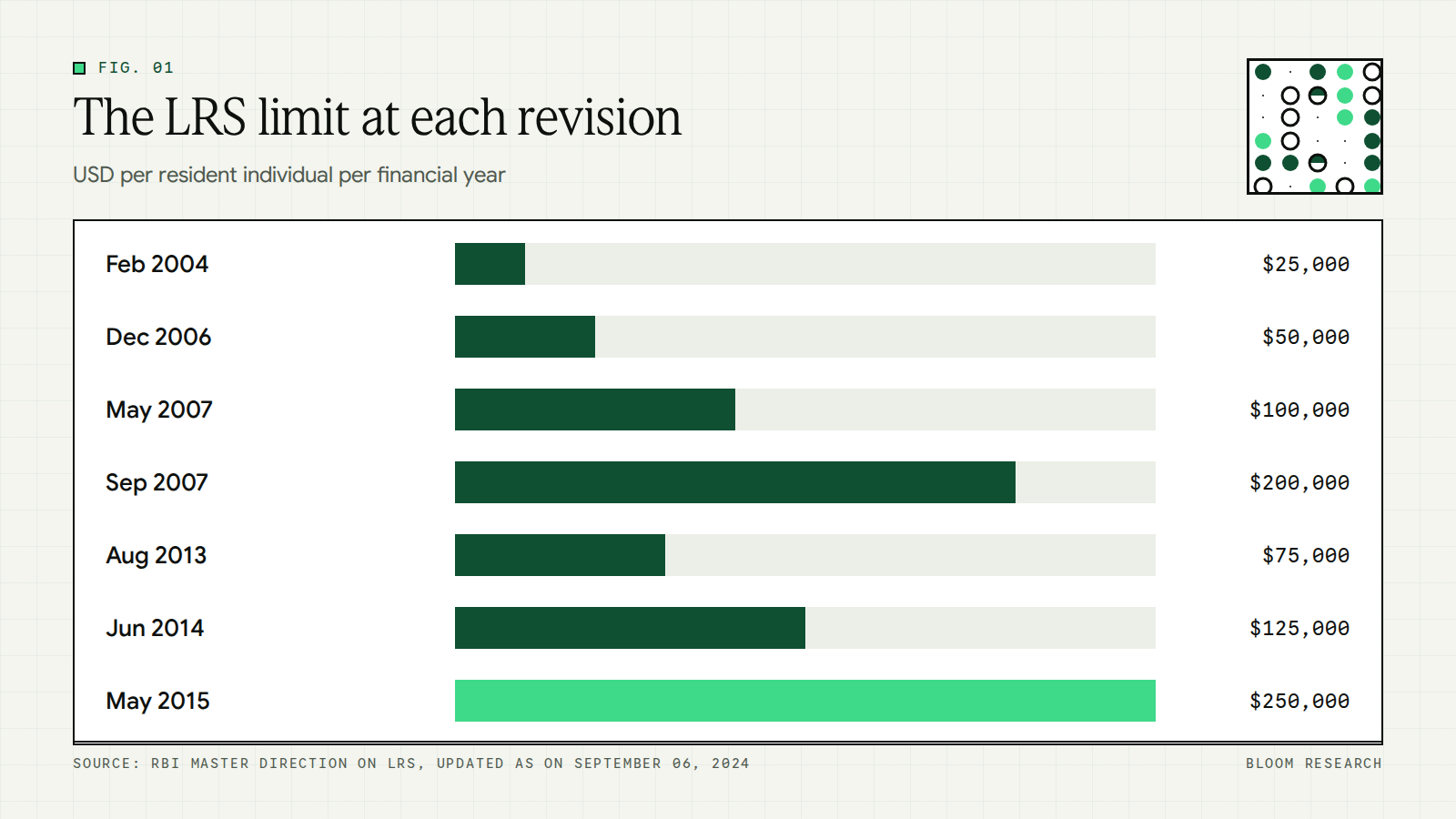
The RBI's Master Direction on the Liberalised Remittance Scheme, updated as on September 06, 2024, states that the scheme was introduced on February 4, 2004 with a limit of USD 25,000. The RBI has revised the limit in stages since then, in line with prevailing macro and micro economic conditions. The Master Direction lists each revision.
| Date of revision | LRS limit per financial year |
|---|---|
| February 4, 2004 | USD 25,000 |
| December 20, 2006 | USD 50,000 |
| May 8, 2007 | USD 100,000 |
| September 26, 2007 | USD 200,000 |
| August 14, 2013 | USD 75,000 |
| June 3, 2014 | USD 125,000 |
| May 26, 2015 | USD 250,000 |
The 2013 revision was a cut, from USD 200,000 to USD 75,000, before the limit was raised again in 2014 and 2015. It has stayed at USD 250,000 since the May 26, 2015 revision.
The Master Direction is where the RBI consolidates its instructions on the scheme to banks and other authorized persons. The RBI states that it issues any change to the regulations, or to how banks handle these transactions, through A.P. (DIR Series) circulars, and amends the Master Direction at the same time. When you check the current rules, the date at the top of the Master Direction shows the last update.
Who can use LRS
The RBI's FAQ on the Liberalised Remittance Scheme, updated as on April 06, 2023, states that all resident individuals, including minors, can use the scheme. If the remitter is a minor, the LRS declaration form must be countersigned by the minor's natural guardian. The scheme is not available to corporates, partnership firms, HUFs or trusts.
Residence under LRS follows Section 2(v) of FEMA, which covers a person residing in India for more than one hundred and eighty-two days during the course of the preceding financial year. The definition excludes people who have gone abroad for employment, business or other purposes that indicate an intention to stay outside India, and the RBI FAQ reproduces it in full.
Definition: An authorized dealer (AD) bank is a bank that the RBI authorizes to deal in foreign exchange. Under LRS you send money through an AD bank, and the bank checks your documents and declaration before it releases the remittance.
#The LRS limit of USD 250,000 per financial year
The LRS limit is USD 250,000 per financial year, and the RBI defines that financial year as April to March. The RBI FAQ states that resident individuals can remit this amount for any permissible current or capital account transaction, or a combination of both.
The limit applies to each resident individual across all sources in India, whatever the purpose. Buying US shares, paying for a trip abroad and sending a gift to a relative abroad all draw on the same USD 250,000.
How the LRS limit is counted
The RBI sets no restriction on how often you remit under LRS. The FAQ states that the total foreign exchange purchased from or remitted through all sources in India during a financial year should be within the cumulative limit of USD 250,000. It also states that once a resident individual has remitted up to USD 250,000 in a financial year, no further remittances are allowed under the scheme that year. This holds even if the proceeds of the investments have been brought back into the country.
The Master Direction states that the USD 250,000 limit also includes remittances for current account purposes. These are private visits, gifts and donations, going abroad for employment, emigration, maintenance of relatives abroad, business trips, medical treatment abroad and studies abroad. Release of foreign exchange above USD 250,000 requires prior permission from the RBI.
Family members can consolidate remittances only on stated terms. The FAQ states that remittances can be consolidated for family members if each member complies with the scheme's terms. Clubbing is not permitted for capital account transactions such as opening a bank account and investment, unless the family members are co-owners or co-partners of the investment. A sole proprietor has one limit: the RBI states that an individual who remits USD 250,000 in a financial year cannot remit another USD 250,000 as owner of a sole proprietorship. Remittances can be made in any freely convertible foreign currency, not only in US dollars.
The account rules differ by type of transaction. The RBI FAQ states that the requirement to have held the bank account for at least one year applies to capital account transactions, such as investment. It does not apply to current account transactions such as private visits, because foreign exchange for those visits can also come from FFMCs, which cannot maintain accounts for remitters. Individuals can also open, maintain and hold a foreign currency account with a bank outside India for remittances under the scheme without prior approval from the RBI.
Key point: The LRS limit is one annual ceiling of USD 250,000 per resident individual. Money sent for travel, study, gifts and investment all counts toward it, and proceeds you bring back do not restore it within the same financial year.
#How LRS applies when you buy US stocks
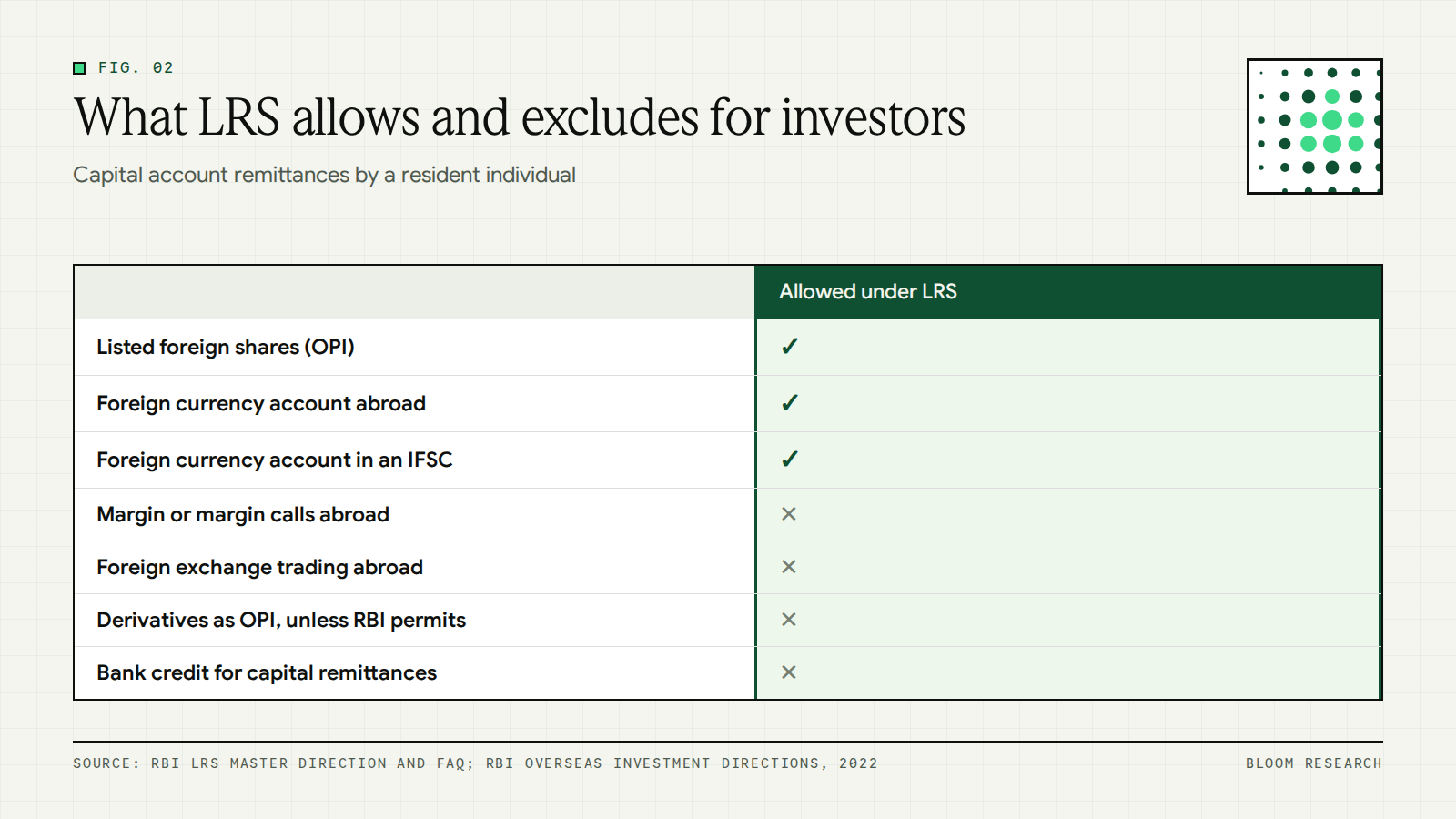
The LRS Master Direction lists the capital account transactions a resident individual can make under the scheme. They are opening a foreign currency account abroad with a bank, acquiring immovable property abroad, overseas direct investment (ODI) and overseas portfolio investment (OPI), and extending loans to non-resident Indian relatives. Property, ODI and OPI must follow the Foreign Exchange Management (Overseas Investment) Rules, 2022, the matching Regulations and the Overseas Investment Directions, 2022.
For a US stock investor, the relevant category is OPI. The rules for it come from the overseas investment framework, and the money for it comes from your LRS limit.
Overseas portfolio investment under the OI Rules 2022
The RBI's Overseas Investment Directions, 2022, issued on August 22, 2022, define both categories. Overseas portfolio investment (OPI) means investment, other than ODI, in foreign securities. Overseas direct investment (ODI) includes any acquisition of unlisted equity capital of a foreign entity and any investment in 10% or more of the paid-up equity capital of a listed foreign entity.
The same Directions state that resident individuals may make OPI within the overall limit for the Liberalised Remittance Scheme, in terms of schedule III of the OI Rules. A listed instrument, in these Directions, means one listed on a recognized stock exchange outside India. The Directions also exclude some instruments from OPI:
- Unlisted debt instruments
- Securities issued by a person resident in India who is not in an IFSC
- Derivatives, unless otherwise permitted by the RBI
- Commodities, including Bullion Depository Receipts
The RBI sets no quality test for what you buy. Its LRS FAQ states that no ratings or guidelines have been prescribed on the quality of the investment an individual can make. The investor is expected to exercise due diligence, and the investment must follow the Overseas Investment Rules and Regulations, 2022. Shares and ETFs listed on US exchanges are the kind of assets our pages on US stocks and US ETFs list.
What the scheme does not allow
The Master Direction states that transactions not otherwise permissible under FEMA, and remittances for margins or margin calls to overseas exchanges or an overseas counterparty, are not allowed under the scheme. The RBI FAQ lists the other exclusions:
- Remittance for any purpose prohibited under Schedule I, or any item restricted under Schedule II, of the Current Account Transactions Rules, 2000
- Remittance for trading in foreign exchange abroad
- Remittances to buy foreign currency convertible bonds (FCCBs) issued by Indian companies in the overseas secondary market
- Capital account remittances to countries that the Financial Action Task Force (FATF) identifies as non-cooperative countries and territories
- Remittances to individuals and entities that the RBI advises banks pose a significant risk of committing acts of terrorism
Credit is also excluded. The Master Direction states that banks should not extend any kind of credit facilities to resident individuals to facilitate capital account remittances under the scheme.
Remittances to GIFT City IFSC
An International Financial Services Centre (IFSC) is a center in India for financial services and products under the International Financial Services Centres Authority Act, 2019, and NSE IFSC is an international exchange set up in the GIFT IFSC. The Master Direction states that authorized persons may facilitate remittances to IFSCs in India for all permissible purposes under LRS, and that resident individuals may open a foreign currency account in an IFSC for those purposes. Resident individuals may not settle domestic transactions with other residents through these accounts.
Coverage of the 2022 launch of NSE IFSC Receipts, republished on the NSE website, states that Indian retail investors can transact on the NSE IFSC platform within the LRS limits prescribed by the RBI. A remittance to GIFT City is still an LRS remittance.
#Documents and steps for an LRS remittance
The RBI's Master Direction and FAQ set out what a remitter provides and what the bank checks for an LRS remittance to invest abroad:
- Permanent Account Number (PAN): the RBI states that providing a PAN is mandatory for all transactions under the scheme.
- A designated branch: you designate one branch of an AD bank through which all your capital account remittances under the scheme are made.
- Account age: for capital account transactions, the RBI states that applicants should have maintained the bank account for at least one year before the remittance.
- New customers: if you are new to the bank, it carries out due diligence on the account and obtains your previous year's bank statement, or, if that is not available, your latest Income Tax Assessment Order or Return.
- Form A2: you state the purpose of the remittance and declare that the funds belong to you and will not be used for purposes prohibited or regulated under the scheme.
- KYC and anti-money laundering checks: the bank applies Know Your Customer (KYC) guidelines to your account and complies with the Anti-Money Laundering Rules.
- Your own funds: the bank ensures that payment comes from funds belonging to you. It can be a check drawn on your account, a debit to your account, a demand draft or pay order, or a credit, debit or prepaid card.
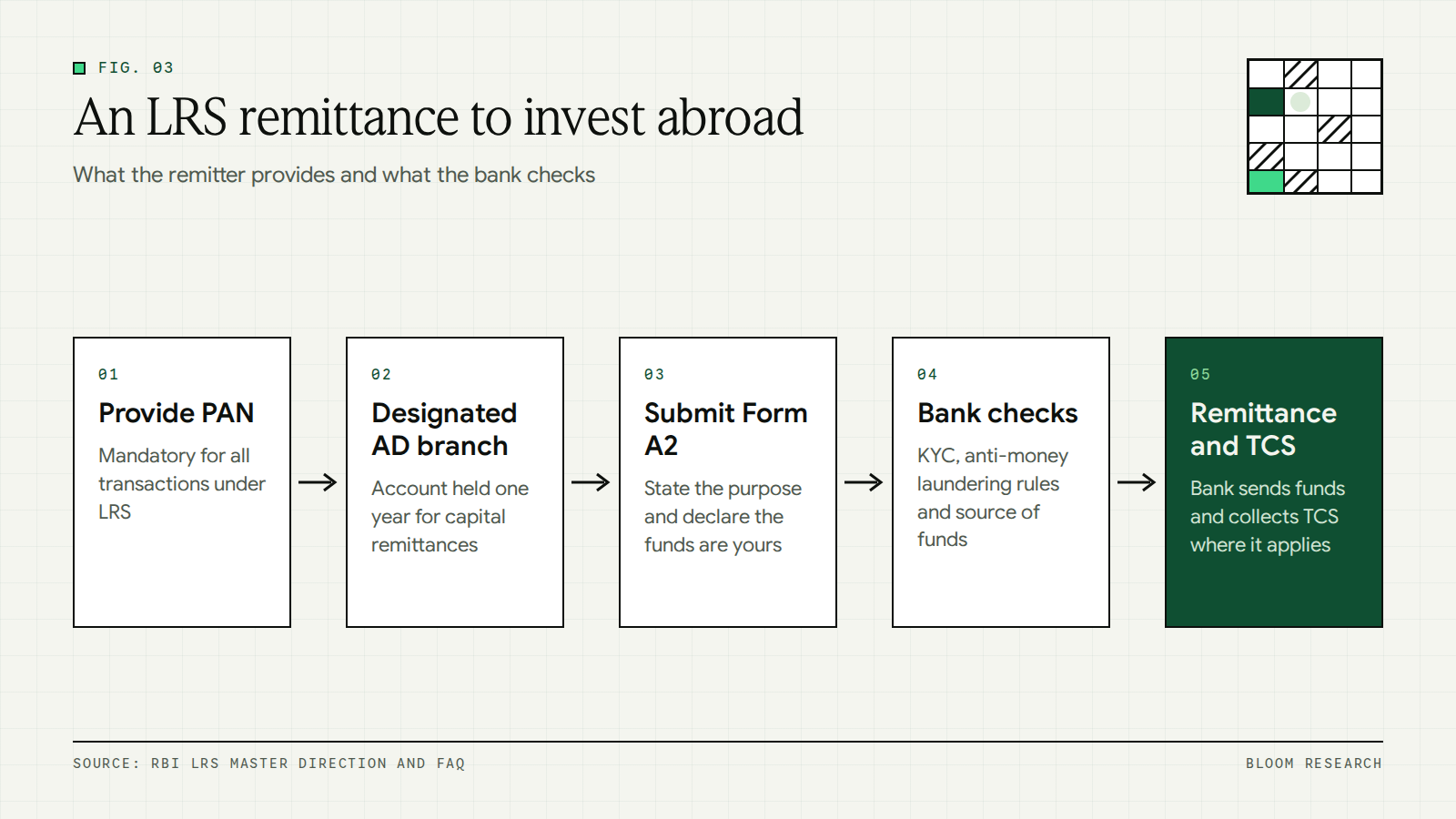
Form A2 is the application and declaration a resident individual gives an AD bank to buy foreign exchange under LRS. The RBI FAQ states that the bank is guided by the nature of the transaction as you declare it in Form A2, and then certifies that the remittance conforms to RBI instructions.
Important: The RBI states that the ultimate responsibility for compliance with FEMA rules and regulations rests with the remitter. Your bank relies on the purpose you declare in Form A2, and the declaration states that the funds will not be used for purposes prohibited or regulated under the scheme.
Keeping and bringing back investment proceeds
The RBI allows an investor who remitted funds under LRS to retain and reinvest the income earned on those investments. Received, realized, unspent or unused foreign exchange that is not reinvested must be repatriated and surrendered to an authorized person within 180 days of receipt, realization, purchase, acquisition or return to India, as applicable. The FAQ adds that any further repatriation requirement under the Overseas Investment Rules and Regulations, 2022 also applies.
Reporting follows the same framework. The Overseas Investment Directions state that a resident individual making overseas investment must comply with the reporting requirements in the OI Regulations, and that reporting is also done under LRS where the investment counts toward the LRS limit. Ask your bank which forms apply to the investments you make.
#TCS on foreign remittance under LRS in 2026
Tax collected at source (TCS) is tax that your bank collects from you when it processes a remittance under LRS. HDFC Bank's notice states that TCS on foreign exchange transactions under LRS was introduced by the Finance Act 2020. Standard Chartered's notice on the amendment in TCS states that the Finance Act, 2026, read with the Income Tax Act, 2025, amended Section 506 of the Income Tax Act, 2025, with effect from April 1, 2026. The notice states that Section 506 corresponds to section 206C(1G) of the Income Tax Act, 1961.
The Union Budget 2026-27 summary lists a cut in the TCS rate to 2%, from 5%, for LRS remittances for education and medical treatment. HDFC Bank's notice on the revision in TCS on LRS transactions sets out the rates it applies from April 1, 2026 for a normal PAN:
| Purpose of remittance under LRS | TCS from April 1, 2026 (HDFC Bank, normal PAN) |
|---|---|
| Education, funded by a loan from a specified institution | Nil |
| Education (other) or medical treatment | Nil up to ₹10 lakh; 2% above ₹10 lakh |
| Any other purpose under LRS | Nil up to ₹10 lakh; 20% above ₹10 lakh |
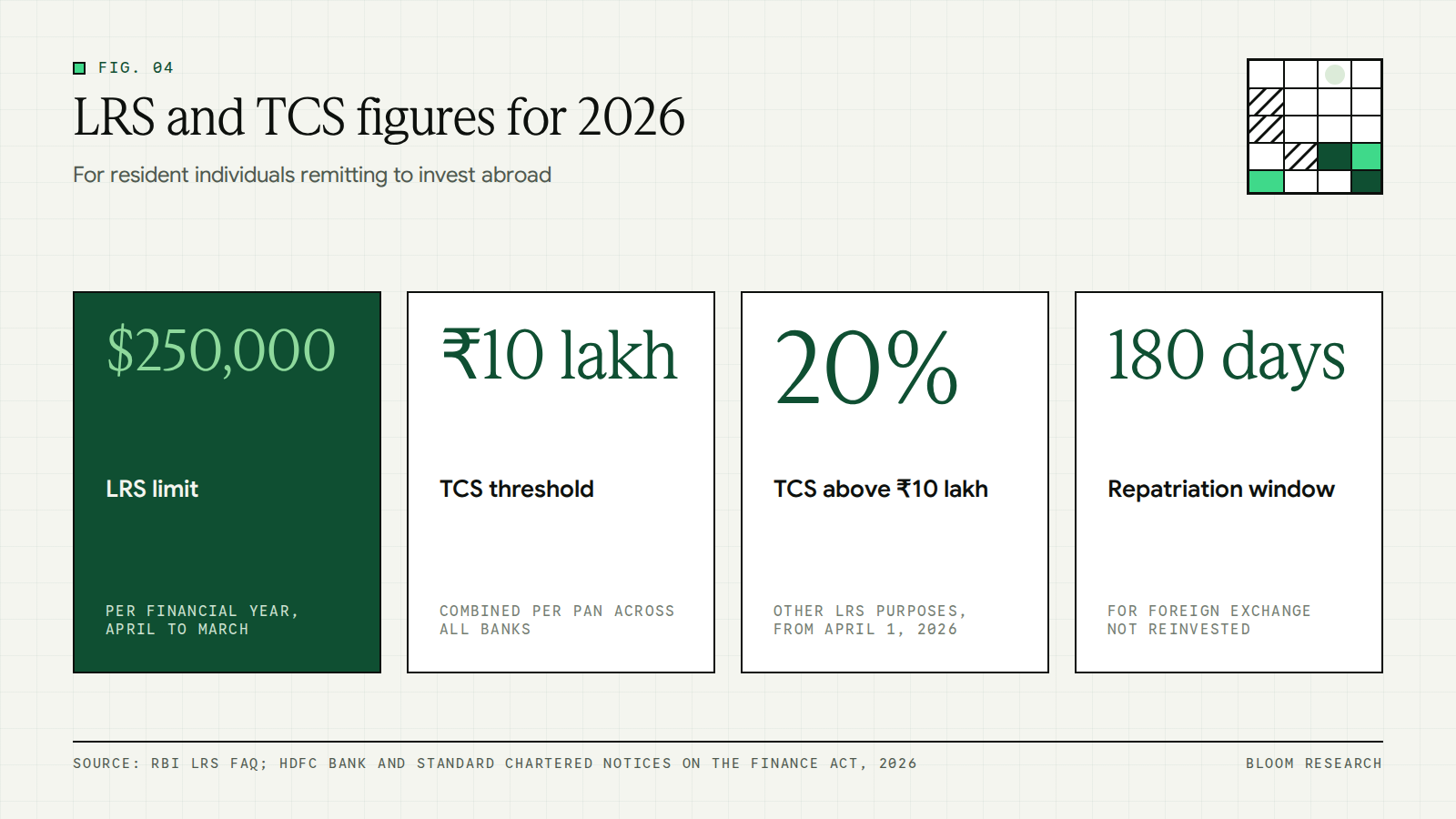
Standard Chartered's table shows other LRS purposes at nil up to ₹10 lakhs and 20% above ₹10 lakhs, both before and after April 1, 2026. Neither bank's table has a separate line for investing, so a remittance to buy shares abroad falls under the other purposes line.
How the ₹10 lakh threshold is counted
HDFC Bank states that the ₹10 lakh threshold per financial year is a combined limit per PAN on all categories of LRS remittance, through all modes of payment and across all authorized dealers, regardless of the purpose. Its notice adds that the threshold covers remittances and foreign exchange drawn under LRS across all authorized dealers and RBI-licensed authorized persons.
An inoperative PAN is a PAN that has stopped working because it was not linked with Aadhaar. HDFC Bank's notice explains that under Section 262 of the Income-tax Act, 2025, a person who has been allotted a PAN and is eligible for an Aadhaar number must link the two. If they are not linked, the PAN becomes inoperative. Standard Chartered's notice states that a higher rate of TCS applies if PAN and Aadhaar are not linked.
Claiming TCS credit in your return
Standard Chartered's notice states that the TCS amount is recovered from your account and that quarterly certificates for the TCS collected are sent to your registered email ID or mailing address. It states that credit for the TCS amount can be claimed while filing the return of income. It also states that TCS, once collected, cannot be refunded by the bank if the transaction or remittance is returned.
Note: The rates and rules in this section are those that HDFC Bank and Standard Chartered publish for the Finance Act, 2026, effective April 1, 2026. They are general information, not tax advice. Confirm the TCS that applies to your remittance with your bank and a qualified Indian tax adviser.
#Tax and reporting on US stocks bought under LRS
TCS is collected when money leaves India. Tax on the gains and income from your investments, and the reporting of the foreign assets you hold, are separate obligations under Indian tax law.
The Income Tax Department's guidance on tax on long-term capital gains sets a 12.5% rate for long-term capital gains on transfers on or after July 23, 2024. The same page sets the holding period for long-term treatment at 12 months for shares listed on a recognized stock exchange in India and 24 months for unlisted shares. That page describes the Income-tax Act, 1961, and the Union Budget 2026-27 summary notes that the new Income-tax Act, 2025 comes into effect from April 2026. Ask a qualified tax adviser how the current rules apply to shares listed on a US exchange.
Schedule FA is the part of the income tax return where a resident taxpayer reports foreign assets, and Schedule FSI is where foreign-source income is reported. The Central Board of Direct Taxes (CBDT) has stated that compliance with Schedule FA and FSI is mandatory under the Black Money Act, 2015, which requires full disclosure of foreign assets and income.
Form W-8BEN is the IRS certificate a non-US individual gives to a withholding agent or payer when the individual is the beneficial owner of an amount subject to withholding. Our W-8BEN form guide explains how to fill in Parts I to III and how long the form stays valid.
#LRS and tokenized US stocks on Bloom
A tokenized stock is an on-chain token that represents a real share. On Bloom, each asset is an on-chain token backed 1:1 by a real share held in custody at a regulated US broker-dealer such as Alpaca Markets or Interactive Brokers. The token is held in your own wallet, and the minimum trade is $1. Our documentation on how tokenized stocks work on Bloom sets out the details.
Funding from India generally starts with a stablecoin. USDC is a US-dollar stablecoin whose value tracks the dollar. As our India country page states, investors in India generally convert rupees into USDC through a locally operating exchange that supports on-chain withdrawals, then move it to a self-custody wallet under their own keys. Our overview of the crypto assets you can fund with lists USDC and the other options.
The Income Tax Department's page on taxation of virtual digital assets states that income from the transfer of virtual digital assets (VDAs) is taxed at a flat 30% plus surcharge and cess. No deduction is allowed except the cost of acquisition. Because we settle in USD stablecoins, you hold INR to USD exchange-rate exposure in addition to the price movement of the stock, and the treatment of tokenized securities can differ from that of directly held shares.
On Bloom: We do not state that any route, including stablecoin funding and tokenized stocks, falls outside LRS, TCS, KYC, income tax or Schedule FA. These are your obligations as a resident of India, and nothing on Bloom changes them. Confirm how they apply to each step you take with your bank and a qualified adviser.
Vested and INDmoney fund INR accounts under LRS and hold US shares through US broker-dealers. Our comparison of Vested vs INDmoney vs Bloom sets out their custody, KYC, LRS funding, fees and withdrawal times beside our tokens.
All investing carries risk, including the loss of principal. Market risk, smart contract risk, custody risk, bridging risk and liquidity risk apply to tokenized stocks, and our risk disclosure explains each one. We are in public beta. Our service is not available in the United States or in other restricted jurisdictions, and you must be 18 or older to use Bloom. The service availability page explains regional gating, and our legal terms set out the full conditions.
#Checking your LRS position before you invest
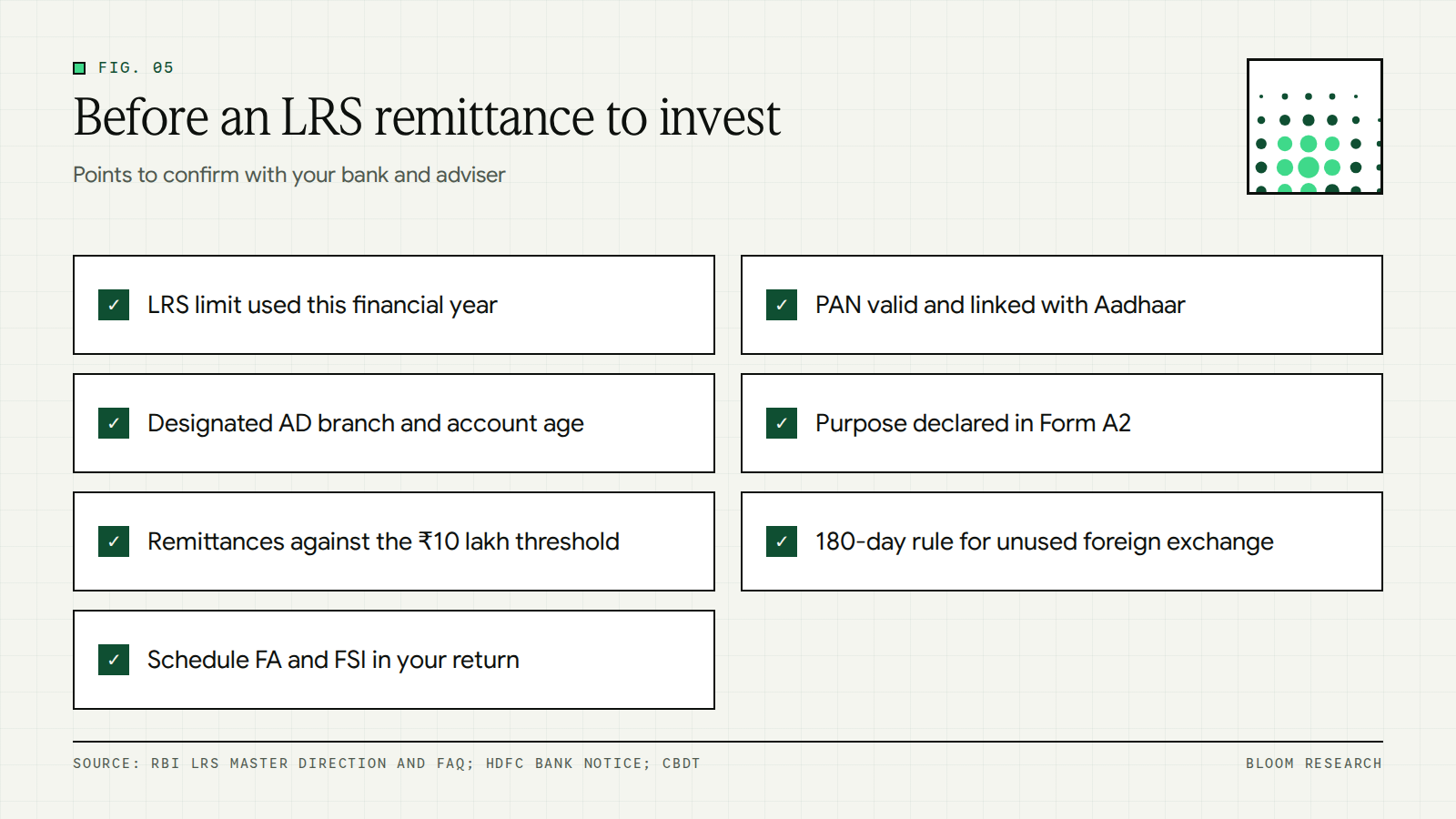
The RBI and the banks place several checks on each LRS remittance, and the responsibility for compliance rests with you as the remitter. These are the points to confirm with your bank and adviser before you send money abroad to invest:
- How much of your USD 250,000 LRS limit you have used this financial year, across all sources in India
- That your PAN is valid and linked with Aadhaar
- Your designated AD branch, and whether your account meets the one-year rule for capital account remittances
- The purpose you will declare in Form A2
- Your LRS remittances this financial year across all banks, measured against the ₹10 lakh TCS threshold
- The 180-day rule for foreign exchange you receive and do not reinvest
- Schedule FA and Schedule FSI reporting in your next income tax return
To see the US stocks and ETFs available on Bloom, visit our overview of investing in US stocks on Bloom. Our country guides list the markets we serve.
Frequently asked questions
What is the LRS limit for FY 2026-27?
The RBI's Liberalised Remittance Scheme allows each resident individual to remit up to USD 250,000 per financial year, which runs from April to March. The RBI has kept the limit at USD 250,000 since its revision on May 26, 2015. The limit covers permissible current and capital account transactions combined, so travel, studies, gifts and investments abroad all count toward the same USD 250,000.
Who is eligible for LRS?
The RBI states that all resident individuals, including minors, can use the Liberalised Remittance Scheme. For a minor, the declaration form must be countersigned by the minor's natural guardian. The scheme is not available to corporates, partnership firms, HUFs or trusts. Residence follows the definition of a person resident in India in Section 2(v) of the Foreign Exchange Management Act, 1999.
When was the Liberalised Remittance Scheme introduced?
The RBI's Master Direction on the Liberalised Remittance Scheme states that the scheme was introduced on February 4, 2004, with a limit of USD 25,000. The RBI has revised the limit in stages since then, most recently to USD 250,000 on May 26, 2015, where it has remained.
What is the difference between LRS and non-LRS remittances?
LRS remittances are those a resident individual makes under the USD 250,000 annual limit, and they include overseas portfolio investment. The RBI's LRS Master Direction describes some remittances as outside LRS: when an entity deputes an employee on a business trip and bears the expenses, those are residual current account transactions outside LRS. The RBI FAQ states that an LLP sponsoring its partners' education abroad is outside the partners' LRS limit.
Can I buy US stocks under the Liberalised Remittance Scheme?
Yes. The RBI's LRS Master Direction lists overseas portfolio investment among the capital account transactions a resident individual can make under LRS, in line with the Overseas Investment Rules, Regulations and Directions, 2022. The RBI's Overseas Investment Directions state that resident individuals may make overseas portfolio investment within the overall LRS limit. Remittances for margins or margin calls to overseas exchanges are not allowed.
How much is TCS on foreign remittance for investing?
HDFC Bank's notice lists TCS from April 1, 2026 for any other purpose under LRS at nil up to ₹10 lakh and 20% above ₹10 lakh, and Standard Chartered's notice shows the same rates for other LRS purposes. Neither table has a separate line for investing. HDFC Bank states that the ₹10 lakh threshold is a combined limit per PAN across all LRS remittances and all authorized dealers in the financial year.
Is TCS on foreign remittance refundable?
Standard Chartered's notice states that TCS is recovered from your account, that quarterly TCS certificates are sent to you, and that credit for the TCS amount can be claimed while filing your return of income. The same notice states that TCS, once collected, cannot be refunded by the bank if the transaction or remittance is returned. Confirm how the credit applies to your return with a qualified tax adviser.
Is PAN mandatory for LRS remittances?
Yes. The RBI's FAQ on the Liberalised Remittance Scheme states that it is mandatory for a resident individual to provide a Permanent Account Number (PAN) for all transactions under LRS made through authorized persons. Standard Chartered's notice on TCS also states that a higher rate of TCS applies if the PAN is inoperative because it is not linked with Aadhaar.