

W-8BEN Form: What It Is and How to Fill It Out in 2026
What the W-8BEN form is, who gives it to a US withholding agent, how to fill Parts I to III line by line, how long it stays valid, and India reporting points.

Key takeaways
- Form W-8BEN is the IRS certificate a non-US individual gives to a withholding agent or payer when the individual is the beneficial owner of an amount subject to withholding, and the form says not to send it to the IRS.
- The current Form W-8BEN is the October 2021 revision (Rev. 10-2021).
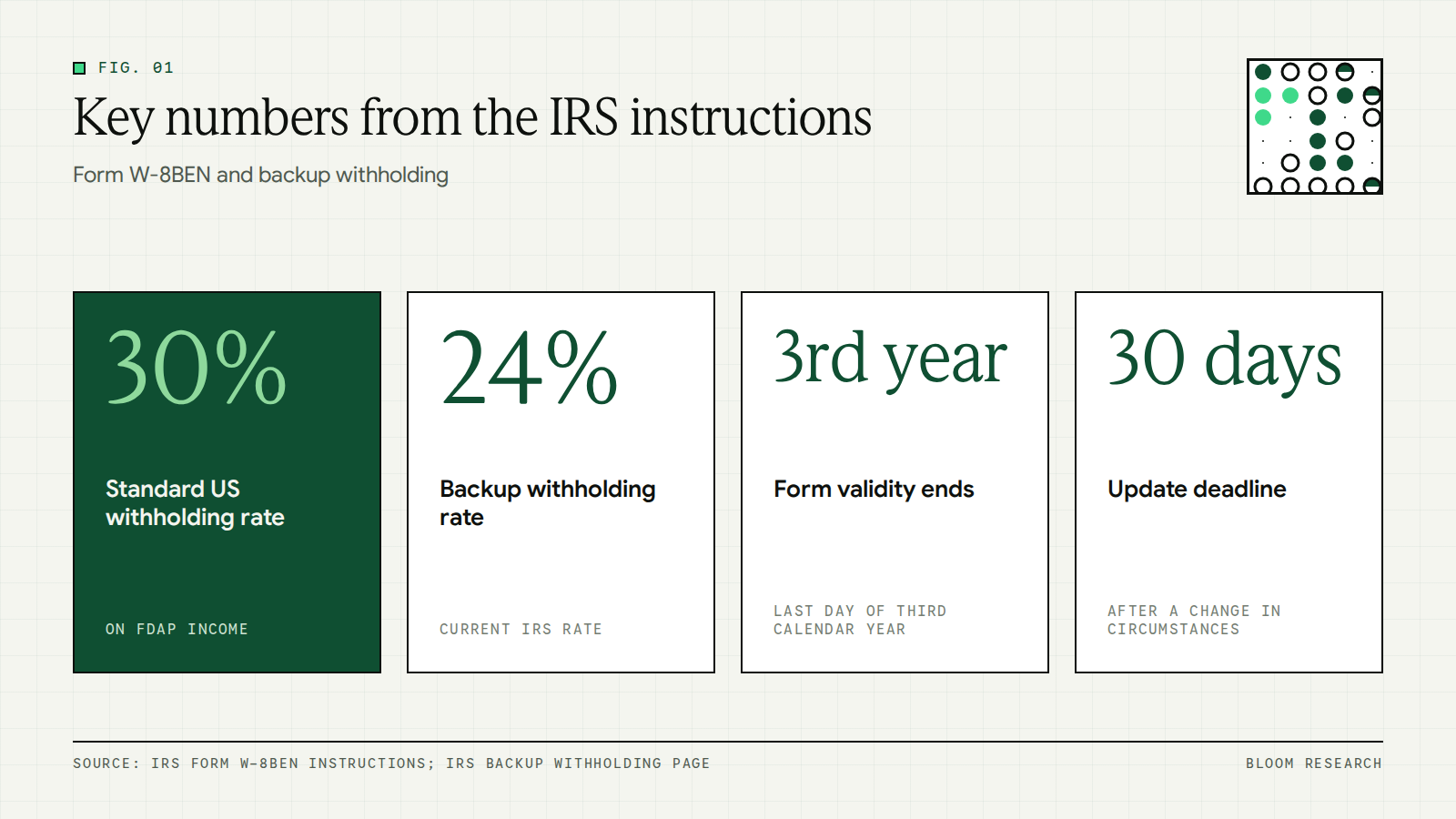
- The IRS says a Form W-8BEN generally remains in effect from the date signed until the last day of the third succeeding calendar year, unless a change in circumstances makes any information on the form incorrect.
- The IRS says failure to provide Form W-8BEN when requested may lead to withholding at the foreign-person rate of 30% or at the backup withholding rate under section 3406.
- For India residents, the Income Tax Department says foreign tax credit under Rule 128 is allowed only if Form 67 is furnished within the specified timelines, and its guide covers Schedules FSI and FA.
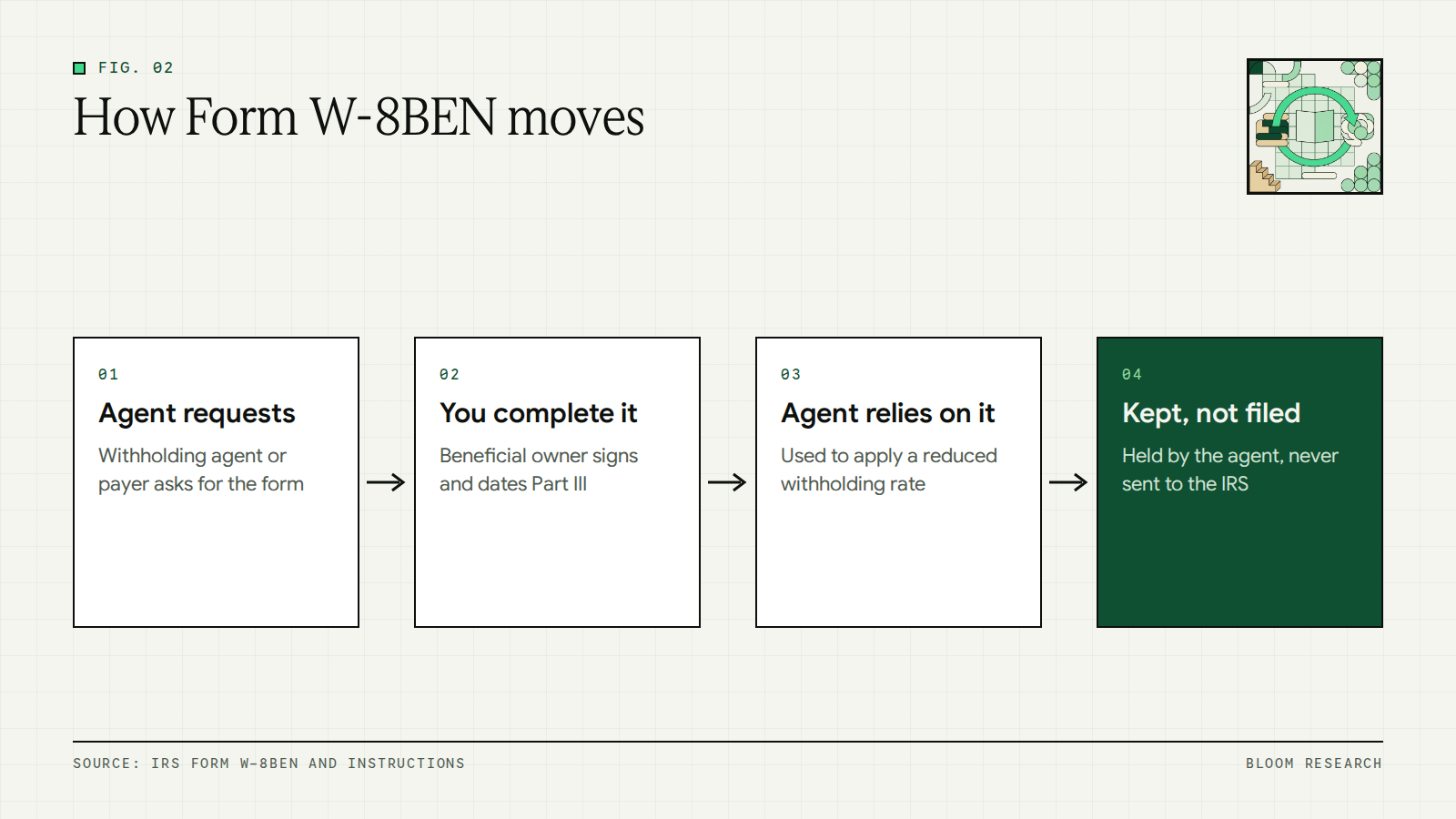
The W-8BEN form is the IRS certificate a non-US individual gives to a withholding agent or payer, such as a US broker, to establish foreign status as the beneficial owner of income. Where the individual is eligible, the same form also claims a reduced rate of withholding under an income tax treaty. The form itself says to give it to the withholding agent or payer and not to send it to the IRS. The IRS says to submit it when requested, whether or not you claim a reduced rate of, or exemption from, withholding.
This guide covers who needs the form, how it differs from Form W-8BEN-E and Form W-9, and each line of Parts I to III. It also covers how long the form stays valid, what the IRS says happens without it, and the India reporting points that the Income Tax Department publishes. We do not provide financial, investment, tax or legal advice, as our disclaimers state, so every rule below is taken from IRS and Income Tax Department publications. We also publish our investor guides to buying tokenized US stocks and ETFs, organized by stock, by country and by the crypto used to pay.
#What is the W-8BEN form?
This section answers what is W8BEN form, using the IRS title, revision and instructions. The official title of Form W-8BEN is Certificate of Foreign Status of Beneficial Owner for United States Tax Withholding and Reporting (Individuals). The current revision is dated October 2021 (Rev. 10-2021), and the IRS About page listed no recent developments when we checked in September 2026. The form is for use by individuals, and the IRS says entities must use Form W-8BEN-E.
The W-8BEN form download (PDF) and its instructions are both linked from the IRS About Form W-8BEN page. The instructions give a general beneficial owner test for payments other than those for which a reduced rate of, or exemption from, withholding is claimed under an income tax treaty. Under that test, the beneficial owner of income is generally the person who is required under U.S. tax principles to include the payment in gross income on a tax return. Under the same test, a person is not the beneficial owner to the extent that person receives the income as a nominee, agent or custodian.
Definition: A withholding agent is any person, U.S. or foreign, that has control, receipt, custody, disposal or payment of U.S.-source FDAP income subject to chapter 3 or 4 withholding, according to the IRS instructions for Form W-8BEN.
What the form certifies
The IRS instructions list three purposes for Form W-8BEN:
- Establish that you are not a U.S. person.
- Claim that you are the beneficial owner of the income for which Form W-8BEN is being provided.
- If applicable, claim a reduced rate of, or exemption from, withholding as a resident of a foreign country with which the United States has an income tax treaty and who is eligible for treaty benefits.
The instructions explain why these statements matter to a payer. Foreign persons are subject to U.S. tax at a 30% rate on income they receive from U.S. sources, such as interest, dividends, rents and royalties. The IRS says this tax is imposed on the gross amount paid and is generally collected by withholding under section 1441.
The form can also be needed for certain income that is not subject to the 30% foreign-person withholding, such as broker proceeds. For that income, the instructions say you may be required to submit Form W-8BEN to claim an exception from domestic information reporting and backup withholding. Backup withholding is tax that a payer is required to withhold from certain payments in specific situations, and the IRS backup withholding page gives the current rate as 24 percent.
The form also works for the payer. The IRS says a withholding agent or payer may rely on a properly completed Form W-8BEN to treat a payment as made to a foreign person who beneficially owns the amounts paid. If applicable, the withholding agent may also rely on the form to apply a reduced rate of, or exemption from, withholding at source.
#Who needs to fill out Form W-8BEN
The IRS rule is stated in the instructions. You must give Form W-8BEN to the withholding agent or payer if you are a nonresident alien who is the beneficial owner of an amount subject to withholding. The same applies if you are an account holder of a foreign financial institution (FFI) documenting yourself as a nonresident alien.
A nonresident alien is any individual who is not a citizen or resident alien of the United States. The IRS treats an alien individual as a resident alien for a calendar year if that person meets either the green card test or the substantial presence test for that year.
The instructions also set the timing and the recipient. You provide Form W-8BEN to the withholding agent or payer before income is paid or credited to you, and you give it to the person requesting it. Generally, a separate Form W-8BEN must be given to each withholding agent.
Joint accounts follow a separate IRS rule. An account with joint owners is treated as foreign-owned only if every owner provides Form W-8BEN or Form W-8BEN-E. If the withholding agent or financial institution receives a Form W-9 from any of the joint owners, the payment must be treated as made to a U.S. person and the account treated as a U.S. account.
W-8BEN rules for Canadian residents
The IRS rules tie Form W-8BEN to tax status, not to nationality. A resident of Canada who is a nonresident alien and the beneficial owner of an amount subject to withholding gives Form W-8BEN when the withholding agent or payer requests it. A Canadian who is also a U.S. citizen, or who is a U.S. resident alien, is a U.S. person, and the IRS instructions direct U.S. persons to use Form W-9 instead.
For treaty rates, IRS Table 1 (Rev. May 2023) lists Canada's general rate on dividends paid by U.S. corporations as 15%. The table prints the general rate in a separate column from the direct dividend rate, which a Table 1 footnote says generally applies to dividends paid by a subsidiary to a foreign parent corporation. The IRS also says its tax treaty tables are not meant to be a complete guide to all provisions of every income tax treaty.
#W-8BEN vs W-8BEN-E vs W-9
The IRS publishes three separate forms for three types of payee. Each form documents a different status, and the table below sets out who uses each one and where it goes.
| Form | Who uses it | What it documents | Where it goes |
|---|---|---|---|
| W-8BEN | Individuals who are not U.S. persons | Foreign status, beneficial ownership and, if applicable, a treaty claim | The withholding agent or payer, not the IRS |
| W-8BEN-E | Foreign entities | Entity status for chapter 3 and chapter 4 purposes | The withholding agent that requests it |
| W-9 | U.S. citizens, including those living outside the United States, and other U.S. persons | The correct taxpayer identification number (TIN) | The person required to file an information return with the IRS |
The instructions also name other forms for specific cases. A person acting as a foreign intermediary, for the account of others as an agent, nominee or custodian, provides Form W-8IMY. A nonresident alien claiming exemption from withholding on compensation for personal services performed in the United States provides Form 8233 or Form W-4. A person receiving income effectively connected with a U.S. trade or business provides Form W-8ECI instead.
Key point: The IRS instructions say a U.S. citizen, even one who resides outside the United States, or any other U.S. person, including a resident alien individual, uses Form W-9 to document U.S. status instead of Form W-8BEN.
#How to fill out Form W-8BEN, line by line
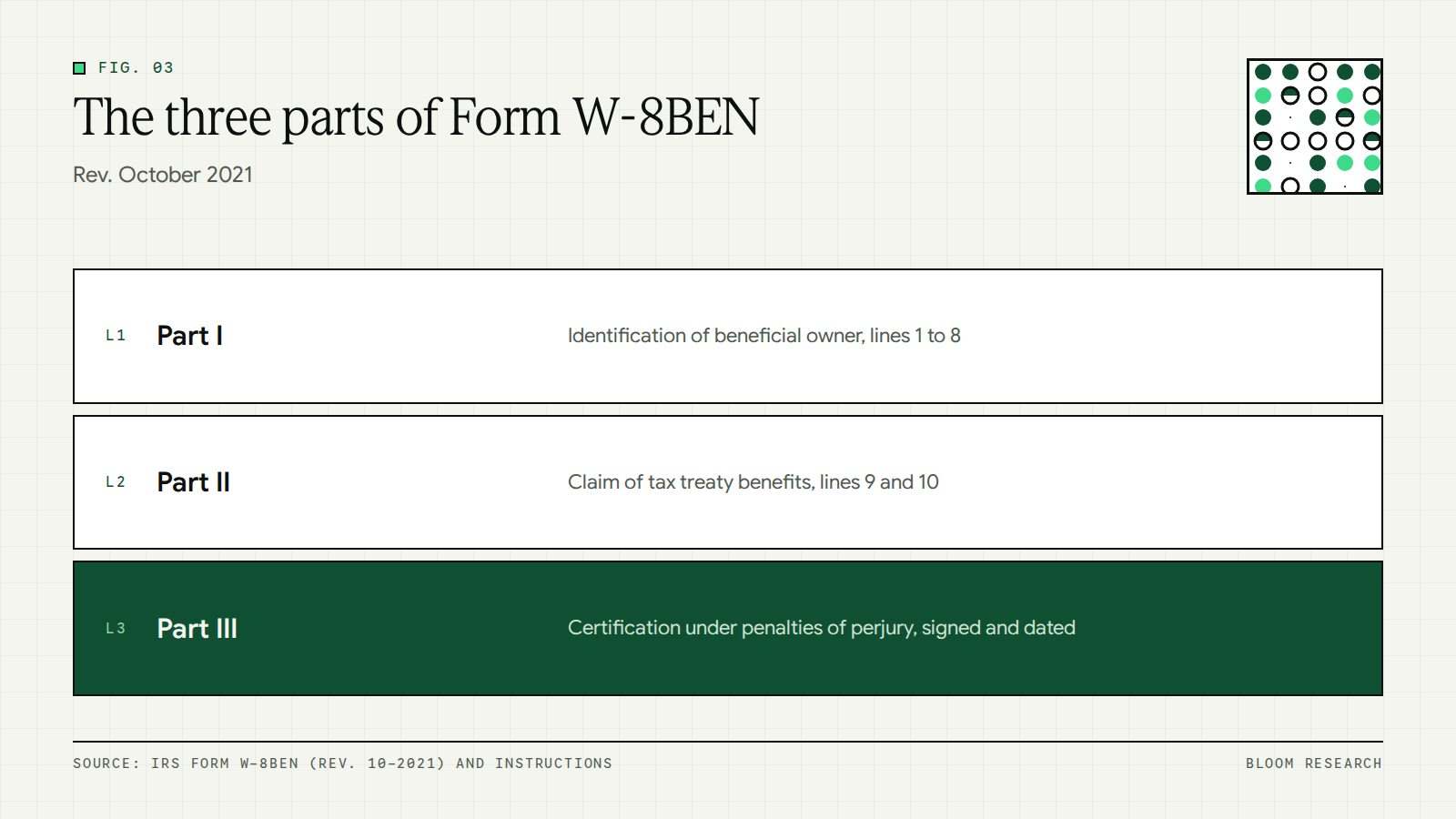
This section answers how to fill W8BEN form, part by part, in the order the IRS prints them. Form W-8BEN has three parts, printed as Part I, Identification of Beneficial Owner; Part II, Claim of Tax Treaty Benefits (for chapter 3 purposes only); and Part III, Certification. A substitute form is a withholding agent's own version of Form W-8, which the IRS allows if its content is substantially similar to the official form and it includes an identical penalties of perjury statement. The line descriptions below follow the W8BEN form IRS instructions for Form W-8BEN.
Part I: identification of beneficial owner (lines 1 to 8)
- Line 1 asks for the name of the individual who is the beneficial owner.
- Line 2 asks for your country of citizenship. A dual citizen enters the country where they are both a citizen and a resident at the time they complete the form.
- Line 3 asks for your permanent residence address, the address in the country where you claim to be a resident for purposes of that country's income tax. The instructions say not to show the address of a financial institution, a post office box, or an address used solely for mailing purposes.
- Line 4 is for a mailing address, entered only if it is different from the address on line 3.
- Line 5 asks for a U.S. taxpayer identification number (SSN or ITIN), if required. An ITIN, or individual taxpayer identification number, is for people who do not have an SSN and are not eligible to get one; it is applied for with Form W-7 and usually takes 4 to 6 weeks. An ITIN is not required to claim treaty benefits on dividends and interest from stocks and debt obligations that are actively traded.
- Line 6a asks for the foreign tax identifying number (FTIN), the tax number issued to you by your jurisdiction of tax residence identified on line 3. An account holder at a U.S. office of a financial institution receiving income reportable on Form 1042-S must provide this number unless an exception applies. Line 6b is a box to check if you are not legally required to obtain an FTIN, including if your jurisdiction does not issue TINs. Without a required FTIN, a checked 6b box or other explanation, the withholding agent must treat the form as invalid for payments reportable on Form 1042-S.
- Line 7 is for reference numbers, such as the number of the account for which the form is provided.
- Line 8 asks for your date of birth in MM-DD-YYYY format.
Part II: claim of tax treaty benefits (lines 9 and 10)
Line 9 identifies the country where you claim to be a resident for income tax treaty purposes. The IRS says its IRS tax treaty tables assist Form W-8BEN filers in determining the rate to claim and the treaty article. It also says the tables are not meant to be a complete guide to all provisions of every income tax treaty.
IRS Table 1 (revised May 2023) lists India's rate on dividends paid by U.S. corporations as 25% in the general column and 15% in the column qualifying for the direct dividend rate, under treaty article 10(2). The direct dividend rate generally applies to dividends paid by a subsidiary to a foreign parent corporation that owns the required percentage of the voting stock, generally 10%.
The India-US treaty of 1989 sets 15 per cent in Article 10(2) where the beneficial owner is a company that owns at least 10 per cent of the voting stock of the payer. In all other cases, the treaty sets 25 per cent. Table 1 lists the United Kingdom's general rate on dividends paid by U.S. corporations as 15%.
We describe the routes resident Indians use to reach US stocks in our guide to investing in US stocks from India.
Line 10 must be used only for treaty benefits that require conditions not covered by line 9 and Part III. The IRS says it is generally not applicable to treaty benefits under an interest or dividends article, other than dividends subject to a preferential rate based on ownership. IRS examples include royalties where the treaty has different rates for different types of royalties, foreign students and researchers, business profits not attributable to a permanent establishment, and remittance provision claims.
Note: These treaty rates are as IRS Table 1 (revised May 2023) and the treaty text publish them. The IRS says the tables are not a complete guide and that you must meet all of the treaty requirements before an item of income can be exempt. They are not a statement of what any reader will pay.
Part III: certification and signature
The certification is made under penalties of perjury that the information on the form is true, correct, and complete. The form must be signed and dated by the beneficial owner or the account holder of a foreign financial institution (FFI), or an agent with legal authority. A withholding agent may allow an electronic signature, but the IRS says typing your name into the signature line is not an electronic signature. By signing, you agree to submit a new form within 30 days if any certification made on the form becomes incorrect.
The IRS says income from transactions with a broker is subject to reporting rules and backup withholding unless Form W-8BEN or a substitute form notifies the broker that you are an exempt foreign person. The IRS conditions for an exempt foreign person in a calendar year are:
- You are a nonresident alien individual or a foreign corporation, partnership, estate, or trust.
- You have not been, and do not plan to be, present in the United States for a total of 183 days or more during the calendar year.
- You are not engaged, and do not plan to be engaged, in a U.S. trade or business that has effectively connected gains from transactions with a broker or barter exchange.
#How long a W-8BEN form stays valid
The IRS says a Form W-8BEN generally remains in effect from the date signed until the last day of the third succeeding calendar year, unless a change in circumstances makes any information on it incorrect. The IRS example: a Form W-8BEN signed on September 30, 2022, generally remains valid through December 31, 2025. Under certain conditions, a Form W-8BEN remains in effect indefinitely until a change of circumstances occurs.
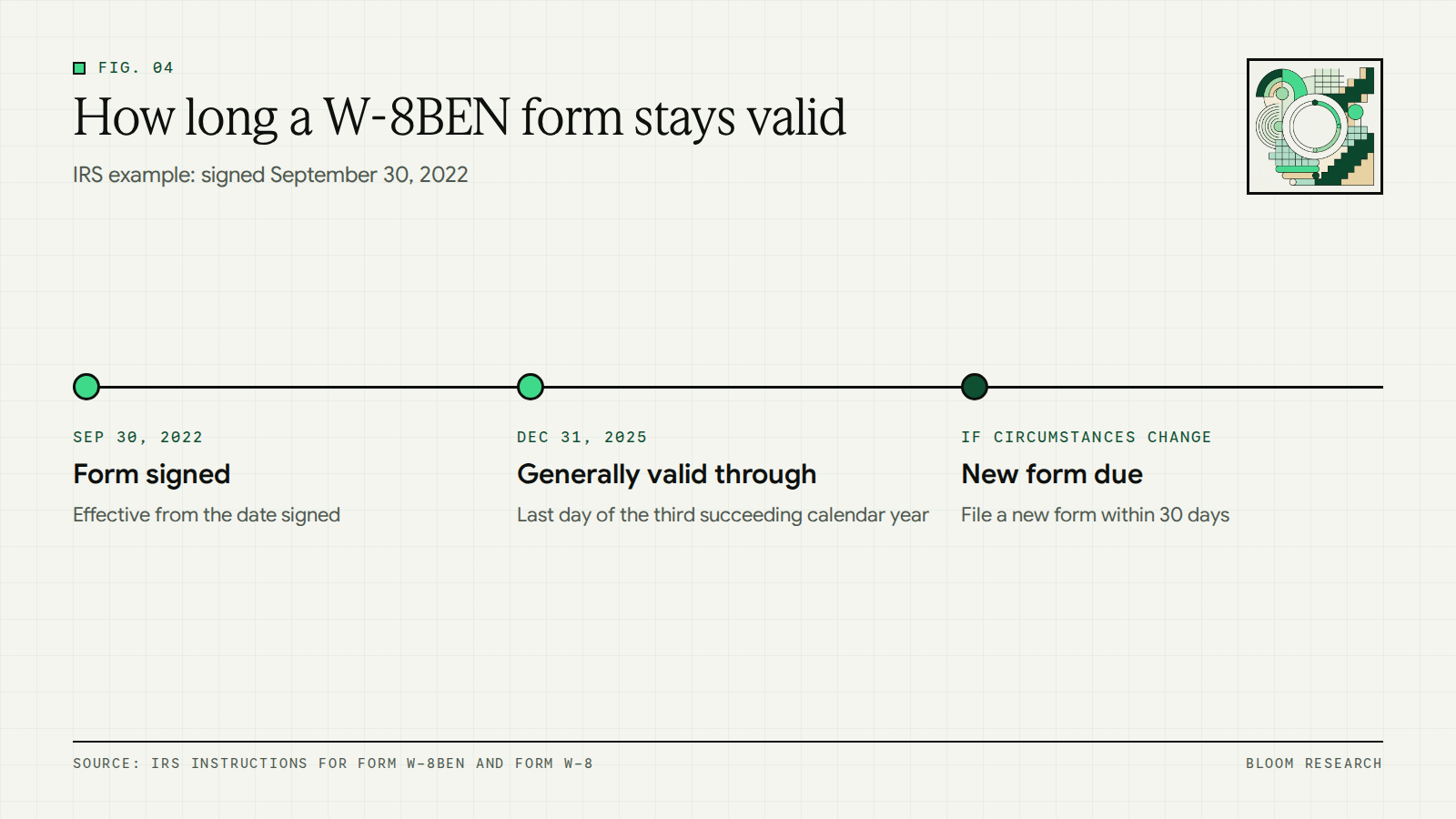
A change in circumstances is a change that makes any information on the Form W-8BEN you submitted incorrect. The IRS says you must then notify the withholding agent, payer, or FFI within 30 days and file a new Form W-8BEN or other appropriate form. A change of address to an address in the United States is a change in circumstances. A move within the same foreign country or to another foreign country generally is not, but for treaty claims a move outside the treaty country is.
The substantial presence test is one of the two IRS tests, with the green card test, that make an alien individual a resident alien for the calendar year. If you satisfy it, the IRS says you must notify the withholding agent, payer, or financial institution within 30 days and provide a Form W-9.
Important: A change in circumstances that makes the form incorrect must be reported to the withholding agent within 30 days, and the form carries an agreement to submit a new form within 30 days.
#What happens if you don't submit a W-8BEN
The IRS instructions say that failure to provide Form W-8BEN when requested may lead to withholding at the foreign-person rate of 30% or the backup withholding rate under section 3406.
Chapter 3 means chapter 3 of the Internal Revenue Code, titled Withholding of Tax on Nonresident Aliens and Foreign Corporations. Chapter 4, known as FATCA, is titled Taxes to Enforce Reporting on Certain Foreign Accounts and contains sections 1471 through 1474.
For chapter 4, the IRS says that failing to give the form to a foreign financial institution (FFI) when requested could result in 30% withholding on U.S.-source income as a recalcitrant account holder. The IRS says a recalcitrant account holder includes an individual who fails to comply with an FFI's requests for documentation and information for determining the U.S. or foreign status of the account, including furnishing this form when requested.
The 30% regime applies to U.S.-source fixed or determinable annual or periodical (FDAP) income, which the IRS defines as all income included in gross income, including interest, dividends, rents, royalties and compensation. The same definition does not include most gains from the sale of property.
NRA withholding is the IRS name for the regime that requires 30% withholding on a payment of U.S.-source income and the filing of Form 1042 and Form 1042-S. The IRS NRA withholding page states that a reduced rate, including exemption, may apply under a Code section or a tax treaty.
Important: The IRS says that if you do not provide this form, the withholding agent may have to withhold at the 30% rate under chapters 3 and 4, the backup withholding rate, or the rate under section 1446.
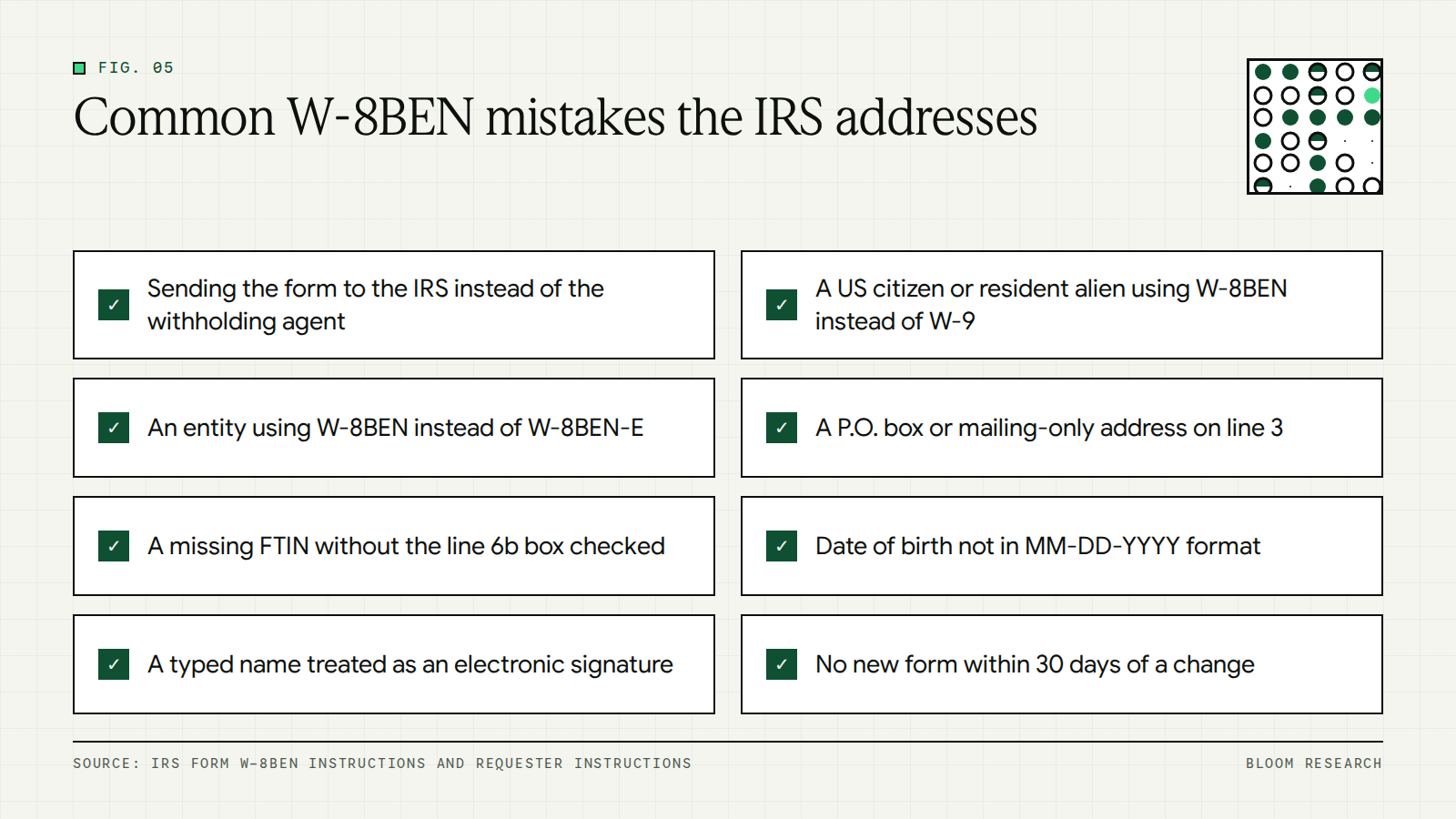
#Common W-8BEN mistakes the IRS instructions address
Each item below is a point that the W-8BEN form or its IRS instructions state directly.
- Sending the form to the IRS: the form says to give it to the withholding agent or payer, not the IRS.
- Using W-8BEN as a U.S. person: a U.S. citizen, even one living outside the United States, or a resident alien uses Form W-9 instead.
- Using W-8BEN as an entity: the form is for individuals, and entities must use Form W-8BEN-E.
- Entering the wrong line 3 address: the IRS says not to show a financial institution's address, a post office box, or an address used solely for mailing.
- Leaving out a required FTIN: without an FTIN on line 6a when required, a checked line 6b box, or an explanation, the withholding agent must treat the form as invalid for payments reportable on Form 1042-S.
- Writing the date of birth in another format: line 8 uses the MM-DD-YYYY format.
- Treating a typed name as a signature: the IRS says that typing your name alone into the signature line is not an electronic signature.
- Missing the 30-day update: after a change in circumstances makes information incorrect, you must notify the withholding agent, payer or FFI within 30 days and file a new form.
#W-8BEN for Indian residents: reporting points in India
For readers searching w8ben form India, the three parts of the form are covered above, and this section covers the Indian reporting points. The W-8BEN deals with U.S. withholding. Indian residents also have reporting steps in their Indian return, set out here only as the Income Tax Department publishes them. The Income Tax Department pages cited here refer to the Income Tax Rules, 1962, and the Income-tax Act, 2025 comes into effect from April 2026.
The Liberalised Remittance Scheme (LRS) is the RBI scheme under which resident individuals, including minors, can remit up to USD 250,000 per financial year (April to March). The RBI LRS FAQ states that the limit covers permissible current or capital account transactions, and that capital account transactions include investment. Our India country guide covers funding rails, currency notes and popular assets for investors in India.
The Income Tax Department notes that in FATCA data, the tax identification number for an individual in India is the PAN. It also states that under the CRS and FATCA schema, India receives detailed information about financial accounts its residents hold in foreign jurisdictions.
Foreign tax credit and Form 67
Form 67 is the form in which a taxpayer furnishes the required particulars of foreign tax paid to claim credit for it. The Income Tax Department Form 67 user manual states that under Rule 128 of the Income Tax Rules, 1962, a resident taxpayer is eligible to claim credit for foreign tax paid. The manual adds that the credit is allowed only if the taxpayer furnishes Form 67 within the specified timelines.
Form 67 can only be submitted online on the e-Filing portal. The Income Tax Department FAQ states that it should be filed before the due date of filing the return under section 139(1). The taxpayer attaches a copy of the certificate or statement and proof of payment or deduction of foreign tax. The same FAQ states that a CA certificate is not mandatory.
Schedule FSI and Schedule FA
The Income Tax Department guide states that Schedule FSI, the foreign source income schedule, applies to residents, who must report all income that accrues or arises from sources outside India. The guide says that details of foreign tax credit and income must be reported in Form 67 to claim the credit in India. Schedule FSI asks for the TIN in the country where tax has been paid, or the passport number if that country has not allotted a TIN.
Schedule FA is the schedule for foreign assets and accounts held at any time during the calendar year ending December 31. For Assessment Year 2025-26, the guide states that this calendar year ran from January 1, 2024 to December 31, 2024. Table A3 covers foreign equity and debt interest, including initial value, peak value, closing value, gross amounts paid or credited, and sale proceeds. Values are converted to rupees using the SBI telegraphic transfer buying rate on the relevant date.
The guide states that Schedule FA need not be completed by a taxpayer classified as not ordinarily resident or non-resident. It also states that taxpayers with any foreign assets or income should not file using ITR-1 or ITR-4, as these forms lack the schedules for foreign disclosures.
Why it matters: The CBDT compliance campaign release states that accurate Schedule FA and FSI reporting is mandatory under the Black Money (Undisclosed Foreign Income and Assets) and Imposition of Tax Act, 2015.
#Where Bloom fits: records, not tax advice
On Bloom: We do not provide financial, investment, tax or legal advice, and we do not file taxes on your behalf. From Portfolio, you can export a complete CSV of every trade and transaction for your records.
The Bloom FAQ states that we do not provide tax advice, that you are responsible for tax obligations in your jurisdiction, and that we provide a complete CSV export of every trade and transaction. Every Bloom trade receipt also ends with a line to consult your tax advisor about the treatment of that transaction in your jurisdiction.
The Bloom Portfolio documentation shows a top-right menu with CSV export, PDF export and print, and the CSV lists every trade, transaction and fee.
NAV, or net asset value, is the on-chain value of a tokenized asset, reflecting price, accrued dividends and corporate actions. Our page on how dividends and corporate actions are reflected states that they are reflected in the token's on-chain NAV rather than as separate cash distributions to your wallet.
Our tokenized US stock guides include a company profile, the risks, where each stock is available and how to pay. The tokenized ETF guides cover S&P 500 and total-market index funds, sector funds, bonds, international markets and gold. We also publish guides to paying with USDC, USDT and other crypto and country guides with funding rails, currency and popular stocks for each country.
Trading carries risk, including the loss of principal, as our risk disclosure sets out. We do not offer our product or services to users in the United States or in other restricted jurisdictions, as our service availability page states. The Bloom India country guide covers the local funding and currency points, and the tokenized US stocks and ETFs available on Bloom are listed on our markets page.
Frequently asked questions
What is the W-8BEN form for?
The IRS instructions say Form W-8BEN establishes that you are not a U.S. person, claims that you are the beneficial owner of the income, and, if applicable, claims a reduced rate of, or exemption from, withholding as a resident of a treaty country. You give it to the withholding agent or payer if you are a foreign person and the beneficial owner of an amount subject to withholding. The form says not to send it to the IRS.
How do I fill out the W-8BEN form in India?
Part I, lines 1 to 8, identifies you. On line 3, the IRS asks for your permanent residence address in the country where you claim residence for income tax, and not a post office box or a mailing-only address. Line 6a asks for the foreign tax identifying number issued by that jurisdiction, and the Income Tax Department describes the TIN for India in FATCA data as the PAN. Line 9 names the treaty country, and Part III is signed and dated.
What happens if I don't submit a W-8BEN?
The IRS says failure to provide Form W-8BEN when requested may lead to withholding at the foreign-person rate of 30% or at the backup withholding rate under section 3406. Without the form, the withholding agent may have to withhold at the 30% rate under chapters 3 and 4, the backup withholding rate, or the rate under section 1446. Under chapter 4, failing to give the form to an FFI when requested could result in 30% withholding as a recalcitrant account holder.
Do Canadians need to fill out W-8BEN?
The IRS rules depend on tax status, not nationality. You must give Form W-8BEN to the withholding agent or payer if you are a nonresident alien who is the beneficial owner of an amount subject to withholding, which can include a resident of Canada. A U.S. citizen, even one who resides outside the United States, or another U.S. person, including a resident alien, uses Form W-9 instead.
How long is a W-8BEN form valid?
The IRS says a Form W-8BEN generally remains in effect from the date it is signed until the last day of the third succeeding calendar year, unless a change in circumstances makes any information on the form incorrect. The IRS example: a form signed on September 30, 2015, remains valid through December 31, 2018. After a change in circumstances, you must notify the withholding agent, payer or FFI within 30 days and file a new form.
What is the difference between W-8BEN and W-8BEN-E?
Form W-8BEN is for use by individuals, and the form says entities must use Form W-8BEN-E. The IRS says Form W-8BEN-E is used by foreign entities to document their status for purposes of chapter 3 and chapter 4, as well as other code provisions. An individual who is not a U.S. person uses Form W-8BEN, and a foreign company or other foreign entity uses Form W-8BEN-E.
Do I send Form W-8BEN to the IRS?
No. The form says to give it to the withholding agent or payer and not to send it to the IRS. The IRS instructions say to give it to the person requesting it, generally before the payment is made to you or credited to your account. Generally, a separate Form W-8BEN must be given to each withholding agent.