
Vested vs INDmoney vs Bloom: US Investing Apps Compared
Vested vs INDmoney vs Bloom in 2026: US broker and custody, SIPC, IFSCA status, KYC, LRS funding, published fees, minimums and withdrawal times side by side.
Key takeaways
- Vested and INDmoney fund INR accounts under LRS and hold US shares through SIPC-member US broker-dealers: VF Securities for Vested, and Alpaca Securities LLC and DriveWealth LLC for INDmoney.
- Our tokens are each backed 1:1 by a real share in custody at a regulated US broker-dealer, are held in your own wallet and are not a SIPC-eligible brokerage account.
- Each app publishes its own trading fee: Vested 0.25% on Basic or 0.15% on Premium up to $35 per trade, INDmoney 0.25% per trade up to $25 excluding GST, and our fee of 0.10% to 0.20%.
- LRS, TCS and Schedule FA rules apply to Indian residents on every route, and we do not state that any route, including stablecoin funding, falls outside them.
- All three start from $1 with fractional amounts: Vested and INDmoney from $1, and our minimum trade is $1 with fractions down to six decimal places.
On Vested vs INDmoney, as of September 27, 2026, both give Indian residents INR brokerage accounts funded under the Liberalised Remittance Scheme (LRS), with shares held through US broker-dealers that are Securities Investor Protection Corporation (SIPC) members. We offer tokens backed 1:1 by real shares in custody at US broker-dealers, held in your own wallet and funded with stablecoins. All three let you start from $1 with fractional amounts.
LRS is the Reserve Bank of India scheme that lets resident individuals remit money abroad for permitted purposes, including investment, and the India rules section below gives its limits. Our guide to investing in US stocks from India lists the full set of routes. This INDmoney vs Vested comparison adds our tokens, a table, the same four headings per app, a checklist, India rules and risks.
#Vested vs INDmoney vs Bloom: the short answer
The list states who holds the shares, how you fund the account and what regulatory status each company publishes.
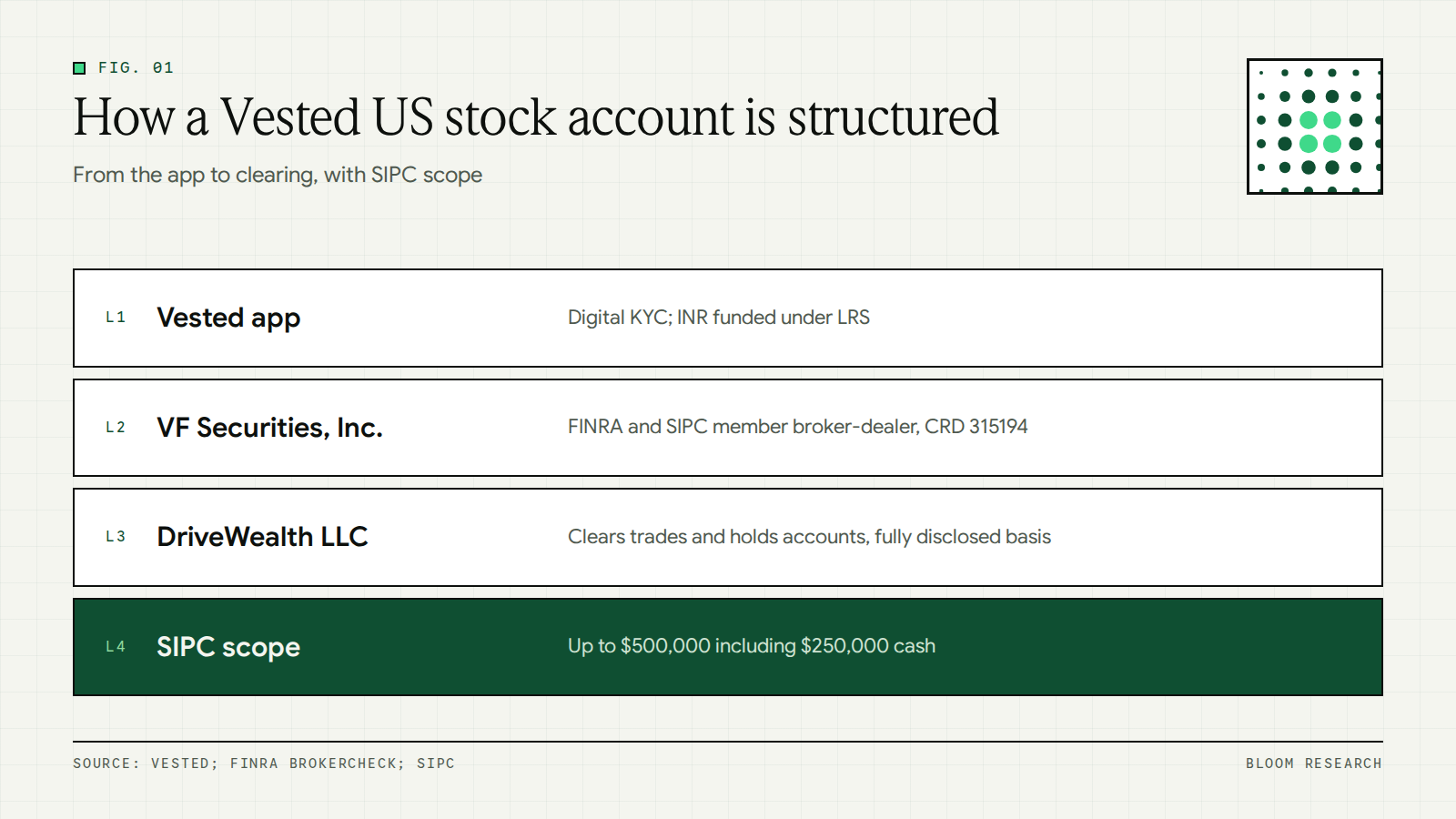
- Vested: US stocks and ETFs are offered through VF Securities, Inc., a FINRA and SIPC member that clears through DriveWealth LLC. You fund the account in INR under LRS, and Vested states it is an IFSCA-authorized Global Access Provider at GIFT City.
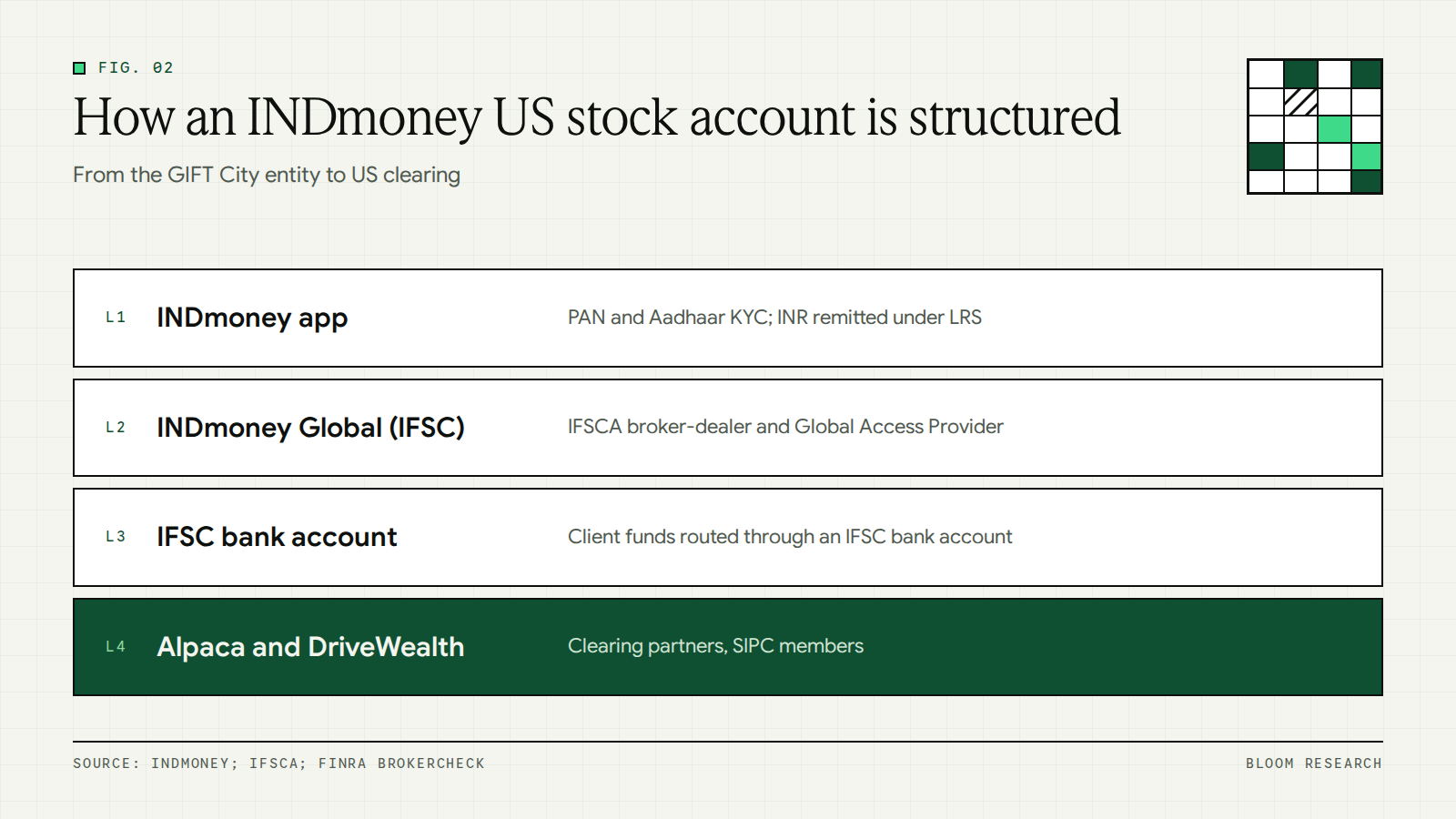
- INDmoney: US stocks are offered through IFSCA-registered INDmoney Global (IFSC) Private Limited, with clearing partners Alpaca Securities LLC and DriveWealth LLC. You fund the account in INR under LRS.
- Bloom: Our tokenized US stocks and ETFs are each backed 1:1 by a real share in custody at a regulated US broker-dealer such as Alpaca Markets or Interactive Brokers. The tokens are held in your own wallet, trades settle in stablecoins, and we do not offer our product or services in the United States or other restricted jurisdictions. Our investor guides by stock, country and payment method cover each step.
Key point: Each company publishes its own fees, eligibility rules and protections, and these change over time.
#Vested vs INDmoney vs Bloom compared side by side
The table uses each company's published pages and filings as of September 27, 2026; a cell with no source reads Not stated.
| Vested | INDmoney | Bloom | |
|---|---|---|---|
| US broker and clearing | VF Securities, Inc.; clears through DriveWealth LLC | Clearing partners Alpaca Securities LLC and DriveWealth LLC | Shares in custody at US broker-dealers such as Alpaca Markets or Interactive Brokers |
| SIPC | Through VF Securities: up to $500K, $250K cash | Through clearing partners: up to $500,000 | Tokens in your own wallet, not a SIPC-eligible brokerage account |
| Registration in India | States IFSCA-authorized GAP and broker-dealer at GIFT City | IFSCA broker-dealer IFSC/BD/2023-24/0016; GAP IFSCA/GAP/BD/2025-26/002 | Not stated |
| US registration | Vested Finance, Inc.: SEC-registered investment adviser | Not stated | Not stated |
| Account opening | Digital KYC, under 5 minutes | PAN and Aadhaar KYC, paperless, under 5 minutes | Sign in with Apple, Google, email, passkey or wallet; our privacy policy covers what we collect via KYC |
| Funding route | INR from an Indian bank under LRS | INR remitted under LRS to a GIFT City wallet | Stablecoins such as USDC and USDT |
| Trading fee | 0.25% Basic, 0.15% Premium, max $35 per trade | 0.25% per trade, max $25 excl. GST | 0.10% to 0.20% by 14-day volume, included in the quote |
| Account and plan fees | Free account; Premium ₹375/month annual or ₹450/month quarterly | Account opening, maintenance and platform fees zero | No deposit, custody or inactivity fees; network gas per trade |
| Currency conversion | Set by remitting bank; ~1-3% at partner banks, per help center | 0.5% to 1.2%, charged by the bank | No FX markup charged by us; INR to stablecoin conversion happens at a locally operating exchange, whose costs that exchange sets |
| Withdrawal fee | INR: free above $100, $3 below; USD: $5 | Zero | No withdrawal fee charged by us |
| Minimum and fractions | From $1, whole or fractional | From $1 as a fractional share | $1 minimum trade; fractions to six decimals |
| Withdrawal time | 1-3 business days after broker processing, per help center | 3-5 business days for most banks, per July 2025 blog | Seconds to an external wallet once the network confirms; getting from stablecoins back to INR in a bank account is a separate step outside our platform, and we do not state how it works or how long it takes |
Note: Not stated means the pages we checked do not state it, not that the feature is absent. Fee schedules and help articles change, and the company's current page governs.
Our US stock guides cover the US stocks we offer, listed on NYSE, NASDAQ and AMEX.
#Vested: how US investing works
Vested offers Indian residents US stocks, ETFs and other products through two US entities.
Vested broker, custody and investor protection
The FINRA BrokerCheck report for VF Securities lists the firm as CRD 315194, approved by FINRA on 07/06/2022. It also shows that VF Securities introduces customers to DriveWealth LLC, which clears their transactions and maintains their accounts on a fully disclosed basis.
A clearing firm settles trades and holds customer cash and securities for other brokers. On a fully disclosed basis, the introducing broker discloses each customer to the clearing firm, which carries the account in that customer's name.
Vested states that investments are protected up to $500K, with $250K for cash. SIPC protects against the loss of cash and securities held by customers of failed member brokerage firms. The limit of SIPC protection is $500,000, which includes a $250,000 limit for cash, and SIPC does not protect against a decline in the value of securities.
Vested regulation and account opening
Vested's Form CRS on the SEC adviser site, last revised May 29, 2025, states that Vested Finance, Inc. is an SEC-registered investment adviser and VF Securities, Inc. a FINRA and SIPC member broker-dealer. Vested notes that SEC registration does not imply a certain level of skill or training.
Vested states it is an authorized Global Access Provider and broker-dealer at GIFT City, regulated by IFSCA. GIFT City is the site of India's International Financial Services Centre (IFSC). IFSCA, the International Financial Services Centres Authority, regulates the IFSC. Under IFSCA's framework, a Global Access Provider (GAP) can be an IFSCA-registered broker-dealer with direct contractual arrangements with foreign brokers.
Vested says its 100% digital KYC takes less than 5 minutes, with zero opening fee.
Vested funding and fees as published
Vested says you can transfer money from any Indian bank with in-app instructions or through partner banks HDFC Bank, ICICI Bank and Axis Bank. Vested states that the $250,000 LRS limit applies per person per financial year. Its help center says deposits usually reflect 1-3 business days after your bank marks the transfer complete.
Vested's India page lists these charges:
- Plans: Basic at ₹0, and Premium at ₹375 per month billed annually or ₹450 per month billed quarterly.
- Brokerage on US stocks, ETFs and Global Funds: 0.25% of the trade amount on Basic and 0.15% on Premium, with a maximum of $35 per trade on both.
- OTC securities, including European companies: 0.5% on Basic and 0.25% on Premium.
- Currency conversion: set by the remitting bank; Vested's help center says Indian banks typically charge about 3-5% and partner banks HDFC, ICICI and Axis about 1-3%.
- Withdrawals: in INR, free above $100 and $3 below $100; in USD, $5 per withdrawal. Per the help center, intermediary banks could charge more on USD withdrawals.
Vested products, minimums and withdrawals
Vested lists more than 10,000 US stocks and ETFs on NYSE and NASDAQ, whole or fractional, from $1. It also lists Global Funds from $50, Managed Portfolios at 0.6% to 1% of AUM (assets under management) per year, and Private Markets from $10,000. Extended-hours trading runs 4:00 AM to 9:30 AM ET and 4:00 PM to 8:00 PM ET.
Vested's help center says sale proceeds take T+1 business day to settle in the brokerage cash account. Withdrawn funds then take 1-3 business days to reach your bank once the broker partner processes the withdrawal. Vested provides tax filing documents with the details required for Schedule CG and Schedule FA.
#INDmoney: how US investing works
INDmoney offers US stocks and ETFs through its GIFT City entity, INDmoney Global (IFSC) Private Limited. The four headings below follow the same order as the Vested section above.
INDmoney broker, custody and investor protection
INDmoney names its clearing partners for US stocks as Alpaca Securities LLC and DriveWealth LLC. It describes both as self-clearing broker-dealers that are members of SIPC and of DTCC, where INDmoney says the shares are custodied.
The FINRA BrokerCheck report for DriveWealth lists DriveWealth, LLC under CRD 165429, approved on 12/02/2013. It records that the firm holds or maintains funds or securities or provides clearing services for other broker-dealers. BrokerCheck lists Alpaca Securities LLC under CRD 288202, approved on 03/26/2018, with the same clearing description.
INDmoney states that US stocks purchased through it are SIPC protected for value up to $500,000 in the event of broker failure. INDmoney also says that if the company were to go under, holdings would be moved to another broker through its clearing partners and under IFSCA's supervision.
INDmoney regulation and account opening
The service is offered by INDmoney Global (IFSC) Private Limited. INDmoney lists its IFSCA broker-dealer registration number as IFSC/BD/2023-24/0016 and its Global Access Provider authorization number as IFSCA/GAP/BD/2025-26/002. INDmoney says it has served US stocks via GIFT City since August 2025.
An INDmoney blog last updated December 22, 2025 says the company comes under IFSCA rather than SEBI for its international investing services. The same blog says SEBI compliance applies to its domestic offerings. IFSCA's September 2025 amendment to the Global Access framework requires Global Access Providers to route the funds of all participating clients through a bank account in the IFSC.
Account opening requires KYC with PAN and Aadhaar. INDmoney describes the process as paperless and says it typically takes less than 5 minutes.
INDmoney funding and fees as published
The investor remits money under RBI's LRS, and INDmoney facilitates the INR to USD conversion and the LRS paperwork, Form A2, in the app. Form A2 is the form in which a remitter states the purpose of the remittance and declares that the funds belong to them. The funds then go to a US stocks wallet at GIFT City.
INDmoney lists direct in-app integrations with HDFC, Federal, ICICI, Kotak and IDFC, with funds typically credited within hours. INDmoney publishes these charges for US stocks:
- Account opening, annual maintenance, platform fees, withdrawal fees and reports: zero.
- Brokerage: 0.25% per trade, max $25 (excl. GST).
- Forex conversion: 0.5% to 1.2%, charged by the bank.
INDmoney's GIFT City page also states that the currency-conversion markup is charged by the banks.
INDmoney products, minimums and withdrawals
INDmoney lists 10,000+ US stocks and ETFs, which can be bought as whole shares or in fractions. Investing starts from $1 in any US stock as a fractional share, with no minimum account balance and no opening fee.
INDmoney says one tap in its app starts a withdrawal from the US stocks wallet to the linked Indian savings account, with zero transfer fees. An INDmoney blog last updated July 14, 2025 says sale proceeds settle T+1 at Alpaca and DriveWealth before withdrawal. The same blog says funds typically reach an Indian bank account within 2 days with IDFC Bank, or 3 to 5 business days for other banks.
INDmoney says it submits Form W-8BEN on the investor's behalf. It also generates capital gains statements in the format required for ITR Schedule FA and Schedule FSI.
#Bloom: how US investing works
We offer tokenized US stocks and ETFs to eligible users outside the United States. A tokenized stock is an on-chain token backed 1:1 by a real share. Our guide to how tokenized stocks work describes the model in more detail.
Bloom broker, custody and investor protection
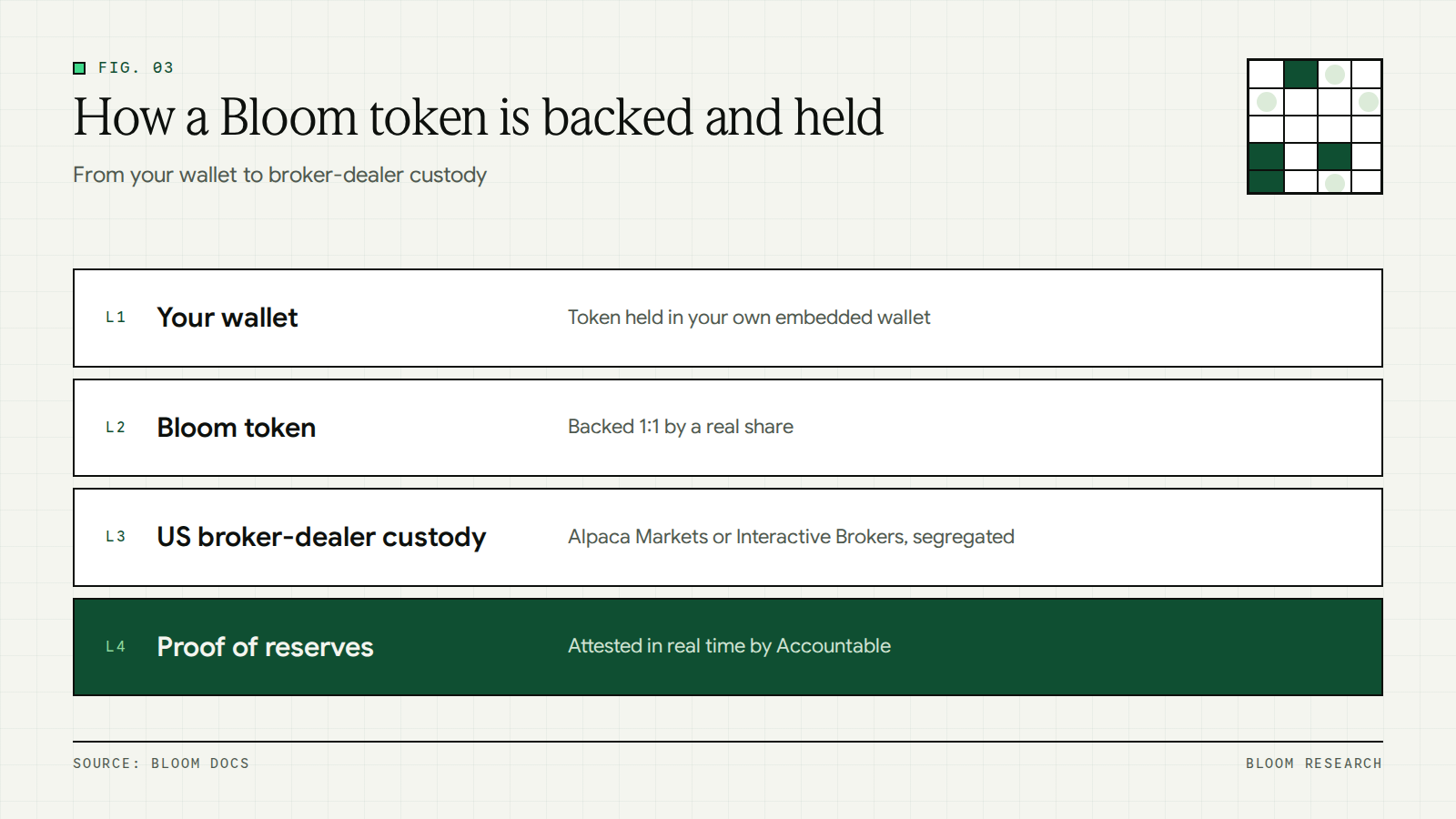
Each token is backed 1:1 by a real share held in custody at a regulated US broker-dealer such as Alpaca Markets or Interactive Brokers. Customer assets at these brokers are held separately from the broker's own funds, as our custody and backing doc explains.
The token is held in your own embedded wallet, which Privy provisions using multi-party computation, so no single party, including us, holds your complete private key.
Reserves are attested in real time by Accountable, a third-party proof-of-reserves provider. If we discontinue operations, a designated security agent, GenTwo, works with the custodian to redeem outstanding tokens against the underlying shares. That redemption depends on the continued operation of the broker partner.
The tokens you hold are on-chain assets in your own wallet, not a SIPC-eligible brokerage account. Investor-protection arrangements apply within the jurisdictional limits of each broker.
On Bloom: NAV (net asset value) is the on-chain value of a tokenized asset, reflecting price, accrued dividends and corporate actions. Dividend cash is used to buy more underlying shares, and the token's NAV rises, with no separate cash distribution.
Bloom regulation and account opening
We do not offer our product or services to users in the United States or in other restricted jurisdictions. These restrictions are enforced regardless of how a user authenticates. Users of our service confirm that they are 18 or older.
You open an account by signing in through Privy with Apple, Google, email, a passkey or an external wallet. Our legal page states that our privacy policy covers what we collect via Privy, PostHog, Sentry and KYC. You can export your private key at any time from Account, then Security.
Bloom funding and fees as published
We settle trades in stablecoins, and our guides to paying with USDC, USDT and other crypto cover USDC, USDT, SOL, ETH and BTC. Your trading balance is a unified USD balance backed 1:1 by USDC and USDT held in custody.
Because we settle in USD stablecoins, an investor in India holds INR/USD exchange-rate exposure in addition to the price movement of the stock. Our India guide says an investor in India would generally convert rupees into stablecoins through a locally operating exchange that supports on-chain withdrawals. Indian residents remain responsible for the LRS, TCS and Schedule FA rules on this route, as on any other, as the India rules section below sets out.
We publish these charges:
- Trading fee: 0.10% to 0.20%, 0.20% by default, dropping as 14-day trading volume grows through the VIP tiers. The quoted price already includes it.
- Network gas: charged per trade.
- Deposit, withdrawal, custody and inactivity fees and FX markups: not charged by us.
Our pricing and fees doc lists the volume range for each VIP tier, and our pricing page shows the VIP fee tiers.
Bloom products, minimums and withdrawals
We offer US stocks listed on NYSE, NASDAQ and AMEX and US ETFs such as SPY, QQQ and VOO. Our ETF guides cover index, sector, bond, international and gold funds. The minimum trade is $1, and fractional shares are supported down to six decimal places.
Each asset follows the trading session inherited from its underlying instrument. Orders placed outside market hours are queued and execute at the next open, and orders in an extended session may partially fill.
Selling converts a holding into USD trading balance, and withdrawing is a separate step. Withdrawing to an external wallet completes in seconds once the network confirms the transfer, as our sell and withdraw doc describes. Portfolio exports a CSV of every trade, and we do not file taxes on your behalf or provide tax advice.
#A checklist for comparing US investing apps
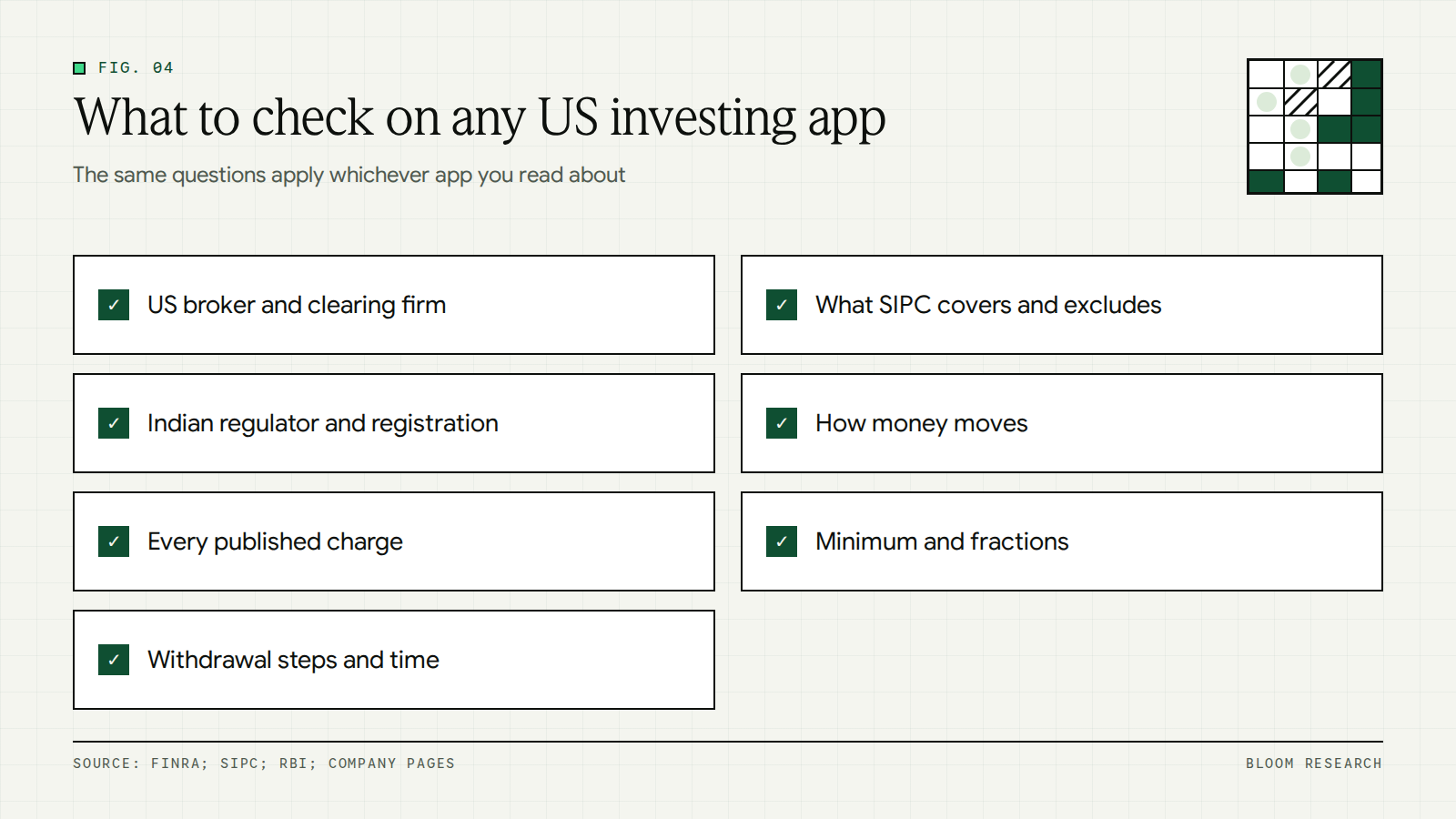
The same seven questions apply whether you are weighing Vested vs INDmoney or any other US investing app used from India, including the three described above.
- The US broker-dealer and clearing firm. Check each firm's name on FINRA BrokerCheck, which lists its CRD number and FINRA approval date. BrokerCheck lists VF Securities, Inc. as CRD 315194, DriveWealth, LLC as CRD 165429 and Alpaca Securities LLC as CRD 288202.
- What SIPC covers. The Vested section above sets out the SIPC limit and scope. SIPC also states that digital asset securities that are unregistered investment contracts are not protected, even if a SIPC-member brokerage firm holds them, as SIPC's page on what it protects explains.
- The Indian regulator and registration number. Check which Indian regulator the app names and whether its pages show a registration number. INDmoney lists IFSCA Broker Dealer Registration No. IFSC/BD/2023-24/0016 and Global Access Provider Authorisation No. IFSCA/GAP/BD/2025-26/002, and Vested states it is an authorized Global Access Provider and Broker Dealer at GIFT City, regulated by IFSCA.
- How money moves. For an INR account, money goes abroad as an LRS remittance, and the remitter furnishes Form A-2 stating the purpose of the remittance and declaring that the funds belong to them. We settle trades in stablecoins.
- Every published charge. List the trading fee, plan fee, currency conversion charge, withdrawal fee and network gas, and read each one on the company's own page. Vested lists a Premium plan at ₹375 per month billed annually or ₹450 per month billed quarterly, and brokerage of 0.25% on Basic and 0.15% on Premium with a maximum of $35 per trade. INDmoney lists brokerage of 0.25% per trade, max $25 (excluding GST), and forex conversion of 0.5% to 1.2%, charged by the bank. Our trading fee is 0.10% to 0.20%, and network gas is charged per trade.
- The minimum amount and fractional support. Vested says investing starts from $1, and INDmoney says investing starts from $1 in any US stock as a fractional share. Our minimum trade is $1.
- Withdrawal steps and time. Vested's help center says funds take 1-3 business days to reach the bank once its broker partner processes the withdrawal. An INDmoney blog last updated July 14, 2025 says funds typically reach an Indian bank in 3 to 5 business days, or 2 days with an IDFC Bank account, and a withdrawal from our app to an external wallet completes in seconds once the network confirms the transfer. Getting from stablecoins back to INR in a bank account is a separate step outside our platform, and we do not state how it works or how long it takes.
#India rules that apply on every route: LRS, TCS and Schedule FA
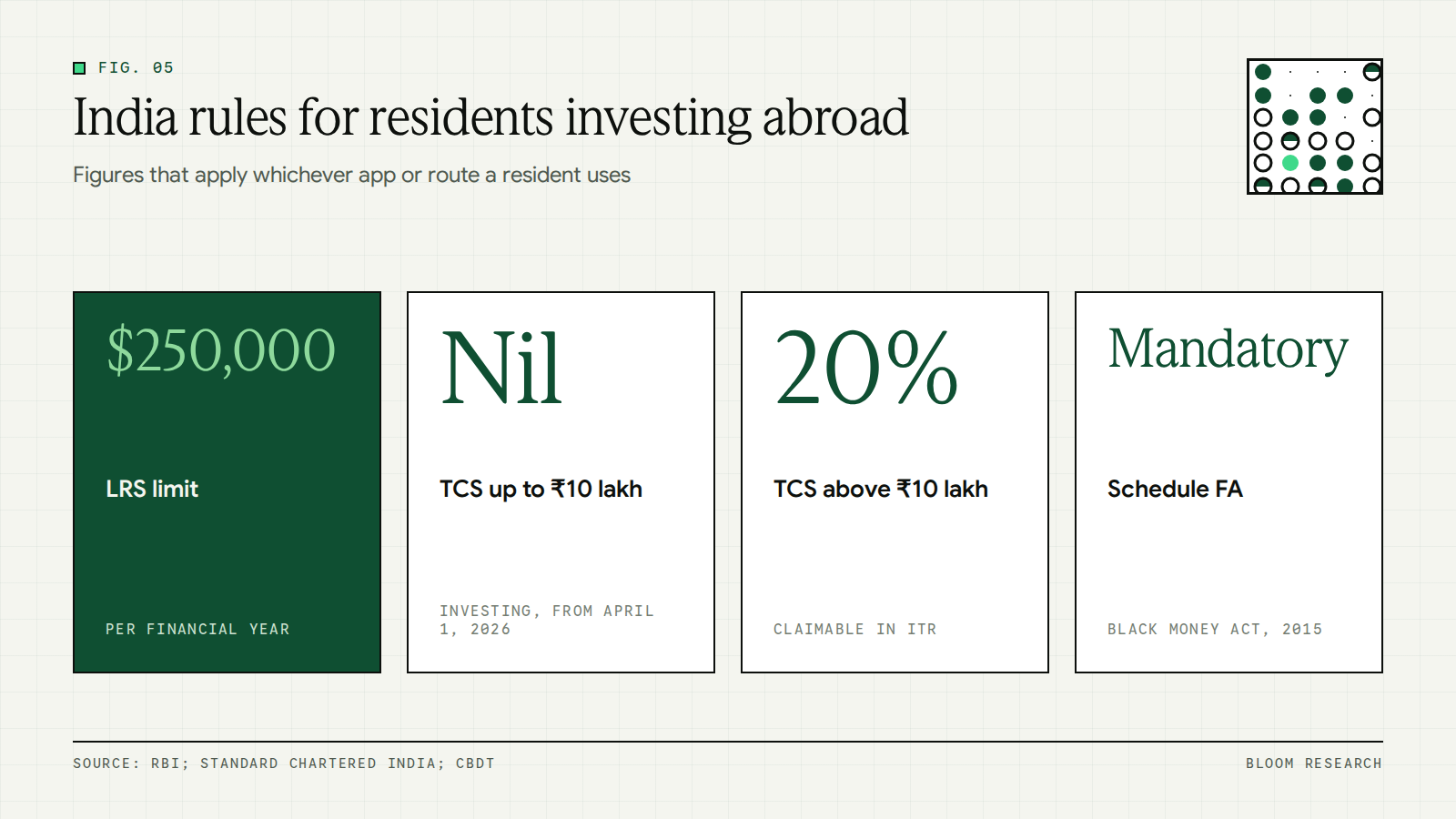
Under the Liberalised Remittance Scheme, resident individuals, including minors, can remit up to USD 250,000 per financial year (April to March) for any permissible current or capital account transaction. RBI lists investment among the capital account transactions. The remitter designates one branch of an AD bank, short for authorized dealer bank, and makes all capital account remittances under the scheme through that branch. RBI also says the applicant should have held the account with that bank for at least one year before the remittance.
An investor who remits under LRS can retain and reinvest the income earned on those investments. Foreign exchange that is not reinvested must be repatriated and surrendered to an authorized person within 180 days, according to RBI's LRS FAQ. These limits and conditions apply to the individual remitter, not to a particular app. Our guide to the Liberalised Remittance Scheme for US stocks covers the LRS limit, PAN and Form A2, and TCS on foreign remittance in more detail.
TCS, short for tax collected at source, is an amount the bank collects on an LRS remittance and recovers from the remitter's account. The Finance Act, 2026, read with the Income Tax Act, 2025, changed the TCS provisions for LRS with effect from April 1, 2026. From that date, TCS on other LRS purposes, such as investing, is nil up to ₹10 lakh and 20% above ₹10 lakh, and it applies across all LRS remittances in a financial year.
The TCS credit can be claimed when filing the income tax return. Once collected, TCS cannot be refunded by the bank if the remittance is returned, as Standard Chartered India's notice on TCS rates from April 2026 states.
Schedule FA is the foreign assets schedule in the Indian income tax return, and Schedule FSI covers foreign source income. The CBDT said in a November 16, 2024 release that accurate Schedule FA and FSI reporting is mandatory under the Black Money (Undisclosed Foreign Income and Assets) and Imposition of Tax Act, 2015. The details are in the CBDT release on Schedule FA reporting.
GIFT City has its own limits for residents. IFSCA issued its revised Regulatory Framework for Global Access in the IFSC on August 12, 2025, superseding its earlier circulars of November 25, 2021 and June 6, 2024. Under that framework, resident Indian individuals are confined to products permissible under the Master Direction on the Liberalised Remittance Scheme, and the circular expressly excludes crypto-assets and instruments based on crypto, according to a law-firm summary of IFSCA's Global Access framework.
Important: Indian residents remain responsible for the LRS, TCS, Schedule FA and tax rules that apply to them whichever app or funding route they use, including stablecoin funding; we do not state that any route falls outside them. Check with your AD bank and a tax adviser.
#Risks that apply to all three routes
For Vested vs INDmoney and for our app, the risks below come from SIPC, the SEC staff and our own disclosures, and each one is described as its source states it.
- Price risk: asset prices can fall, and the SIPC limits described above do not cover market losses.
- Currency risk: because we settle in USD stablecoins, an investor in India holds INR/USD exchange-rate exposure in addition to the price movement of the stock itself.
- Market gaps and liquidity on our app: overnight gaps may exceed a slippage tolerance or Stop Loss trigger, and the tokenized security issuers that quote prices may withdraw liquidity in extreme conditions.
- Smart contract and bridging risk on our app: every contract is audited, but no audit eliminates risk entirely, and cross-chain bridges and the underlying blockchains can be congested, halted or compromised.
- Third-party tokenized securities: SEC staff stated on January 28, 2026 that holders of tokenized securities issued by a third party may be exposed to risks of that third party, such as bankruptcy, as described in the SEC staff statement on tokenized securities.
- Redemption: if we discontinue operations, token redemption through the security agent GenTwo depends on the continued operation of the broker partner, as our risk disclosure explains.
Trading carries risk, including the loss of principal, and nothing in this post is investment, tax or legal advice. We do not offer our product or services in the United States or other restricted jurisdictions, as our service availability page states.
#Next steps on Bloom
Our India guide to tokenized US stocks shows popular stocks and ETFs to buy from India. It also notes that an investor in India holds INR/USD exchange-rate exposure because we settle in USD stablecoins.
Our country guides cover tokenized US stocks and ETFs funded with stablecoins, with funding rails, currency and popular stocks for each country. Each company's own pages govern its current fees and terms, including ours.
Frequently asked questions
Which apps are alternatives to INDmoney for US stocks?
Vested and Bloom are two alternatives covered in this comparison. Vested offers US stocks and ETFs through VF Securities, Inc., which clears through DriveWealth LLC, and its accounts are funded in INR under LRS. We offer tokenized US stocks and ETFs, each backed 1:1 by a real share in custody at a regulated US broker-dealer such as Alpaca Markets or Interactive Brokers, and held in your own wallet. Our guide to investing in US stocks from India lists other routes.
Is it safe to invest in Vested?
FINRA BrokerCheck lists VF Securities, Inc. as CRD 315194, approved by FINRA on 07/06/2022, and Vested's Form CRS states that Vested Finance, Inc. is an SEC-registered investment adviser. Vested states that investments are protected under US regulatory bodies up to $500K, with $250K for cash. The limit of SIPC protection is $500,000, including $250,000 for cash, and SIPC does not protect against a decline in the value of securities, so market risk remains.
Is INDmoney safe to invest in US stocks?
INDmoney's US stocks service is offered by INDmoney Global (IFSC) Private Limited, which lists IFSCA broker-dealer registration IFSC/BD/2023-24/0016 and GAP authorization IFSCA/GAP/BD/2025-26/002. INDmoney names Alpaca Securities LLC and DriveWealth LLC, both SIPC members, as its clearing partners and states that US stocks bought through it are SIPC protected up to $500,000 in the event of broker failure. SIPC does not protect against a decline in the value of securities.
What are the disadvantages of INDmoney?
INDmoney publishes brokerage of 0.25% per trade, max $25 excluding GST, and forex conversion charges of 0.5% to 1.2%, charged by the bank. Under IFSCA's Global Access framework, resident Indian individuals are confined to products permissible under the LRS Master Direction, and the framework excludes crypto-assets and crypto-based instruments. From April 1, 2026, banks apply TCS on LRS remittances for investing at nil up to ₹10 lakh and 20% above ₹10 lakh.
What are Vested vs INDmoney charges for US stocks?
Vested lists a Basic plan at ₹0 and a Premium plan at ₹375 per month billed annually or ₹450 per month billed quarterly, with brokerage of 0.25% on Basic and 0.15% on Premium, up to $35 per trade. Vested's INR withdrawals are free above $100 and cost $3 below $100, and USD withdrawals cost $5. INDmoney lists brokerage of 0.25% per trade, max $25 excluding GST, and says account opening, annual maintenance, platform, withdrawal and report charges are zero.
Do LRS and TCS apply on all three apps?
Vested states that the $250,000 LRS limit applies, and INDmoney says investors remit under RBI's LRS. Under LRS, resident individuals can remit up to USD 250,000 per financial year, and from April 1, 2026 banks apply TCS on LRS remittances for investing at nil up to ₹10 lakh and 20% above ₹10 lakh. Indian residents remain responsible for the LRS, TCS, Schedule FA and tax rules that apply to them whichever route they use, and we do not state that any route, including stablecoin funding, falls outside them.
Can I use Bloom from the United States?
No. We do not offer our product or services to users in the United States or in other restricted jurisdictions. Outside those jurisdictions, our tokenized US stocks and ETFs are each backed 1:1 by a real share in custody at a regulated US broker-dealer such as Alpaca Markets or Interactive Brokers, and trades settle in stablecoins.