
What Is a Stablecoin? How USDC and USDT Hold Their Peg
What is a stablecoin? See how fiat-backed coins like USDC and USDT hold a $1 peg through reserves, attestations and mint and redeem, plus GENIUS and MiCA.
Key takeaways
- A stablecoin is a crypto token that targets a fixed value against a reference asset, usually one US dollar. USDC and USDT are fiat-backed examples.
- Circle and Tether mint and redeem tokens only with verified direct customers. Arbitrage between the issuer rate and exchange prices keeps market prices near the $1 peg.
- Circle discloses USDC reserves weekly with monthly Big Four assurance. Tether typically publishes circulation daily and quarterly reserve reports prepared by BDO.
- The US GENIUS Act, signed on July 18, 2025, requires at least one dollar of permitted reserves for every dollar of payment stablecoins issued.
- On Bloom, your trading balance is a unified USD balance backed 1:1 by USDC and USDT held in custody.
What is a stablecoin? A stablecoin is a crypto token that aims to hold a fixed value against a real-world asset, and for the vast majority of stablecoins traded in crypto markets that asset is the US dollar. USD Coin (USDC), issued by Circle, and Tether (USDT), issued by Tether, are two US-dollar stablecoins, and together they back our trading balance on Bloom. We settle trades on Bloom in stablecoins, and our pay with crypto page lists the coins you can fund an account with.
This guide explains how stablecoins work, how USDC and USDT stay close to $1, what backs them, and how US and EU rules now treat them. Our sources are the issuers' own transparency pages, Federal Reserve research and official regulatory summaries, and we give the date of every figure we quote.
#What is a stablecoin?
Any answer to what is a stablecoin starts with the peg. The Federal Reserve describes stablecoins as cryptocurrencies that peg their value to a real-world asset, typically the US dollar, known as the reference asset. The process a stablecoin uses to hold that peg is called its stabilization mechanism, according to a Federal Reserve note on the stable in stablecoins. The same note points out that stablecoins pegged to the same asset can use different mechanisms, so they can carry different levels of run risk.
Definition: A stablecoin is a crypto token that targets a fixed value against a reference asset, such as one US dollar, and relies on reserves, collateral or code to hold that target.
Tether's FAQ on how Tether tokens work says its tokens are called stablecoins because they offer price stability as they are pegged to a fiat currency. It states the peg directly: 1 USD₮ = 1 USD. Our funding guides for USD Coin (USDC) and Tether (USDT) describe both as US-dollar stablecoins whose value tracks the dollar.
What the stablecoin peg means
A stablecoin peg is the fixed price a token aims to trade at, such as $1. When Circle tokenizes US dollars into USDC, its terms say it does so at a rate of one dollar per USDC, and it redeems at the same rate, less fees where applicable. Circle's terms also state that the value of USDC on third-party platforms, such as crypto exchanges, could fluctuate above or below $1.
The peg therefore has two prices to watch: the issuer's fixed rate and the price on exchanges. The section on minting and arbitrage below covers the trading that links the two.
Bitcoin is not a stablecoin. It has no peg, and Tether's FAQ notes that the rate of exchange between Bitcoin and the US dollar is volatile. The Federal Reserve draws the same line: stablecoins are meant to hold a stable value, unlike crypto assets whose values are intended to fluctuate.
#Three types of stablecoin design
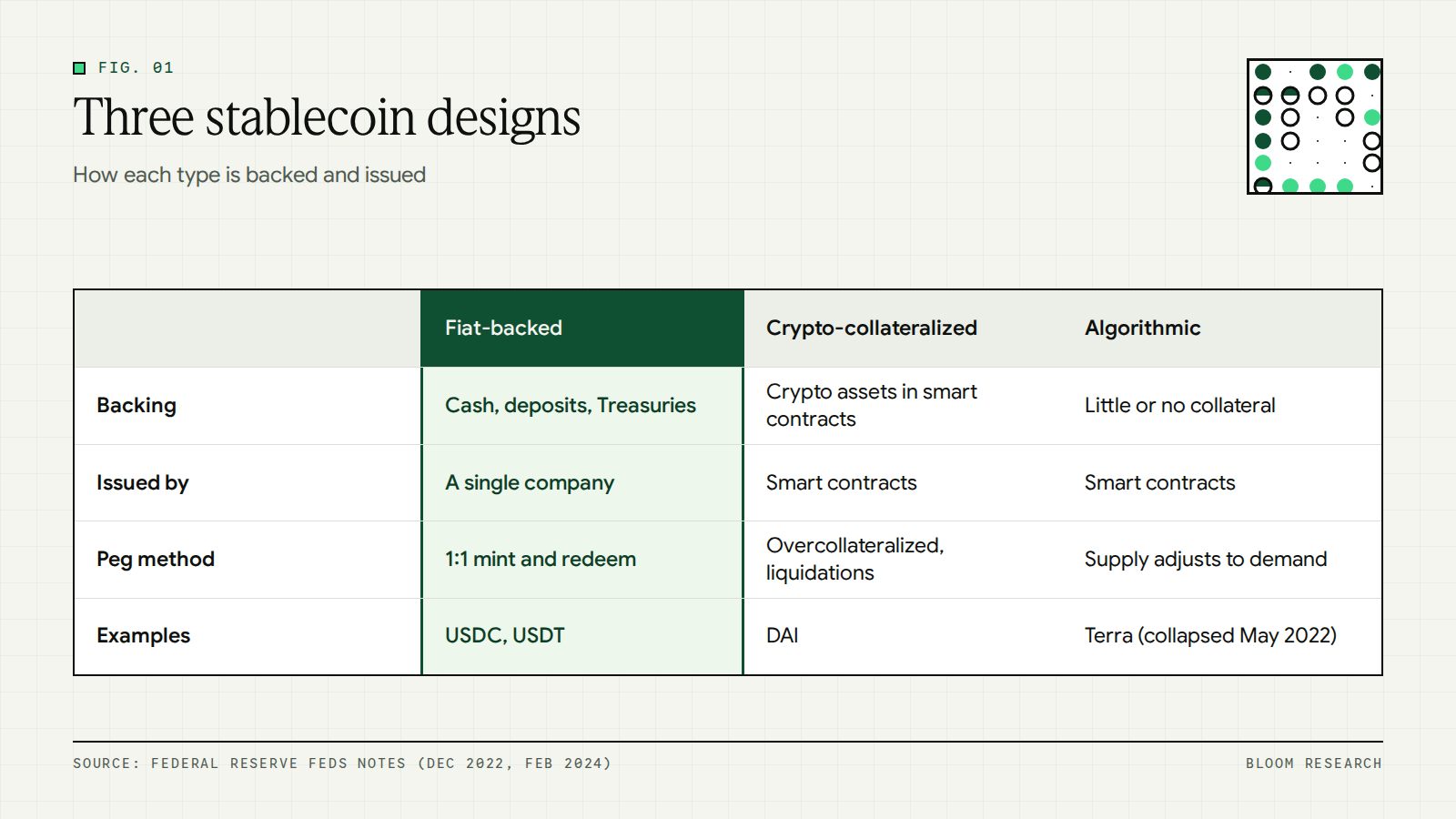
A Federal Reserve note from February 2024 groups stablecoins into three categories by how they are collateralized and issued: fiat-backed stablecoins, crypto-collateralized stablecoins, and algorithmic stablecoins. The note adds that the design shapes how useful a coin is as a means of exchange or store of value, and how centralized it is.
Fiat-backed stablecoins
A fiat-backed stablecoin is backed by cash and cash-equivalent reserves, such as deposits, Treasuries and commercial paper, held off the blockchain. The Fed notes that most fiat-backed stablecoins are centralized: a single company issues tokens on public blockchains at 1:1 parity with fiat reserves. The issuer is responsible for keeping the number of tokens on the blockchain no greater than the dollar value of its reserves.
USDC and USDT belong to this group. The Fed's December 2022 note lists Tether and USD Coin as examples of off-chain collateralized stablecoins, which it describes as typically fully collateralized by dollar-denominated assets. The collateral needs a custodian to hold it until users redeem their tokens.
Crypto-collateralized and algorithmic stablecoins
A crypto-collateralized stablecoin is backed by a basket of other crypto assets, such as bitcoin or ether, held in smart contracts. A smart contract is self-executing code on a blockchain. A user deposits collateral and the contract mints stablecoins, generally at an overcollateralized ratio, so at least a dollar's worth of crypto backs each token. If the collateral value falls below a set level, the contract liquidates it and removes excess stablecoins from supply.
An algorithmic stablecoin is under-collateralized or has no collateral by design. It uses smart contracts and incentives to adjust supply as demand changes. The Fed note describes Terra as the largest algorithmic stablecoin before its collapse in May 2022, and says this design has led to rapid "death spirals" in several algorithmic stablecoins.
Key point: The word "stable" names a goal. How closely a coin tracks its peg depends on what backs it and on who can redeem it with the issuer.
#Why stablecoins matter for trading
The practical side of what is a stablecoin shows up in trading. Stablecoins give crypto markets a unit of account priced in dollars. The Fed's December 2022 note reported that over 80 percent of trade volume on major centralized crypto exchanges involved stablecoins as part of the traded pair. The same note says stablecoins serve as both a means of payment and a store of value in markets otherwise populated with volatile assets.
Federal Reserve research names several uses for stablecoins in crypto markets:
- Trading pairs on crypto exchanges, where stablecoins facilitate trades.
- Collateral, since stablecoins serve as the underlying asset for many crypto loans.
- Decentralized finance (DeFi) markets and services, where they are widely used.
- An on-ramp into crypto markets for new users.
They also remove a step for traders. The Fed note says stablecoins allow market participants to avoid inefficiencies stemming from converting back to fiat currency for crypto trades. A trader can move from one position to another in a dollar token without a bank transfer in between.
The same role now extends to tokenized stocks, which are on-chain tokens that track real shares. On Bloom, each asset is an on-chain token backed 1:1 by a real share held in custody at a regulated US broker-dealer, and we settle trades in stablecoins. Our USDC funding page describes a dollar stablecoin as a way to fund tokenized-stock purchases without price swings on the cash leg. Our glossary of trading terms defines the other terms used across the app, from NAV to slippage tolerance.
#How do stablecoins work? Minting and redeeming
For a fiat-backed coin, the answer to how do stablecoins work is a cycle of creation and redemption with the issuer. The Fed's December 2022 note describes it: a person who wants new stablecoins sends another asset, such as dollars, to a designated party, which may be a bank, a wallet provider or another custodian. Once the assets arrive, the issuer creates, or mints, an equivalent amount of stablecoins and sends them to the user's wallet.
To mint is to create new tokens on a blockchain, and to burn is to withdraw tokens from circulation. Redemption runs the same steps in reverse. The holder sends stablecoins to an address specified by the issuer, which burns them, and the custodian then transfers an equivalent amount of the original assets back to the holder.
Between those two steps, the tokens move on public blockchains. The Fed note says network participants validate each transfer, possibly charging transaction fees, and a validated transaction is typically stored on a publicly visible ledger such as a blockchain. The same token can also exist on several chains: Tether's FAQ says Tether tokens run on blockchains including Ethereum, Solana and Tron, and asks users to check that they select the correct transport protocol before sending.
We apply the same rule to deposits. When you receive USDC on Bloom, you pick the network in the deposit flow, and our list of supported networks explains that each network shows its own address and QR code.
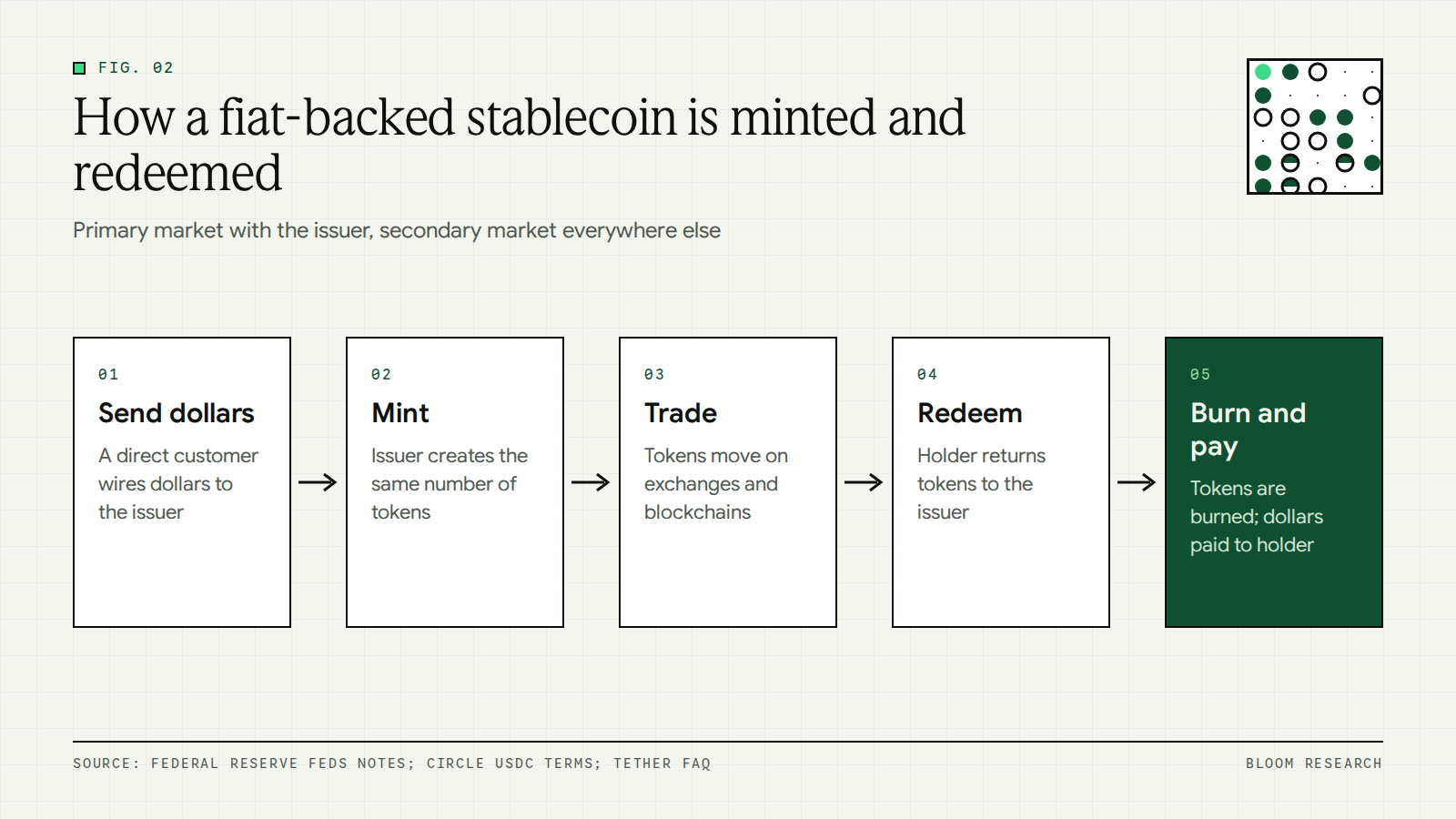
How it works: The primary market is where the issuer mints and redeems tokens at a fixed $1. The secondary market is every other place the token trades, such as centralized and decentralized exchanges, where buyers and sellers set the price.
Tokenized stocks follow a similar pattern with shares in place of dollars. Our guide to how tokenized stocks are minted, settled and redeemed covers how share tokens are minted and burned against shares held in custody.
Who can mint and redeem USDC
The Fed's February 2024 note says only direct customers of Circle, cleared through an application process, have access to the primary market for USDC. Those customers tend to be businesses such as crypto exchanges, financial technology companies and institutional traders. Circle's USDC Terms say a user may only tokenize dollars into USDC and redeem USDC for dollars directly with Circle with a Circle Mint account in good standing.
The same terms state that for every USDC issued and in circulation, Circle holds either one US dollar or an equivalent amount of dollar-denominated assets in segregated accounts on behalf of users. Circle may hold those reserves in interest-bearing accounts, but holders are not entitled to that interest, and USDC does not itself generate any return. Most retail users, the Fed note adds, buy USDC from intermediaries and trade it on centralized and decentralized exchanges.
Who can mint and redeem USDT
Tether's fee schedule for acquisitions and redemptions sets a minimum Tether token acquisition or redemption amount of 100,000 USD. Each redemption costs the greater of $1,000 or 0.1%, and each acquisition costs 0.1%. New customers pay a non-refundable verification fee of 150 USD in Tether tokens and pass a know-your-customer (KYC) review, which Tether says could take days to weeks.
Tether's FAQ also explains how new tokens are created. Multiple Tether private authorization keys sign each creation transaction, so no single person can authorize tokens alone. New tokens sit in Tether's treasury as "authorized but not issued" and are not counted in circulation until they are transferred out, for example to a customer who purchases them through tether.to.
As with USDC, the Fed note says fiat-backed issuers tend to mint and burn new stablecoins only with institutional customers, so retail traders rely on secondary markets to access the stablecoin.
#How arbitrage holds the stablecoin peg
Arbitrage is buying in one market and selling in another to profit from a price difference. The Fed's note on primary and secondary markets for stablecoins says direct customers of issuers can engage in arbitrage trading, profiting off differences between the primary exchange rate and the rate on secondary markets, to maintain the peg of a stablecoin.
The trade can run in either direction:
- Below the peg: a direct customer buys the stablecoin on an exchange for less than $1 and redeems it with the issuer at $1, less any fee.
- Above the peg: a direct customer mints new tokens with the issuer at $1 and sells them on an exchange for more than $1.
- Across venues: traders use decentralized exchanges and liquidity pools, which the Fed note says offer additional opportunities for arbitrage trading.
Access to the issuer shapes how well this works. The Fed note cites research finding that Tether's design changes in 2019 and 2020, which broadened access to its primary market, reduced peg instability. Market observers do not look to the issuer's own rate to judge the peg, the note adds, because an issuer is unlikely to ever promise to redeem a stablecoin for less than a dollar. Prices aggregated across exchanges are the more common reference.
Key point: The issuer's $1 rate applies at the primary market, for customers who can mint and redeem. The exchange price that most holders see stays near $1 because those customers trade on any gap.
What happened when USDC slipped in March 2023
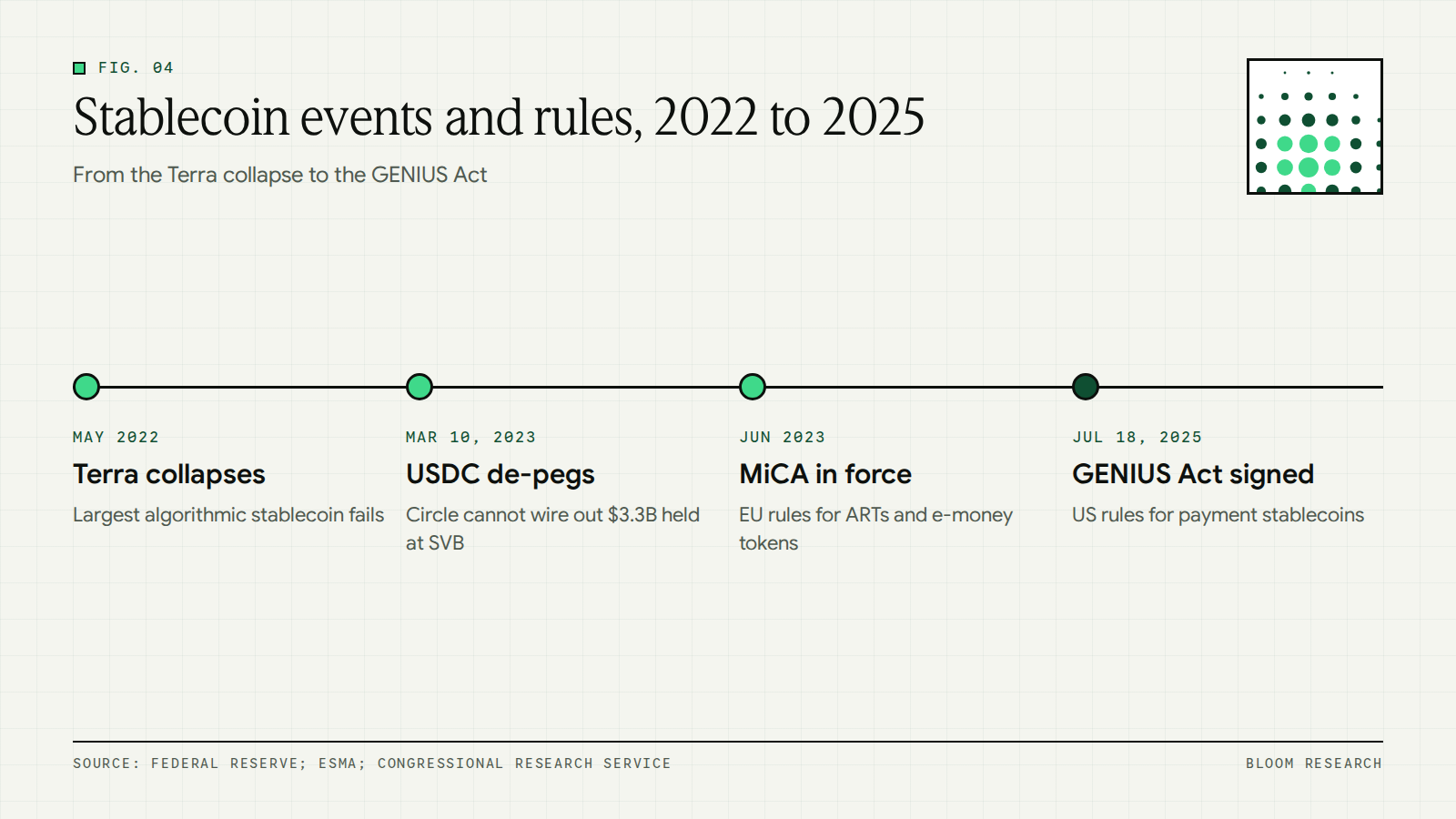
On March 10, 2023, Circle announced that it had been unable to wire out $3.3 billion of USDC reserves, out of around $40 billion, held at Silicon Valley Bank before regulators took control of the bank. The Fed note reports that the price of USDC on secondary markets de-pegged off the dollar, and that markets for other stablecoins fluctuated significantly as traders responded.
The primary market could not respond at full speed. On March 11, Circle said USDC issuance and redemption was constrained by the working hours of the US banking system, and that liquidity operations would resume when banks opened on Monday. The Fed note counts nearly 2 billion USDC tokens removed from secondary markets on March 10. USDT was the only stablecoin in the study that saw increased flows into secondary markets in the following week.
The case study shows that a fiat-backed peg depends on two things at once: the reserves themselves and a primary market that is open to process redemptions.
#What backs USDC and USDT: reserves and attestations
Reserves are what a fiat-backed issuer redeems tokens against, so both Circle and Tether publish reserve data. An attestation is a report in which an independent accounting firm checks figures that the issuer's management asserts, such as the value of reserves on a set date. Circle and Tether use different reserve assets, reporting schedules and accounting firms.
Circle's transparency page for USDC and EURC says the majority of the USDC reserve is held in the Circle Reserve Fund (USDXX), an SEC-registered 2a-7 government money market fund managed by BlackRock. The fund can contain cash, short-dated US Treasuries and overnight US Treasury repurchase agreements. The remainder of the reserve is held in cash, mostly among a handful of the world's largest banks, separately from Circle's operating funds.
Circle says USDC reserve holdings are fully disclosed on a weekly basis, along with associated mint and burn flows. A Big Four accounting firm provides monthly third-party assurance that the value of USDC reserves is greater than the amount of USDC in circulation, under attestation standards set by the American Institute of Certified Public Accountants (AICPA). As of September 24, 2026, the page showed $75.2 billion of USDC in circulation and $75.5 billion in total reserves, with $341.7 billion issued and $340.5 billion redeemed over the prior 365 days.
Tether's FAQ says every Tether token is 100% backed by reserves, which include traditional currency, cash equivalents and other assets, including receivables from loans made by Tether to third parties. Tether also holds bitcoin and gold in its reserves, and it notes that the dollar value of its bitcoin holdings may change significantly after its most recent reserves report.
Tether typically publishes the number of tokens in circulation daily and reserve reports quarterly, prepared by BDO Italia under criteria established by the International Auditing and Assurance Standards Board (IAASB). Its USD₮ transparency page showed about $183.7 billion of USD₮ in net circulation on September 27, 2026. Tether's Q2 2026 attestation release says its assets exceeded its liabilities by about $4.11 billion as of June 30, 2026, with the majority of reserves in US government-backed instruments and short-term liquidity facilities.
| Peg mechanism | USDC (Circle) | USDT (Tether) |
|---|---|---|
| Reserve assets the issuer names | Circle Reserve Fund (USDXX) plus cash at banks | Traditional currency, cash equivalents and other assets, including loan receivables, bitcoin and gold |
| Reserve disclosure | Weekly, with mint and burn flows | Quarterly reserve reports; circulation typically daily |
| Third-party reports | Monthly assurance by a Big Four firm under AICPA standards | Quarterly reports prepared by BDO Italia under IAASB criteria |
| Direct mint and redeem | Circle Mint account in good standing | Verified account, 100,000 USD minimum |
| Published circulation | $75.2 billion (September 24, 2026) | About $183.7 billion (September 27, 2026) |
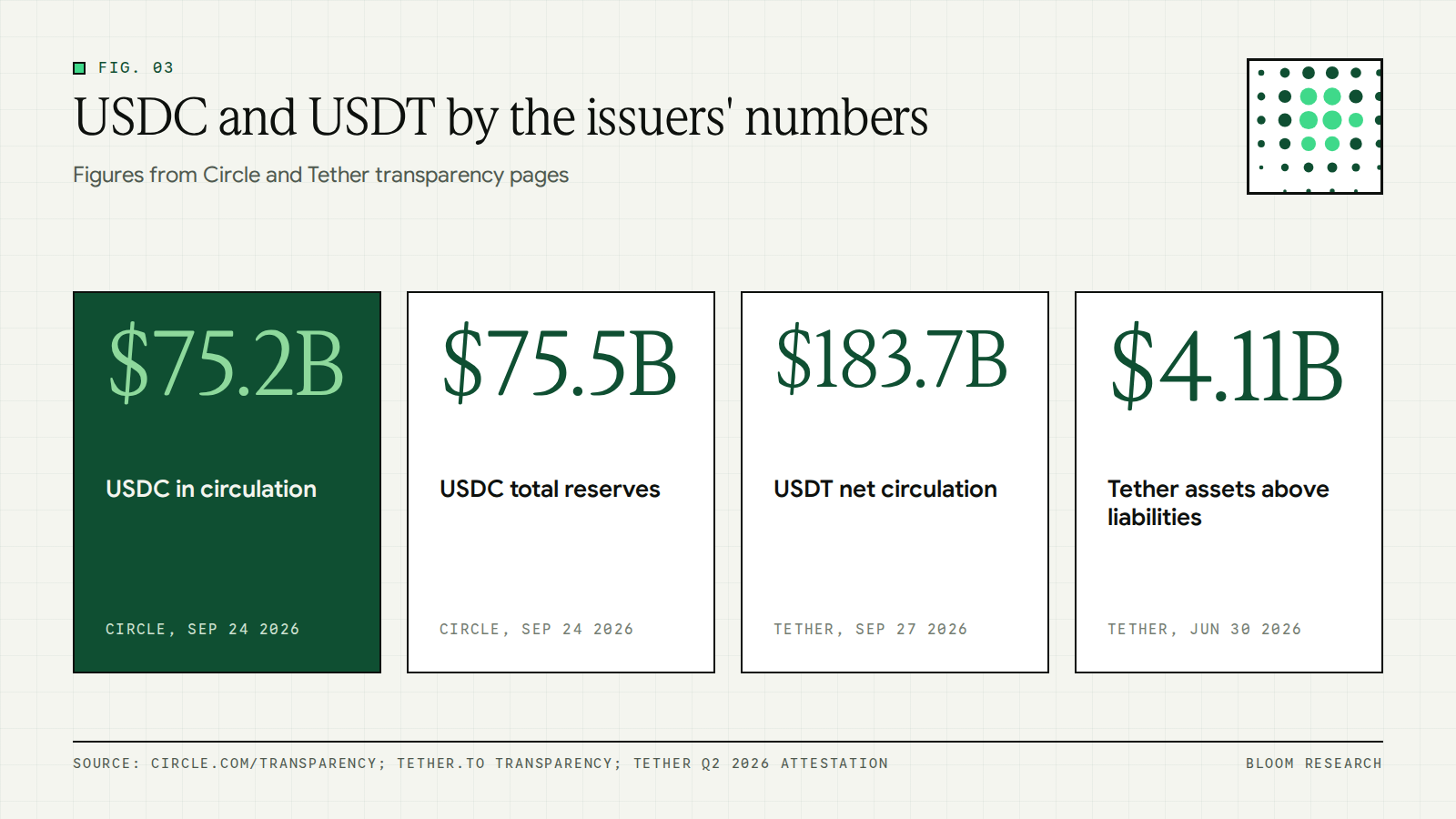
Tether also states that it does not commit to update this information at any particular interval, and that its circulation figures may be delayed. Reading either page means reading the date next to each number.
#How regulators treat stablecoins: GENIUS Act and MiCA
In the United States, the GENIUS Act was signed into law on July 18, 2025, as Public Law 119-27, according to a Congressional Research Service overview of the GENIUS Act. A payment stablecoin, under the act, is a digital asset issued for payment or settlement and redeemable at a predetermined fixed amount, such as $1. CRS summarizes the main requirements for issuers:
- Approval by a state or federal regulator, unless an exception in the act applies.
- At least one dollar of permitted reserves for every one dollar of stablecoins issued.
- Permitted reserves limited to coins and currency, insured deposits, short-dated Treasury bills, Treasury-backed repos and reverse repos, government money market funds, central bank reserves and similar approved assets.
- Disclosed redemption procedures and periodic reports on outstanding stablecoins and reserve composition, examined by registered public accounting firms.
- Audited annual financial statements for issuers with more than $50 billion in stablecoins outstanding.
- No interest paid by issuers to stablecoin holders.
CRS adds that the act grants stablecoin holders priority over all other claims against the issuer in bankruptcy. It also clarifies that payment stablecoins are not securities or commodities and are not federally insured.
In the European Union, the Markets in Crypto-Assets Regulation (MiCA) entered into force in June 2023, according to ESMA's overview of the MiCA regulation. MiCA sets uniform EU market rules for crypto assets not covered by existing financial services legislation, including asset-referenced tokens (ARTs) and e-money tokens (EMTs). The EBA page on asset-referenced and e-money tokens states that issuers of ARTs and EMTs must hold the relevant authorization to carry out activities in the EU.
What these rules do not change for holders
Important: A payment stablecoin is not a bank deposit. CRS notes that payment stablecoins under the GENIUS Act are not federally insured, and Circle's terms state that it does not guarantee that one USDC will always equal $1 on other platforms.
#How we use stablecoins on Bloom
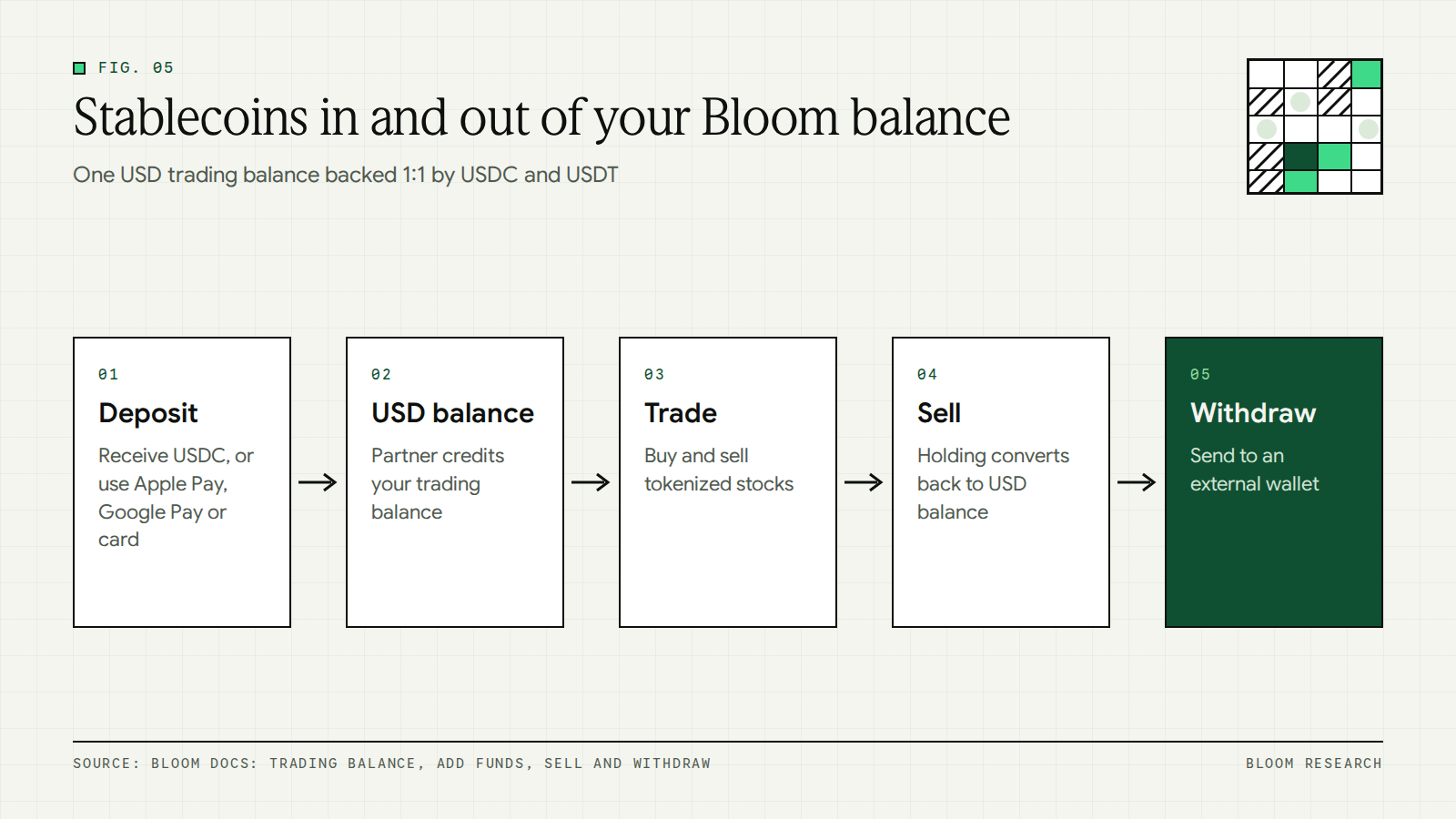
On Bloom, your trading balance is a unified USD balance backed 1:1 by USDC and USDT held in custody, and it always displays as USD in the app. Our trading balance documentation explains that it is represented by a real on-chain ERC-20 token, not a UI abstraction. ERC-20 is the standard token format on Ethereum, which Tether's FAQ describes for USDT on that chain.
When you deposit, an authorized partner credits the equivalent trading balance to your wallet. When you withdraw, the balance is queued for redemption back to USDC or fiat through the same partner. One balance means you do not need to think about USDC versus USDT, and there is no exchange-rate drift between the two in the balance you see.
On Bloom: You can fund with Apple Pay, Google Pay or a card where your device supports it, or receive USDC from an external wallet on a supported network. Per-chain crypto deposits have a minimum of $10 to $50 depending on the chain and asset, shown before you send. Our pricing page lists deposits and withdrawals as free, alongside the trading fee.
Selling and withdrawing are two separate actions. Selling converts a holding back into USD trading balance, and withdrawing moves that balance out to an external wallet. Our sell and withdraw guide notes that a withdrawal to an external wallet completes in seconds once the network confirms the transfer.
The stock tokens you buy with that balance have their own reserve reporting. Reserves on Bloom are independently attested by a third-party proof-of-reserves provider that reads share balances from segregated accounts at regulated US broker-dealers and publishes them on-chain in real time. Our proof of reserves documentation shows how to check live token supply, attested broker balance and backing ratio for every asset.
For readers in India, our India country page says an investor would generally convert rupees into stablecoins through a locally operating exchange that supports on-chain withdrawals, then move the USDC to a self-custody wallet under their own keys. Because we settle trades on Bloom in USD stablecoins, an investor holds INR/USD exchange-rate exposure in addition to the price movement of the stock itself. Our guide to investing in US stocks from India covers LRS, TCS and tax for overseas investing.
#Risks to know before you hold stablecoins
A full answer to what is a stablecoin also covers what can go wrong. Stablecoins reduce price swings on the cash side of a trade, but they carry their own risks:
- De-peg risk: the exchange price can move away from $1, as the USDC price did on secondary markets in March 2023.
- Issuer and reserve risk: holders rely on the issuer's reserves and on its ability to process redemptions, and reserve reports describe a stated date.
- Freezes: Tether's FAQ says it may seize and destroy Tether tokens remotely in response to demands from government, law enforcement or other authorities.
- Network risk: cross-chain bridges and the underlying blockchains can be congested, halted or compromised.
Trading on Bloom carries risk, including the loss of principal, and our risk disclosure covers market, smart contract, custody, bridging and liquidity risk. Bloom is not available in the United States or in other restricted jurisdictions, as our service availability page states. We do not provide financial, investment, tax or legal advice.
To fund an account, start from our add funds guide, which lists each funding method and the devices it works on.
Frequently asked questions
What is an example of a stablecoin?
USD Coin (USDC), issued by Circle, and Tether (USDT) are fiat-backed stablecoins pegged to the US dollar. The Federal Reserve lists DAI as a crypto-collateralized stablecoin issued through smart contracts. Terra was an algorithmic stablecoin, the largest of its kind before its collapse in May 2022, according to the Fed.
Is Bitcoin a stablecoin?
No. Bitcoin has no peg to a currency or other reference asset. Tether's FAQ notes that the rate of exchange between Bitcoin and the US dollar is volatile, and the Federal Reserve contrasts stablecoins with crypto assets whose values are intended to fluctuate.
Is a stablecoin a cryptocurrency?
Yes. The Federal Reserve describes stablecoins as cryptocurrencies that peg their value to a real-world asset, typically the US dollar. In the United States, the GENIUS Act clarifies that payment stablecoins are not securities or commodities and are not federally insured, according to the Congressional Research Service.
How is a stablecoin pegged to the dollar?
A fiat-backed issuer holds reserves and mints or redeems tokens at a fixed rate of $1 for its direct customers. When the exchange price drifts from $1, those customers can profit from the difference, and the Federal Reserve notes that this arbitrage helps maintain the peg of a stablecoin.
Can a stablecoin lose its peg?
Yes. On March 10, 2023, Circle said it could not wire out $3.3 billion of USDC reserves held at Silicon Valley Bank, and the price of USDC on secondary markets de-pegged off the dollar, according to a Federal Reserve note. Circle's terms state that USDC's value on third-party platforms could fluctuate above or below $1.
How does Bloom use stablecoins?
We settle trades in stablecoins. Your trading balance on Bloom is a unified USD balance backed 1:1 by USDC and USDT held in custody, and it always displays as USD in the app. You can fund it by receiving USDC from an external wallet or with Apple Pay, Google Pay or a card where available.