
Robinhood Alternatives for International Investors (2026)
Robinhood alternatives for investors outside the US: Robinhood's 2026 eligibility and markets, global brokers, India routes like LRS and GIFT City, and tokens.
Key takeaways
- Robinhood's US account requires a valid Social Security Number, a legal US residential address, and US citizenship, US permanent residency or a valid US visa.
- Robinhood operates outside the US through Robinhood U.K. Ltd, regulated by the FCA, and Robinhood Europe, UAB, regulated by the Bank of Lithuania, and it announced availability to Canadian residents on July 1, 2026.
- Robinhood Stock Tokens are available on the Robinhood Wallet in more than 120 countries, subject to restrictions in other jurisdictions, and are tokenized debt securities issued by Robinhood Assets (Jersey) Limited.
- Indian residents can remit up to USD 250,000 per financial year under LRS, and from April 1, 2026 banks apply TCS at 20% above ₹10 lakh for other LRS purposes such as investing.
- On Bloom, each token is backed 1:1 by a real share held in custody at a regulated US broker-dealer, the minimum trade is $1 and the trading fee is 0.10% to 0.20%.
The main Robinhood alternatives for investors outside the US are global brokers that accept non-US residents, India-specific routes such as LRS-based overseas accounts, NSE IFSC receipts and international mutual funds, and tokenized stocks such as Bloom. Robinhood's US brokerage account asks for a Social Security Number (SSN) and a legal US residential address. Outside the US, Robinhood serves customers through separate local entities: Robinhood U.K. Ltd in the UK, Robinhood Europe, UAB in the EU, and, since July 1, 2026, an offering for Canadian residents.
This guide describes each route with sourced facts as of September 2026. We build Bloom, one of the tokenized routes, and our markets page lists tokenized US stocks and ETFs from companies listed on NYSE, NASDAQ and AMEX. Our investor guides for tokenized US stocks and ETFs are organized by stock, by country and by the crypto you pay with.
#Why most investors outside the US cannot open a Robinhood account
Robinhood publishes a short list of individual requirements for its US account. Each applicant must meet all of them.
What Robinhood's US account requires
Robinhood's US support page lists these individual requirements:
- Be 18 years or older.
- Have a valid Social Security Number, not a Taxpayer Identification Number.
- Have a legal US residential address within the 50 states, Puerto Rico or the US Virgin Islands.
- Be a US citizen, a US permanent resident or hold a valid US visa.
An SSN is the number issued by the US Social Security Administration, which describes it as a person's first and continuous connection to the agency. Robinhood's list states that a Taxpayer Identification Number does not replace a valid SSN for this account. The same page notes that visa eligibility may exclude citizens of countries under US sanctions administered by OFAC.
Key point: Robinhood's accounts outside the US are offered by separate local entities, such as Robinhood U.K. Ltd and Robinhood Europe, UAB, each with its own residency requirements.
A resident of another country who has no SSN and no US residential address does not meet the published US list. That does not mean Robinhood is absent from every other country.
#Where Robinhood operates outside the US in 2026
Robinhood runs a brokerage in the UK, holds licenses in the EU, and announced availability to Canadian residents in July 2026. Its Stock Tokens product follows different country rules from its brokerage accounts.
United Kingdom
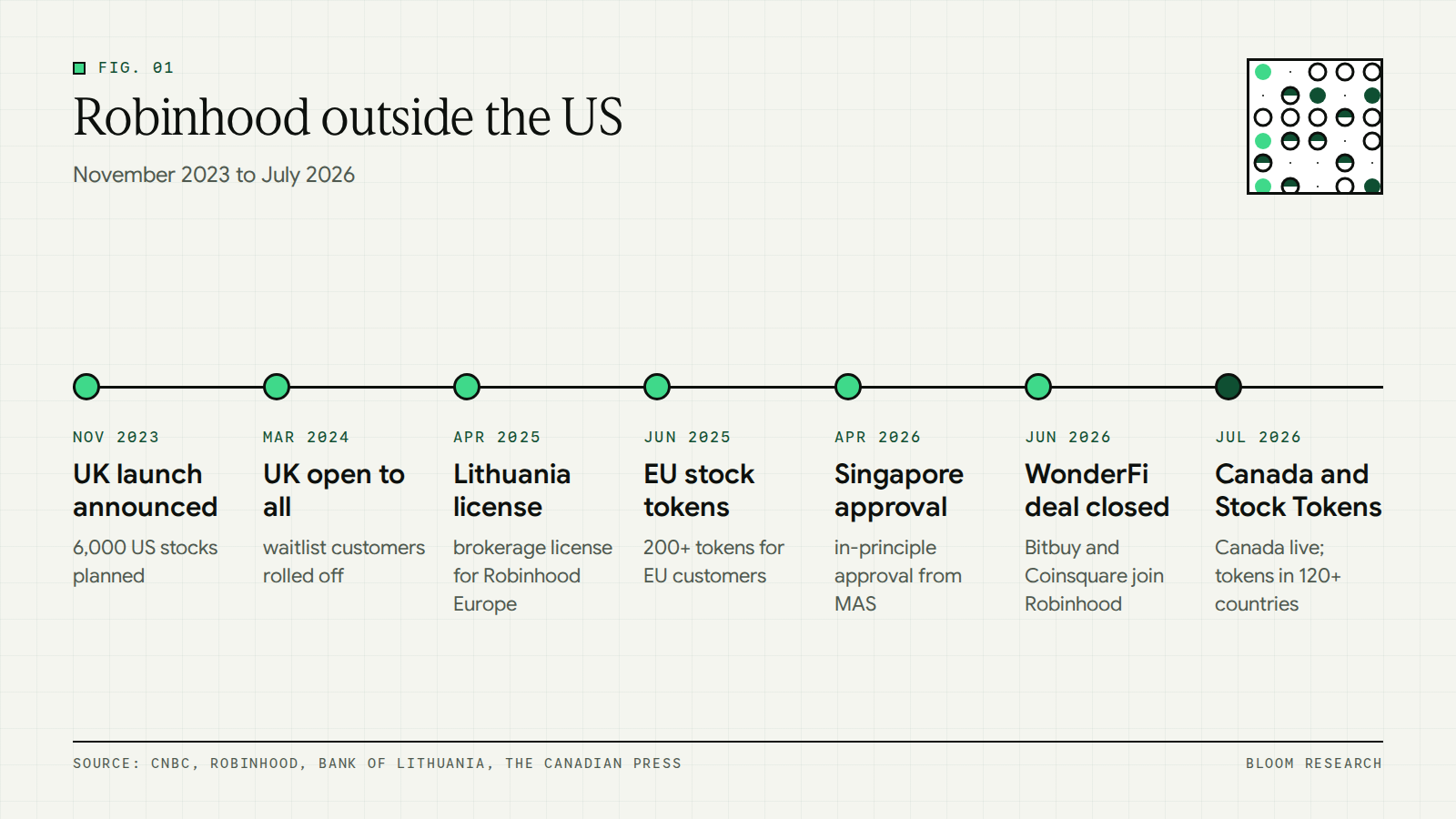
CNBC reported on November 30, 2023 that Robinhood was set to launch in the UK in its third attempt at international expansion, with a choice of 6,000 US stocks. On March 19, 2024, Robinhood said it had rolled all eligible customers off its waitlist and was officially available throughout the United Kingdom.
The Financial Conduct Authority (FCA) is the UK regulator that regulates the conduct of financial services businesses in the UK. Robinhood U.K. Ltd is authorized and regulated by the FCA under firm reference number 823590. Robinhood UK introduces UK customers to Robinhood Securities, LLC for order routing, execution, clearing, settlement and arranging custody services.
To apply for a Robinhood UK brokerage account, an applicant must be 18 or older, hold a valid National Insurance number and have a UK bank account. The applicant also needs a UK residential address, must be a UK resident for income tax purposes and must not be a US person. Our United Kingdom guide to tokenized US stocks lists funding rails, currency and popular stocks, and notes that a sterling-based investor holds GBP/USD exposure on Bloom because we settle in US-dollar stablecoins.
European Union
The Bank of Lithuania register entry for Robinhood Europe, UAB shows three licenses. It lists a Category A financial brokerage firm license valid from April 3, 2025, a crypto-asset service provider license valid from May 29, 2025 and a payment institution license valid from March 12, 2026.
Robinhood states that Robinhood Europe, UAB (RHEU) is authorized and regulated by the Bank of Lithuania as a financial brokerage firm and a crypto-asset service provider. Robinhood Stock Tokens are Robinhood's product that gives eligible customers exposure to US equities through tokens. On June 30, 2025, Robinhood launched US stock and ETF tokens in the EU and said European customers would have access to 200+ US stock and ETF tokens.
Canada, Singapore and Robinhood Wallet Stock Tokens
The Canadian Press, in a report published by BNN Bloomberg on June 1, 2026, said Robinhood expanded into Canada by closing its acquisition of WonderFi. WonderFi's Bitbuy and Coinsquare platforms will become part of the Robinhood brand. The report said the deal brought Robinhood's international funded customer base to one million, an increase of 300,000.
On July 1, 2026, Robinhood announced that it is officially available to Canadian residents. In Singapore, Robinhood received in-principle approval from the Monetary Authority of Singapore on April 23, 2026, and Robinhood said that approval does not constitute a license to provide brokerage services. In July 2026, Robinhood said Robinhood Singapore had received its capital markets services license from MAS, a step towards offering brokerage services to customers in the future.
Robinhood also said on July 1, 2026 that Stock Tokens are available on the Robinhood Wallet in more than 120 countries. The same announcement said Stock Tokens are not available in the US or to US persons and are subject to restrictions in other jurisdictions. CFOtech reported that availability varies by jurisdiction.
Note: Robinhood says Stock Tokens are not available to residents of the United States, Canada, the United Kingdom or Switzerland. The product offered in a country can therefore differ from Robinhood's brokerage account in that country.
#Is Robinhood available in India?
As the sections above show, the US account needs an SSN and a US address, the UK account needs UK residency and a National Insurance number, and EU access runs through Robinhood Europe, UAB, regulated by the Bank of Lithuania.
For Stock Tokens on the Robinhood Wallet, Robinhood lists more than 120 countries and states that the product is subject to restrictions in other jurisdictions. CFOtech also reported that Stock Token availability varies by jurisdiction.
Any overseas investment by an Indian resident also falls under India's remittance and reporting rules. The next section sets out those rules and the routes that operate within them. Our country guides for tokenized US stocks list funding rails, currency and popular stocks for each country we cover.
#Robinhood alternatives for international investors: five route types
The routes to US stocks for people outside the US differ in what you hold, who holds the underlying asset, how you fund the purchase and which home-country rules apply. The table below sets out five types of Robinhood alternatives, using published facts for each one.
The first route is an international brokerage account. That term means a brokerage account opened with a broker in another country; in this guide, it refers to a US-market broker that accepts non-US residents.
| Route | What you hold | Who holds the underlying asset | How it is funded | Eligibility and limits |
|---|---|---|---|---|
| Global broker account (Interactive Brokers, Charles Schwab International) | Shares in a brokerage account | The broker | Transfer from a bank account | IBKR Pro and IBKR Lite list a USD 0.00 account minimum; Schwab accepts residents of a qualifying country |
| Overseas investing from India under LRS | Shares at an overseas broker | The overseas broker | Remittance through a designated AD bank branch | Up to USD 250,000 per financial year; TCS of 20% above ₹10 lakh |
| NSE IFSC Receipts in GIFT City | A receipt issued against a US share | Market makers buy the shares in the US | Remittance under LRS | Transactions within LRS limits |
| International mutual funds in India | Units of an Indian scheme bought in rupees | The fund invests per its overseas mandate | Rupees | SEBI overseas investment limits for mutual funds |
| Tokenized stocks (Bloom) | An on-chain token in your own embedded wallet | A real share in custody at a regulated US broker-dealer | Stablecoins | Not offered in the United States or other restricted jurisdictions; trades from $1 |
We settle trades in stablecoins, and our guides to buying US stocks with crypto cover funding with USDC, USDT, SOL, ETH and BTC.
#Global brokers that accept non-US residents
Interactive Brokers
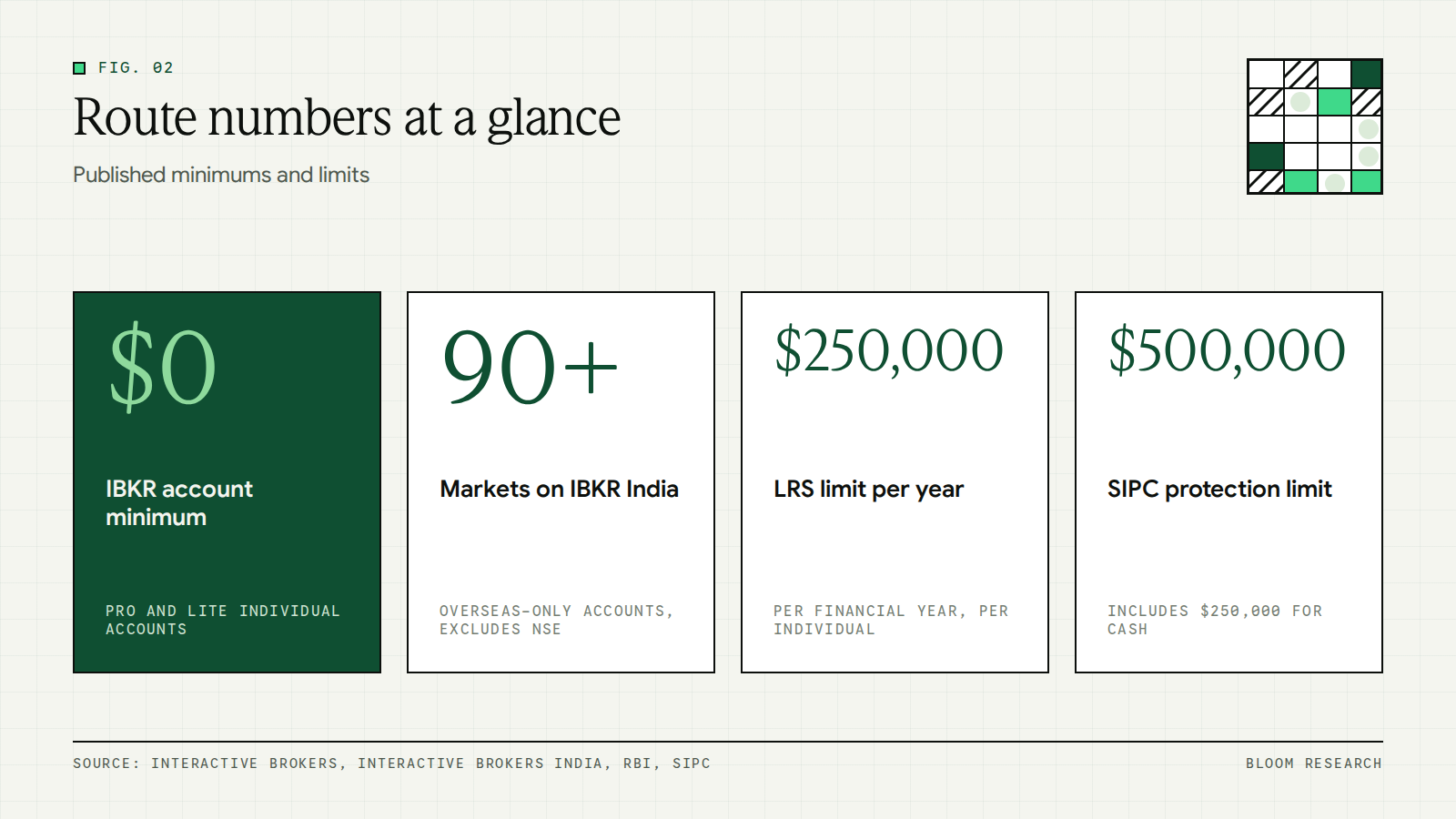
Interactive Brokers lists account minimums of USD 0.00 and inactivity fees of USD 0.00 for IBKR Pro and IBKR Lite individual accounts. Indian resident individuals can open an account through Interactive Brokers India to trade overseas only.
That account gives access to over 90 worldwide markets, excluding the NSE, and it is a cash account only. Applicants must be 18 or older. USD 500 or the non-USD equivalent is the minimum required to subscribe to and maintain market data and research subscriptions.
The Interactive Brokers India application page asks applicants to keep these items ready:
- A PAN card, so that the PAN number is entered correctly
- Address proof, so that the address and PIN code match the document
- A bank check, so that the bank account number, MICR code and branch address match the check
- Financial documents, so that the net income and liquid net worth figures are correct
Interactive Brokers India conducts a web-cam in-person verification after it receives the application form and documents.
Charles Schwab International
Investors who live outside the US can open an international account through Schwab.com if they live in a qualifying country. Schwab asks applicants to prepare electronic copies of documents that include a valid passport or government ID and proof of residence. Its restricted-country page states that, due to US federal laws and regulations, Schwab cannot accept applications from residents of some countries or regions.
Note: SIPC, the Securities Investor Protection Corporation, protects against the loss of cash and securities, such as stocks and bonds, held by a customer at a financially troubled SIPC-member brokerage firm. The limit of SIPC protection is $500,000, which includes a $250,000 limit for cash.
Our guide to the W-8BEN form explains the IRS form that US brokers request from non-US account holders.
#India-specific routes to US stocks
Our guide to investing in US stocks from India compares overseas brokers, GIFT City receipts, mutual funds and tokenized stocks in more detail. The sections below summarize the published rules for each India route.
Overseas investing under LRS
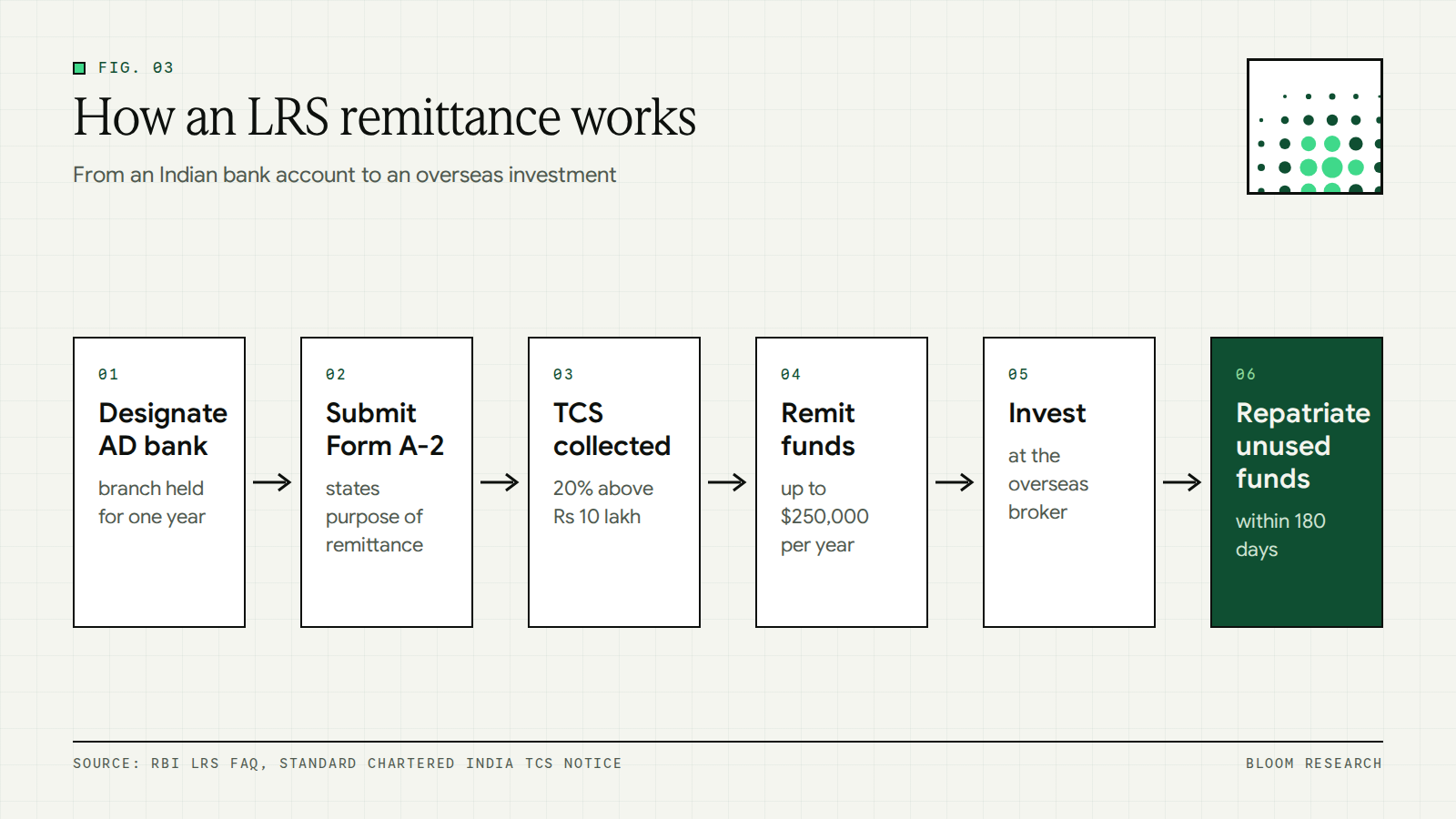
The Liberalised Remittance Scheme (LRS) is the RBI scheme under which all resident individuals, including minors, can remit up to USD 250,000 per financial year (April to March). The money can go to any permissible current or capital account transaction, or a combination of both. The RBI's LRS FAQ lists investment among the capital account transactions.
Each remitter must designate a branch of an AD bank (authorized dealer bank) through which all capital account remittances under the scheme will be made. The applicant must have held the bank account for a minimum of one year before the remittance. The remitter also furnishes Form A-2, which states the purpose of the remittance and declares that the funds belong to the remitter.
An investor who remitted funds under LRS can retain and reinvest the income earned from those investments. Foreign exchange that is received, realized, unspent or unused and not reinvested must be repatriated and surrendered to an authorized person within 180 days.
Tax Collected at Source (TCS) is an amount the bank recovers from the remitter's account on an LRS remittance. From April 1, 2026, banks apply TCS on other LRS purposes, such as investing, at nil up to ₹10 lakh and at 20% above ₹10 lakh. All remittances made under LRS in a financial year are liable for TCS at these rates, and the TCS credit can be claimed when filing the income tax return.
Schedule FA is the foreign assets schedule that residents file for foreign holdings. The Central Board of Direct Taxes (CBDT) states that accurate Schedule FA and FSI reporting is mandatory under the Black Money Act, 2015.
Important: LRS limits, TCS and foreign asset reporting are set by the RBI and the Indian tax authorities, and each remitter is responsible for meeting them on every route described in this guide.
NSE IFSC Receipts in GIFT City
NSE IFSC Receipts are receipts that market makers issue against US shares they buy in the US. In coverage of the 2022 launch republished on NSE's website, market makers buy the shares and issue receipts against them, so the holder has a receipt rather than the share. The same coverage states that Indian retail investors can transact on the NSE IFSC platform within the LRS limits prescribed by the RBI.
International mutual funds
An investor buys units of an Indian mutual fund scheme in rupees. The asset management company then invests the money according to the scheme's stated overseas mandate. These schemes may invest directly in overseas securities, track an international index or invest through an overseas mutual fund or exchange-traded fund (ETF).
SEBI sets overseas investment limits for mutual funds in India. On Bloom, US ETFs such as S&P 500 and total-market index funds are available as tokens, each backed 1:1 by the real fund share, funded with stablecoins, from $1.
Our comparison of Vested vs INDmoney vs Bloom sets two LRS-based apps and our tokens side by side.
#Tokenized stocks as a Robinhood alternative
A tokenized stock is a blockchain token linked to a listed share or exchange-traded fund (ETF). Robinhood and Bloom both offer tokenized US stocks and ETFs to investors outside the US, and the two products use different legal structures.
In a statement on tokenized securities from SEC staff dated January 28, 2026, the staff said that the format in which a security is issued, onchain or offchain, does not affect application of the federal securities laws. The same statement said that holders of a tokenized security issued by a third party may be exposed to risks with respect to that third party, such as bankruptcy. A holder of the underlying security would not necessarily be exposed to those third-party risks.
How Robinhood Stock Tokens are structured
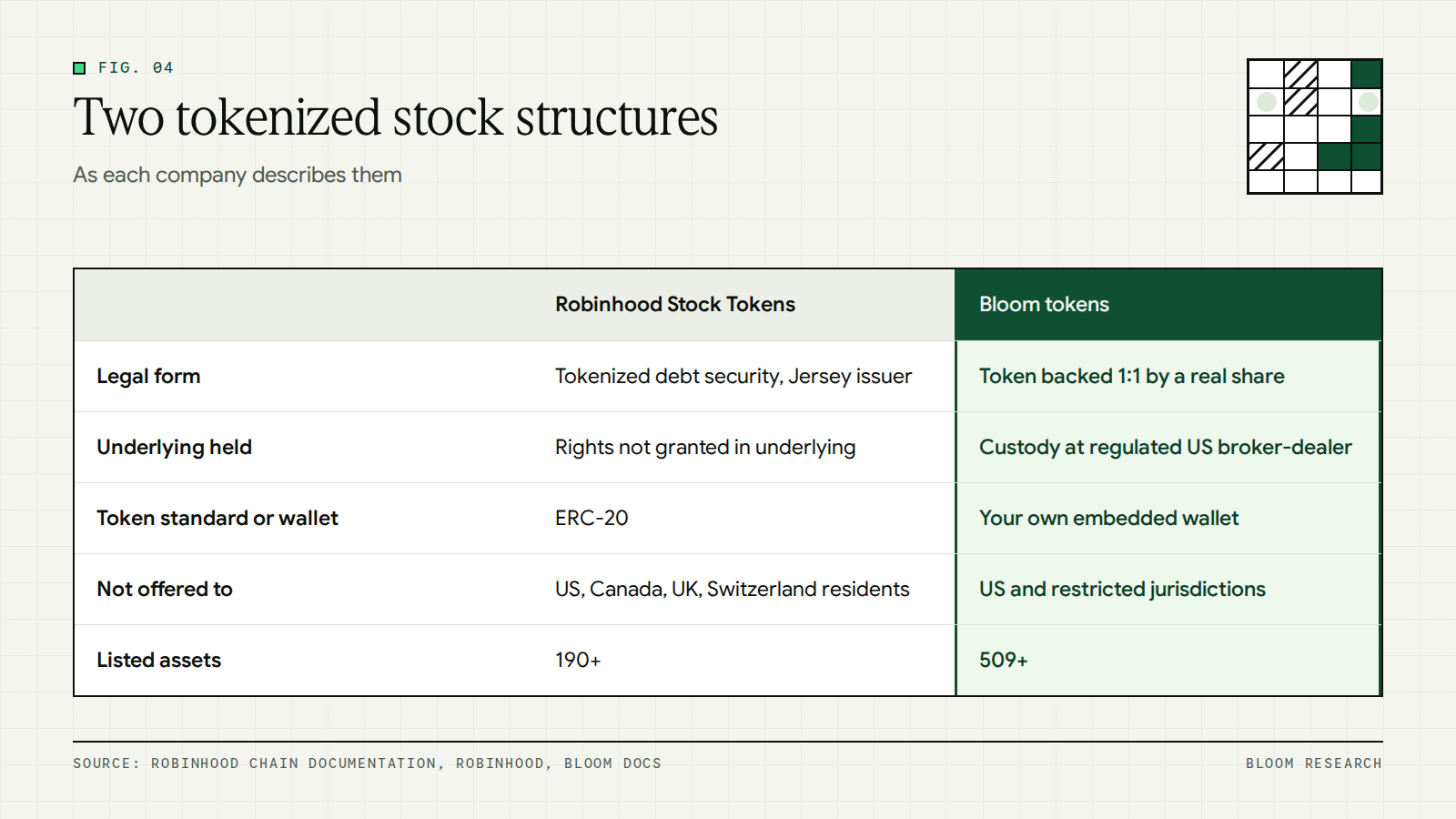
Robinhood's documentation describes Stock Tokens as tokenized debt securities issued by Robinhood Assets (Jersey) Limited. The product provides economic exposure to underlying securities such as US shares and ETFs. It does not grant investors any legal or beneficial rights in those underlying securities or against their issuer.
The documentation states that Stock Tokens are issued as standard ERC-20 tokens. Robinhood lists 190+ Stock Tokens.
How our tokens are structured
Each asset on Bloom is an on-chain token backed 1:1 by a real share held in custody at a regulated US broker-dealer such as Alpaca Markets or Interactive Brokers. The token is held in your own embedded wallet, so you retain custody and can move or trade it at any time. Our tokenized stocks documentation explains how each token tracks the price of its underlying share. Customer assets at these brokers are held in segregated custody, separately from the broker's own funds.
Our custody and backing documentation sets out what happens if Bloom discontinues operations. In that case, a designated security agent, GenTwo, works directly with the custodian to redeem outstanding tokens against the underlying shares for token holders. Our risk disclosure states that this redemption depends on the continued operation of the broker partner.
Net asset value (NAV) is the on-chain value of a tokenized asset, reflecting price, accrued dividends and corporate actions. When the underlying company pays a dividend, the cash is used to buy more of the underlying shares. The on-chain NAV of the token then increases to reflect the added shares per token, with no separate cash distribution.
The Transparency page, described in our proof of reserves documentation, shows the live token supply for every asset. For each asset it also shows the attested broker balance, the backing ratio and a link to the on-chain attestation contract.
#How to compare apps like Robinhood outside the US
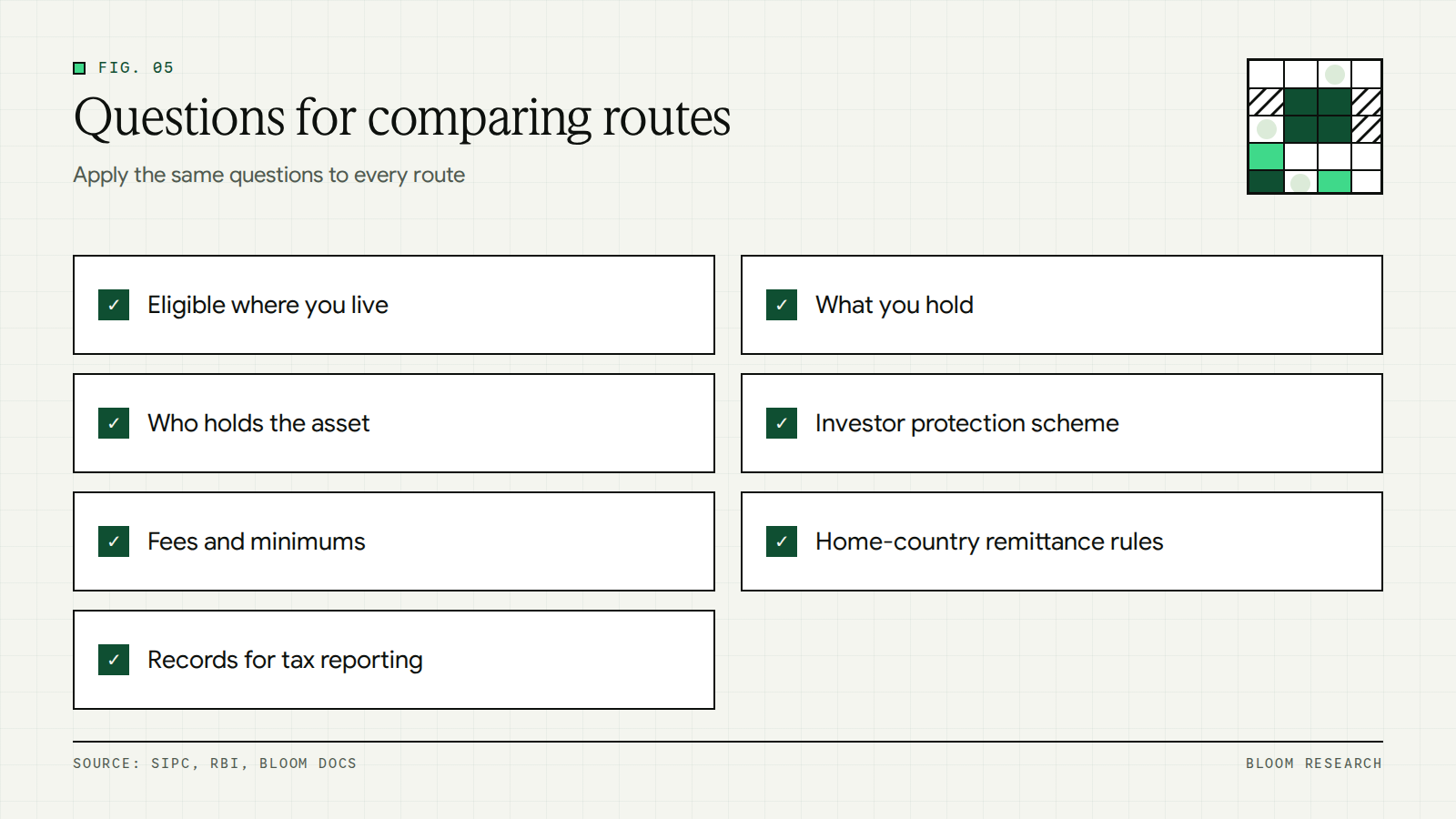
The same seven questions apply to all the Robinhood alternatives in this guide, from global brokers to India-specific routes and tokenized stocks. Each question below uses published facts from the providers and regulators named earlier.
- Eligibility: Robinhood's US account asks for a Social Security Number and a US residential address, its UK account asks for a UK residential address, and Schwab opens international accounts for people who live in a qualifying country.
- What you hold: depending on the route, the holder has a share, a receipt issued against a US share, units of an Indian mutual fund scheme bought in rupees, or a token.
- Who holds the underlying asset: Robinhood UK introduces UK customers to Robinhood Securities, LLC for arranging custody services, and our tokens are backed by shares held in custody at regulated US broker-dealers.
- Investor protection: SIPC protects against the loss of cash and securities held by a customer at a financially troubled SIPC-member brokerage firm.
- Fees and minimums: Interactive Brokers lists USD 0.00 account minimums for IBKR Pro and IBKR Lite, and our trading fee is 0.10% to 0.20% with a minimum trade of $1.
- Home-country funding rules: resident individuals in India can remit up to USD 250,000 per financial year under LRS, and banks apply TCS at 20% above ₹10 lakh on other LRS purposes such as investing.
- Records for tax reporting: we do not file taxes or give tax advice, and Portfolio exports a complete CSV of every trade and transaction.
#Investing in US stocks from outside the US with Bloom
On Bloom: Our trading fee ranges from 0.10% to 0.20%, the default rate is 0.20%, and the fee drops as your 14-day trading volume grows. The fee is included in the quoted price you see in the trade sheet. Network gas is charged per trade, there is no account minimum, and you can trade from $1. Fractional shares are supported down to six decimal places on every asset. We do not charge deposit fees, withdrawal fees, custody fees, inactivity fees or FX markups, and our pricing page lists each fee.
We list 509+ tokenized stocks and ETFs in total. Each one is an on-chain token backed 1:1 by a real share or fund share held in custody at a regulated US broker-dealer.
Our India investor guide describes funding from India. To hold USDC from India, rupees are generally converted into stablecoins through a locally operating exchange that supports on-chain withdrawals. The USDC is then moved to a self-custody wallet under the investor's own keys. Because we settle in USD stablecoins, an investor holds INR/USD exchange-rate exposure in addition to the price movement of the stock itself.
The same guide notes that the treatment of tokenized securities can differ from that of directly held shares. Rupee funding through an exchange does not change any obligation under the LRS, TCS and Schedule FA rules covered in the India section above.
Important: Our tokens are on-chain assets in your own wallet, not a SIPC-eligible brokerage account. Most transfers of customer accounts between US brokerage firms occur through the Automated Customer Account Transfer Service (ACATS), and no direct ACATS path exists between a US brokerage account and a tokenized-stock platform. Investor-protection arrangements apply within the jurisdictional limits of each broker, and protection is not unlimited.
Trading on Bloom carries risk, including the loss of principal. Our risk disclosure summarizes the major categories, including market risk, smart contract risk, custody risk and liquidity risk. It also covers bridging and chain risk, since cross-chain bridges and the underlying blockchains can be congested, halted or compromised.
We do not offer our product or services to users in the United States or in other restricted jurisdictions. Our service availability documentation states that these restrictions are enforced regardless of how a user authenticates. Our legal page states that the list of restricted jurisdictions is maintained operationally and may be updated as regulations evolve. Bloom is in public beta.
Frequently asked questions
Is there a better platform than Robinhood?
No single answer applies in every country, because platforms publish different eligibility rules by country. Robinhood's US account requires a valid Social Security Number and a legal US residential address. Interactive Brokers lists account minimums of USD 0.00 for IBKR Pro and IBKR Lite individual accounts. Charles Schwab says investors who live outside the US can open an international account if they live in a qualifying country.
What apps are similar to Robinhood?
Similar routes include Robinhood's own UK app for UK residents and its EU services through Robinhood Europe, UAB. Global brokers such as Interactive Brokers and Charles Schwab International accept some non-US residents, with Schwab limited to qualifying countries. India has its own routes under LRS. Tokenized stocks such as Bloom are another route, where each token is backed 1:1 by a real share held in custody at a regulated US broker-dealer.
Can I use Robinhood in India?
Robinhood's US account requires a valid Social Security Number, a legal US residential address, and US citizenship, US permanent residency or a valid US visa. Its UK account requires a National Insurance number, a UK bank account, a UK residential address and UK tax residency. For Stock Tokens on the Robinhood Wallet, availability varies by jurisdiction, so the terms Robinhood publishes for each country apply.
Can I use Robinhood outside the US?
Robinhood operates in several places outside the US. Robinhood U.K. Ltd is regulated by the FCA, and Robinhood said on March 19, 2024 that it was available throughout the United Kingdom. Robinhood Europe, UAB is regulated by the Bank of Lithuania and launched stock tokens in the EU on June 30, 2025. Robinhood announced availability to Canadian residents on July 1, 2026, and Stock Tokens on the Robinhood Wallet in more than 120 countries.
What is an international brokerage account?
An international brokerage account is a brokerage account opened with a broker in another country, here a broker for US markets that accepts non-US residents. Interactive Brokers lists USD 0.00 account minimums for IBKR Pro and IBKR Lite. Its Indian resident accounts for overseas trading cover over 90 worldwide markets, excluding the NSE. Charles Schwab opens international accounts for investors who live in a qualifying country.
Who is Robinhood's rival?
Robinhood's rivals for investors outside the US fall into route types rather than one company. Global brokers such as Interactive Brokers and Charles Schwab accept some non-US residents. Indian residents also have routes under LRS, such as overseas broker accounts and NSE IFSC Receipts. Tokenized stocks are another route, including Robinhood's own Stock Tokens and Bloom, where each token is backed 1:1 by a real share in custody.
Does Bloom have SIPC coverage?
No. The tokens you hold on Bloom are on-chain assets in your own wallet, not a SIPC-eligible brokerage account. Each token is backed 1:1 by a real share held in custody at a regulated US broker-dealer such as Alpaca Markets or Interactive Brokers. Investor-protection arrangements apply within the jurisdictional limits of each broker, and that protection is not unlimited.