
USDC vs USDT: Which Stablecoin Should You Hold in 2026?
USDC vs USDT compared with issuer data: who issues each, reserves and attestations, GENIUS Act and MiCA status, chains, supply, redemption and depeg history.
Key takeaways
- USDC is issued by regulated affiliates of Circle. USDT is issued by Tether, and its Q2 2026 attestation was published by Tether International, S.A. de C.V.
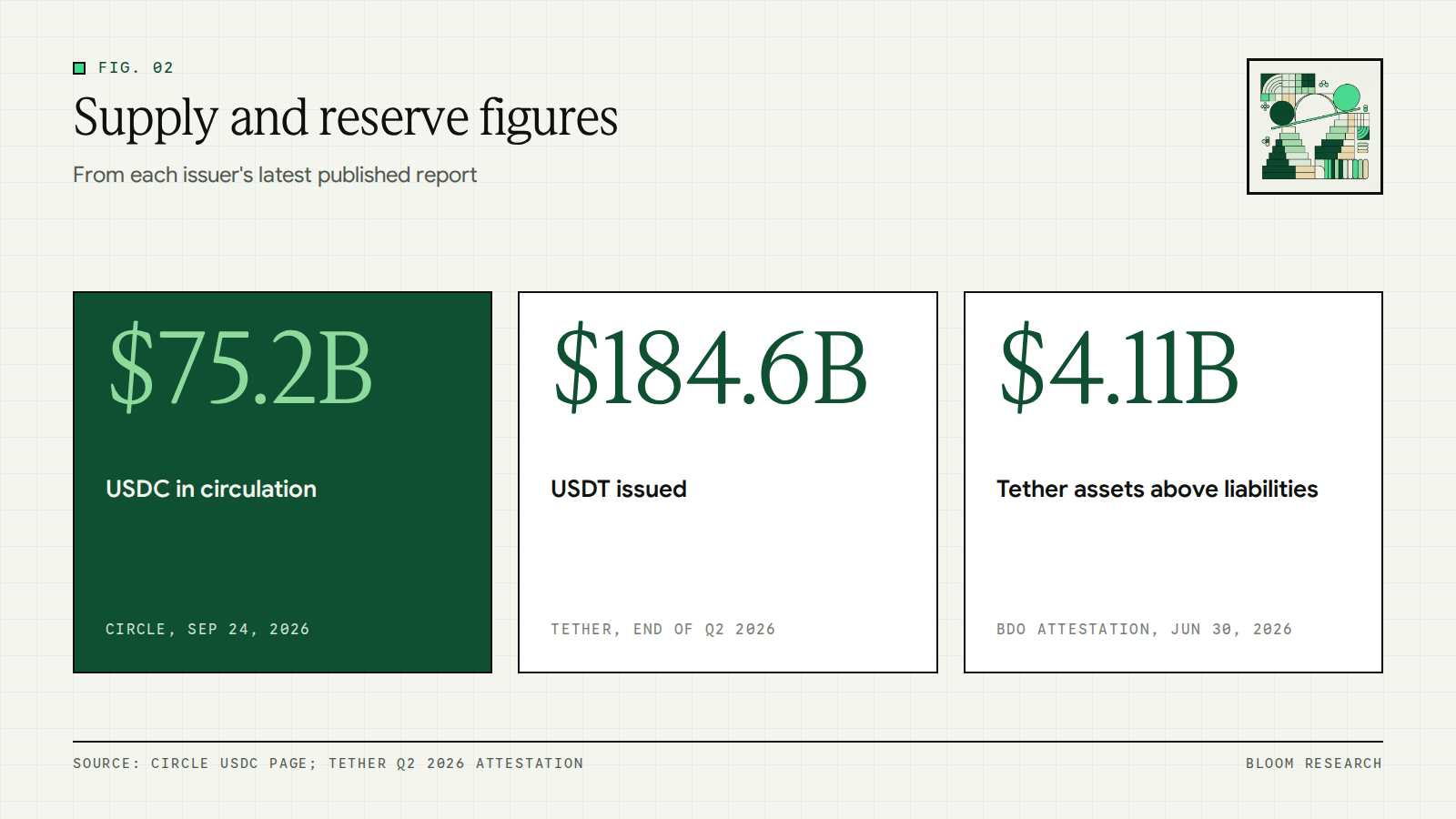
- Circle reported $75.2 billion of USDC in circulation on September 24, 2026. Tether reported about $184.6 billion of USDT issued at the end of Q2 2026.
- Circle publishes monthly reserve attestations by a Big Four accounting firm. Tether's Q2 2026 attestation, prepared by BDO, showed assets exceeding liabilities by about $4.11 billion on June 30, 2026.
- ESMA's interim MiCA register lists Circle Internet Financial Europe SAS as an e-money token issuer and lists no Tether entity. Tether says USDT is progressing towards GENIUS Act compliance.
- On Bloom, the trading balance is a unified USD balance backed 1:1 by USDC and USDT, so it shows no exchange-rate drift between the two tokens.
USDC vs USDT is a comparison of two US-dollar stablecoins from two different companies: USDC is issued by regulated affiliates of Circle, and USDT is issued by Tether. Both tokens are designed to track one US dollar, but they differ in who issues them, how their reserves are reported, which regulators have authorized them, which blockchains carry them and who can redeem them with the issuer.
This guide answers the question in the title with sourced facts only. We do not recommend one token over the other. Instead, we set out issuer, reserve, attestation, regulatory, chain, supply, redemption and depeg data from Circle, Tether and regulators, with a date on each figure. Our guides to funding with crypto cover both tokens, and on Bloom the USD trading balance is backed 1:1 by USDC and USDT.
The comparison below uses the issuers' own pages and reports as of September 2026. Where a figure comes from a quarterly report rather than a live page, we say so, because a USDT vs USDC supply comparison is only meaningful when the dates are visible.
#USDC vs USDT at a glance
The table sets out the main differences, with the source date for each figure.
| Feature | USDC | USDT |
|---|---|---|
| Issuer | Regulated affiliates of Circle | Tether; Q2 2026 attestation published by Tether International, S.A. de C.V. |
| Supply | $75.2 billion in circulation (September 24, 2026) | About $184.6 billion issued (end of Q2 2026) |
| Blockchains | Natively supported on 38 blockchain networks (September 16, 2026) | Ethereum, Tron, Solana, Avalanche, Ton, Aptos and other supported protocols |
| Reserve reporting | Monthly reserve attestations by a Big Four accounting firm | Q2 2026 attestation prepared by BDO, as of June 30, 2026 |
| Direct redemption | Circle Mint, for institutional customers only | Minimum 100,000 USD; fee is the greater of $1,000 or 0.1% |
| EU MiCA register | Circle Internet Financial Europe SAS listed as an e-money token issuer | No Tether entity listed |
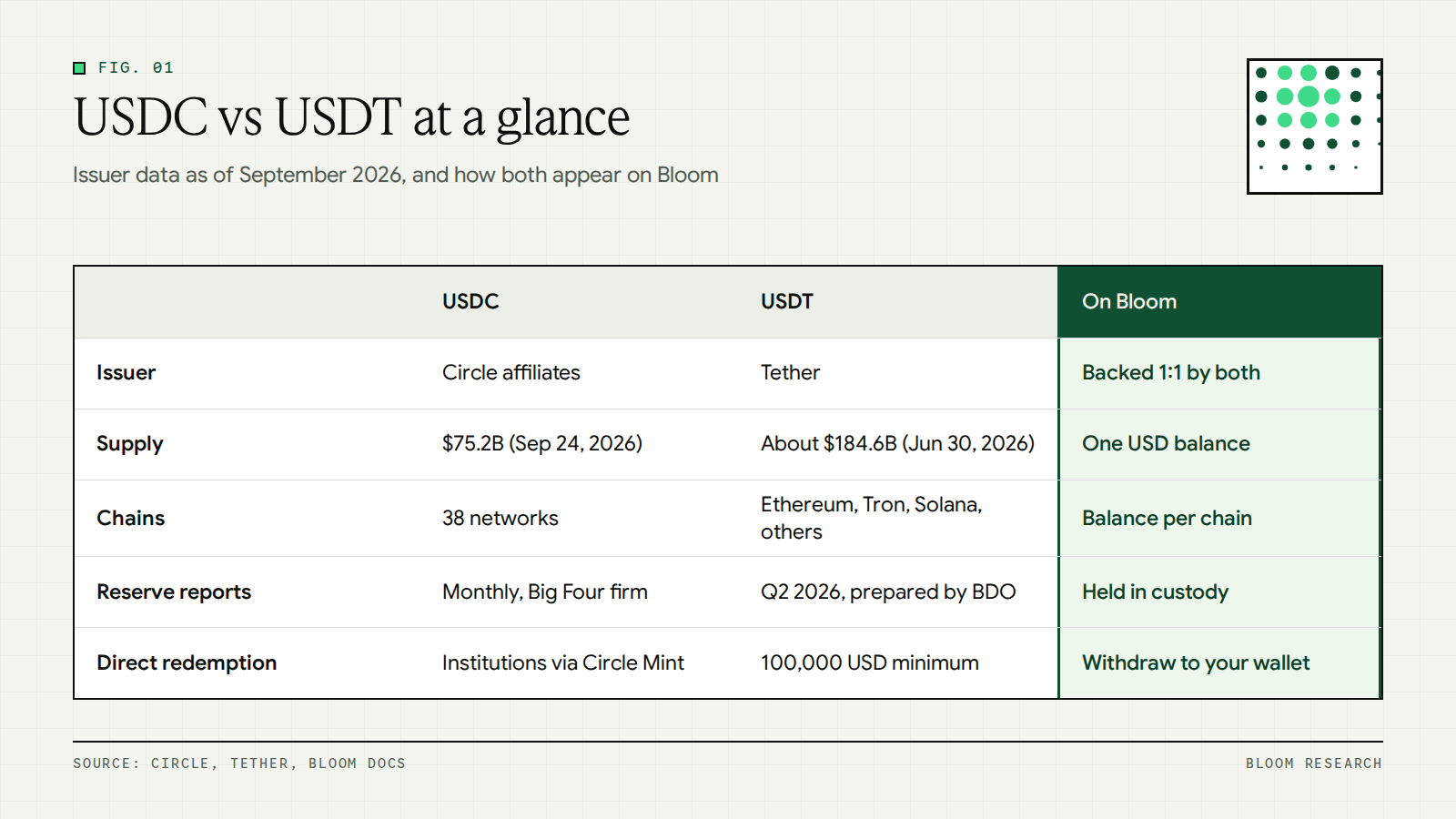
Each row is explained in the sections that follow, with a link to the issuer or regulator page behind it. The reserve, depeg and redemption rows are covered in detail after the chain and supply figures.
#Who issues USDC and USDT
The issuer is the company that creates new tokens, holds the reserve assets and redeems tokens for dollars. For these two stablecoins, the issuers are separate companies with separate reserves and separate legal entities. Knowing which entity issues a token also shows which regulator supervises it and which reports to read.
Circle and USDC
Circle states that USDC is issued by regulated affiliates of Circle and is 100% backed by highly liquid cash and cash-equivalent assets, with holdings that equal or exceed the amount in circulation. Circle's USDC page also states that Deloitte & Touche LLP is Circle's independent auditor and has audited Circle's financials since fiscal year 2022. That audit covers Circle's financials; the reserve reports behind USDC are separate monthly attestations, described in the reserves section.
In the European Union, USDC is issued by Circle's French entity, Circle Internet Financial Europe SAS, a licensed Electronic Money Institution in France. The same French entity also issues EURC, Circle's euro stablecoin, which this guide does not cover. Our USDC funding guide describes USD Coin (USDC) as a US-dollar stablecoin whose value tracks the dollar.
Tether and USDT
USDT is issued by Tether. Its most recent reserve attestation, for Q2 of 2026, was published by Tether International, S.A. de C.V., and Tether's fees page is published by Tether Operations, S.A. de C.V. Tether writes the ticker as USD₮ in its own materials, and this guide uses USDT throughout.
Tether also supports a separate token called USA₮, which is issued by Anchorage Digital Bank, N.A., not by Tether Operations, S.A. de C.V. USA₮ is not USDT, and the regulatory section below explains how it relates to the GENIUS Act. Our Tether (USDT) page describes Tether (USDT) as a US-dollar stablecoin whose value tracks the dollar.
#Chains and supply
Both tokens exist on many blockchains at once. The chain matters in practice because each network has its own contract address and, on our deposit screen, its own estimated finality time.
Where each token is issued
Native support means the issuer itself issues the token on that blockchain, rather than a third party wrapping a token from another chain. Circle states that USDC is natively supported on 38 blockchain networks as of September 16, 2026. The chains named on Circle's USDC page include Ethereum, Solana, Arbitrum, Base, Avalanche, Polygon PoS, Stellar and Sui, among others. Circle's list also includes Algorand, which is one of the chains where Tether states it no longer issues or redeems USDT.
Tether's supported protocols page lists a USDT contract address for each network it supports, including Ethereum, Tron, Solana, Avalanche, Ton, Aptos, Near and Tezos. Tether states that 1 Tether token on one blockchain equals 1 Tether token on another and that the tokens should be treated as interchangeable. Tether also states that it is no longer issuing or obligated to redeem Tether tokens on the Kusama, Bitcoin Cash SLP, Omni Layer, EOS and Algorand blockchains.
On Bloom, when you receive USDC from an external wallet, you pick the network in the deposit flow, and each supported network shows its own address and QR code. The deposit screen lists the chains supported at any given moment.
Supply figures and dates
Circle reports $75.2 billion of USDC in circulation as of September 24, 2026. Tether's Q2 2026 attestation reports approximately $184.6 billion in USDT issued at the end of Q2, around $446 million higher than at the end of Q1. Supply for both tokens changes as tokens are minted and redeemed, so each figure applies only to its stated date.
Tether also states that USDT's market share extended to over 60% of the total stablecoin market during that quarter, a figure Tether reported for its own token.
Key point: The USDC figure is dated September 24, 2026 and the USDT figure is dated June 30, 2026. The two numbers come from different reports on different dates, so they are not a same-day comparison of supply.
Supply shows how many tokens are outstanding. It does not show what backs them, so the next section compares the reserve reports that each issuer publishes.
#How the reserves behind each token compare
Reserves are the assets an issuer holds so that it can pay out dollars when tokens are redeemed. For the USDC vs USDT reserve comparison, this section sets out what Circle and Tether each say they hold, who checks those statements and how often.
Definition: An attestation is a report in which an independent accountant checks specific statements made by a company's management, such as the value of its reserves on a stated date. It is narrower than a full audit of the company's financial statements.
What backs USDC
According to Circle's transparency page, the majority of the USDC reserve is held in the Circle Reserve Fund (USDXX), which Circle describes as an SEC-registered 2a-7 government money market fund. The remainder of the reserve is held in cash, mostly among a handful of the world's largest banks. The Circle Reserve Fund can contain cash, short-dated US Treasuries and overnight US Treasury repurchase agreements with leading global banks.
Circle states that daily, independent, third-party reporting on the fund's portfolio is publicly available via BlackRock. In addition, a Big Four accounting firm provides monthly third-party assurance that the value of USDC reserves is greater than the amount of USDC in circulation. Circle says these reports are prepared according to attestation standards set out by the American Institute of Certified Public Accountants (AICPA).
What backs USDT
Tether's attestation for Q2 2026, prepared by BDO, reports management's figures as of June 30, 2026. Total assets were US$187,751,426,411 and total liabilities were US$183,641,897,215, of which US$183,622,105,630 related to digital tokens issued. Assets exceeded liabilities by US$4,109,529,196, which Tether rounds to about $4.11 billion.
Tether states that the majority of its reserves remain in U.S. government-backed instruments and short-term liquidity facilities. The reserves also include physical gold: Tether reported adding 14 tons during the quarter, taking its gold holdings to more than 146 tons. Tether also reported reducing its secured lending exposure by approximately $2.38 billion (15%), and it described the quarter as one of significant volatility across gold and Bitcoin.
How often each issuer reports
The two issuers publish on different schedules. Circle's reserve reports are monthly, and its transparency page showed data as of September 24, 2026. Tether's latest attestation covers the quarter to June 30, 2026, and Tether says information about Tether tokens in circulation is typically published daily. Tether's Q2 release states that its Big Four audit process continued during the quarter; it does not state that an audit was completed.
We apply the same idea of published backing to our own tokenized stocks. Our proof-of-reserves page shows live token supply, attested broker balance, backing ratio and the attestation contract for every asset.
#Depeg history: USDC in March 2023 and USDT reserve findings
A depeg is a period when a stablecoin trades away from its target value, which for both tokens is one US dollar. The two tokens have different histories on this point: USDC lost its peg during a banking event in 2023, and USDT was the subject of a US regulator's findings about its reserves in 2021.
USDC and Silicon Valley Bank
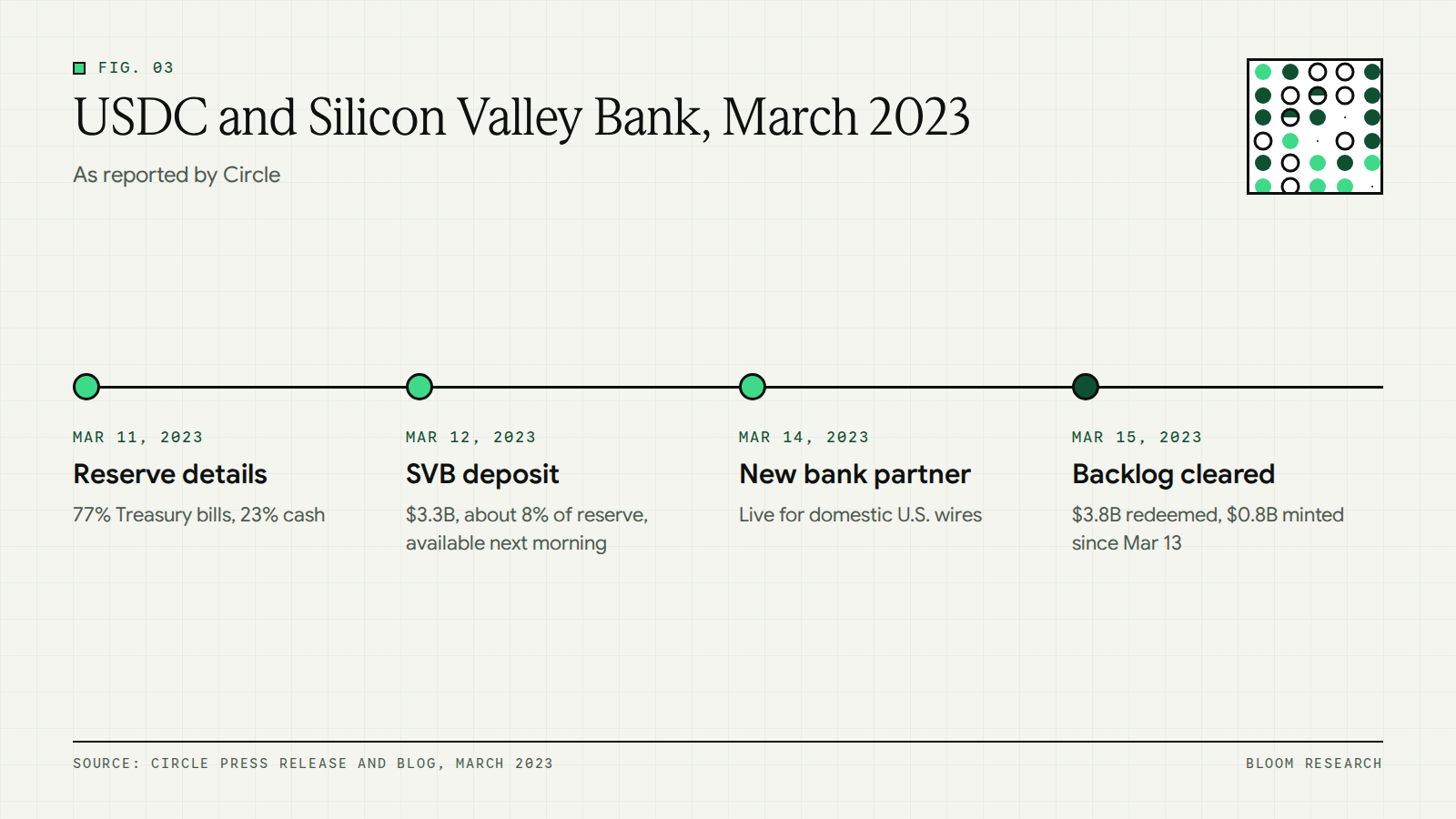
On March 11, 2023, Circle shared details of the USDC reserve: 77% ($32.4 billion) was held in short-dated U.S. Treasury Bills and 23% ($9.7 billion) in cash. The next day, following a joint announcement by the U.S. Treasury Secretary and US prudential regulators that all Silicon Valley Bank depositors would be made whole, Circle said its $3.3 billion USDC reserve deposit at Silicon Valley Bank, about 8% of the total reserve, would be fully available when U.S. banks opened. Circle titled that press release on the SVB deposit "Dollar De-peg Closes" and said no USDC cash reserves were held at Signature Bank.
In a March 15, 2023 update on USDC operations, Circle said it had cleared substantially all of the backlog of minting and redemption requests. Since the morning of Monday, March 13, Circle had redeemed $3.8 billion of USDC and minted $0.8 billion. Circle went live with a new banking partner for domestic U.S. wires on March 14, 2023.
USDT and the 2021 CFTC order
On October 15, 2021, the US Commodity Futures Trading Commission ordered Tether to pay a $41 million civil monetary penalty over claims that USDT was fully backed by US dollars. The order found that from at least June 1, 2016 to February 25, 2019, Tether misrepresented that it held sufficient US dollar reserves to back every USDT in circulation.
As found in the order, Tether held sufficient fiat reserves to back USDT in circulation for only 27.6% of the days in a 26-month sample period from 2016 through 2018. The order also found that Tether represented it would undergo routine, professional audits even though its reserves were not audited.
Important: These events describe what happened in 2016 to 2019 and in March 2023. They do not predict how either token will trade in the future, and every stablecoin depends on its issuer, its reserves and the banks and custodians that hold them.
#Redemption terms for each token
Redemption is the process of returning tokens to the issuer and receiving US dollars. The two issuers set different terms for who can redeem directly and at what cost.
- USDC: Circle Mint is for institutional customers, typically exchanges, institutional traders, wallet providers, banks and consumer-app companies, and states that USDC can be redeemed 1:1 for US dollars through Circle in 185+ countries.
- USDT: Tether sets a minimum acquisition or redemption amount of 100,000 USD.
- USDT: the fee per redemption is the greater of $1,000 or 0.1%, and the fee per acquisition is 0.1%.
- USDT: opening an account requires a 150 USD verification fee in Tether tokens, which is non-refundable, and Tether keeps sole discretion to approve accounts.
Tether's fees page also states that withdrawal requests for digital tokens held by Tether are evaluated per request and can take several days to process.
In practice: Circle Mint is not available to individuals, and Tether requires a verified account and a 100,000 USD minimum. Circle says individuals access USDC in the secondary market through a network of providers rather than through Circle itself.
#Regulatory status of USDC and USDT
Stablecoin rules differ by jurisdiction, so the regulatory side of USDC vs USDT is set out one jurisdiction at a time. The sections below cover the United States, the European Union, India and the United Kingdom, using the regulators' and issuers' own publications.
United States and the GENIUS Act
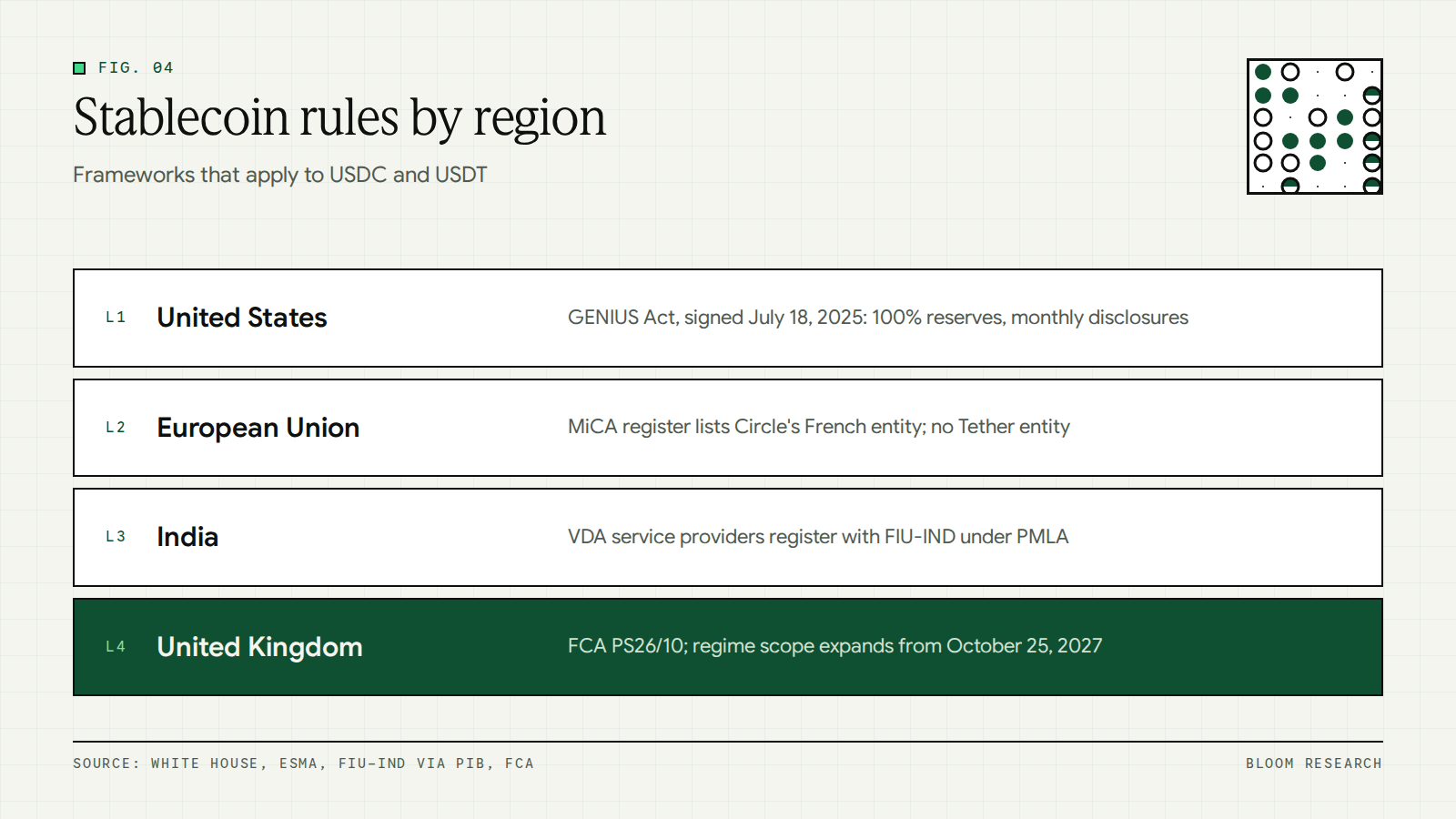
The GENIUS Act is the US federal law for payment stablecoins, signed by President Trump on July 18, 2025. According to the White House fact sheet on the GENIUS Act, the law creates the first federal regulatory system for stablecoins and requires 100% reserve backing with liquid assets like U.S. dollars or short-term Treasuries. It also requires issuers to make monthly, public disclosures of the composition of their reserves.
The fact sheet states that the Act prioritizes stablecoin holders' claims over all other creditors if an issuer becomes insolvent. It also states that all stablecoin issuers must have the technical capability to seize, freeze or burn payment stablecoins when legally required.
Tether has taken a two-token approach to the US framework. In its USA₮ launch announcement of January 27, 2026, Tether said USDT continues to operate globally while progressing towards GENIUS Act compliance, and that USA₮ was developed specifically to operate within the new federal stablecoin framework. USA₮ is issued by Anchorage Digital Bank, N.A., and Cantor Fitzgerald serves as the designated reserve custodian. Tether's announcement states that USA₮ is not legal tender and is not subject to FDIC or SIPC insurance protections.
European Union and MiCA
MiCA is the EU's Markets in Crypto-Assets Regulation. ESMA, the EU securities regulator, states that MiCA entered into force in June 2023 and that its key provisions for those issuing and trading crypto-assets, including asset-reference tokens and e-money tokens, cover transparency, disclosure, authorization and supervision. An e-money token is the MiCA category that Circle describes as covering stablecoins.
On July 1, 2024, Circle announced MiCA compliance for USDC after its French entity obtained an Electronic Money Institution license from the ACPR, the French banking regulator. In the same release, Circle stated that of the top 10 stablecoins by market capitalization, only USDC was then MiCA-compliant; that statement is dated July 1, 2024.
ESMA's MiCA page publishes an interim register, last updated on September 24, 2026, which includes a file of e-money token issuers. That file lists Circle Internet Financial Europe SAS, supervised by the ACPR, with an authorization date of July 1, 2024. We searched the same file for Tether and found no entry for a Tether entity.
Note: The EU register shows authorization status in the EU only. It does not describe how a token is treated in India, the United Kingdom or the United States, where separate rules apply.
India and the United Kingdom
In India, the Financial Intelligence Unit (FIU-IND) states that virtual digital asset service providers operating in India, whether offshore or onshore, are required to register with FIU-IND as reporting entities. They must also comply with the obligations set under the Prevention of Money Laundering Act, 2002. FIU-IND restated this in a September 9, 2026 release on notices to 15 VDA service providers.
In the United Kingdom, the FCA has published its cryptoasset regime policy statements, including PS26/10 on stablecoin issuance. The FCA says that policy statement covers rules on backing assets and safeguarding, redemption requirements and disclosures to holders. The FCA also states that the full scope of regulated activities under the regime will expand from October 25, 2027.
#How Bloom handles USDC and USDT
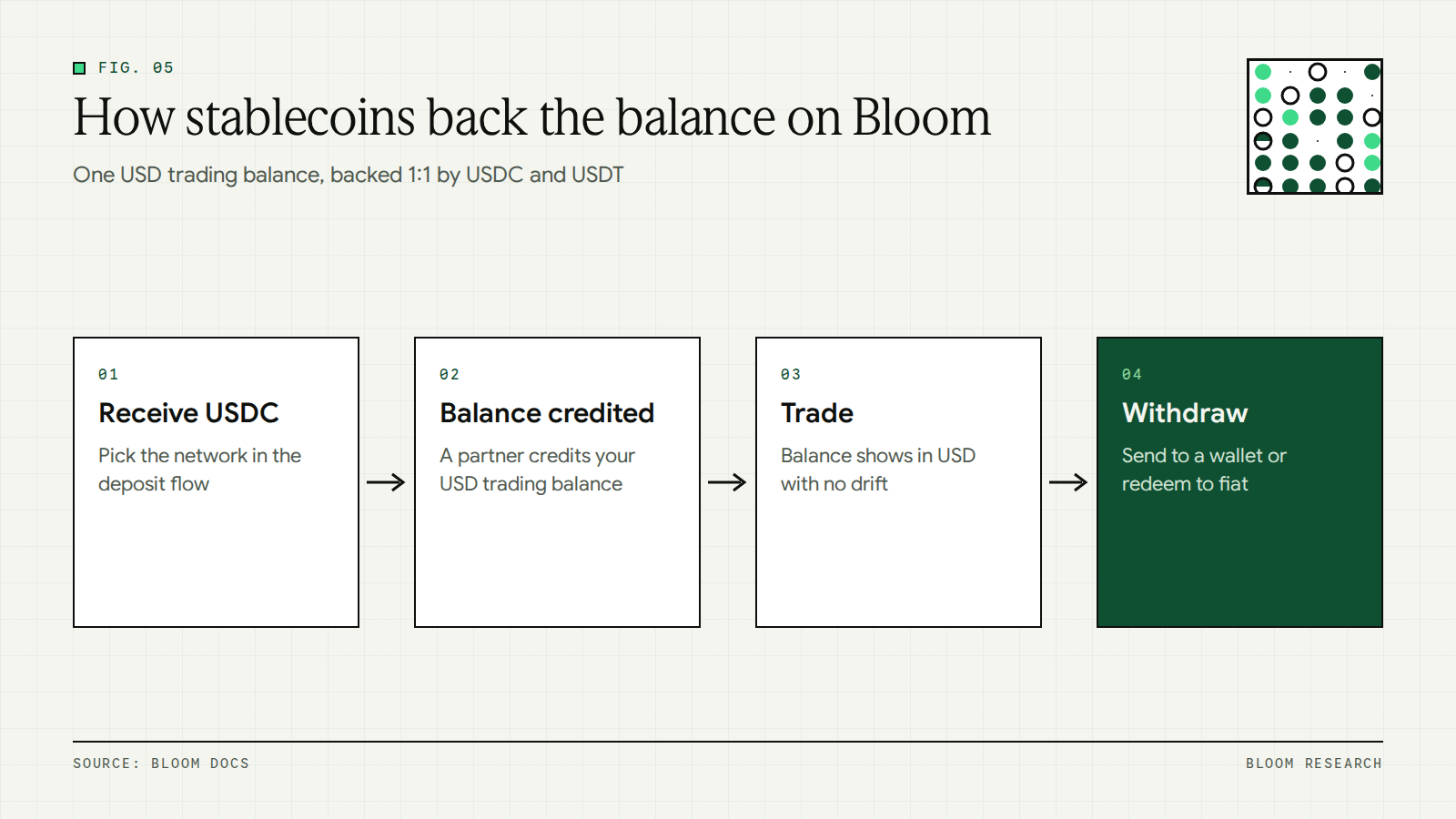
On Bloom, you do not pick USDC or USDT inside the app. Our USD trading balance is a unified USD balance backed 1:1 by USDC and USDT held in custody, and the product always displays it as USD. You hold one balance rather than two, and the balance shows no exchange-rate drift between USDC and USDT.
The trading balance is represented by a real on-chain ERC-20 token. When you deposit, an authorized partner credits the equivalent trading balance to your wallet, and when you withdraw, the balance is queued for redemption back to USDC or fiat through the same partner. The balance is per-chain at the wallet level, and the Portfolio aggregates across chains for a single total.
When you add funds, the funding sheet shows two methods: Crypto, which means receiving USDC on-chain from an external wallet, and Cash, which covers Apple Pay, Google Pay or card. Per-chain crypto deposits have a minimum of $10 to $50 depending on the chain and asset, and the deposit sheet shows it before you send.
When you sell and withdraw, the two are separate actions. Selling converts a holding into USD trading balance, and withdrawing moves trading balance to an external wallet. A withdrawal to an external wallet completes in seconds once the network confirms the transfer.
We do not charge deposit, withdrawal, custody or inactivity fees. Network gas is charged per trade, as our pricing page shows.
On Bloom: Stablecoins appear in the product with their canonical symbols, USDC and USDT, and the trading balance appears as USD. USDC and USDT are trademarks of Circle and Tether, and we use the symbols only to identify the underlying stablecoin held in custody.
Funding from India or the United Kingdom
Our India country page describes converting rupees into stablecoins through a locally operating exchange that supports on-chain withdrawals, then moving the USDC to a self-custody wallet under your own keys. Because we settle in USD stablecoins, an investor in India also holds INR/USD exchange-rate exposure. Our guide to investing in US stocks from India covers the LRS, TCS and tax context for Indian residents.
Our United Kingdom country page describes a Faster Payments or SEPA transfer to a regulated on-ramp that converts pounds to USDC, which is then withdrawn to a self-custody wallet. A sterling-based investor also holds GBP/USD exposure alongside the stock. We settle trades in stablecoins, and our guide to tokenized stocks explains the tokenized US stocks that the balance is used to buy on Bloom.
#Risks that apply to both stablecoins
The facts above show several risks that apply to any dollar stablecoin, including USDC and USDT:
- Issuer and reserve risk: each token depends on its issuer's reserves and reporting, as the 2021 CFTC findings on Tether and Circle's 2023 Silicon Valley Bank exposure show.
- Banking risk: in March 2023, about 8% of the USDC reserve was deposited at Silicon Valley Bank.
- Redemption access: Circle Mint is for institutional customers, and Tether sets a 100,000 USD minimum for direct redemption.
- Network risk: our risk disclosure states that bridges and blockchains can be congested, halted or compromised, so the network has to be confirmed before sending.
- Regulatory change: the GENIUS Act, MiCA and the FCA regime set rules that apply to issuers and service providers, and the FCA regime expands from October 25, 2027.
Trading on Bloom carries risk, including loss of principal. Our risk disclosure lists market risk, smart contract risk, custody risk, bridging risk and liquidity risk. We do not offer our product or services in the United States or other restricted jurisdictions, as our service availability page sets out.
#USDC vs USDT: what the comparison shows
The sourced differences are specific. Circle publishes monthly reserve attestations by a Big Four accounting firm, while Tether's latest attestation, prepared by BDO, covers the quarter to June 30, 2026. Circle Mint is for institutional customers, while Tether sets a 100,000 USD minimum for direct redemption. ESMA's register lists Circle's French entity as an e-money token issuer and lists no Tether entity, and Tether says USDT is progressing towards GENIUS Act compliance.
This guide does not rank the two tokens or say which one to hold. On Bloom, both back the same USD trading balance 1:1, and our trading balance documentation explains how deposits are credited and how withdrawals are redeemed back to USDC or fiat.
Frequently asked questions
Is USDC better than USDT, or safer?
We do not rank the two tokens, and the issuers' disclosures do not settle that question. The documented differences are factual. Circle publishes monthly reserve attestations by a Big Four accounting firm, while Tether's latest attestation, prepared by BDO, covers Q2 2026. ESMA's MiCA register lists Circle's French entity as an e-money token issuer and lists no Tether entity. USDC lost its dollar peg in March 2023, and in 2021 the CFTC ordered Tether to pay $41 million over claims about its reserves.
Is 1 USDC equal to 1 USDT?
Both tokens are designed to track one US dollar. Circle states that USDC is redeemable 1:1 for US dollars, and Tether states that its tokens are pegged 1-to-1 with a matching fiat currency and backed by its reserves. They remain separate tokens from separate issuers with separate reserves. On Bloom, both back the USD trading balance 1:1, and the balance shows no exchange-rate drift between USDC and USDT.
Did USDC ever lose its dollar peg?
Yes. In March 2023, $3.3 billion of the USDC reserve, about 8% of the total, was deposited at Silicon Valley Bank. On March 12, 2023, after US regulators said all depositors would be made whole, Circle announced that the deposit would be available the next morning and that the dollar de-peg had closed. From March 13 to March 15, Circle redeemed $3.8 billion of USDC and minted $0.8 billion.
Who checks the reserves behind USDC and USDT?
Circle says a Big Four accounting firm provides monthly third-party assurance that USDC reserves are greater than the USDC in circulation, following AICPA attestation standards. Deloitte & Touche LLP audits Circle's company financials. Tether's Q2 2026 attestation was prepared by BDO and covers the assets backing USDT as of June 30, 2026. Tether said its Big Four audit process continued during that quarter.
Can individuals redeem USDC or USDT directly with the issuer?
Circle Mint, the service that mints and redeems USDC with Circle, is for institutional customers and is not available to individuals, who access USDC in the secondary market. Tether sets a minimum acquisition or redemption amount of 100,000 USD, charges the greater of $1,000 or 0.1% per redemption, and asks for a non-refundable 150 USD verification fee in Tether tokens.
Are USDC and USDT authorized under MiCA?
Circle announced on July 1, 2024 that its French entity had obtained an Electronic Money Institution license from the ACPR and was issuing USDC in the EU under MiCA. ESMA's interim MiCA register of e-money token issuers, last updated September 24, 2026, lists Circle Internet Financial Europe SAS. The same register file contains no entry for a Tether entity.
Is USDC 100% safe?
Circle states that USDC is 100% backed by highly liquid cash and cash-equivalent assets and is redeemable 1:1 for US dollars. Full backing does not remove every risk. In March 2023, $3.3 billion of the USDC reserve, about 8% of the total, was deposited at Silicon Valley Bank, and USDC lost its dollar peg until Circle announced that the deposit would be available. Our risk disclosure lists market, smart contract, custody, bridging and liquidity risk for trading on Bloom.
Can I convert USDT to USDC?
On Bloom, you do not need to pick USDC or USDT or convert one into the other. Our trading balance is a unified USD balance backed 1:1 by USDC and USDT held in custody, and the app always displays it in USD, with no exchange-rate drift between the two tokens. Selling converts a holding into USD trading balance, and when you withdraw, the balance is queued for redemption back to USDC or fiat.