
Is Robinhood Safe? What International Users Should Know
Is Robinhood safe? We cover SIPC limits, crypto, FINRA and SEC actions, the 2021 breach, and how protection differs for UK, EU and other international users.
Key takeaways
- Robinhood Financial, LLC and Robinhood Securities, LLC are SEC-registered brokerage firms regulated by FINRA, and their parent Robinhood Markets, Inc. is listed on Nasdaq as HOOD.
- SIPC protection is limited to $500,000, which includes a $250,000 limit for cash, and it does not cover a decline in value or crypto that does not qualify as a security.
- Robinhood firms paid SEC penalties in 2020 and 2025 and FINRA penalties in 2021 and 2025, and Robinhood disclosed a data security incident in November 2021.
- A Robinhood US account requires a US residential address and a valid Social Security Number, while Robinhood U.K. Ltd (FCA) and Robinhood Europe, UAB (Bank of Lithuania) are separate entities with different protections.
- On Bloom, each token is backed 1:1 by a real share held in segregated custody at a regulated US broker-dealer, and the tokens are on-chain assets in your own wallet, not a SIPC-eligible brokerage account.
Is Robinhood safe? The factual answer starts with regulation: Robinhood's US brokerage firms are SEC-registered broker-dealers regulated by FINRA, and SIPC protects customer securities and cash at a failed member firm up to $500,000, which includes a $250,000 limit for cash. That protection does not cover a decline in the value of securities or crypto that does not qualify as a security. Robinhood firms have also paid FINRA and SEC penalties, and Robinhood disclosed a data security incident in November 2021.
For readers outside the US, the answer depends on which Robinhood company holds the account. This guide covers the US, UK and EU entities, then describes how custody works on Bloom for comparison. For a comparison of the routes Indian investors use to buy US shares, see our guide to investing in US stocks from India.
#Is Robinhood safe? What regulators and filings show
Robinhood Markets, Inc. is a public company listed on Nasdaq under the ticker HOOD. FINRA's BrokerCheck database lists Robinhood Markets, Inc. as the 100% owner of Robinhood Financial, LLC. The sections below list the regulated companies that sit under that parent in the US.
A broker-dealer is a securities firm registered with the SEC that can hold cash and securities for customer accounts. FINRA, the Financial Industry Regulatory Authority, is an independent, non-governmental regulator for all securities firms doing business with the public in the United States. BrokerCheck is the free FINRA tool that shows a firm's registrations and disclosures.
Which Robinhood companies hold a US account
Three Robinhood companies appear in the US filings and support pages:
- Robinhood Financial, LLC: CRD 165998 and SEC 8-69188, listed on FINRA BrokerCheck for Robinhood Financial as a brokerage firm regulated by FINRA, with SEC registration approved on October 14, 2013.
- Robinhood Securities, LLC: CRD 287900 and SEC 8-69916, listed on FINRA BrokerCheck for Robinhood Securities as a brokerage firm regulated by FINRA, with SEC registration approved on October 13, 2017.
- Robinhood Crypto, LLC: licensed to engage in virtual currency business activity by the New York State Department of Financial Services.
As of September 26, 2026, BrokerCheck shows 68 total disclosures for Robinhood Financial, LLC and 6 total disclosures for Robinhood Securities, LLC. BrokerCheck provides a Detailed Report for each firm with the details of these disclosures. The counts are totals of listed items, and BrokerCheck does not present them as a rating.
The same BrokerCheck pages show other registration details. Each firm is listed with registrations at the SEC, one self-regulatory organization and 53 US states and territories. Robinhood Financial is listed as conducting 11 types of business, and Robinhood Securities is listed as conducting 7 types of business. For disclosures involving registered affiliated entities, BrokerCheck directs readers to the BrokerCheck page for each of those firms.
#What SIPC covers at Robinhood, and what it does not
SIPC is the Securities Investor Protection Corporation. Any broker-dealer registered with the SEC, with narrow statutory exceptions, is automatically a SIPC member. According to SIPC, the limit of SIPC protection is $500,000, which includes a $250,000 limit for cash.
SIPC protection is limited, because SIPC only protects the custody function of the broker-dealer. The custody function is the role a broker-dealer plays when it holds cash and securities for safekeeping for customer accounts. A broker-dealer must keep custody of customer assets in segregated accounts for the benefit of customers, separate from its own business accounts. In a liquidation, SIPC replaces the missing stocks and other securities when it is possible to do so. SIPC does not compensate investors for a decline in the value of their stocks, bonds and other investments, regardless of the cause.
SIPC protects stocks, bonds, Treasury securities, certificates of deposit, mutual funds, money market mutual funds and certain other investments as securities. It protects cash deposited with members when the cash is in the account for the purpose of investing in securities. Only customers are eligible, and SIPC defines a customer as a person with a claim against the failed broker-dealer for securities held for the customer's account, or a person owed cash on deposit for buying securities.
SIPC's page on what SIPC protects and what it does not lists several exclusions. SIPC does not protect against the decline in value of your securities, and it does not protect individuals who are sold worthless stocks and other securities. It also does not protect against losses due to a broker's bad investment advice. SIPC does not protect any digital or crypto asset that does not qualify as a security, even if a SIPC-member brokerage firm holds it. SIPC also does not protect commodity futures contracts, and cash held in connection with a commodities trade is not protected.
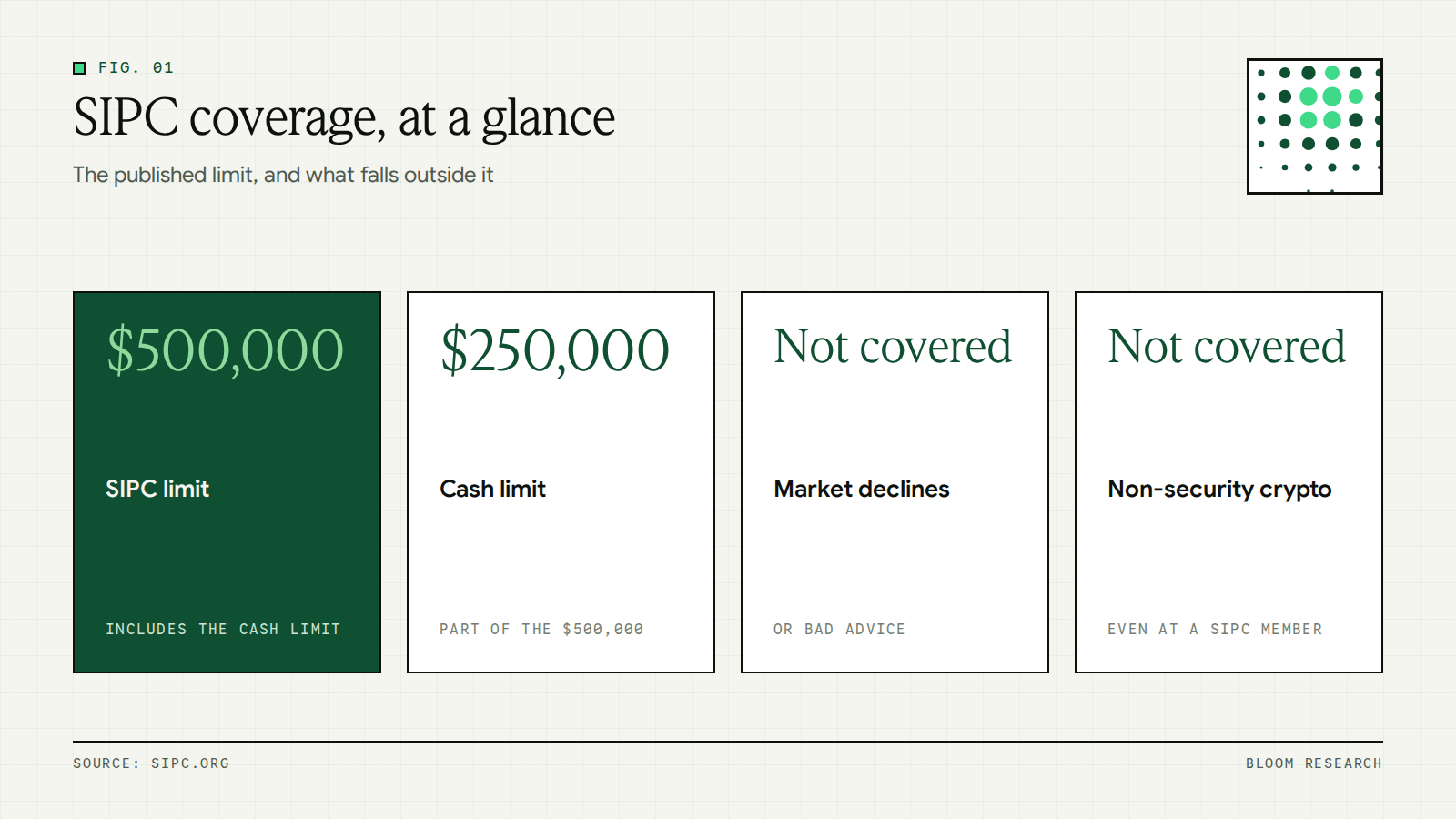
Key point: SIPC protects the custody of securities and cash at a failed member firm, not their market value.
SIPC does not require a customer to reside in or be a citizen of the United States. A non-US citizen with an account at a SIPC-member brokerage firm is treated the same as a US resident or citizen. Whether a person can open a Robinhood account in the first place is a separate question, covered in the section on international users below.
#Is Robinhood crypto safe?
Robinhood offers crypto trading through Robinhood Crypto, LLC, which the New York State Department of Financial Services licenses to engage in virtual currency business activity. Robinhood states that cryptocurrencies offered by Robinhood Crypto, LLC are not securities and are not FDIC insured or protected by SIPC. This matches SIPC's own statement that it does not protect crypto assets that do not qualify as securities. SIPC's page also quotes the SEC and the Commodity Futures Trading Commission, which have stated that examples of digital commodities include Bitcoin (BTC), Ether (ETH), Solana (SOL) and Dogecoin (DOGE).
Robinhood says nearly all customer crypto is held in cold storage. Cold storage means the private keys that control the crypto are kept offline, away from internet-connected systems. Robinhood also says it does not lend customer crypto or leverage against it.
Note: Crypto and brokerage holdings at Robinhood are held by different legal entities, and the protections that apply to each are different.
For crypto at Robinhood, the relevant facts are the NYDFS license held by Robinhood Crypto, LLC and Robinhood's own statements on storage, because SIPC does not protect crypto that is not a security. For securities and cash at Robinhood's broker-dealers, the SIPC limits and exclusions described above are the published reference points.
#Robinhood's regulatory record: fines, outages and settlements
This section lists the main public actions by FINRA and the SEC against Robinhood's US broker-dealers and how each one was settled.
SEC charges in December 2020
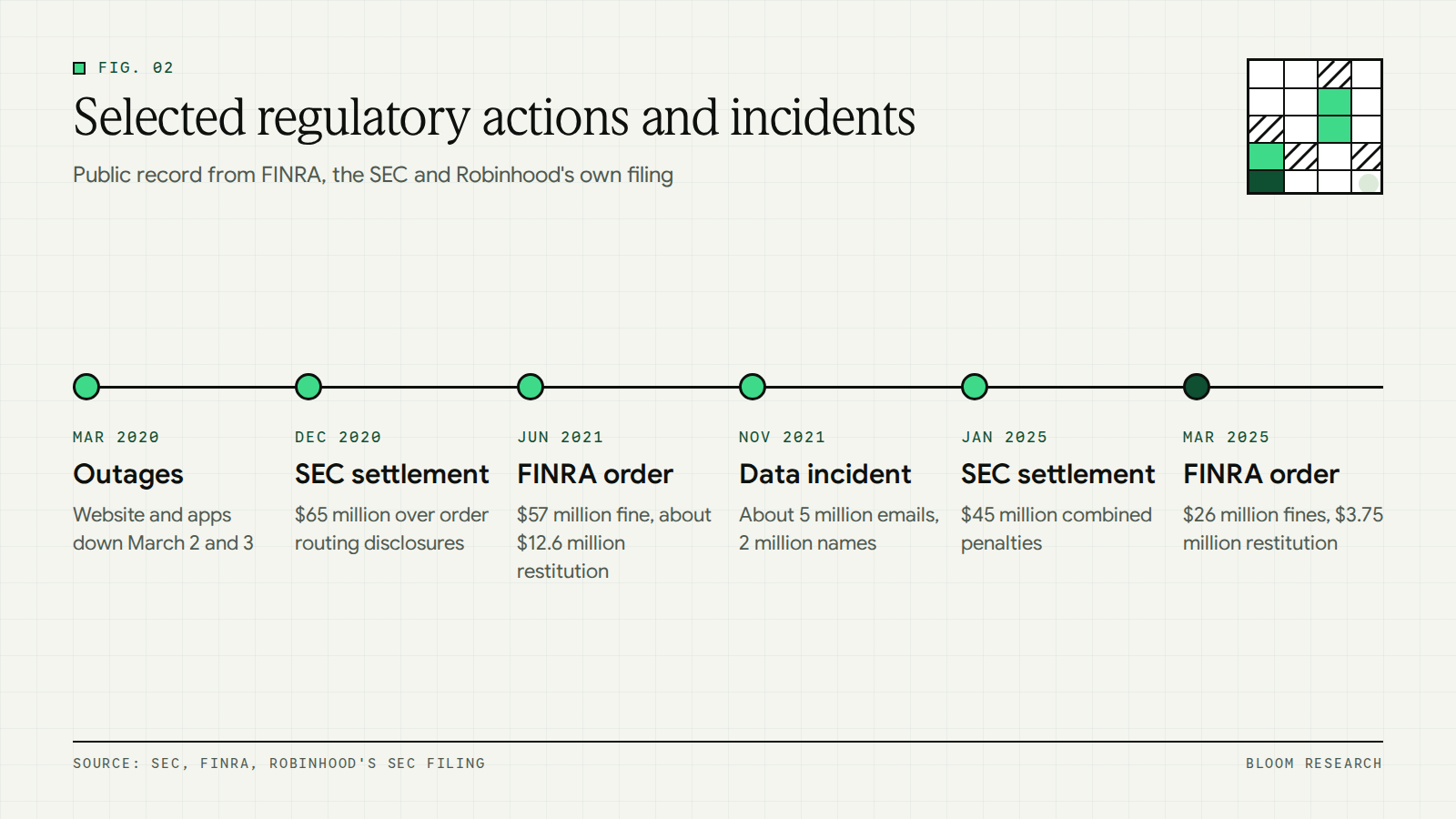
On December 17, 2020, the SEC charged Robinhood Financial LLC over undisclosed order routing payments. The charges covered repeated misstatements that failed to disclose the firm's receipt of payments from trading firms for routing customer orders to them. Payment for order flow is the name for these payments, which trading firms make to a broker for sending customer orders to them.
The SEC also charged the firm with failing to satisfy its duty to seek the most favorable terms reasonably available when executing customer orders. That duty requires a broker to look for good prices and terms for each customer order, not only for the broker's own benefit. Robinhood agreed to pay $65 million to settle the charges.
FINRA's 2021 order and the March 2020 outages
On June 30, 2021, FINRA fined Robinhood Financial LLC $57 million and ordered it to pay about $12.6 million in restitution, plus interest, to thousands of harmed customers. Restitution is money a firm is ordered to repay to customers who lost money because of its conduct. FINRA announced the order in a news release distributed on Business Wire.
FINRA said the firm negligently communicated false and misleading information to its customers. It also said the firm relied on algorithms, known at Robinhood as option account approval bots, to approve customers for options trading, with only limited oversight by firm principals.
The action cited system outages at Robinhood. The most serious outage occurred on March 2 and 3, 2020, when Robinhood's website and mobile applications shut down. FINRA said the outage prevented customers from accessing their accounts during a time of historic market volatility.
The January 2021 trading restrictions
On October 18, 2021, the SEC released a staff report on market conditions in early 2021, the period of heavy trading in meme stocks. The report says several retail broker-dealers temporarily prohibited certain activity in some of these stocks and options.
According to the report, some of the impacted broker-dealers maintained that the trading restrictions were a reaction to margin calls and capital charges imposed by NSCC. The National Securities Clearing Corporation (NSCC) is the clearing agency that settles US equity trades between brokers. In its 2025 action, FINRA found that Robinhood Securities' clearing system experienced severe latency in January 2021 due to a surge in trading volume and volatility.
SEC and FINRA actions in 2025
On January 13, 2025, the SEC announced that two Robinhood broker-dealers agreed to pay $45 million in combined civil penalties. Robinhood Securities LLC agreed to pay a $33.5 million penalty and Robinhood Financial LLC agreed to pay an $11.5 million penalty. The violations cited include suspicious activity reporting, identity theft protection rules, recordkeeping and short-selling rules under Regulation SHO. The SEC said the charges arose from the firms' brokerage operations. Both firms admitted certain findings in the order and agreed to be censured.
On March 7, 2025, FINRA ordered Robinhood Financial to pay $3.75 million to its customers. FINRA also fined Robinhood Financial and Robinhood Securities $26 million for violating numerous FINRA rules, as its news release on finra.org states. FINRA found the firms failed to establish reasonable anti-money laundering programs, which caused them to fail to detect suspicious activity. That activity included instances where customers' accounts were taken over by third-party hackers. The firms consented to the entry of FINRA's findings without admitting or denying the charges. They also agreed to certify that they remediated the issues identified in the settlement.
Important: Each settlement has its own terms. The Robinhood firms settled the 2025 FINRA matter without admitting or denying the charges, while in the 2025 SEC matter both firms admitted certain findings. Read each regulator's own release for the exact wording rather than a summary.
#Is Robinhood safe from hackers?
Robinhood disclosed a data security incident that occurred late in the evening of November 3, 2021, and filed its incident update with the SEC. The company said an unauthorized party obtained a list of email addresses for about five million people. The same party obtained full names for a different group of about two million people.
For about 310 people, Robinhood said additional personal information, including name, date of birth and zip code, was exposed. The company said no Social Security numbers, bank account numbers or debit card numbers were exposed. Robinhood said there was no financial loss to any customers as a result of the incident.
Two regulatory findings from 2025 also relate to account security. The FINRA order described above found account takeovers, where an unauthorized person gains control of a customer's account, among the suspicious activity the firms failed to detect. The SEC order from the same year cited violations of identity theft protection rules.
Robinhood describes the following account security features on its UK site:
- Multi-factor authentication on all accounts. Multi-factor authentication is a login check that asks for a second proof of identity, such as a code or a device prompt, in addition to a password.
- Passkeys, which Robinhood says are stored on individual devices and require a biometric authenticator such as Face ID or Touch ID. Robinhood says this makes passkeys more resistant to phishing attacks, and it states that passkeys are available for iOS only.
On April 23, 2026, the SEC published an investor bulletin on protecting online investment accounts from fraud.
In practice: The investor.gov bulletin says to use two-step verification or multi-factor authentication, if available. It also says to check investment account statements and trade confirmations for any suspicious activity.
#Is Robinhood safe for international users? Account eligibility first
Robinhood's US eligibility page lists the requirements for a US account. An applicant must be 18 years or older and have a valid Social Security Number, not a Taxpayer Identification Number. The applicant must also have a legal US residential address within the 50 states, Puerto Rico or the US Virgin Islands.
The same page says the applicant must be a US citizen, a US permanent resident or hold a valid US visa. These are Robinhood's own account rules. As the SIPC section above explains, SIPC itself does not require a customer to reside in or be a citizen of the United States.
Robinhood runs separate companies for customers in the UK and the EU, and the next section covers each of them. For readers in India, our India page lists the US stocks and ETFs available from India as tokens on Bloom.
#Robinhood outside the US: the UK and EU entities
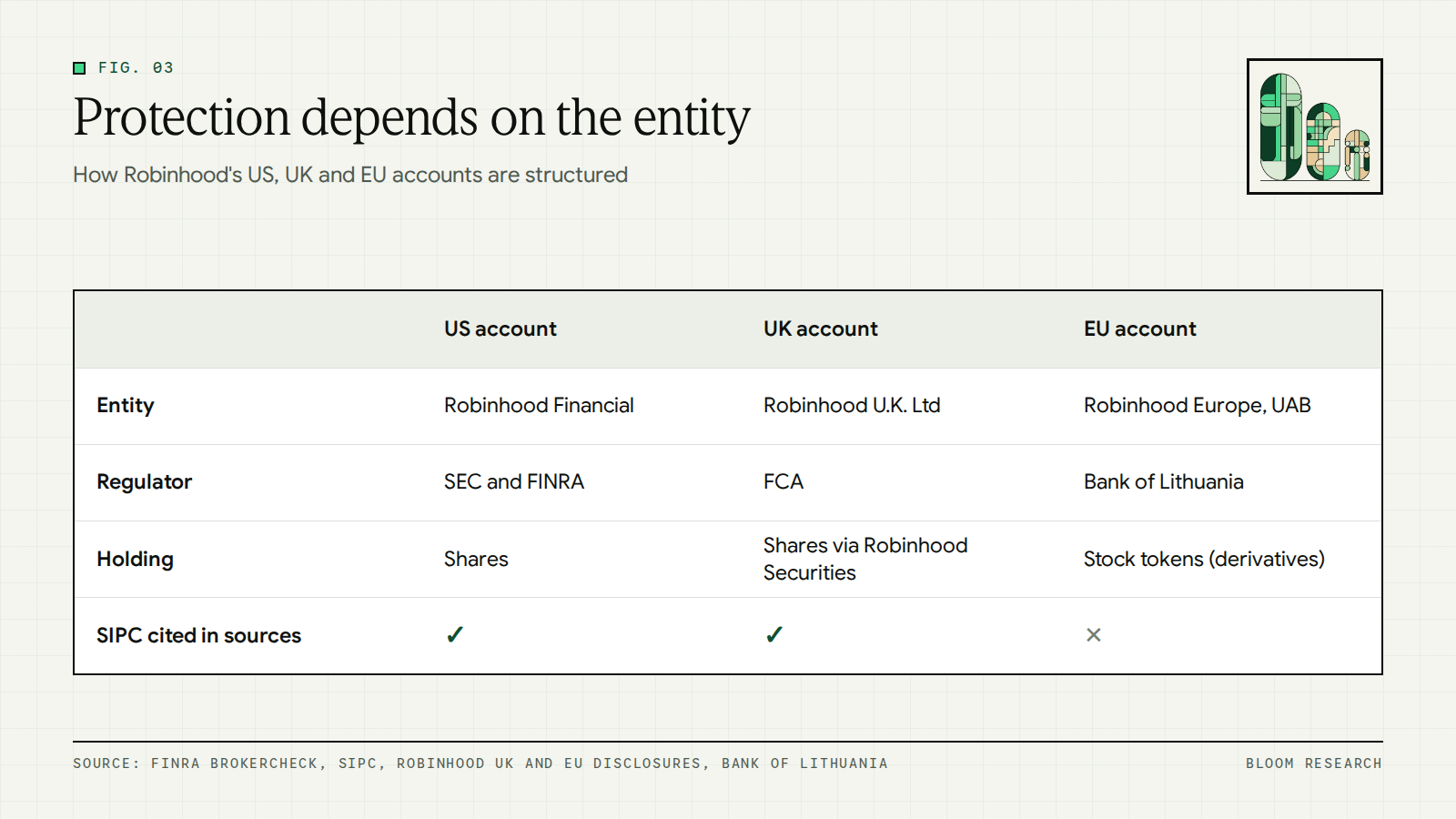
Outside the US, protection depends on the legal entity that holds the account. Robinhood serves UK and EU customers through separate companies.
Robinhood UK and the FCA
Robinhood U.K. Ltd is authorized and regulated by the Financial Conduct Authority (FRN 823590). The FCA is the UK regulator that authorizes and supervises financial services firms. The FCA's Financial Services Register is a public record of firms that are, or have been, authorized by the FCA or the PRA.
Robinhood UK introduces UK customers to Robinhood Securities, LLC for order routing, execution, clearing, settlement and arranging custody services. Robinhood Securities, LLC is regulated in the US by the SEC and FINRA.
Robinhood UK's asset protection page says customers' securities and cash are protected by SIPC up to $500,000 per account, including $250,000 for cash. It says the UK Financial Services Compensation Scheme, which protects UK brokerage customers up to £85,000, doesn't apply to Robinhood UK accounts. The FSCS is the UK scheme that compensates customers when an authorized financial firm fails.
The page adds that Robinhood has secured additional insurance covering up to $1 billion total, with a $50 million limit per customer. That limit includes $1.9 million for uninvested cash, and market losses on investments aren't covered. UK crypto trading goes through Bitstamp UK Ltd, and crypto held there is not protected by the FSCS.
The FSCS page on investment claims states it can pay up to £85,000 per eligible person, per firm, for investment firms that failed after April 1, 2019. It can't accept claims for poor investment performance. For UK readers, we publish our guide to buying tokenized US stocks in the United Kingdom.
Robinhood Europe and the Bank of Lithuania
The Bank of Lithuania's register lists three licenses for Robinhood Europe, UAB: a Category A financial brokerage firm license valid from April 3, 2025, a crypto-asset service provider license valid from May 29, 2025, and a payment institution license valid from March 12, 2026.
Robinhood announced its EU stock token launch on June 30, 2025, at an event in Cannes, France. The release said European customers would have access to 200+ US stock and ETF tokens, initially issued on Arbitrum. As of September 2026, Robinhood's EU site lists 2,000+ Classic Stock Tokens.
A derivative contract is an agreement between two parties whose value is based on the price of another asset. Robinhood's EU site states that Classic Stock Tokens are derivative contracts between the customer and Robinhood, priced at the underlying securities' prices without granting rights to them. It warns that investors may lose up to the full amount of their invested capital due to market conditions or the insolvency of Robinhood.
| Robinhood entity | Serves | Regulator named in sources | Protection stated in sources |
|---|---|---|---|
| Robinhood Financial and Robinhood Securities | US accounts | SEC, FINRA | SIPC up to $500,000, including a $250,000 limit for cash |
| Robinhood Crypto, LLC | US crypto | NYDFS license | Not SIPC protected or FDIC insured |
| Robinhood U.K. Ltd | UK customers | FCA (FRN 823590) | SIPC via Robinhood Securities, per Robinhood UK; not FSCS |
| Robinhood Europe, UAB | EU customers | Bank of Lithuania | Stock tokens are derivative contracts |
Key point: The same Robinhood brand can refer to different legal entities, and each entity has its own regulator and its own protection arrangements.
#How custody works on Bloom, for comparison
We describe our own structure with the same kind of facts.
Shares, tokens and proof of reserves
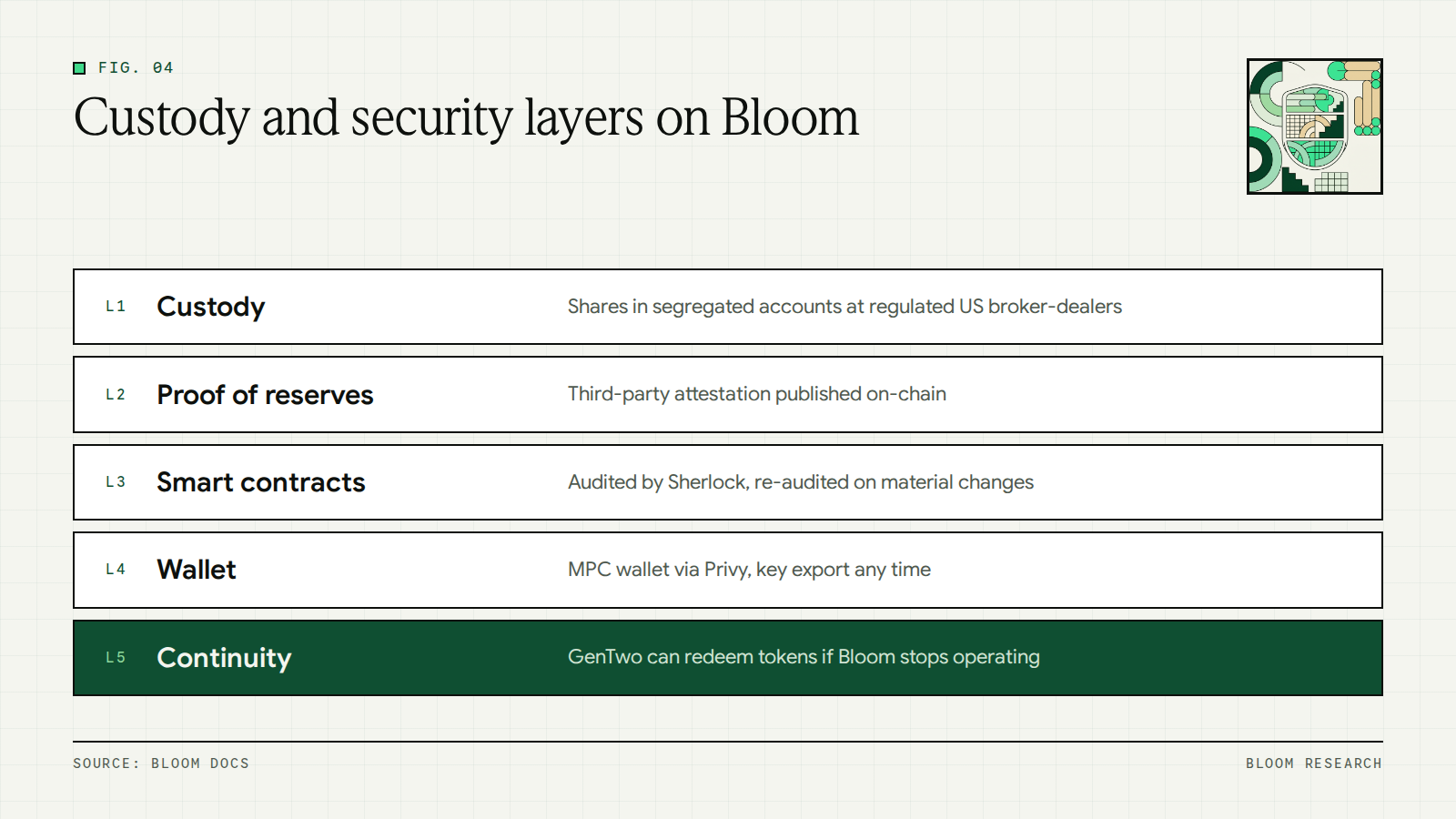
Each asset on Bloom is an on-chain token backed 1:1 by a real share held in the same kind of segregated customer account described above, at a regulated US broker-dealer such as Alpaca Markets or Interactive Brokers. Our custody and backing documentation states that the value of your tokens is held in segregated customer accounts at the custodian, not on our balance sheet.
A security agent is a party appointed to act on behalf of token holders. If we discontinue operations, our security agent, GenTwo, works with the custodian to redeem outstanding tokens against the underlying shares. The redemption path is enforced by the on-chain contract. Redemption depends on the continued operation of the broker partner, and investor-protection arrangements apply within the jurisdictional limits of each broker and are not unlimited.
Proof of reserves is a published check that the assets backing a token exist in the stated amount. Our reserves are attested in real time by Accountable, a third-party proof-of-reserves provider that reads broker balances directly and publishes them on-chain. For every asset, the attestation publishes the live token supply, attested broker balance, backing ratio, attestation timestamp and attester signature. See our proof of reserves documentation, our public reserves page and the reserve ratio for each asset.
Every smart contract that custodies value or handles authorization on Bloom is audited by Sherlock before deployment, and every material change triggers a re-audit. Our smart contract audits page lists which contracts are audited.
On Bloom: SIPC covers US-registered broker-dealer accounts. The tokens you hold on Bloom are on-chain assets in your own wallet, not a SIPC-eligible brokerage account.
Wallet and account security
MPC, or multi-party computation, splits a private key into separate shares held by different parties. Privy provisions an embedded MPC wallet, and no single party, including us, holds your complete private key. Our guide to self-custody and custodial wallets compares who holds the private key in each model and how MPC wallets differ from both. You can export your private key at any time from Account, Security, gated by email magic-link confirmation as a second factor.
Recovery paths include a passkey on a backup device, an email magic link, an optional TOTP authenticator app and a linked external wallet. SMS OTP is never sent for any flow, as our recovery and security documentation states.
A first sign-in from a new device requires re-authentication, as does suspicious activity such as geo jumps or device changes. Biometric or passkey confirmation on every trade is optional and off by default. Trades, deposits and withdrawals never trigger a second-factor prompt based on dollar size, per our security model documentation.
Our guide to how a tokenized share is minted, settled and redeemed follows one token through each stage of that custody model.
#A checklist for judging any trading platform's safety
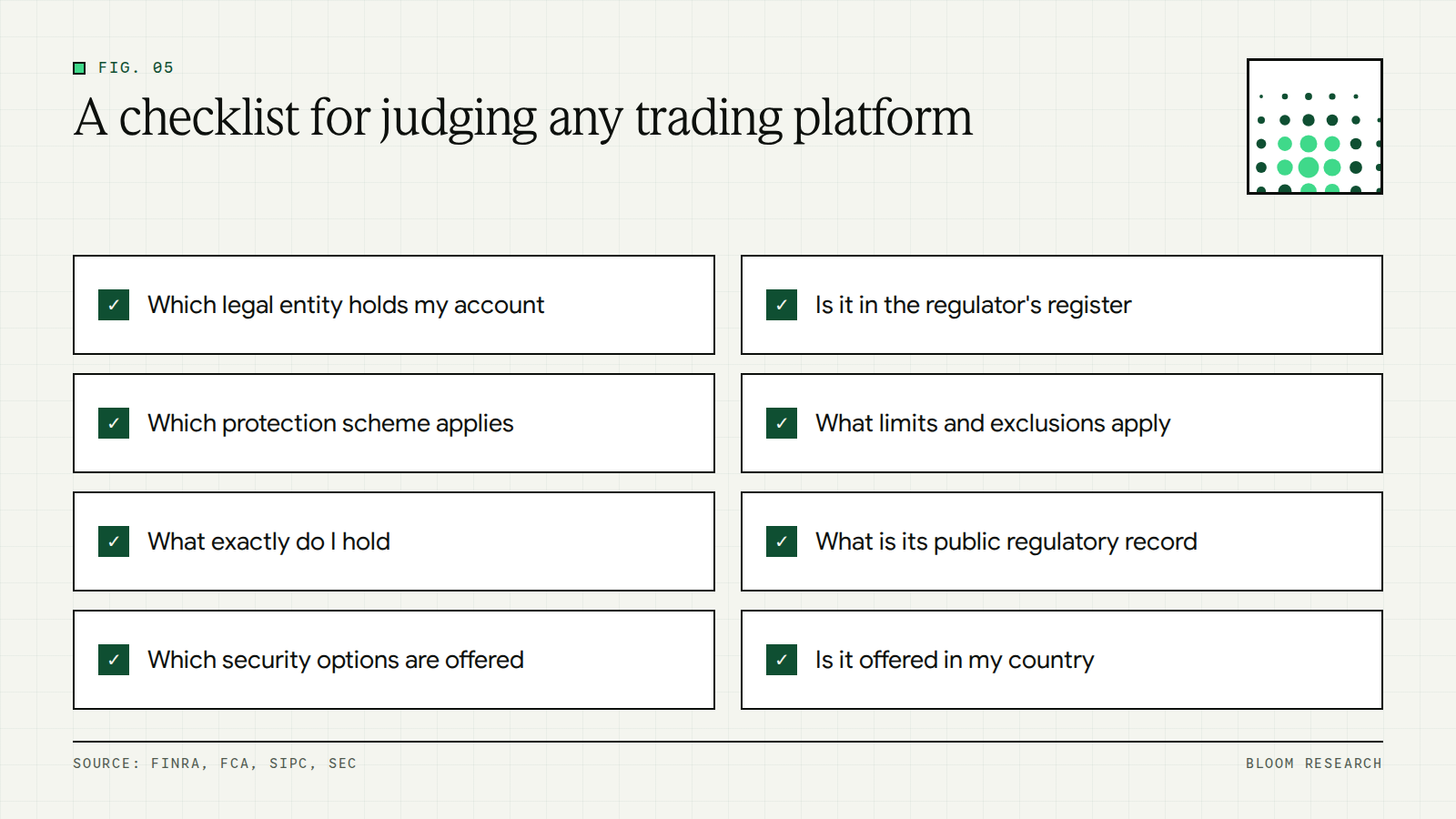
The same questions apply to any platform, including Robinhood and Bloom.
- Confirm the legal entity that holds the account in the regulator's own register, such as BrokerCheck or the FCA register.
- Identify the protection scheme and its limit, such as SIPC's $500,000, which includes a $250,000 limit for cash.
- Check the exclusions. SIPC does not protect against the decline in value of your securities, or any crypto asset that does not qualify as a security.
- Check what you hold: a share, a token backed by shares, or a derivative contract. SEC staff have stated that holders of third-party tokenized securities may be exposed to risks with respect to the third party, such as bankruptcy.
- Check the regulatory record in FINRA and SEC public releases and in BrokerCheck disclosures.
- Check the security options. An April 23, 2026 SEC investor bulletin advises multi-factor authentication, if available.
- Check whether the platform serves your country.
#Where to read more about Bloom's security
Our security page summarizes custody, wallet and key management, smart contracts, continuity protection and our bug bounty. We respond to triage of security reports within 24 hours.
Trading on Bloom carries risk, including the loss of principal. Market, smart contract, custody, bridging and liquidity risks apply, as our risk disclosure describes. We do not offer our product or services to users in the United States or in other restricted jurisdictions, as our service availability page states.
Frequently asked questions
Can you trust Robinhood?
BrokerCheck lists Robinhood Financial, LLC and Robinhood Securities, LLC as brokerage firms regulated by FINRA, and both are registered with the SEC. Robinhood Markets, Inc. is a public company listed on Nasdaq as HOOD. The record also includes a $57 million FINRA fine in June 2021, $45 million in combined SEC civil penalties announced in January 2025, and a $26 million FINRA fine in March 2025. BrokerCheck lists each firm's disclosures.
What is the downside of Robinhood?
SIPC protection is limited to $500,000, which includes a $250,000 limit for cash, and it does not protect against the decline in value of securities. Robinhood states that the cryptocurrencies offered by Robinhood Crypto are not securities and are not protected by SIPC. FINRA's 2021 action cited outages, the most serious on March 2 and 3, 2020, when Robinhood's website and apps shut down. FINRA and the SEC have also fined Robinhood firms.
Is it safe to have all my money in Robinhood?
SIPC protection at a failed member firm is limited to $500,000, which includes a $250,000 limit for cash, and SIPC does not protect against the decline in value of securities. Robinhood UK's asset protection page says it has secured additional insurance covering up to $1 billion total, with a $50 million limit per customer, including $1.9 million for uninvested cash. The same page says market losses are not covered.
Is Robinhood legit?
Robinhood Financial, LLC (CRD 165998) and Robinhood Securities, LLC (CRD 287900) are listed on FINRA BrokerCheck as brokerage firms regulated by FINRA, with SEC registration approved in 2013 and 2017. Their parent, Robinhood Markets, Inc., is a public company listed on Nasdaq under the ticker HOOD. BrokerCheck shows each firm's registrations and disclosures.
Is Robinhood crypto safe?
Robinhood offers crypto through Robinhood Crypto, LLC, which is licensed to engage in virtual currency business activity by the New York State Department of Financial Services. Robinhood states that these cryptocurrencies are not securities and are not FDIC insured or protected by SIPC. Robinhood says nearly all customer crypto is held in cold storage and that it does not lend it or leverage against it.
Is Robinhood safe from hackers?
Robinhood disclosed a data security incident on November 3, 2021, in which an unauthorized party obtained email addresses for about five million people and full names for about two million others. Robinhood said no Social Security numbers, bank account numbers or debit card numbers were exposed. In 2025 FINRA found the firms failed to detect suspicious activity, including account takeovers by third-party hackers. The SEC advises using multi-factor authentication if available.
Is Robinhood safe for international users?
It depends on the entity. A Robinhood US account requires a valid Social Security Number and a legal US residential address. SIPC does not require customers to reside in or be citizens of the US. Robinhood U.K. Ltd is regulated by the FCA and says UK accounts are protected by SIPC, while the FSCS does not apply. Robinhood Europe, UAB is regulated by the Bank of Lithuania, and its Classic Stock Tokens are derivative contracts.